
 Worksheets
How are Rocks alike and different?
Total questions: 31
Worksheet time: 24mins
Name
Class
Date
1.
How are igneous rocks formed?
a)
heat and pressure
b)
melted rock cools and hardens
c)
layers of rock build up
2.
What is a mineral?
a)
A solid, nonliving material found in nature
b)
another name for a rock
c)
something people build with
3.
How do Metamorphic rocks form?
a)
heat and pressure
b)
magma cools and hardens
c)
layers build up
4.
How can the streak of a mineral be tested?
a)
use a knife to scratch the mineral
b)
look at the color
c)
rub it across a tile to see the color of the powder it leaves
5.
Which property of minerals is measured by scratching the surface of a mineral?
a)
hardness
b)
streak
c)
luster
6.
What property of minerals is measured by breaking it into flat sections?
a)
fracture
b)
cleavage
c)
color
d)
luster
7.
How are sandstone, coal, and granite similar?
a)
they are all minerals
b)
they are all rocks
8.
How does sedimentary rock form?
a)
pressure changes it
b)
heat changes it
c)
magma cools and hardens
d)
pieces of rock get squeezed together in layers
9.
What type of rocks contains fossils?
a)
sedimentary
b)
metamorphic
c)
igneous
10.
What can we tell about a rock by looking at the fossil?
a)
The streak of the rock
b)
The luster of the rock
c)
The age of the rock
11.
What are rocks MOSTLY made out of?
a)
other rocks
b)
minerals
c)
pieces of sand
12.
What tool would you use to look at the grains in a rock?
a)
Hand lens
b)
Tile
c)
MOHs scale
d)
Scale
13.

This rock formed when bits of other rocks became pressed into a solid. What type of rock is it?
a)
Sedimentary Rock
b)
Metamorphic Rock
c)
Igneous Rock
14.
When you are describing the sizes of the mineral grains in a rock, you are detailing the rock's _____
a)
Texture
b)
Composition
c)
Sedimentation
d)
Igneous-ness
15.
The individual particles that make up a rock are known as _____
a)
Grains
b)
Textures
c)
Metamorphs
d)
Lava
16.
What are the 3 major types of rocks?
a)
Igneous, Metamorphic, Sedimentary
b)
Metamorphic, Igneous, Cementation
c)
Brown, Red, Gray
d)
Streak, Hardness, Breakage
17.
What process is used to form sedimentary rocks?
a)
Lava cools and hardens to form a rock.
b)
Bits of sand and gravel form layers that turn into rock from pressure.
c)
Extreme heat and pressure from inside the Earth turn rocks into new rocks.
d)
Magma trapped under the Earth's surface cools and solidifies.
18.
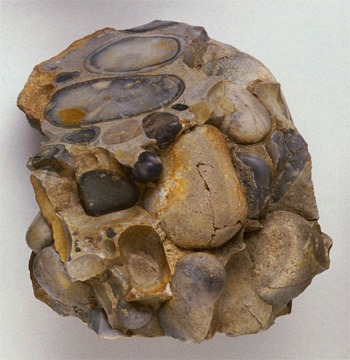
This rock was formed by smaller pieces of rock that settled at the bottom of a lake millions of years ago. What type of rock is this?
a)
Sedimentary
b)
Igneous
c)
Metamorphic
19.
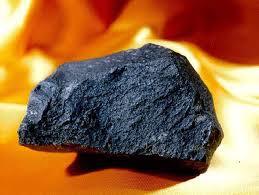
This rock was found near the mouth of a volcano. What type of rock is this?
a)
Sedimentary
b)
Igneous
c)
Metamorphic
20.
How light reflects off of a mineral is called the mineral's
a)
luster
b)
streak
c)
cleavage
d)
fracture
21.
Diamond has a hardness of ___ on Mohs Hardness Scale.
a)
1
b)
5
c)
8
d)
10
22.
How do you test the hardness of a mineral?
a)
Throw it against a wall
b)
Step on it
c)
Scratch Test
d)
Kick it until it breaks
23.
What mineral is known as "fools gold"?
a)
graphite
b)
quartz
c)
galena
d)
pyrite
24.
What mineral can pick up a paperclip because of it's magnetic properties?
a)
galena
b)
graphite
c)
magnetite
d)
hematite
25.
A mineral is a living object
a)
True
b)
False
26.

Which mineral property is being shown here?
a)
luster
b)
hardness
c)
cleavage
d)
streak
27.

The mineral in the picture has a ____________ luster.
a)
Nonmetallic
b)
Metallic
c)
Pearly
d)
Earthy
28.
___________ is the color of powdered mineral.
a)
Luster
b)
Streak
c)
Fracture
29.
_________ is how easily something can be scratched.
a)
specific gravity
b)
luster
c)
hardness
30.
___________ describes how the mineral reflects light.
a)
cleavage
b)
magnetic
c)
luster
31.
Minerals are identified by observing their ___________.
a)
physical properties
b)
name
c)
location
100 %

