
 Worksheets
Carbon Cycle, Photosynthesis and Respiration
Total questions: 52
Worksheet time: 43mins
Name
Class
Date
1.
When humans burn fossil fuels, most of the carbon quickly enters the as carbon dioxide.
a)
Water
b)
Atmosphere
c)
Sun
d)
Air
2.
Which one of these does not add CO2 to the atmosphere?
a)
cooking with gas
b)
planting trees
c)
burning wood
d)
riding in a bus
3.
Combustion is another word for _______________.
a)
a train
b)
a bus
c)
a dog
d)
burning
4.
What does not produce carbon dioxide?
a)
Photosynthesis
b)
Burning Fossil Fuels
c)
Animal respiration
d)
Plants decaying
5.
How do living organisms return carbon to the atmosphere in the carbon cycle?
a)
respiration and photosynthesis
b)
decomposition and respiration
6.

In the carbon cycle, producers take in the gas __
a)
carbon dioxide
b)
oxygen
c)
nitrogen
d)
carbon monoxide
7.
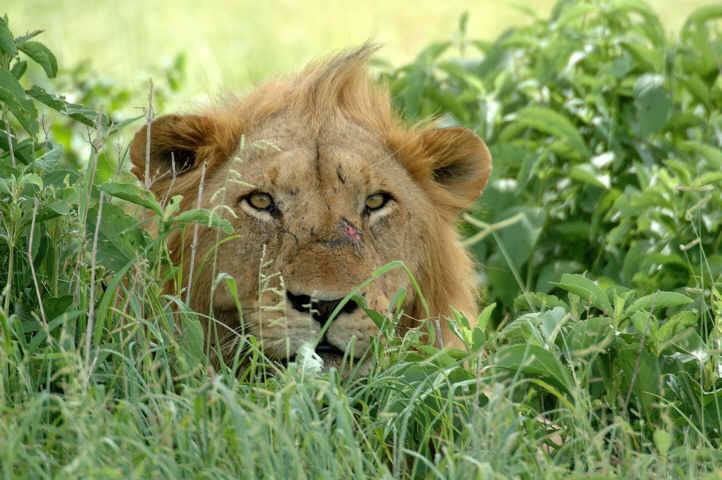
How does the carbon in grass become part of a lion?
a)
The lion eats the grass
b)
Carbon from grass doesn't end up in a lion.
c)
The carbon ends up in the lion's food chain.
d)
The lion breathes in carbon given out by the plant
8.
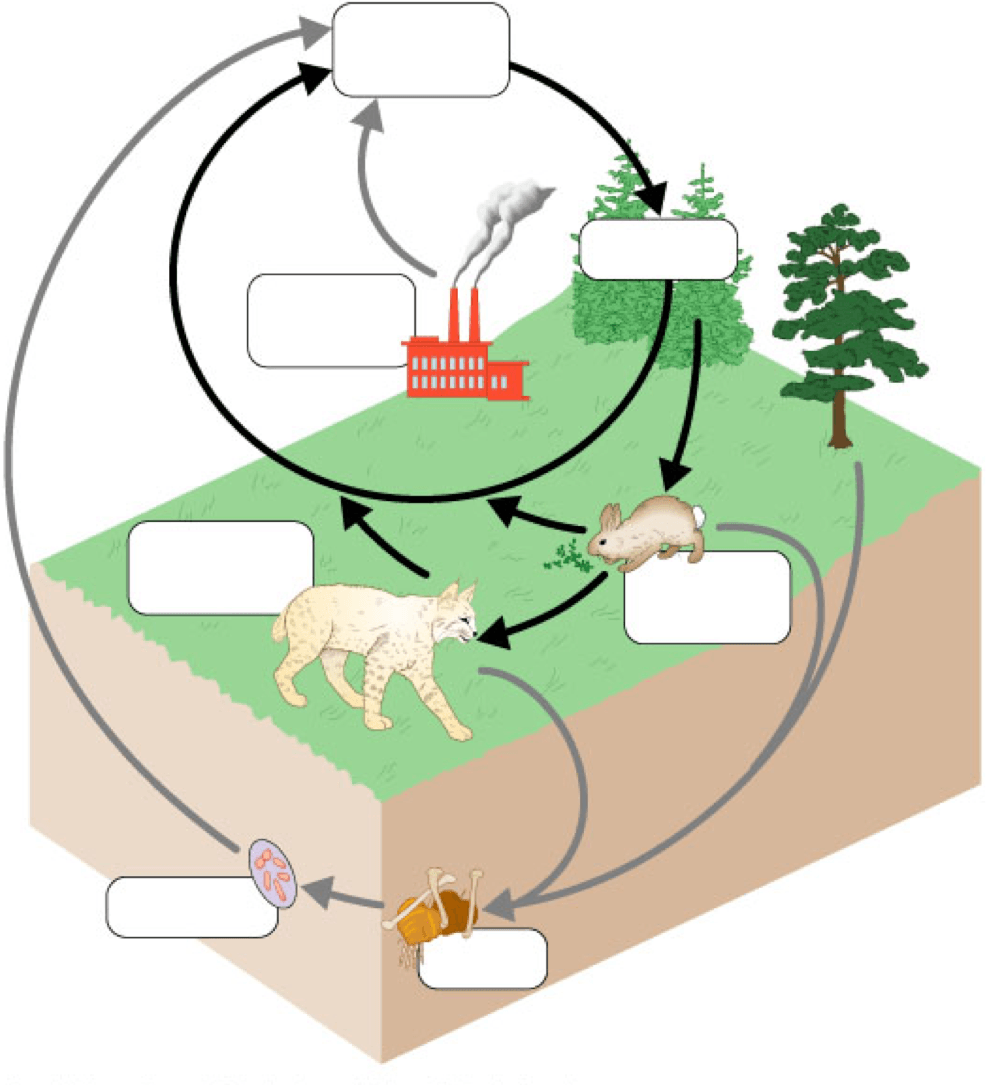
In what process is Carbon transformed into chemical energy?
a)
Photosynthesis
b)
Respiration
c)
Primary Production
d)
Secondary Production
9.
oxygen is a gas produced by _ and used by _
a)
plants, animals
b)
photosynthesis, carbon dioxide
c)
animals, plants
d)
carbon dioxide, photosynthesis
10.
Which of the following removes carbon from the atmosphere?
a)
Combustion
b)
Respiration
c)
Photosynthesis
d)
Death
11.
Organisms that do not decompose can be buried and become what?
a)
water
b)
nutrients
c)
air
d)
fossil fuels
12.
Carbon can be found in...?
a)
The atmosphere
b)
Inside of the Earth
c)
Fossil fuels
d)
All of the above!
13.
A molecule of sugar that is a product of photosynthesis and a reactant in cellular respiration.
a)
Water
b)
Oxygen
c)
Glucose
d)
Carbon Dioxide
14.
An organelle in Eukaryotic cells where cellular respiration occurs.
a)
Chloroplast
b)
Mitochondria
c)
Chlorophyll
d)
Vacuole
15.
The movement of carbon from the nonliving environment into the living environment and back.
a)
Carbon Cycle
b)
Water Cycle
c)
Cellular Respiration
d)
Photosynthesis
16.
The breakdown of the remains of dead organisms or animals wastes.
a)
Fossil Fuel
b)
Combustion
c)
Consumption
d)
Decomposition
17.
Mass can not be created or destroyed.
a)
Law of Conservation of Mass
b)
Law of Conservation of Energy
18.
The capacity to do work.
a)
Mass
b)
Matter
c)
Energy
d)
Deomposition
19.
A storage place for matter (such as water or carbon)...
a)
Matter
b)
Reservoir
c)
Fossil Fuel
d)
Energy
20.
What goes into a reaction; the inputs.
a)
Mass
b)
Matter
c)
Products
d)
Reactants
21.

What is the source of energy for photosynthesis?
a)
carbohydrates-chemical
b)
sunlight-radiant
c)
heat-thermal
d)
television-electrical
22.
What are the reactants (what's needed) for photosynthesis?
a)
glucose and oxygen
b)
light, water, and carbon dioxide
23.
What gas is released by plants during photosynthesis?
a)
sulfur
b)
carbon dioxide
c)
oxygen
d)
hydrogen
24.
What is the purpose of photosynthesis?
a)
make glucose (sugar) to store for energy
b)
make carbon dioxide
c)
make light
d)
release carbon dioxide
25.
What is the correct equation for cellular respiration?
a)
6O2 + C6H12O6 -> 6CO2 + 6H2O + Energy
b)
6O2 + C6H12O6 + Energy -> 6CO2 + 6H2O
c)
6CO2 + 6H2O -> 6O2 + C6H12O6 + Energy
d)
6CO2 + 6H2O + Energy -> 6O2 + C6H12O6
26.
What are the products of photosynthesis?
a)
sugar and glucose
b)
carbon dioxide
c)
sugar and Oxygen
d)
water and energy
27.
What is cellular respiration?
a)
the breakdown of glucose (sugar) to release energy
b)
the breakdown of glucose (sugar) to release oxygen
c)
the breakdown of glucose (sugar) to release HGTV
d)
the breakdown of glucose (sugaro to release nitrogen
28.

During photosynthesis, what gas do plants release?
a)
oxygen
b)
carbon dioxide
c)
water
d)
nitrogen
29.

Photosynthesis is important because....
a)
plants need air to breathe
b)
it makes the plants green
c)
it is the process by which plants make their own food
d)
without it the Earth would all be a desert
30.

The energy that starts the process of photosynthesis comes from....
a)
sunlight
b)
transpiration
c)
cellular respiration
d)
germination
31.

The process by which cells use oxygen to produce energy from food is called?
a)
photosynthesis
b)
transpiration
c)
cellular respiration
d)
germination
32.

By which process do plants make their own food from carbon dioxide and water?
a)
cellular respiration
b)
transpiration
c)
chlorophyll
d)
photosynthesis
33.

What gas do plants take in to make food?
a)
natural gas
b)
oxygen
c)
carbon dioxide
d)
oxygen and carbon dioxide
34.
In the process of photosynthesis, plants use the energy of the Sun to form ___ and ___ from ___ and ___.
a)
glucose and oxygen; carbon dioxide and water
b)
carbon dioxide and water; glucose and oxyge
35.
You might think that carbon trapped deep in Earth's crust would be locked there forever, but in fact subduction and the intense heat of the core release carbon dioxide through:
a)
volcanoes
b)
magnetic pole reversals
c)
hot springs
36.
What is a natural process which moves carbon?
a)
Photosynthesis
b)
Respiration
c)
Decomposition
d)
All of the above
37.
Which of the following statements is true?
a)
Biotic matter contains carbon, but abiotic matter does not
b)
We can still have life on Earth without carbon
c)
Plants contain carbon compounds called "carbohydrates" but animals (including people) do not
d)
Carbon is an element that forms millions of compounds that make life possible
38.
The global carbon cycle involves which factors?
a)
the flow of carbon matter and energy from one reservoir to another
b)
the natural processes of photosynthesis and respiration
c)
a holding place for carbon, including the ocean, terrestrial living organisms, soils, sediments and atmosphere
d)
all of the above
39.

What is shown here:
a)
Carbon Cycle
b)
Photosynthesis
c)
Respiration
d)
Magic
40.

Define the process shown here:
a)
Carbon Cycle
b)
Respiration
c)
Photosynthesis
d)
Magic
41.
Which of the following is the correct equation for PHOTOSYNTHESIS?
a)
CO2 + light + H2O --> O2 + Sugar
b)
CO2 + sugar + H2O --> O2 + light
c)
O2 + light + H2O --> CO2 + Sugar
d)
CO2 + O2 + H2O --> Light+ Sugar
42.

Increasing deforestation contributes to an ____________ of atmospheric carbon
a)
decrease
b)
increase
c)
end
d)
start
43.

The carbon cycle includes all of the following processes except.
a)
photosynthesis
b)
combustion
c)
decomposition
d)
precipitation
44.
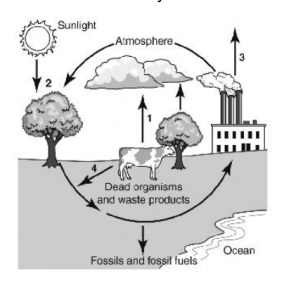
What is happening at 1?
a)
respiration: releasing CO2
b)
decomposing CO2 in the soil
c)
photosynthesis: absorbing CO2
d)
turning CO2 from the atmosphere into organic molecules
45.
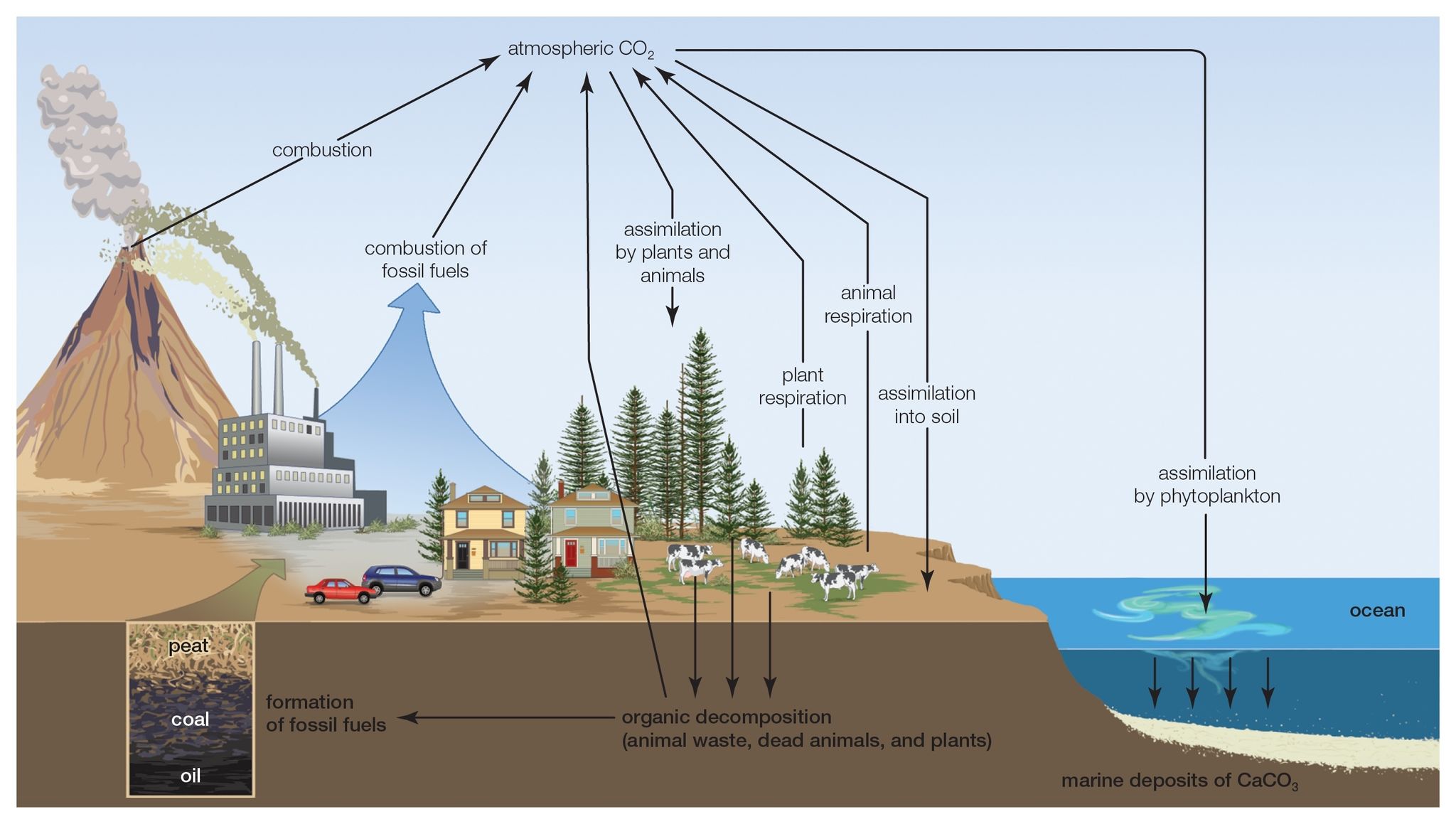
Which of the following add carbon dioxide to the atmosphere?
a)
volcanoes
b)
combustion of fossil fuels
c)
animal and plant respiration
d)
all of these
46.

What number represents combustion in this diagram?
a)
1
b)
2
c)
3
d)
4
47.

What number would represent photosynthesis in this
diagram?
diagram?
a)
1
b)
2
c)
3
d)
4
48.
Carbon is stored in many areas in the carbon cycle. Select the one location carbon is NOT stored.
a)
fossil fuels
b)
water
c)
atmosphere
d)
sunlight
49.
Although direct measurements of atmospheric carbon dioxide have only been taken consistently since the 1950s, scientists have been able to retrieve data from the past 500,000 years. They have been able to do this by looking at
a)
ice cores from ice sheets
b)
sediment cores from the ocean
c)
tree rings
d)
all of the above
50.
Which of the following would be considered a long-term carbon reservoir?
a)
Coal & oil deposits
b)
Plants
c)
Atmosphere
d)
Animals
51.
Which of the following would be considered a short-term carbon reservoir?
a)
Rocks
b)
Ocean floor
c)
Atmosphere
d)
Fossil Fuels
52.
Does photosynthesis store chemical energy or release it?
a)
Store
b)
Release
100 %

