Worksheets
Evolution
Total questions: 56
Worksheet time: 5hrs 30mins
Scientist find dinosaur fossils in the bottom of a cliff and mammals fossils in the middle layer. What can be inferred?
Dinosaurs ate plants
Dinosaurs were eaten by the mammals
Dinosaurs and mammals lived at the same time
Dinosaurs lived before the mammals
In natural selection, what is the selective pressure?
Breeders
Mutations
Environment
All of the above
What is the process in which humans breed organisms for desirable traits?
Natural selection
Inheritance
Artificial selection
Adaptation
Natural selection results in change over time by acting on traits that are ___________.
heritable
new
mutated
lack variation

When organisms move from one population to another, there is more genetic variation in the population because there are more alleles for a trait. This is known as ______________.
genetic drift
natural selection
mutation
gene flow
Natural selection is also known as _____________________.
survival of the smartest
survival of the fastest
survival of the biggest
survival of the fittest
Some individuals in a population have traits that make them better suited to the environment. These individuals are more likely to survive, to reproduce, and to pass down their genes to their offspring. This is process is ___________.
gene flow
genetic isolation
natural selection
mutation
True or False: During snowy winters, owls with white feathers are better adapted to their environment than owls with brown feathers.
True
False
Darwin observed that Galapagos Island finches that lived on different islands had different beak shapes. What did Darwin hypothesis about the finches?
Finch populations wanted to look different
Finch populations needed protection against different predators
Finches were adapted to eat the most available food source in their environment.
All of the above
The struggle for existence against other individuals and species is ______________.
gene flow
natural selection
genetic drift
competition
Which of the following does NOT affect the process of natural selection?
Overpopulation
Abundant resources
Competition
Variations
A __________ is a branching diagram that shows evolutionary relationships.
model
table
cladogram
graph
Select the reason why species may become extinct.
Lack of genetic diversity
Increased competition with other species
Loss of habitat or food sources
All of the above

According to the diagram, which organism is the oldest species?
Ammonite
Coral
Gastropod
Trilobite
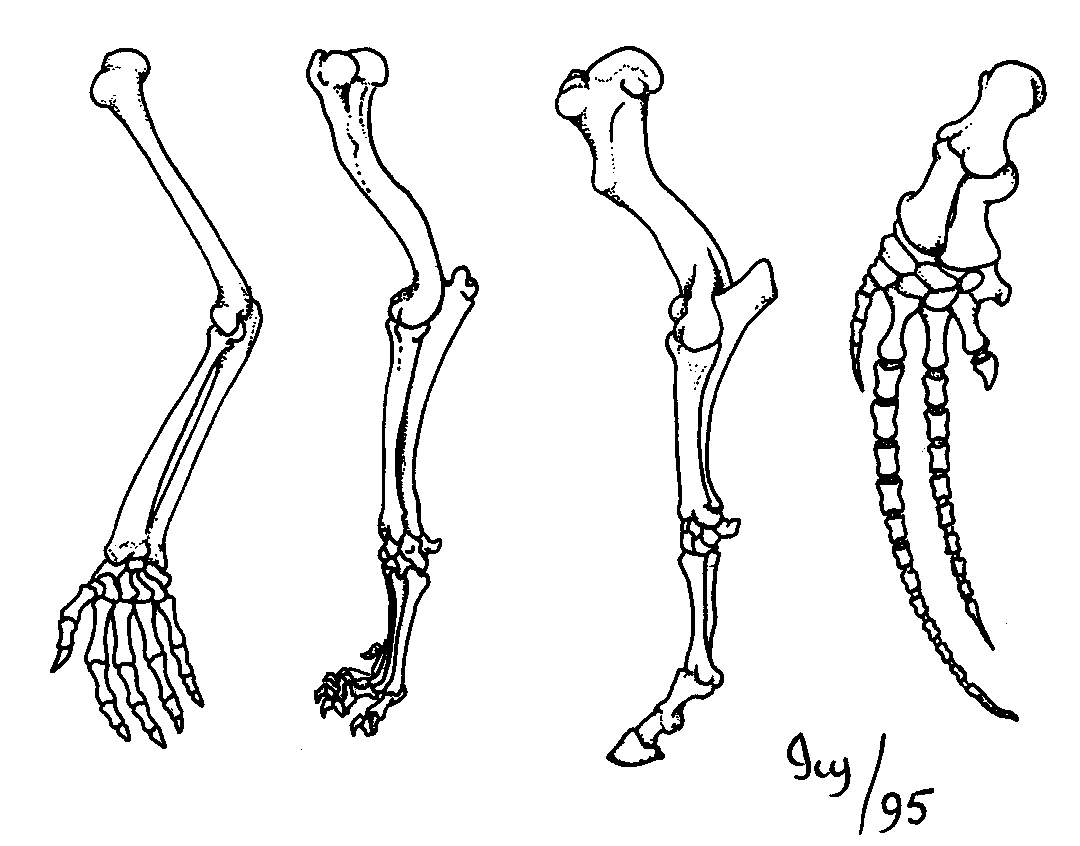
Organisms with a common ancestor often have ____________ structures that look similar but have different functions.
vestigial
homologous
analogous
none of the above
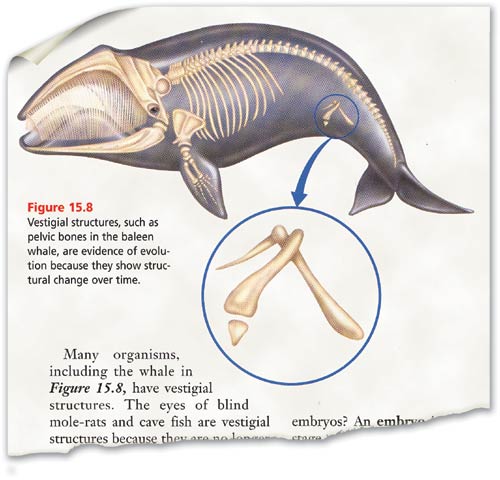
Which of the following is an example of a vestigial structure?
Wings on a red-tailed hawk
Hind limbs of a cat
Fins of sharks
Eyes in blind cave fish

If two species have genes and proteins that have many similarities, what is probably TRUE?
Species A and species B do not share a common ancestor
Species A and species B share a relatively recent common ancestor
Species A is younger than species B
Species A is older than species B
Organisms that are better adapted to survive and reproduce in their specific environment have ___________ fitness.
no
low
high
none of the above
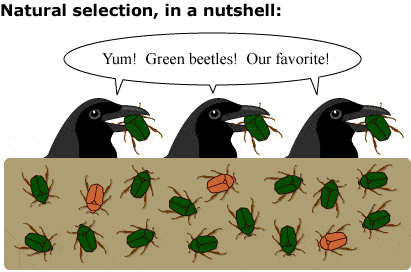
Which of the following is a requirement of natural selection?
There are more individuals in the population than resources; individuals must compete to survive.
Individuals in the population have variation in heritable traits.
Some individuals in the population are better adapted to the environment.
All of the above


Which of the following is a likely effect of this ability to alter leaf composition?

A comparison of amino acid sequences in hemoglobin reveals that humans and ______________ have the fewest amino acid differences.
kangaroos
horses
chickens
chimpanzees

A group of individuals of the same species that live together in a particular area is called a ______________.
community
population
fossil
neighbor

What is the term for a physical or behavioral trait that allows an organism to better survive and to reproduce in its environment?
Variation
Diversity
Adaptation
Vestigial structure

The solidified remain or imprint of once living organisms is called a ________________.
rock
fossil
vestigial structure
homologous structure
A mouse population that mostly forages for food at night has some mice with light gray fur and some mice with dark gray fur. In the next generation, more offspring will have what color of fur?
Light gray
Medium gray
Dark gray
50% light gray, 50% dark gray
On a cladogram, species located near each other have closer evolutionary relationship.
True
False
True or False: Homologous structures are an important indication of a common ancestor.
True
False
True or False: Vestigial structures are important to an organism's survival.
True
False
Natural disasters, disease, or other events may kill a large number of individuals in a population. As such, there are fewer alleles in the population that offspring can inherit, so there is less variation. This is known as __________________.
Adaptation
Gene Flow
Genetic Isolation
Genetic drift
Speciation may occur because of which event?
Genetic isolation
Mutation
Genetic drift
All of the above
True or False: All mutations are harmful.
True
False
In ____________________, organisms that do not have a closely related common ancestor independently evolve traits that have a similar structure and/or function.
adaptive radiation
divergent evolution
convergent evolution
none of the above


What happens in divergent evolution?
Organisms that have a common ancestor evolve similar structures or traits
Organisms that do not have a common ancestor evolve similar structures or traits
Organisms that have a common ancestor evolve different structures of traits
Organisms that do not have a common ancestor evolve different structures of traits
Cichlid fishes in lakes of the East African Rift. The lakes in this area are believed to support and sustain about 2,000 different species of these fish, each with different ecological and morphological characteristics such as body size. These lakes form a fragmented landscape that bio-geographically isolates the different species of cichlid fish from one another, allowing them, and many of the organisms they live with, to evolve separately.
Phyletic Speciation
Adaptive Radiation
Convergent Evoltion
Divergent Evoltuion
Co-evolution
The Rough-skinned newt produces a potent neurotoxin that concentrates in their skin. Garter snakes, have evolved resistance to this toxin through a series of genetic mutations, and prey upon the newts. The relationship between these animals has resulted in an evolutionary arms race that has driven toxin levels in the newt to extreme levels.
Phyletic Speciation
Adaptive Radiation
Convergent Evoltion
Divergent Evoltuion
Co-evolution
__________________ isolation occurs when two different species cannot produce viable offspring
Geographic
Behavioral
Reproductive
Habitat

What distinguishes zebras from from giraffes?
un-branching horns (in males)
even number of toes
fur
carnivorous teeth

What number is the common ancestor of C and D
1
2
3
4

What is the common ancestor of Letters A, B, C, D, E?
1
2
3
4
_____________ selection occurs when one extreme trait is favored and that trait becomes frequent in the population.
Disruptive
Stabilizing
Directional
Species
_____________ selection occurs when the population has less variation and the average (most common) trait is favored.
Directional
Disruptive
Species
Stabilizing
_____________ selection occurs when two extreme traits are more favorable and genetic variation increases.
Stabilizing
Disruptive
Species
Directional

Organisms with ____________ structures have structures that look similar and have similar functions, but they do not share a recent common ancestor.
homologous
vestigial
analogous
all of the above
Organisms with ____________ structures have structures that once had an important function, but no longer have a purpose.
vestigial
homologous
analogous
none of the above

In adaptive radiation, one species rapidly evolves into many new species with different structures or forms to fill an ecological niche. This is an example of _________ evolution.
convergent
divergent
Neither of the above
Both of the above