
 Worksheets
Meiosis
Total questions: 58
Worksheet time: 29mins
In which phase does crossing-over happen?
Prophase I
Prophase II
Metaphase I
Anaphase II
Mitosis is the same as which of the following?
Meiosis I
Meiosis II
Meiosis III
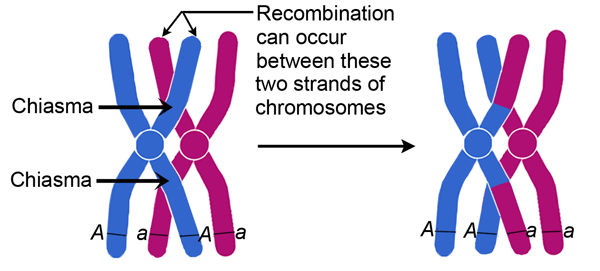
Crossing Over

What phase is this?
Prophase I
Metaphase II
Anaphase I
Telophase II

What phase is this?
Telophase I
Prophase II
Metaphase I
Anaphase II

What phase is this?
Metaphase I
Prophase II
Telophase I
Anaphase II

What phase is this?
Metaphase II
Prophase II
Telophase I
Anaphase I

What phase is this?
Telophase II
Anaphase II
Telophase I
Anaphase I

What phase is this?
Metaphase II
Prophase I
Telophase I
Anaphase I

What phase is this?
Metaphase II
Prophase I
Telophase I
Anaphase II

What phase is this?
Metaphase II
Prophase I
Telophase II
Anaphase I

What phase is this?
Prophase II
Telophase II
Telophase I
Prophase I

What phase is this?
Prophase II
Prophase I
Anaphase II
Anaphase I

What phase is this?
Prophase I
Metaphase I
Metaphase II
Prophase II

In humans, the haploid number of chromosomes is ____.
23
46
69
92
Which of the following is the best definition for MEIOSIS?
the process of two haploid cells uniting
the counting of chromosomes within a diploid cell
a two-step process that reduces the number of chromosomes in half such that there is only one copy of all the chromosomes
the equational division of a cell into two identical copies
True or False? Before cells undergo meiosis they pass through interphase first.
true
false
What is unique to Prophase I- is that the duplicated chromosomes pair up to form _______.
a centrosome
a tetrad
the mitotic spindle
sister chromatids

In which stage of MEIOSIS does crossing over occur? (The exchange of genetic material between chromosomes in a tetrad.)
Anaphase I
Metaphase I
Prophase I
Telophase I
In Metaphase I, tetrads line up along the _______.
mitotic spindle
centrosomes
equatorial plane
contractile ring
In Anaphase I, the _________ are separated by the pulling of the spindle fibers to opposite poles of the cell.
homologous pairs of chromosomes
sister chromatids
centromeres
centrosomes
Check all of the following that DO occur during Telophase I and cytokinesis.
The separated homologous chromosomes are at opposite poles of the cell.
The cell divides in two.
The chromosomes do not uncoil, since they are getting ready for Meiosis II.
Sister chromatids are pulled away from each other.
In Metaphase II, _________ line up on equatorial plane.
homologous pairs of chromosomes
single chromosomes (made up of 2 sister chromatids)
tetrads
centrosomes
In Anaphase II, the _________ separate.
Homologues
Sister Chromatids
Tetrads
Centrioles
How many cells are formed at the end of Meiosis II?
2
3
4
8
True or False. In Meiosis II, there are TWO cells that go through each phase at the same time.
true
false
Which of the following does NOT happen during Telophase II?
the nuclei reform
each cell begins to split evenly in two
the chromosomes duplicate
the nuclei contain a haploid number of chromosomes
Which of the following are CORRECT observations about the differences between MITOSIS and MEIOSIS? (Check all that apply.)
Mitosis produces cells that identical to the parent cell.
Meiosis produces cells that have half the number of chromosomes as the parent cell.
All cells go through INTERPHASE as part of the cell cycle, whether it goes to mitosis or meiosis next.
In both types of cell division, the chromosomes are only duplicated once.
Only in Mitosis, do you see chromosomes pair up to form a tetrad.
Which part of MEIOSIS is identical to MITOSIS?
Meiosis I
Meiosis II
The products of MEIOSIS have _______ number of chromosomes.
haploid
diploid


Which of the following is not a stage of interphase?
Gap 1
Synthesis
Gap 2
Anaphase
Which stage facilitates cell growth and preparation for mitosis?
Interphase
Metaphase
Prophase
Anaphase
DNA is replicated in which stage?
Interphase
Prophase
Anaphase
Metaphase
What happens during synthesis?
DNA is replicated in the nucleus resulting in two identical copies of DNA.
Cells just function as they should.
DNA is replicated in the cytoplasm resulting in two different copies of DNA.
Cells are duplicated.
What are 1/2 of duplicated chromosome, made of condensed (packaged) chromatin?
chromatid
chromatin
chromosome
dna
What are two identical sister chromatids connected at the centromere?
chromosome
chromatid
chromatin
dna
Each chromosomes pairs with its corresponding homologus chromosome to form a tetrad
Metaphase I
Telophase I & Cytokinesis
Prophase I
Anaphase II
The fibers pull the homologous chromosomes toward opposite ends of the cell
Metaphase I
Prophase I
Anaphase I
Interphase
Nuclear membranes form; the cell separates into two cells
Interphase
Telophase I & Cytokinesis
Prophase II
Metaphase I
Meiosis I results in two haploid daughter cells; Meiosis II starts when the cells once again lose their nuclear membranes, chromosomes condense
Metaphase II
Prophase II
Anaphase II
Interphase
Meiosis II results in four haploid daughter cells
Prophase II
Anaphase II
Telophase II & Cytokinesis
Metaphase II
What is a gamete?
a body cell (ex. skin or heart cell)
an autosome
a sex cell (ex. sperm or egg)
a somatic cell
How many chromosomes does a sex cell have compared to a body cell?
twice as many
the same amount
the same, but replicated
half as many
The matching pair of chromosomes you inherit from your genetic parents are called
sister chromatids
autosomes
homologous chromosomes
sex chromosomes
When does "crossing over" of genes occur during meiosis?
Prophase I
Metaphase I
Anaphase I
Telophase I
How many chromosomes are in the somatic cells of humans?
46
23
42
26
Which of the following is an example of a somatic cell?
egg cells
stomach cells
sperm cells
gametes
A diploid pea plant cell contains 14 chromosomes. How many chromsomes would be in a haploid pea plant cell?
28
14
7
21
What is the purpose of meiosis?
growth
repair
reproduction
to create identical cells
True or False: Crossing over only occurs in meiosis.
True
False
True or False: Meiosis results in identical cells.
True
False

