wayground logo

Free Printable Worksheets

Font size

S
M
L
XL
Worksheets

Protein Synthesis

Total questions: 63

Worksheet time: 1hrs 2mins

Name
Class
Date
1.

Which molecule is responsible for transferring an Amino Acid to the ribosome when building protein?

a)

mRNA

b)

DNA

c)

RNA

d)

tRNA

2.
Choose the nucleotide sequence of the RNA strand that would be complementary to the following strand: 
GTAGTCA
a)
UATUAGA
b)
ACGACTG
c)
CAUCAGU
d)
CATCAGT
3.
The main function of tRNA is to...
a)
carry a message that, when translated, forms proteins
b)
form a portion of ribosomes
c)
string together complementary RNA and DNA strands
d)
bring amino acids from the cytoplasm to the ribosomes
4.
What is the term for a three-nucleotide sequence that codes for an amino acid?
a)
base
b)
codon
c)
amine
d)
serine
5.
Which phrase best describes translation?
a)
converts mRNA into a polypeptide
b)
catalyzes bonds between amino acids
c)
produces RNA from DNA molecules
d)
recycles tRNA molecules for reuse
6.
Which of the following is the site of transcription?
a)
vacuole
b)
lysosome
c)
nucleus
d)
ribosome
7.
Which of the following is the site of translation?
a)
vacuole
b)
lysosome
c)
nucleus
d)
ribosome
8.
Which of the following is created in the nucleus and carries the genetic code to the cytoplasm?
a)
DNA
b)
tRNA
c)
mRNA
d)
rRNA
9.
In RNA, Uracil pairs with ______. 
a)
cytosine
b)
adenine
c)
guanine
d)
thymine
10.
The process to go from DNA to mRNA is _______
a)
translation
b)
transcription
c)
replication
11.
The process to go from mRNA to a protein is called ____
a)
transcription
b)
rRNA
c)
replication
d)
translation
12.
DNA holds the code for
a)
lipids
b)
carbohydrates
c)
protein
d)
sugar
13.
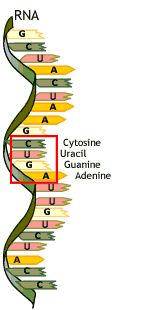
What process is going on in this photo? 
a)
Transcription 
b)
Translation 
c)
Replication 
d)
All the above 
14.
Which component of DNA determines the traits of an organism? 
a)
Nitrogen Bases
b)
Sugar-Phosphate Backbone
c)
Hydrogen bonds
15.
How many amino acids are coded for by this sequence of nucleotides:
ATG GGA ACT CCA
a)
4
b)
2
c)
6
d)
12
16.
What is the mRNA strand that would result from the DNA template strand CCTA?
a)
GGAT
b)
CCAT
c)
GGAU
d)
CCAU
17.
Which of these nitrogenous bases is NOT in RNA?
a)
Uracil
b)
Thymine
c)
Cytosine
d)
Guanine
18.

During transcription, this type of ribonucleic acid is responsible for copying the DNA and brining it out of the nucleus.

a)

tRNA

b)

mRNA

c)

rRNA

d)

dRNA

19.

Which of the following are differences in the structure between RNA and DNA

a)

DNA uses deoxyribose sugar, RNA uses sugar ribose

b)

DNA pairs Adenine with Uracil, RNA pairs Adenine with Thymine

c)

DNA is a double helix, RNA is a single helix

d)

DNA pairs Adenine with Thymine, RNA pairs Adenine with Uracil

20.

When these bond together, they form a protein

a)

Amino Acids

b)

Peptide Bonds

c)

Ribose

d)

Nucleotides

21.

These building blocks consist of a sugar, phosphate, and nitrogen base.

a)

Ribose

b)

Nucleotide

c)

Gene

d)

Protein

22.

How many amino acids are found on one tRNA?

a)

20

b)

4

c)

1

d)

3

23.
This is the triplet of bases on the end of a tRNA molecule
a)
Anticodon
b)
Codon
c)
Protein
24.

Which of the following would the codon that this molecule of tRNA will bind to?

a)
b)

ATC

c)

CUC

d)

GAG

e)

CTC

25.

TRANSCRIBE this DNA sequence: TACGTTACT

a)

AUGCAAUGA

b)

ATGCAATGA

c)

AUGGATUGA

d)

TACGTTACT

26.
Genetic info flows in one direction. Which best represents this flow?
a)
DNA-protein-RNA
b)
Protein-RNA-DNA
c)
RNA-protein-DNA
d)
DNA-RNA-protein
27.

DNA is an acronym for _____

a)

Diphosphorus Nucleic Acid

b)

Ribose Nucleic Acid

c)

Deoxyribonucleic Acid

d)

Deoxyribonucleic Acetate

28.
Which of the following best describes a DNA molecule?
a)
double helix
b)
contains ribose
c)
made of amino acids
d)
contains Uracil
29.
Which 2 molecules form the sides (backbone) of the DNA ladder?
a)
deoxyribose sugar and adenine
b)
deoxyribose sugar and a hydrogen bond
c)
deoxyribose sugar and the nucleus
d)
deoxyribose sugar and phosphate
30.

After DNA replication has occured, what is the correct matching sequence to the following DNA Strand?

ATTCGCGA

a)

TAAGCGCT

b)

TAAGAGCT

c)

TAAGCGCA

d)

CAAGCGCT

31.
What is it called when a sperm and egg meet?
a)
meiosis
b)
fertilization
c)
cell division
d)
mitosis
32.
Which process and type of resulting cells are represented?
a)
mitosis, gametes
b)
mitosis, body cells
c)
meiosis, gametes
d)
meiosis, body cells
33.
Which letter(s) in the diagram correspond to cells that are haploid? 
a)
A
b)
B
c)
C
d)
A and B
34.
Compared to the number of chromosomes contained in a body cell, how many chromosomes would normally be contained in a gamete?
a)
The same number
b)
One-fourth as many
c)
Twice as many
d)
Half as many
35.
What causes genetic variation in meiosis?
a)
chromosomes lining up
b)
crossing over of chromosomes
c)
separation of chromosomes
d)
chromosomes pulling apart
36.
Crossing over helps promote 
a)
male genotype
b)
genetic variation
c)
DNA replication
d)
mitosis
37.
Females have ____ and males have _____ chromosomes.
a)
XX, XY
b)
XY, XX
c)
XX, XX
d)
XY, XY
38.
A human being has a somatic cell that has 46 chromosomes.  What is the haploid number found in a gamete?
a)
23
b)
46
c)
69
d)
92
39.

What type of cells does meiosis produce?

a)

2 Genetically identical cells

b)

2 Genetically different cells

c)

4 genetically identical cells

d)

4 genetically different cells

40.
In mitosis, the two resulting cells are
a)
different from the starting cell and identical to each other.
b)
different from the starting cell and different from each other.
c)
identical to the starting cell and different from each other.
d)
identical to the starting cell and identical to each other.
41.
Why would it be important to replicate DNA before a cell divides in mitosis or meiosis?
a)
In order for genetic information to be transferred into daughter cells.
b)
In order for the cell to be able to increase in size.
c)
In order for the DNA to be contained in the nucleus.
d)
In order for the cell to re-order the DNA sequencing in the new cells.
42.
Transcription is a process that in eukaryotic cells takes place in the:
a)
Nucleus
b)
Cytoplasm
c)
Golgi Apparatus
d)
Rough E.R.
43.
What is the RNA synthesized from a section of DNA with the code: GATTACA ?
a)
CUAAUGU
b)
GATTACA
c)
GAUUCA
d)
CTAATGA
44.
RNA contains which bases?
a)
adenine, guanine, uracil, cytosine
b)
thymine, guanine, cytosine, uracil
c)
thymine, uracil, cytosine, guanines
d)
adenine, uracil, guanine, thymine
45.
The codon chart contains what information?
a)
amino acids
b)
DNA sequences
c)
protein chains
d)
sugars
46.
The end product of translation is what?
a)
amino acid
b)
protein
c)
sugar
d)
lipid
47.

mRNA codon is UAG, what is the DNA sequence?

a)

ATC

b)

AUC

c)

TAC

d)

AAC

48.
Which of the following is incorrect regarding RNA?
a)
RNA contains uracil
b)
RNA can only be found inside the nucleus
c)
RNA is single stranded
d)
RNA contains genetic information
49.
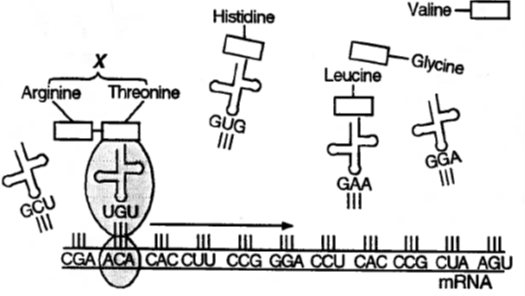
The diagram shows the process of
a)
Transcription
b)
Translation
c)
Replication
d)
Mitosis
50.
This diagram shows the process of 
a)
Transcription
b)
Translation
c)
Replication
d)
Mitosis
51.
What is occurring in this diagram?
a)
Translation
b)
Transcription
c)
Dehydration Synthesis
d)
Hydrolysis
52.
What monomers are DNA and RNA consisted of?
a)
nitrogen base
b)
nucleotides
c)
sugar-phosphate backbone
d)
blood
53.
DNA has a ______ strand; RNA has a ______ strand.
a)
double/double
b)
double/triple
c)
double/single
d)
single/single
54.
Transcription is the production of ___ from ___.
a)
protein, RNA
b)
RNA , DNA
c)
DNA, RNA
d)
DNA, protein
55.
Translation is the production of ___ from ___.
a)
RNA, protein
b)
DNA, protein
c)
RNA, DNA
d)
protein, RNA
56.
In RNA, the nitrogen base____ replaces ____ that was present in DNA. 
a)
A, U (adenine, uracil)
b)
C, G (cytosine, guanine)
c)
U, T (uracil, thymine)
d)
U, A (uracil, adenine)
57.
The backbone (sides) of the DNA and RNA molecules are made of alternating 
a)
nitrogen bases and phosphates
b)
sugars and nitrogen bases
c)
phosphates and sugars
d)
nitrogen bases
58.
What kind of cells are made in MEIOSIS?
a)
Haploid cells
b)
Diploid Cells
c)
Skin Cells
d)
Liver Cells
59.
If the Diploid number of Carrots is 18, the haploid number is
a)
18
b)
9
c)
27
d)
36
60.
Which cellular process is shown?
a)
meiosis
b)
endocytosis
c)
mitosis
d)
phagocytosis
61.
Which of the following best describes meiosis?
a)
It is carried out in all tissues theat require cell replacement
b)
It occurs only in cells in the reproductive structures of an organism
c)
It happens in all of the tissues except the brain and spinal cord
d)
It is the first stage of mitosis
62.
Meiosis makes sperm and egg cells. In humans, sperm and egg cells each have _____ chromosomes. Therefore a fertilized human egg cell (sperm and egg cell combined) would create a cell with _____ chromosomes.
a)
23, 46
b)
46, 23
c)
2, 4
d)
50, 100
63.
How many daughter cells does Meiosis create?
a)
2
b)
4
c)
8
d)
1