wayground logo

Free Printable Worksheets

Font size

S
M
L
XL
Worksheets

EOC 1- Ecology - Milestone

Total questions: 59

Worksheet time: 49mins

Name
Class
Date
1.

An environment that provides the things an organism needs is its....

a)

biotic factor

b)

habitat

c)

ecosystem

2.

The non-living parts of an organism's environment are called...

a)

community

b)

biotic factors

c)

habitat

d)

abiotic factors

3.

Water, Sunlight, Oxygen and Soil are all parts of an organisms ______________ environment.

a)

biotic

b)

abiotic

c)

living

4.

Choose the correct levels of Organization from lowest to highest...

a)

population, community, ecosystem, organism

b)

organism, population, community, ecosystem

c)

organism, population, ecosystem, community

5.

A community is a level in organization that is....

a)

made of populations of different species that live in the same place and interact.

b)

a single individual species of organisms that are similar.

c)

all the individual organisms of the same species in the same place.

6.

In determining population of a species you would have to use this type of observation and count all of the species in the ecosystem.

a)

mark and recapture

b)

indirect observation

c)

direct observation

d)

sampling

7.

In determining population this type of observation would have you counting nests or signs of an organism.

a)

indirect

b)

direct

c)

sampling

d)

mark and recapture

8.

The largest population an area can support is called its...

a)

carrying capacity

b)

limited factor

c)

adaptation

d)

biotic factor

9.
To measure population density, you must divide the number of individuals living in a defined space by the
a)
area of the space
b)
birth and death rates
c)
carrying capacity
d)
height of the space
10.
Nesting birds often space themselves evenly from other nests. This pattern is called
a)
clumped dispersion.
b)
uniform dispersion.
c)
random dispersion
d)
scatter dispersion
11.
Which of the following will increase the size of a population?
a)
emigration and births
b)
immigration and deaths
c)
immigration and births
d)
emigration and deaths
12.
Which of the following is a density-dependent limiting factor?
a)
human activities 
b)
unusual weather
c)
competition
d)
natural disaster
13.
Which of the following statements about primary succession is true?
a)
It begins with a climax community
b)
Small mammals are the first to live there
c)
It begins with bare rock
d)
It begins with rock and soil
14.
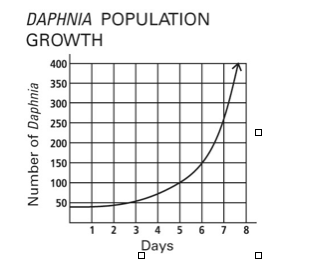
What type of growth is shown on this graph?
a)
logistic
b)
exponential
c)
average
d)
density-independent
15.
Which of the following is a density-independent limiting factor?
a)
natural disaster
b)
predation
c)
disease
d)
parasitism
16.
The way in which individuals of a population are spread out is called
a)
population density
b)
survivorship
c)
population dispersion
d)
logistic curve
17.
What pattern of growth will a population with limited resources show?
a)
density-dependent
b)
exponential 
c)
logistic
d)
logical 
18.
Diseases may spread more rapidly when an area is crowded, so disease is considered to be a
a)
type I survivorship curve
b)
population crasher
c)
density-dependent limiting factor
d)
population enhancer
19.
What type of population growth is shown in the graph?  
a)
logistic growth
b)
logical growth
c)
exponential growth
d)
density-dependent growth
20.
A sequence of biotic changes that regenerate or create an ecological community is known as
a)
factors
b)
erosion
c)
succession
d)
progression
21.
Lichens and mosses that first live in uninhabited areas are examples of
a)
secondary species
b)
non-native species
c)
pioneer species
d)
climax species
22.
Secondary succession is most likely to occur
a)
on a volcanic island
b)
after a rainstorm
c)
after a Thanksgiving Turkey dinner
d)
after a forest fire
23.
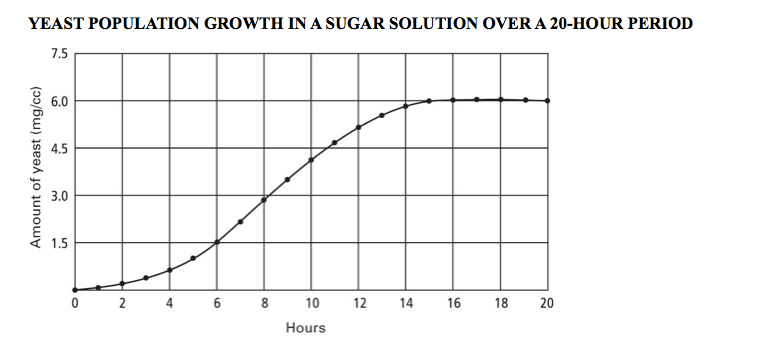
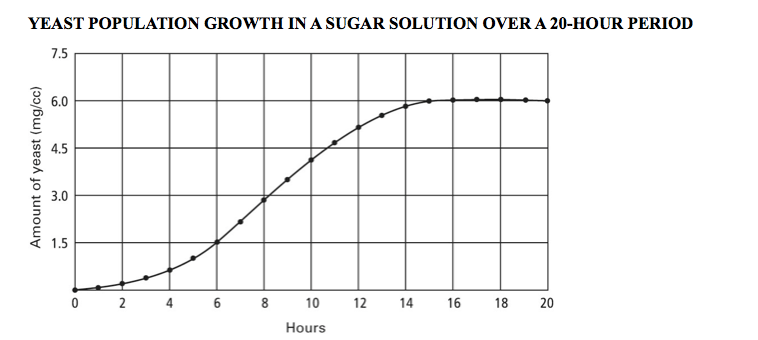
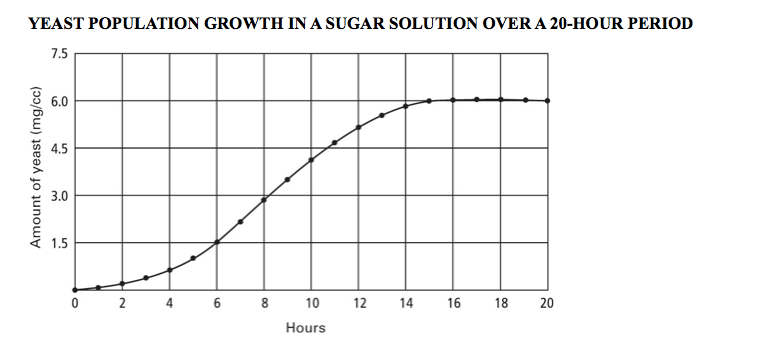
 What is the name for this leveling off shown in the graph?
a)
logistic line
b)
carrying capacity
c)
climax point
d)
mediocre
24.
After how many hours does the yeast population shown in the graph reach its carrying capacity?
a)
15 hours
b)
10 hours
c)
6 hours
d)
At the start
25.
What 2 factors decrease population size?
a)
Immigration, Births
b)
Emigration, Births
c)
Emigration, Deaths
d)
Immigration, Deaths
26.
 At what amount of yeast does the population in Figure 14.3 level off?
a)
3.0 mg/cc
b)
1.5 mg/cc
c)
6.0 mg/cc
d)
4.5 mg/cc
27.

A pattern of survival over time in which there is high survival throughout most of the life span, but then individuals start to die in large numbers as they approach old age.

a)

Type I survivorship

b)

Type II survivorship

c)

Type III survivorship

28.

A pattern of survival over time in which there is a relatively constant decline in survivorship throughout most of the life span.

a)

Type II survivorship

b)

Type I survivorship

c)

Type III survivorship

29.

A pattern of survival over time in which there is low survivorship early in life with few individuals reaching adulthood.

a)

Type III survivorship

b)

Type II survivorship

c)

Type I survivorship

30.

These animals are not choosy about what they eat or where they live

a)

Endangered

b)

Specialists

c)

Extinct

d)

Generalists

31.

These animals have specific diet and climate requirements

a)

Extinct

b)

Generalists

c)

Specialists

d)

Endangered

32.
There are approximately 17,620 people per square mile in New York City. If New York City is 468 square miles, approximately how many people live in New York City?
a)
17,620
b)
8,246,160
c)
37
d)
.027
33.
A city has a population of 8792 people. The area of the city is approximately 6.5 square miles. Approximately, how many people per square mile live in the city?
a)
57148
b)
208
c)
1353
d)
135
34.
Barnacles create home sites by attaching themselves to whales. This relationship neither harms nor benefits the whales. 
a)
parasitism
b)
commensalism
c)
mutualism
35.
Yucca flowers are pollinated by yucca moths. The moths lay their eggs in the flowers where the larvae hatch and eat some of the developing seeds. Both species benefit. 
a)
parasitism
b)
commensalism
c)
mutualism
36.
Mistletoe extracts water and nutrients from a spruce tree. The spruce tree is harmed. 
a)
parasitism
b)
commensalism
c)
mutualism
37.
Two male Giraffes are fighting over the last green leaf of a tree that is dying.  
a)
Competition
b)
Mutualsim
c)
Predation
d)
Commensalism
38.
Tapeworms live in the intestines of dogs and absorb nutrients from food the dog eats. Which best describes the outcome of this relationship?
a)
The dog and tapeworm both become ill. 
b)
The dog becomes ill, and the tapeworm benefits. 
c)
The tapeworm and dog helpe ach other survive. 
d)
The tapeworm helps the dog survive. 
39.
A coyote captures, kills, and eats a rabbit. What type of symbiotic relationship is this?
a)
mutualism
b)
commensalism
c)
parasitism
d)
predation
40.

The ecological role an organism performs in their specific environment is considered the organism's...

a)

Habitat

b)

Population

c)

Biome

d)

Niche

41.
During photosynthesis, carbon is moved from which reservoir to which reservoir?
a)
From the atmosphere to the terrestrial biosphere.
b)
From the troposphere to the terrestrial biosphere.
c)
From the lithosphere to the terrestrial biosphere.
d)
From the hydrosphere to the terrestrial biosphere
42.
Which of the following add carbon dioxide to the atmosphere?
a)
volcanoes
b)
combustion of fossil fuels
c)
animal and plant respiration
d)
all of these
43.
Plants release water into the atmosphere by 
a)
photosynthesis
b)
transpiration
c)
perspiration
d)
respiration
44.
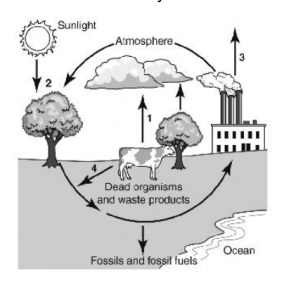
What is happening at 1?
a)
respiration: releasing CO2
b)
decomposing CO2 in the soil
c)
photosynthesis: absorbing CO2
d)
turning CO2 from the atmosphere into organic molecules
45.

Converting atmospheric nitrogen to ammonia and other nitrogen compound is

a)

Nitrogen fixation

b)

Ammonification

c)

Denitrification

d)

Nitrification

46.

The path of food energy in an ecosystem from plants to animals.

a)

omnivore

b)

food chain

c)

producer

d)

consumer

47.

An animal that eats only other animals

a)

producer

b)

herbivore

c)

omnivore

d)

carnivore

48.

An animal that eats both plants and animals

a)

carnivore

b)

omnivore

c)

herbivore

d)

producer

49.

What type of organism is at the beginning of every food chain?

a)

predator

b)

carnivore

c)

producer

d)

herbivore

50.

What role do plants play in a habitat?

a)

They produce food energy from sunlight.

b)

They break down dead matter.

c)

They are prey for predators.

d)

They recycle nutrients from dead matter.

51.
In the energy pyramid here, which organisms have the most energy available?
a)
Producers
b)
Carnivores
c)
Herbivores
d)
Top Predator
52.
In the food web shown, the snail would be considered...
a)
primary consumer
b)
secondary consumer
c)
tertiary consumer
d)
producer
53.
An organism that lives by breaking apart dead organic matter into simpler parts is...
a)
scavenger
b)
consumer
c)
decomposer
d)
carnivore
54.
If there is 1000 Kcal available in the producers in trophic level 1, how much energy is available in the herbivores in trophic level 2?
a)
10 Kcal
b)
1 Kcal
c)
100 Kcal
d)
1000 Kcal
55.
Which organism recieves the least amount of energy from the producer?
a)
Owl
b)
Grasshopper
c)
Lilypad
d)
Mouse
56.
What might happen if you remove a primary consumer from the ecosystem?
a)
There would be more food for secondary consumers.
b)
The number of primary consumers would increase.
c)
The number of plants would increase.
d)
The number of secondary consumers would increase.
57.

The phenomenon by which toxins concentrate in the organisms at higher trophic levels within an ecosystem is known as...

a)

Biotoxicity

b)

Biomagnification

c)

Eutrophication

d)

Predation

58.

What type of organism makes its own food?

a)

Autotroph

b)

Heterotroph

59.

A species that plays a critical role in the health, maintenance, growth, or definition of an ecosystem.

a)

keystone

b)

invasive

c)

engineer

d)

predator