
 Worksheets
Endocrine and Immune Review Questions
Total questions: 61
Worksheet time: 36mins
When you eat a burger , your body produces insulin to control blood sugar . What type of feedback is that
Positive feedback
Negative Feedback
None
Both

Adrenomegaly?
Enlarged adrenals
Small adrenals
No adrenals
Too many adrenals

This structure releases what hormones?
insulin and glucagon
calcitonin and estrogen
Parathyroid hormone and antidiuretic hormone
epinephrine and testosterone
Pineal gland
Chemical substances produced and secreted by the endocrine glands.
releases melatonin and regulates sleep
Pineapple flavor, please
It binds to membrane-bound receptors, that are proteins that extend across the cell membrane, with their hormone-binding sites exposed on the cell membrane’s outer surface
RECEPTOR SITE
WATER-SOLUBLE RECEPTORS
LIPID-SOLUBLE RECEPTORS
PROTEIN KINASES
What hormones targets ovaries and promotes ovulation and progesterone production
GOWTH HORMONE
FOLLICLE-STIMULATING HORMONE
LUTEINIZING HORMONE
PROLACTIN
What Disorder/Disease is caused by hyperthyroidism; results in increased metabolism, heat intolerance, rapid heartbeat, weight loss, and exophthalmos
Goiters
Cretinism
Myxedema
Graves’ Disease
This hormone regulates the homeostasis of calcium, magnesium, and phosphate by increasing blood calcium and magnesium levels, and by decreasing blood phosphate level
Vasopressin
Oxytocin
Parathyroid Hormone
Thyrotrophic Hormone
With aging, the blood levels of PTH, TSH, LH, FSH decreases
TRUE
FALSE
This element is linked to the health of our thyroid gland
Salt
Calcium
Potassium
Iodine
What is the function of the hormone calcitonin
Increase Ca levels i blood
Makes bone stronger
Activates bone loss
Decreases Ca levels in blood
Which is a source of calcium if a person has low Ca blood levels.
Muscle
Bones
Brain
Exocrine glands
Hormones cause specific effects by ______.
Flooding the entire body
Targeting specific parts of the brain
Targeting specific groups of cells in the body
Spreading through the nervous system
What does posterior pituitary gland stores and secretes?
Human growth hormone and thyroid stimulating hormone
Prolactin and follicle stimulating hormone
Glucocorticoids and androgens
Oxytocin and antidiuretic hormone
The alpha cells of the pancreas secrete _______ which targets the _______
Melatonin; Liver
Glucagon; Liver
Calcitonin; Thyroid
Glucagon; Kidney
Too much ANTIDIURETIC hormone will cause you to
lose wight and not eat
retain water and dilute sodium
grow very tall in stature
excrete too much calcium
This targets osteoclasts (bone destroying cells) so that they release calcium from bones when calcium levels are low
calcitonin
parathyroid hormone
osteoclast hormone
ADH
This hormone causes an increase in bone density, deepening of the voice, and increased production of body and facial hair
estrogen
insulin
testosterone
progesterone
When you get hugs from someone you love, you release ______.
Thyroxine
Luteinizing Hormone
Oxytocin
Insulin
When it starts to get dark, your brain releases ____, which makes you tired.
Oxytocin
Melatonin
Testosterone
Estrogen
These hormones promote secondary sex characteristics in females
testosterone and GH
epinephrine and nor-epinephrine
estrogen and progesterone
prolactin and oxytocin

A
B
C
D

A
B
C
D

A
B
C
D

A
B
C
D

A
B
C
D

A
B
C
D
The healthy human immune system responds to pathogens with both specific and nonspecific processes. Which of the following models represents a nonspecific response?


A 3 month old baby contracts a virus called whooping cough (pertussis) after receiving the first of a sequence of 3 necessary DPT vaccines designed to prevent 3 diseases (diphtheria, pertussis, and tetanus). The vaccines are given at 2, 4, and 6 months of age to allow the body to develop specific immunity against these diseases. After the infant recovered from the disease, the doctor informed the parents that from now on the infant would only need the DT (diphtheria, tetanus) part of the vaccine. Why does the infant only need the DT vaccine?
The infant had the first of a series of vaccines which caused the disease
The infant had the pertussis disease and has already produced antibodies against the disease.
The infant had the first of a series of vaccines which protected him from getting the disease.
The infant had the pertussis disease and will get diphtheria in the future.
Many times people visit the doctor requesting antibiotics to treat colds and viral infections. How is the doctor justified in offering the patient treatment options that do not include antibiotics for these cases?
Colds and viruses should be first treated with viral therapies and then when the body begins to recover, antibiotics can be used. Otherwise, the use of antibiotics is not effective at all.
Side effects from antibiotics are severe when used for colds and viruses. Any use of antibiotics for colds and viruses will only make the patient more ill and ultimately make the patient's recovery time longer.
Antibiotics can weaken the immune system when used for colds and viruses, whereas other medications are not so hard on the immune system during these types of illnesses.
If a doctor provides an antibiotic to treat colds and viruses, any bacteria in the patient's body will be killed, but a few will survive. Those few survivors may become resistant to antibiotics needed for real bacterial illnesses.
After an initial infection, B-cells recognize the measles virus. How is this helpful in human immune response?
The B-cells use this recognition to defend the body against other pathogens, such as bacteria.
The B-cells more quickly recognize and respond to any other virus that invades the body.
The B-cells produce antibodies more quickly if the measles virus is encountered again.
The B-cells transfer this recognition to T-cells, which will then devour the viruses.
What is the body's first line (non-specific) of defense against infection by foreign organisms?
antibodies
lymph nodes
white blood cells
the skin
White blood cells are an important part of the human immune response. Two types of white blood cells, neutrophils and macrophages, act as phagocytes. Phagocytes perform which of the following functions in the human body?
They produce antibodies.
They bind to antigens and develop into plasma cells
They form a barrier against pathogens.
They engulf and destroy bacteria
The response to an infection. Causes the area to redden, swell, and feel warm.
Fever
Mucus
Dilation
Inflammation
Which is NOT considered FIRST line of defense?
Helper T-Cells
Skin
Hair
Mucous Membranes
The innate immune system is...
Always working and doesn't require any special preparation
Needs to be "primed" before it can work to its full effectiveness
Very specific and only defends against a specific pathogen
Not very effective at preventing intruders


What attaches to antigens and tags the pathogen for destruction?
Pathogen
Antibodies
B-cells
Lymphocyte
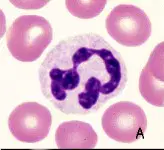
Identify which type of leukocyte is pictured
basophil
monocyte
neutrophil
lymphocyte


If an individual is exposed to a pathogen that they have already been exposed to, the immune system responds by...
Sending extra phagocytes to engulf and destroy the pathogen
Making antibodies to fight the pathogen for the first time
Memory cells make antibodies faster and in larger quantities
What is the correct order for the following statements:
A- B cells produce antibodies to neutralise the pathogen, as well as memory cells for long-term immunity
B- Phagocytes engulf the invading pathogen and present the antigen in their cell membrane
C- Antibodies neutralise the pathogen
D- Lymphocytes (T- cells) are activated, which in turn activates B- cells
E- Pathogen enters the body and antigens on the pathogen alert the phagocytes
E, D, A, C, B
E, B, D, A, C
B, E, D, A, C
D, E, C, B, A
When the body encounters a pathogen, antibodies are created that are specific to that pathogen. The next time the body encounters the pathogen, the response will be:
Slower
Faster

The diagram shows a lymphocyte. What is the arrow pointing to on the surface of the lymphocyte?
molecules called antigens
molecules called antibodies

