Wayground logo

Free Printable Worksheets

Font size

S
M
L
XL
Worksheets

Biology Midterm Review

Total questions: 83

Worksheet time: 2hrs 55mins

Name
Class
Date
1.

A cell _______ in a hypertonic solution because water moves _______ the cell.

a)

shrinks; out

b)

shrinks; in

c)

swells; out

d)

swells; in

2.
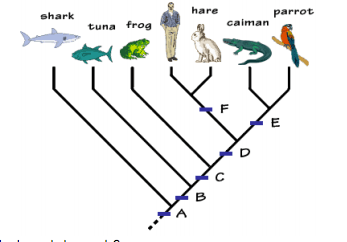
According to this cladogram, birds are LEAST related to -
a)
Amphibians
b)
Sharks
c)
Ray Finned Fish
d)
Crocodiles
3.
On the cladogram, which organism is the closest relative of the human?
a)
Frog
b)
Hare
c)
Caiman
d)
Parrot
4.
Which of the following is the smallest unit of life that can carry out all life functions?
a)
the mitochondria
b)
the vacuoles
c)
the nucleus
d)
the cell
5.
Which cell structure is found in plant and animals cells and controls what can come into or leave a cell?
a)
cell membrane
b)
cytoplasm
c)
nucleus
d)
vacuole
6.
What is the function of the cell nucleus found in both plant and animal cells?
a)
to produce energy
b)
to control cell activity
c)
to remove waste products
d)
to allow molecules to enter the cell
7.
In what part of the plant cell does the process of photosynthesis take place?
a)
nucleus
b)
mitochondria
c)
chloroplasts
d)
vacuoles
8.
What is the main function of chloroplast?
a)
Mitosis
b)
Meiosis
c)
Translation
d)
Photosynthesis
9.

Which statement best explains how sweating during exercise maintains homeostasis?

a)

It regulates mineral concentrations in cells.

b)

It regulates body temperature.

c)

It maintains water balance.

d)

It maintains sugar balance in cells.

10.

Which molecules are joined together to make proteins?

a)

fatty acids

b)

nucleic acids

c)

amino acids

d)

acetic acids

11.
What is the monomer of carbohydrates?
a)
Amino Acid
b)
Nucleic Acid
c)
Triglyceride
d)
Monosaccharide
12.
Proteins are made of:
a)

Amino Acids

b)

Fatty Acids

c)

Nucleotids

d)

Monosaccharides

13.

This is a nucelotide monomer. What polymer is made when these monomers are joined together?

a)

protein

b)

carbohydrate

c)

lipid

d)

nucleic acid

14.

This macromolecule is made of CHO and provides quick energy to the cell.

a)

carbohydrates

b)

proteins

c)

nucleic acids

d)

lipids

15.
DNA and RNA are examples of
a)
lipids.
b)
carbs.
c)
proteins.
d)
nucleic acids.
16.
The function of this macromolecule is to store and pass on genetic information to offspring.
a)
carbohydrates
b)
proteins
c)
nucleic acids
d)
lipids
17.

All of the following are functions of proteins EXCEPT

a)

catalyze/speed up chemical reactions

b)

provide quick energy

c)

make up muscles, hair, and bones

d)

support the immune system

18.

Which of the following is NOT a characteristic of all living things?

a)

ability to move

b)

response to the environment

c)

ability to reproduce

d)

growth and development

19.

What are the four macromolecules

a)

Fatty acids, monosaccharides, proteins , carbo

b)

Carbo, proteins, lipids, nueclic acids

c)

Carbo ,proteins, nueclic acids and fatty acids

d)

polypeptides, amino acid, lipids, carbo

20.

What are the jobs/functions of lipids

a)

Provide structure it is quick access

b)

Long-term energy storage and forms hormones/vitamins and membranes in cells

c)

Instructions for creating proteins

d)

Provide structure

21.
What structure in the cell contains most of the cells genetic information? 
a)
A. rough Endoplasmic Reticulum 
b)
B. mitochondria 
c)
C. nucleus 
d)
D. cytoplasm 
22.
Active transport does not require energy.
a)
True 
b)
False 
23.
I have cell walls
I am an autotroph
I am multicellular
What am I?
a)
Plant
b)
Animal
c)
Eubacteria
d)
Unicorn
24.
All living things are divided into three groups called 'domains'. They include, Domain Bacteria, Domain Archaea, and ____________.
a)
Domain Ikea
b)
Domain Eukarya
c)
Domain Romain (Lettuce-based organisms)
d)
Domain of Spain Rains only on the Plane!
25.
Do prokaryotes have a nucleus? 
a)
yes
b)
no
26.

Why would scientists want to use a taxonomic system that is standardized?

a)

In order to avoid confusion with the identification of organisms.

b)

Because Linnaeus established a system.

c)

So that Latin names can be applied for a practical purpose.

d)

In order to place organisms in different groups.

27.

The Linnaean taxonomic system classifies organisms into divisions called taxa. If two organisms belong to the same taxonomic group, they are related. Similarity at which of these levels indicates the closest relationship?

a)

Kingdom

b)

Class

c)

Order

d)

Genus

28.

A cladogram is pictured here. All the animals to the right of the hagfish would have the common characteristic of...

a)

fur

b)

claws or nails

c)

lungs

d)

jaws

29.
Which of the lists below has all of the levels of classification in the correct order?
a)
Kingdom class phylum genus order species family
b)
Class Phylum Kingdom Species Family Order Genus
c)
Kingdom Family Class Order Phylum Genus Species
d)
Kingdom Phylum Class Order Family Genus Species
30.
Scientific names are written using which two levels of classification?
a)
Kingdom phylum
b)
Kingdom class
c)
Species genus
d)
Genus species
31.
Which of the following is the least closely related animal:
Gray Wolf: Canis lupus
Aardwolf: Proteles cristatus
Coyote: Canis latrans
a)
Coyote
b)
Aardwolf
c)
Gray Wolf
d)
Need more information on body characteristics
32.
Which are the two highest level taxa in the Linnaean system?
a)
kingdom and order
b)
domain and phylum
c)
phylum and kingdom
d)
genus and kingdom
33.
The scientific name of the sugar maple is Acer saccharum. What does the second part of the name, saccharum, designate?
a)
Genus
b)
Species
c)
Family
d)
Kingdom
34.
The table shows characteristics of several organisms. Based on the information given in the table, which two organisms would you think have the most recent common ancestor?
a)
Turtle and jawed fish
b)
Lamprey and jawed fish
c)
Turtle and frog
d)
Lamprey and frog
35.

Which two organisms in the table above are most closely related?

a)

A and B

b)

B and C

c)

C and A

d)

not enough information is given to answer the question

36.

Not living, or produced by nonliving things

a)

Abiotic

b)

Biotic

37.

Living, or produced by living things

a)

Abiotic

b)

Biotic

38.

The maximum number of organisms an ecosystem can hold

a)

limiting factor

b)

carrying capacity

c)

biodiversity

d)

limit

39.

A species that, if removed from an ecosystem, would cause a major change in that ecosystem.

a)

Endangered species

b)

unlimited species

c)

important species

d)

keystone species

40.

An ecological role played by a specific organism

a)

limiting factor

b)

niche

c)

Abiotic factor

d)

Biotic factor

41.

Which of the following is a biotic factor that would affect the carrying capacity of a population?

a)

Soil

b)

Predator

c)

Rainfall

d)

Sunlight

42.

Which statement best describes the predator-prey relationship displayed on this graph?

a)

There is no relationship between the predator and prey.

b)

When the prey population increases, the predator population decreases.

c)

When the prey population increases, the predator population increases.

d)

when the predator population increases, the prey population increases.

43.

What are factors that affect carrying capacity?

a)

Biotic only

b)

Biotic and abiotic

c)

Depends on the ecosystem

d)

Abiotic only

44.

Which statement best describes the term limiting factors?

a)

All the biotic and abiotic factors and the interactions among them in a given area

b)

A finite resource organisms in an ecosystem require

c)

The biotic and abiotic factors in an ecosystem

d)

The maximum number of organisms an ecosystem can support

45.

What happens if a population grows past its carrying capacity?

a)

The population keeps growing

b)

The population starts to die off

c)

The entire species will go extinct

d)

The carrying capacity just increases

46.

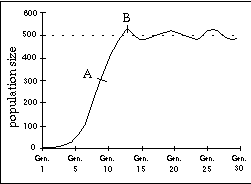
What is the carrying capacity of the graph?

a)

around 500

b)

more than 800

c)

less than 300

d)

around 700

47.

If the carrying capacity of a predator decreases, what will happen to the carrying capacity of the prey?

a)

Will Increase

b)

Will Decrease

c)

Will stay the same

48.

Which of the following would likely be a limiting factor to a population?

a)

Abundance of food

b)

Living near a water source

c)

Presence of a natural predator

d)

Multiple sources for shelter

49.

Which of the following demonstrates population growth when there is limited available water in an area?

a)
b)
c)
50.

A carbohydrate is a macromolecule that is used to...

a)

give cells/systems energy.

b)

build cell parts.

c)

give cells/systems long term energy storage.

d)

help cells with chemical processes.

51.

When reading the ingredients on a nutrition facts label carbohydrates are written as a type of

a)

food additive

b)

enzyme

c)

sugar

d)

protein

52.

Example(s) of Lipids are...

a)

Sugar

b)

Olive Oil

c)

Butter

d)

Bread

53.

When reading the nutrition facts on food packaging total fats is a measure of...

a)

Carbohydrate

b)

Lipids

c)

Water

d)

Protein

54.
Where is there a low concentration of dye?
a)
at the bottom of cup
b)
in the color
c)
at the top of cup 
d)
no concenteraion gradient
55.
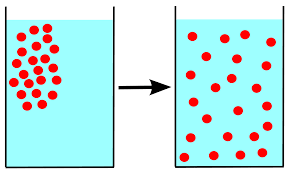
The picture below is an example of _________________.
a)
osmosis
b)
isotonic
c)
diffusion
d)
active transport
56.
What is diffusion?
a)
when molecules move 
b)
when molecules move from a high concentration to a low.
c)
no movement 
d)
molecules move everywhere
57.

What does semi-permeable mean?

a)

Some molecules can move through the membrane

b)

Nothing can move through the membrane

c)

All molecules can pass through the membrane.

58.
Movement of molecules from an area of high concentration to an area of low concentration is
a)
diffusion 
b)
passive transport
c)
osmosis
d)
all of the above
59.
 An animal cell placed in a hypertonic (salty) solution will
a)
Stay the same
b)
Shrink- get smaller
c)
Swell- get bigger
60.
A person would never have pure water put into their veins in a hospital because their cells would...
a)
Shrink/Dehydrate
b)
Expand
61.

Osmosis is the movement of ______from an area of low concentrated solute to an area of high concentrated solute.

a)

molecules

b)

oxygen

c)

water

d)

sugar

62.

Facilitated Diffusion when large molecules move across a membrane via the help from _____________

a)

cell wall

b)

phospholipids

c)

channel proteins

d)

santa

63.

Passive Transport of molecules and nutrients across a membrane includes the following (more than one answer)

a)

Diffusion

b)

Osmosis

c)

Active Tranport

d)

Facilitated Diffusion

64.

A hypotonic solution is one in which there is a ______ concentration of solute outside the cell than inside the cell.

a)

higher

b)

lower

c)

equilibrium

65.

In an isotonic solution, _____________is reached because the cell remains and movement of water remain constant.

a)

water

b)

equilibrium

c)

the same

d)

hypertonic

66.

In a hypertonic solution, the water moves________ the cell because the concentration of solute is greater on the outside of the cell than on the inside.

a)

into

b)

out of

c)

up

d)

around

67.

Which means: same structure, different job?

a)

Analogous Structures

b)

Homologous Structures

c)

Vestigial Structures

68.

Which means: no longer needed, like wisdom teeth in humans or hip bones in whales?

a)

Analogous Structures

b)

Homologous Structures

c)

Vestigial Structures

69.

Which means: same job, different structure? like with bird, bat, and butterfly wings.

a)

Analogous Structures

b)

Homologous Structures

c)

Vestigial Structures

70.

True or False: Embryos show we are related to a common ancestor.

a)

True

b)

False

71.

Why does each finch have a different shape beaks?

a)

The birds adapted to their environments where they ate the SAME food

b)

The birds adapted to their environments where they ate DIFFERENT food

c)

The birds are all different species, not related.

72.

Does the presence of homologous structures in genetically different animals suggest common ancestry?

a)

Yes

b)

No

73.
An organism's ability to survive and reproduce in its environment refers to its
a)
Fitness
b)
Variation
c)
Selection
d)
Mutation
74.
The environment around Manchester, England, changed during the Industrial Revolution.  How did this change affect peppered moths living in the area?
a)
Natural selection favored moths with dark wings because predators could not see them on the soot-colored trees.
b)
Natural selection favored moths with white wings that were easy for predators to see.
c)
Natural selection favored moths with white wings because predators could not see them on the soot-colored trees.
d)
Natural selection caused moths with white wings to become extinct.
75.
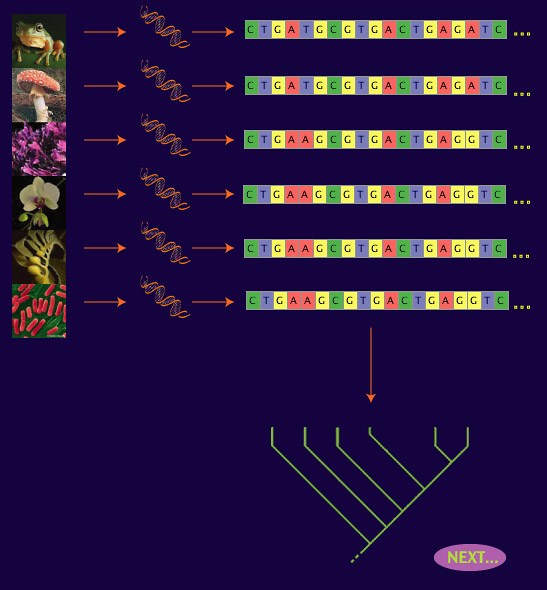
Two organisms that are closely related would have
a)
very similar DNA sequence
b)
exactly the same DNA sequences
c)
no proteins in common
d)
completely different DNA sequence
76.
What is the study of organisms at the early stages of development?
a)

DNA studies

b)

embryology 

c)

extinction

d)

fossil record

77.

An inherited trait that helps those organisms that have it to better survive in its environment

a)

niche

b)

structure

c)

characteristic

d)

adaptation

78.
Which of the following causes variations to develop in a species?
a)
a.  Genetic mutation
b)
b. Common ancestors
c)
c. Reduction of habitats
d)
d. Embryological similarity
79.
The diagram below shows a segment of the amino acid sequence from the hemoglobin protein from several organisms. What conclusion can you draw from the information in the chart?
a)
A. The gorilla and human are the most closely related organisms with the fewest differences in their amino acid sequences.
b)
B. The monkey and the gorilla are the most closely related organisms with the fewest differences in their amino acid sequences.
c)
C. The human and horse are the most distantly related organisms with the greatest differences in their amino acid sequences.
d)
D. The horse and kangaroo are the most distantly related organisms with the greatest differences in their amino acid sequences.
e)
Option 8
80.
According to the diagram, who is most closely related to primates? 
a)
Amphibians
b)
Rodents & Rabbits
c)
Crocodiles
d)
Sharks
81.
When would convergent evolution occur?
a)
When organisms share a common ancestor
b)
When organisms live in similar environments
c)
When organisms become increasingly different
d)
When organisms experience a change in their environment
82.
Humans, birds, whales, and lizards all have similar arm bones. What is the reason for this?
a)
The function of these bones is the same in all animals
b)
They live in similar environments
c)
They have a common ancestor
d)
All organisms resemble humans
83.
Whether or not a variation is an adaptation is dependent on the organism's
a)
Environment
b)
Genotype
c)
Phenotype
d)
Selection