
 Worksheets
STAAR Bio RC 2 (Genetics)
Total questions: 86
Worksheet time: 2hrs 1mins
Name
Class
Date
1.
Which sequence of DNA bases would pair with this partial strand
ATG TGA CAG
ATG TGA CAG
a)
ATG TGA CAG
b)
TAC ACT GTC
c)
GTA AGT GAC
d)
CAT TCA CTG
2.
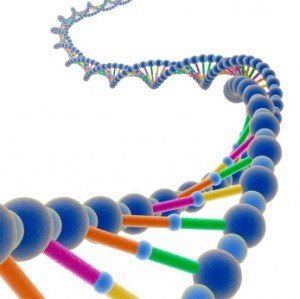
Which of the following best describes a DNA molecule?
a)
double helix
b)
contains ribose
c)
made of amino acids
d)
contains Uracil
3.
Which of the following units are repeatedly joined together to form a strand of DNA?
a)
amino acids
b)
nucleotides
c)
fatty acids
d)
polysaccharides
4.
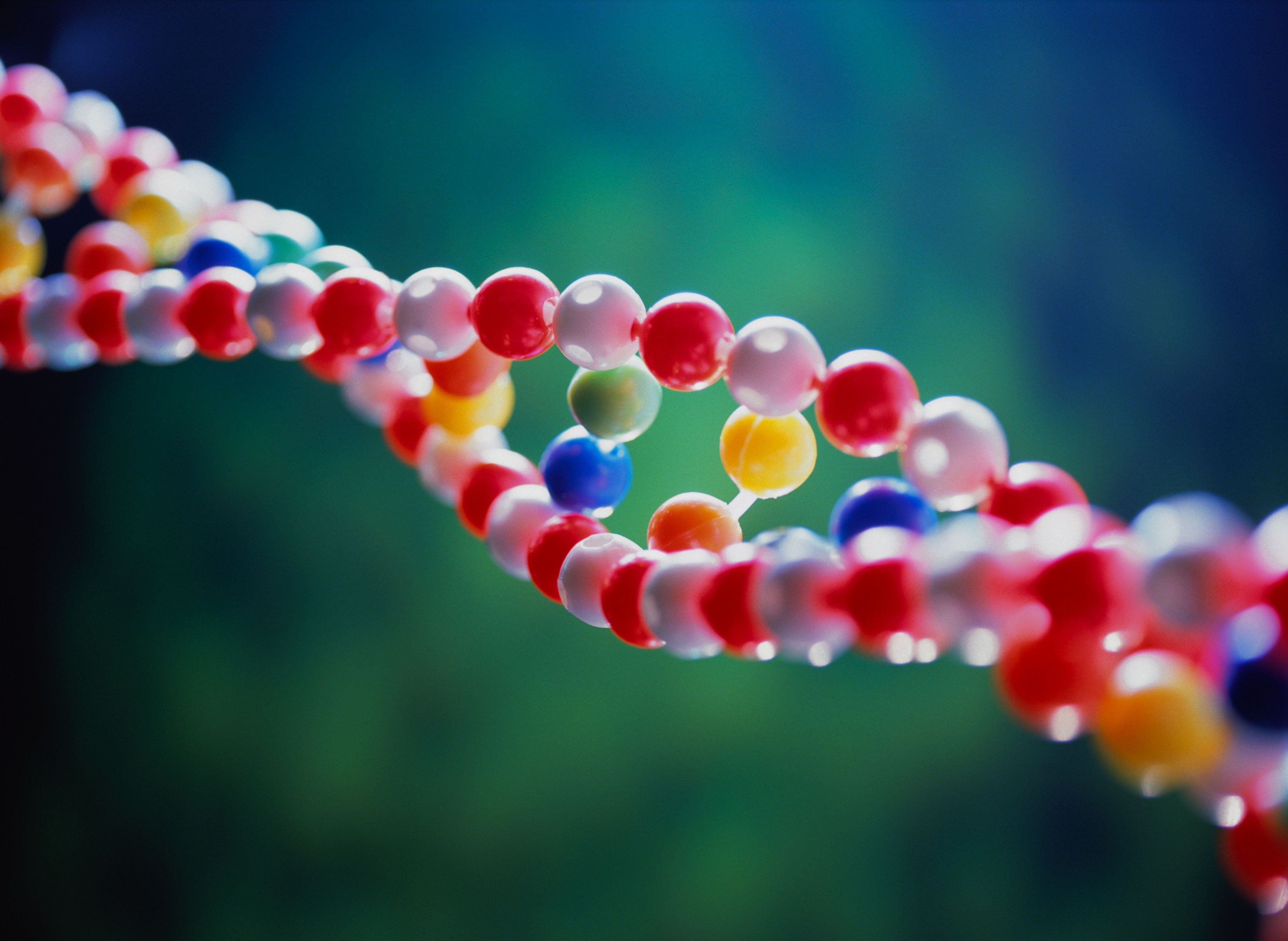
Why is DNA important?
a)
it is very small and very complicated
b)
it's in everything
c)
it serves as the blueprint for traits of all living things
d)
because we eat it every day for energy
5.

Replicate the following strand of DNA:
AATCATGGA
AATCATGGA
a)
AATCATGGA
b)
TTAGTACCT
c)
UUAGUACCU
d)
GGATAUCUA
6.
A process in which DNA has the unique ability to make an exact copy of itself.
a)
Replication
b)
Translation
c)
Transcription
7.
What are the 4 nitrogen bases?
a)
adenine, thymine, cytoplasm, and guanine
b)
adenine, thymine cytosine, and guanine
c)
adenine, thymine, cytosine, and gylcerol
d)
adenine, thymine, cytosine, and glucose
8.
Where does protein synthesis take place?
a)
Ligase
b)
Ribosomes
c)
Codon
d)
Endoplasmic Reticulum
9.
Contains the bases adenine, uracil, cytosine and guanine
a)
DNA
b)
RNA
c)
Both
10.
How many codons are needed to specify for five amino acids?
a)
3
b)
5
c)
15
d)
30
11.
What type of mutation occurs, when a base is subtracted from the sequence?
a)
Deletion
b)
Insertion
c)
Substitution
12.
What is the product of translation?
a)
DNA
b)
mRNA
c)
tRNA
d)
proteins
13.
What is the template for mRNA?
a)
DNA
b)
tRNA
c)
rRNA
d)
proteins
14.
Which type of RNA takes the instructions from the nucleus to the cytoplasm?
a)
mRNA
b)
tRNA
c)
rRNA
d)
RNA polymerase
15.
What is the central dogma of molecular biology?
a)
RNA-protein-DNA
b)
RNA-DNA-protein
c)
DNA-protein-RNA
d)
DNA-RNA-prtein
16.

DNA codes for...
a)
cholesterol
b)
proteins
c)
fatty acids
d)
a sandwich
17.

Nucleotides are made up of a sugar, phosphate, and..?
a)
nitrogenous base
b)
nucleic acid
c)
cholesterol
d)
fatty acid
18.
The five carbon sugar found in RNA
a)
Ribose
b)
Deoxyribose
c)
Glucose
19.

The process shown in this image
a)
is called replication
b)
results in a new copy of the DNA
c)
does not happen during mitosis
d)
All of these apply
20.

In eukaryotes, molecule 1 is found in
a)
ribosomes
b)
chloroplasts
c)
cytoplasm
d)
the nucleus
21.

Molecule 3 is synthesized in
a)
ribosomes
b)
chloroplasts
c)
the cell membrane
d)
the nucleus
22.
What will be the resulting mRNA from this DNA sequence:
GAT-TAC-AGA-TTA-CAT?
GAT-TAC-AGA-TTA-CAT?
a)
CTA-ATG-TCT-AAT-GTA
b)
GAU-UAG-UGA-UUA-GUT
c)
CUA-AUG-UCU-AAU-GUA
d)
CAT-ACA-TAC-ATA-TAG
23.
What is the order for Protein Synthesis?
a)
Transcription -> Translation -> Protein
b)
Translation - > Transcription -> Protein
c)
Protein -> Transcription -> Translation
d)
Translation -> Protein -> Transcription
24.
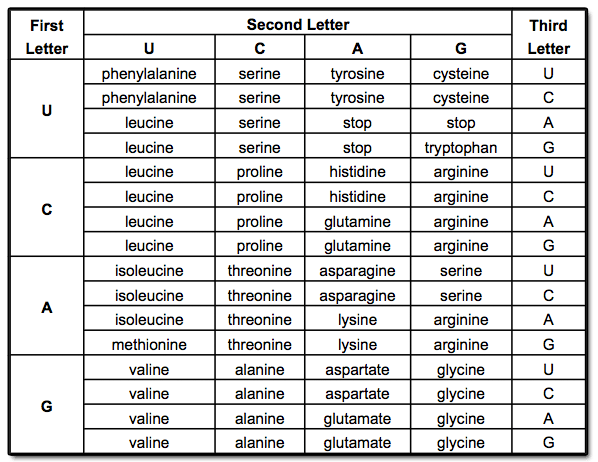
What is the correct amino acid sequence for the mRNA code AUGCCAGUAUGA
a)
Met-Pro-Ala-Val
b)
Met-Pro-Val
c)
Tyr-Gly-His
d)
Tyr-Gly-Arg-His
25.
What is the RNA sequence for this amino acid chain: LYSINE - GLYCINE - STOP
a)
AAA - CCC - UAA
b)
AAA - GGG - UAA
c)
AAG - AUC - CGA
d)
AAG - GGG - UUU
26.
Every three letters (example: ATC) in DNA codes for what??
a)
Amino Acid
b)
Nucleotide
c)
Lipid
d)
Carbohydrate
27.
One difference between DNA and RNA is that RNA....
a)
is double stranded
b)
contains the base Thymine
c)
contains the base Uracil
d)
contained the base Guanine
28.
Transcribe the following piece of DNA:
ATCGTA
ATCGTA
a)
UAGCAU
b)
TAGCAT
c)
ATCGTA
d)
AUCGUA
29.
The codon CAA will code for the amino Acid?
a)
Stop
b)
Met
c)
glu
d)
his
30.
Which Seq could be found in RNA?
a)
ACCTGT
b)
CGCATT
c)
AUGCUU
31.
Which Seq could be found in DNA?
a)
ACCTGT
b)
CGCAUU
c)
AUGCUU
32.

Which amino acid is made from the RNA codon UUA?
a)
Phenylalanine
b)
Leucine
c)
Serine
d)
Tyrosine
33.

Which amino acid is made from the RNA codon ACC?
a)
Tyrosine
b)
Isoleucine
c)
Threonine
d)
Valine
34.
What has DNA?
a)
animals
b)
plants
c)
bacteria
d)
all of the above
35.

What is the relationship between a protein, the cell, and DNA?
a)
DNA is produced by protein which is produced in the cell
b)
Protein is composed of DNA which is produced in the cell
c)
DNA makes RNA which produces protein in the cell
d)
A cell is composed of DNA and protein
36.
Which is true for all organisms?
a)
Replication is when RNA makes RNA.
b)
Duplication is when RNA makes DNA.
c)
Transcription is when DNA makes DNA.
d)
Translation is when RNA makes proteins.
37.
Process in which the gene sequence in DNA is copied to a mRNA strand.
a)
DNA replication
b)
Transcription
c)
Translation
d)
Mutation
38.

What process is shown?
a)
Translation
b)
Transcription
c)
DNA replication
d)
Non-disjunction
39.

What process is occurring in the diagram?
a)
DNA replication
b)
Transcription
c)
Translation
d)
Protein synthesis
40.
A mutation that involves one or a few nucleotide.
a)
Point mutation
b)
Inversion
c)
Translocation
d)
none of the above
41.
A type of mutation that changes an entire amino acid sequence in a polypeptide a chain
a)
Subsitituion
b)
Frame shift mutation
c)
Translocation
d)
Inversion
42.
What mutation has occurred here?
T-G-A-C-C-A
T-G-A-G-C-A
T-G-A-C-C-A
T-G-A-G-C-A
a)
Substitution
b)
Deletion
c)
Insertion
d)
Frameshift
43.
Are all mutations bad?
a)
Yes
b)
No
44.
DNA molecule segment is : TTACGCAAG
The mutated DNA segment is TTACGCAAC. This is an example of ___ mutation.
The mutated DNA segment is TTACGCAAC. This is an example of ___ mutation.
a)
Substitution
b)
Insertion
c)
Inversion
d)
Translocation
45.
Why are insertion and deletion (frameshift) mutations so harmful?
a)
They change all of the codons from the mutation on down the line, which changes the amino acid sequence
b)
They insert things that an organism doesn't need.
c)
They often delete things that organisms need.
d)
Insertion and deletions are not any more harmful than substitution mutations.
46.
ATTTGAGCC- Original
ATTGAGCC - Mutated
The example above is an example of a
ATTGAGCC - Mutated
The example above is an example of a
a)
Insertion- Frameshift
b)
Deletion- Substitution
c)
Deletion -Frameshift
d)
All of the above
47.
If you are a boy, what percent of your genes did you get from your dad?
a)
25%
b)
50%
c)
75%
d)
100%
48.
What is it called when body cells grow uncontrollably
a)
Spinal Stenosis
b)
Anemia
c)
Cancer
49.
What does it mean to be a genetic carrier?
a)
They could pass it along to their children.
b)
They don't have the disease themselves.
c)
Both are true.
50.
a change in one DNA triplet that may result in a new triplet that codes for a stop codon instead of an amino acid is known as
a)
missense
b)
nonsense
c)
frameshift
d)
silent
51.
which of the following mutations results in the loss or addition of a single nucleotide, changing the DNA triplets
a)
missense
b)
nonsense
c)
frameshift
d)
silent
52.
original chromosome
ABC-DEF
mutated chromosome
ABBC-DEF
ABC-DEF
mutated chromosome
ABBC-DEF
a)
duplication
b)
point
c)
frameshift
53.
A type of substitution in which no amino acids change is called
a)
Missense
b)
Nonsense
c)
Silent
d)
Deletion
54.
B=brown eyes
b= blue eyes
What is true about two brothers that have brown eyes?
One has genotype BB the other Bb.
b= blue eyes
What is true about two brothers that have brown eyes?
One has genotype BB the other Bb.
a)
they have same phenotype and genotype
b)
they have different genotypes and phenotypes
c)
they have same phenotype but different genotypes
d)
they have same genotype but different phenotypes
55.
What does heterozygous mean?
a)
An organism that has the same genes for a trait (TT or tt)
b)
An organism that has different genes for a trait (Tt)
c)
When neither gene is fully dominant; offspring is a mixture of both
d)
the different forms of a trait (hair color--> brown, blonde, red
56.

This is an example of what?
a)
Complete dominance
b)
Incomplete dominance
c)
Codominance
d)
None of the above
57.

If a Homozygous red snapdragon and a Heterozygous pink snapdragon were crossed - what percentage of the offspring would be homozygous white?
a)
0%
b)
25%
c)
50%
d)
75%
58.
What is one advantage of sexual reproduction?
a)
offspring are identical to parents
b)
offspring are resistant to viruses
c)
offspring are born live, rather thna from eggs
d)
offspring inherit a wider variety of genetic information
59.

Which best describes the process shown?
a)
mutation in which the DNA content of the gene is ltered
b)
segregation of sister chromatids
c)
condensation and segregation of the alleles
d)
crossing-over which alleles are exchanged
60.

Term for homozygous organisms that display two dominant phenotypes at the same time
a)
codominance
b)
incomplete dominance
c)
multiple alleles
d)
linked genes
61.
W=white hair
w= non-white hair
If you cross a horse with WW and a horse with ww what fraction of the offspring would be expected to have white hair?
w= non-white hair
If you cross a horse with WW and a horse with ww what fraction of the offspring would be expected to have white hair?
a)
none
b)
3/4
c)
1/2
d)
all
62.
A homozygous dominant dog with brown fur is crossed with a heterozygous dog with brown fur. What are the percentages of the possible genotypes?
a)
100% BB
b)
75% BB and 25%Bb
c)
50 % BB and 50% Bb
d)
50% Bb and 50% bb
63.

What gamete possibilities could come from this parent's genotype?
a)
AB, AB, aB, aB
b)
Ab, AB, Ab, ab
c)
Ab, Ab, Ab, Ab
d)
AB, aB, ab, aB
64.

What goes in box 2
a)
AABb
b)
AaBb
c)
aabb
d)
AaBB
65.
Cross Two Homozygous plants
(RRYY x rryy)
R = round seeds, r = wrinkled seeds Y = yellow seeds, y = green seeds
What percent will have Round and Yellow seeds?
(RRYY x rryy)
R = round seeds, r = wrinkled seeds Y = yellow seeds, y = green seeds
What percent will have Round and Yellow seeds?
a)
0%
b)
25%
c)
50%
d)
100%
66.
A male beetle has the genotype Ttbb. If this beetle mates with a female with genotype TTBb, what is the chance their offspring will have the genotype TtBb?
a)
12.5%
b)
25%
c)
50%
d)
75%
67.
What fraction of offspring from the cross AaBB x Aabb will be heterozygous for both traits?
a)
1/16
b)
4/16
c)
8/16
d)
3/16
68.
This produces 2 identical cells.
a)
mitosis
b)
meiosis
69.
The cells produced via meiosis are called:
a)
sex cells
b)
somatic cells
c)
body cells
d)
skin cells
70.
What causes genetic variation in meiosis?
a)
chromosomes lining up
b)
crossing over of chromosomes
c)
separation of chromosomes
d)
chromosomes pulling apart
71.
What kind of cells are made in MEIOSIS?
a)
Haploid Gametes
b)
Diploid Somatic Cells
c)
Skin Cells
d)
Liver Cells
72.
Crossing over helps promote
a)
male genotype
b)
genetic variation
c)
DNA replication
d)
mitosis
73.
How many daughter cells are produced at the end of meiosis?
a)
1
b)
2
c)
3
d)
4
74.

Meiosis makes sperm and egg cells. In humans, sperm and egg cells each have _____ chromosomes. Therefore a fertilized human egg cell (sperm and egg cell combined) would create a cell with _____ chromosomes.
a)
23, 46
b)
46, 23
c)
2, 4
d)
50, 100
75.
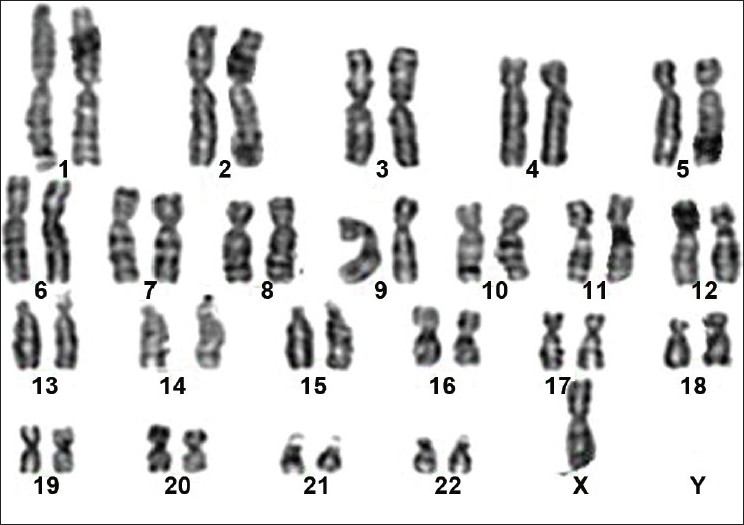
a)
This karyotype shows Trisomy 21
b)
This karyotype has no abnormality
c)
This karyotype is missing a sex chromosome (monosomy x)
d)
This karyotype is from a gamete
76.
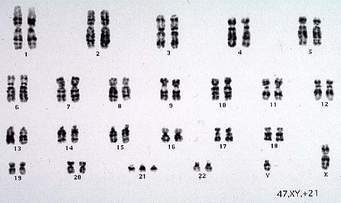
Based on the Karyotype shown, at which chromosome pair can we identify a genetic disorder?
a)
Chromosome pair 5
b)
sex chromosomes
c)
Chromosome pair 21
d)
There are no chromosomal disorders
77.

What is the gender of the individual whose karyotype is seen in the image?
a)
Male
b)
Female
78.

How many generations are shown in this pedigree?
a)
1
b)
2
c)
3
d)
4
79.

Does this pedigree show a dominant or recessive trait?
a)
Dominant
b)
Recessive
80.

In a pedigree, what shape represents a male?
a)
circle
b)
square
c)
triangle
d)
diamond
81.

The genotype of the affected son and daughter at the bottom of this pedigree...
a)
could be homozygous dominant
b)
could be homozygous recessive
c)
could be heterozygous
d)
Can't tell
82.
Hemophilia is a recessive sex-linked trait. If H = normal & h = has hemophilia, which genotype represents a male with hemophilia.
a)
XHY
b)
XHXh
c)
XhXh
d)
XhY
83.

Imagine the shaded individuals are those WITH a "hitchhikers thumb." What must be the genotype of individual II-1?
a)
TT
b)
tt
c)
Tt
d)
Impossible to tell
84.

Based on these results whose blood was found in the blood stain at the crime scene?
a)
Bob
b)
Sue
c)
John
d)
Lisa
85.

Could this be this child's father?
a)
Yes
b)
No
86.

Which two bat species are most closely related?
a)
Bat 1 and Bat 2
b)
Bat 1 and Bat 3
c)
Bat 2 and Bat 3
d)
There’s no way to tell
100 %

