wayground logo

Free Printable Worksheets

Font size

S
M
L
XL
Worksheets

Biology Semester Test Review 2018

Total questions: 91

Worksheet time: 1hrs 22mins

Name
Class
Date
1.
Which of the following best describes a DNA molecule?
a)
double helix
b)
contains ribose
c)
made of amino acids
d)
contains Uracil
2.
Which sequence of DNA bases would pair with this partial strand
ATG TGA CAG
a)
ATG TGA CAG
b)
TAC ACT GTC
c)
GTA AGT GAC
d)
CAT TCA CTG
3.
A process in which DNA has the unique ability to make an exact copy of itself.
a)
Replication
b)
Translation
c)
Transcription
4.
In what phase of the cell cycle does DNA replication take place?
a)
G1
b)
S
c)
G2
d)
M
5.
DNA replication results in two DNA molecules,
a)
each one with two original strands
b)
each one with two new strands
c)
each one with one new strand and one original strand
d)
one with two new strands and the other with two original strands
6.
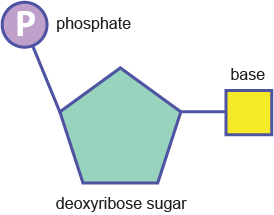
What are the three components of a nucleotide?
a)
sugar, hydrogen, nitrogen base
b)
sugar, oxygen, nitrogen base
c)
sugar, phosphate, nitrogen base
d)
sugar, phosphate, protein
7.
Replicate the following strand of DNA: 
AATCATGGA
a)
AATCATGGA
b)
TTAGTACCT
c)
UUAGUACCU
d)
GGATAUCUA
8.
DNA replication results in two DNA molecules,
a)
each one with two original strands
b)
each one with two new strands
c)
each one with one new strand and one original strand
d)
one with two new strands and the other with two original strands
9.
What are the three parts of a nucleotide?
a)
Polymer, Monomer, Diomer
b)
Phosphorous, Monosaccharide, Sulfur Base
c)
Phosholipid, fatty acid chain, gylercin.
d)
Phosphate group, sugar, nitrogen base
10.
DNA codes for...
a)
cholesterol
b)
proteins
c)
fatty acids
d)
a sandwich
11.
What is the relationship between a protein, the cell, and DNA?
a)
DNA is produced by protein which is produced in the cell
b)
Protein is composed of DNA which is produced in the cell
c)
DNA controls the production of protein in the cell
d)
A cell is composed of DNA and protein
12.
Genetic info flows in one direction. Which best represents this flow?
a)
DNA-protein-RNA
b)
Protein-RNA-DNA
c)
RNA-protein-DNA
d)
DNA-RNA-protein
13.
The diagram shows the process of
a)
Transcription
b)
Translation
c)
Replication
d)
Mitosis
14.
Name this structure
a)
double helix
b)
nucelotide
c)
twisted ladder
d)
hydrogen bond
15.
Nucleotides are made up of a sugar, phosphate, and..?
a)
nitrogenous base
b)
nucleic acid
c)
cholesterol
d)
fatty acid
16.
How does RNA differ from DNA?
a)
RNA contains uracil and deoxyribose
b)
RNA contains ribose and thymine
c)
RNA contains uracil and ribose
d)
RNA contains adenine and ribose
17.
How would the DNA sequence GCTATA be transcribed to mRNA?
a)
GCUAUA
b)
CGATAT
c)
CGAUAU
d)
GCUTUT
18.
The process by which the genetic code of DNA is copied into a strand of RNA is called
a)
translation
b)
transcription
c)
transformation
d)
replication
19.
Which of the following describes RNA?
a)
RNA is usually double-stranded and contains the base thymine
b)
RNA is usually single-stranded and contains the base uracil
c)
RNA is longer than DNA and uses five bases to encode information
d)
RNA is made in the nucleus of eukaryotic cells and stays there to carry out its functions
20.
In messenger RNA, each codon specifies a particular
a)
nucleotide
b)
enzyme
c)
amino acid
d)
promoter
21.
The process of making proteins on the ribosome based on instructions from messenger RNA is called
a)
transcription
b)
transformation
c)
translation
d)
molecular biology
22.
Changes is DNA sequences that affect genetic information are known as
a)
replications
b)
mutations
c)
transformations
d)
translations
23.

During RNA thymine is replaced by

a)

Adenine

b)

Cytosine

c)

Uracil

d)

Guanine

24.

The process shown in the picture is

a)

DNA replication

b)

Transcription

c)

Translation

d)

Photosynthesis

25.

Transcription is the process of....

a)

Making energy

b)

Making DNA

c)

Making proteins

d)

Making RNA

26.

Proteins are made of

a)

Nucleic Acids

b)

Nucleotides

c)

Lipds

d)

Amino Acids

27.

What is taking place in the picture

a)

DNA replication

b)

Transcription

c)

Translation

d)

Energy synthesis

28.

The process of formation of mRNA from DNA is

a)

Translation

b)

Replication

c)

Transformation

d)

Transcription

29.

The DNA chain act as a template for RNA synthesis has the following order of base, AGCTTCGA. What will be the order of bases in mRNA

a)

TCGAAGCT

b)

UGCUAGCT

c)

TCGAUCGU

d)

UCGAAGCU

30.
The process to go from mRNA to a protein is called ____
a)
transcription
b)
rRNA
c)
replication
d)
translation
31.
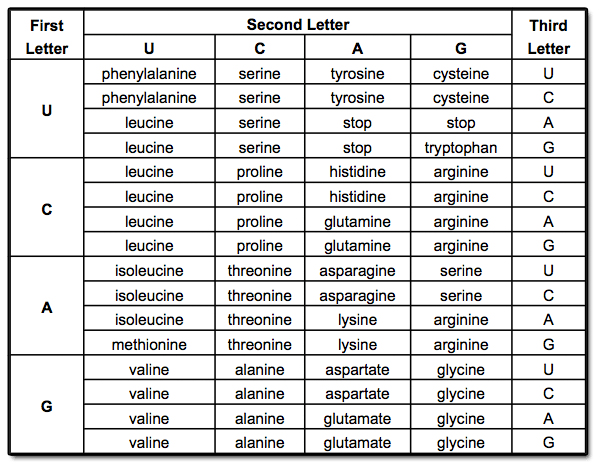
What amino acid is represented by the codon UUA?
a)
Phenylalanine
b)
Tyrosine
c)
Leucine
d)
Stop codon
32.
What is the location in the cell for translation?
a)
nucleus
b)
mitochondria
c)
ribosome
d)
chloroplast
33.
What is the three base sequence of mRNA that codes for a single amino acid?
a)
Anticodon
b)
Codon
c)
Protein
34.
What is the location in the cell for transcription?
a)
nucleus
b)
cytoplasm
c)
ribosome
d)
mitochondria
35.
Translation is the process where
a)
mRNA is created in the Nucleus
b)
mRNA is decoded to form a protein 
c)
glucose molecules are made
d)
is where lipids are synthesised
36.
What phase of mitosis is occuring in the picture?
a)
Prophase
b)
Metaphase
c)
Cytokinesis
d)
Telophase
37.
What phase of mitosis is pictured?
a)
Metaphase
b)
Telophase
c)
Prophase
d)
Anaphase
38.
Fruit fly body cells have 8 chromosomes. After mitosis, you would expect a resulting fruit fly daughter cell to have -
a)
16 chromosomes.
b)
46 chromosomes.
c)
8 chromosomes.
d)
4 chromosomes.
39.
Before cells can divide, what must be copied?
a)
mitochondria
b)
cytoplasm
c)
DNA
d)
Cell Wall
40.
Small-scale mutation that changes a single nucleotide pair is called?
a)
missense mutation
b)
insertion
c)
silent mutation
d)
point mutation
41.
The synthesis of a polypeptide using the information in the mRNA
a)
What is messenger RNA (mRNA)?
b)
What is transcription?
c)
What is translation? 
d)
What is primary transcript? 
42.

Genes make

a)

ATP

b)

ADP

c)

glucose

d)

proteins

43.

What is the reason for DNA replication?

a)

create ATP for cellular respiration

b)

create ATP for photosynthesis

c)

create DNA to put in new daughter cells

d)

create DNA to put in ribosomes

44.

AUACAGCCGACAUU is a gene sequence from

a)

DNA

b)

RNA

45.
Name the phase:
a)
Anaphase
b)
Telophase
c)
Metaphase
d)
Prophase
46.
Why would it be important to replicate DNA before a cell divides in mitosis or meiosis?
a)
In order for genetic information to be transferred into daughter cells.
b)
In order for the cell to be able to increase in size.
c)
In order for the DNA to be contained in the nucleus.
d)
In order for the cell to re-order the DNA sequencing in the new cells.
47.
Before cells can divide, what must be copied?
a)
mitochondria
b)
cytoplasm
c)
DNA
d)
Cell Wall
48.

Why are most cells very small?

a)

It is easier to stay warm when you are small

b)

So they can avoid predators

c)

So materials can move in and out of them more efficiently

49.
The stages of mitosis in order
a)
Metaphase, Anaphase, Prophase, Telophase
b)
Prophase, Anaphase, Metaphase, Telophase
c)
Prophase, Metaphase, Anaphase, Telophase
d)
Anaphase, Prophase, Telophase, Metaphase
50.
In mitosis, the two resulting cells are
a)
different from the starting cell and identical to each other.
b)
different from the starting cell and different from each other.
c)
identical to the starting cell and different from each other.
d)
identical to the starting cell and identical to each other.
51.

Cells of organism must replicate for ?

a)

growth

b)

repair of damaged cells

c)

replacement of dying cells.

d)

All of the above

52.
Before cells can divide, what must be copied?
a)
mitochondria
b)
cytoplasm
c)
DNA
d)
Cell Wall
53.
When an animal cell goes through cytokinesis,__________
a)
a cell plate forms dividing the 2 new nuclei.
b)
the cell membrane pinches off the 2 new cells.
c)
4 new cells are formed.
d)
None of the above
54.
A human cell has 46 chromosomes before mitotic division.  How many chromosomes will the daughter cells after mitosis.
a)
12
b)
23
c)
46
d)
92
55.
Controls the passage of materials inside and outside of the cell. 
a)
Cell Membrane
b)
Lipid Cleric Layer
c)
Membrane Gate
d)
Protein Receptors 
56.
How does a cell maintain homeostasis?
a)
Regulates what enters and leaves the cell
b)
Flexibility
c)
Protective barrier
d)
Structure and support
57.

Organic substances contain

a)

phosphorus

b)

carbon

c)

nitrogen

d)

hydrogen

58.

Purpose of Mitosis

a)

growth

b)

development

c)

replace cells

d)

repair wounds

e)

all answers are correct

59.

If a parent cell has 20 chromosomes, how many chromosomes will a daughter cell have at the end of mitosis?

a)

10

b)

5

c)

20

d)

40

60.

Why is DNA replication important?

a)

needed to create ATP

b)

needed to hold the DNA ladder together

c)

it helps plants go through photosynthesis

d)

creates DNA to go into new daughter cells after mitosis

61.

Which of the following is the correct formula for cellular respiration?

a)

CO2 + glucose --> water + ATP

b)

Glucose + Oxygen --> Water + Carbon dioxide + ATP

c)

Sunlight + water + carbon dioxide --> Glucose + oxygen

62.

Where in the cell does cell respiration occur?

a)

Chloroplast

b)

Mitochondria

c)

Vacuole

d)

Cytoplasm

63.
The cell membrane
a)
regulates what enters/leaves cell
b)
helps maintain homeostasis
c)
keeps contents of cell in place
d)
all of the above
64.
Which of the following is the correct equation for PHOTOSYNTHESIS?
a)
CO+ light + H2O --> O+ Sugar
b)
CO+ sugar + H2O --> O+ light
c)
O2 + light + H2O --> CO+ Sugar
d)
CO+ O2 + H2O --> Light+ Sugar
65.
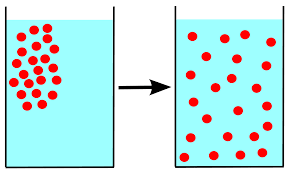
The picture below is an example of _________________.
a)
osmosis
b)
isotonic
c)
diffusion
d)
active transport
66.
Osmosis is the movement of _____ across a membrane.
a)
food
b)
energy
c)
oxygen
d)
water
67.
During osmosis
a)
water moves from high to low concentration
b)
large or oddly shaped molecules move across a cell membrane
c)
water moves when energy is used
d)
proteins are built
68.
An animal cell placed in a hypertonic (salty) solution will
a)
Shrink
b)
Swell
c)
Stay the same
69.
The egg represents a giant ________, now that the shell has been dissolved by vinegar (acetic acid).
a)
bacterium
b)
cell
c)
bubble
d)
organelle
70.
Which way will the water move by osmosis in this situation?
a)
into the cell
b)
out of the cell
c)
won't move
71.
 In the given scenario what will happen?  An egg with a dissolved shell is placed in pure water for 48 hours.
a)
Water will move in and out of the cell equally, and the cell with neither shrink nor swell.
b)
The egg will gain water and swell.
c)
The egg will lose water and shrink.
72.
In this given scenario, corn syrup is hypertonic to an egg with a dissolved shell. What will happen to the egg when it is place in corn syrup?
a)
It will stay the same.
b)
It will swell- get bigger.
c)
It will shrink- get smaller.
73.
In the egg lab __ moved from the egg to the syrup.
a)
water
b)
mice
c)
salt
d)
sugar
74.
 A cell placed in a hypertonic solution will
a)
Stay the same
b)
Shrink- get smaller
c)
Swell- get bigger
75.
Osmosis is the diffusion of _____ across a selectively permeable membrane.
a)
food
b)
air
c)
water
d)
oxygen
76.
This egg has shrunk, what type of solution was it placed in?
a)
hypotonic solution
b)
hypertonic solution
c)
isotonic solution
d)
active transport
77.
What might happen to a freshwater plant that is placed into saltwater?
a)
Cells will swell
b)
Plasmolysis
c)
Cytolysis
d)
There will be no change
78.
Condition that occurs if too much water leaves the cell and cell collapses.
a)
Plasmolysis
b)
Osmosis
c)
Cytolysis
d)
Exocytosis
79.

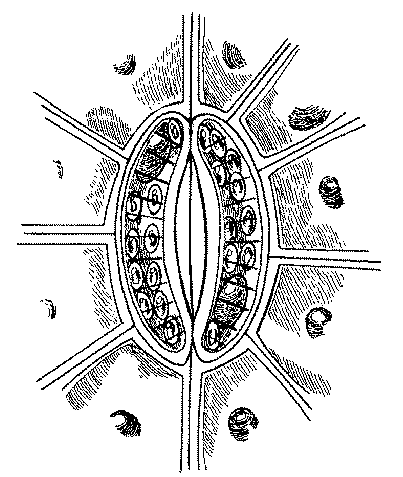
The structure that allows gases to enter and exit plant leaves

a)

Thylakoid

b)

Stomata

c)

Roots

d)

Stems

80.

What is the relationship between light intensity and the rate of photosynthesis?

a)

As intensity increases the rate of photosynthesis increases
b)

As the intensity decreases the rate of photosynthesis increases
81.
How does the stomata work?
a)
It helps transport sugars to the root cells.
b)
It helps to transport nutrients to the roots.
c)
It helps to exchange gases and water.
d)
It helps to conduct fermentation in the leaf.
82.
Photosynthesis:
a)
6CO2 + 6H2O + sun light (energy) -C6H12O6 + 6O2
b)
C6H12O6 + 6O2 - 6 CO2 + 6H2O -energy
c)
C6H12O6 + 6O2 - 6 CO2 + 6H2O - energy
d)
6H2O + sun light (energy) -C6H12O6 + 6O2
83.
Respiration:
a)
C6H12O6 + 6O2 - 6 CO2 + 6H2O - energy
b)
C6H12O6 + 6O2 - 6 CO2 - energy
c)
6CO2 + 6H2O + sun light (energy) -C6H12O6 + 6O2
84.
What gas is released by plants during photosynthesis?
a)
sulfur
b)
carbon dioxide
c)
oxygen
d)
hydrogen
85.
in a nucleic-acid chain, a sub unit that consists of a sugar, phosphate, and a nitrogen base
a)
DNA
b)
Nucleotide
c)
Ribosome
d)
Mutation
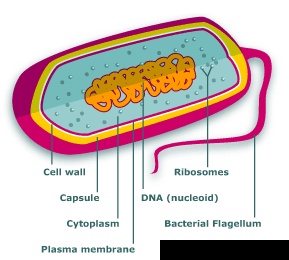
86.
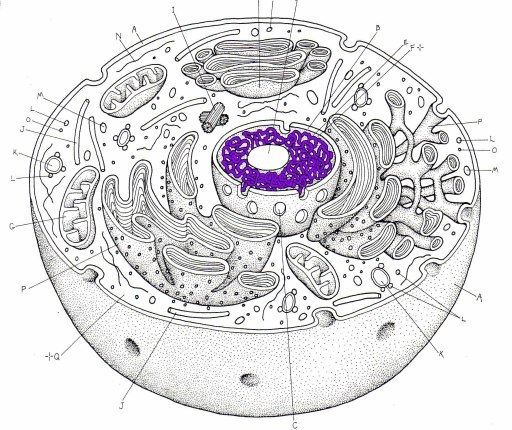
Which type of cell?
a)
Prokaryote
b)
Eukaryote
87.
What kind of cell is this?
a)
Eukaryotic
b)
Prokaryotic
88.
Which organelle belongs in plant cells only?
a)
Cell Membrane
b)
Mitochondrion
c)
Chloroplast
d)
Nucleus
89.
Which organelle belongs in plant cells only?
a)
Cytoplasm
b)
Mitochondrion
c)
Cell Wall
d)
Nucleus
90.
Which organelle belongs in plant cells only?
a)
Cytoplasm
b)
Mitochondrion
c)
Large Central Vacuole
d)
Cell Membrane
91.
What are tiny organelles that convert glucose into ATP?
a)
Ribosomes
b)
Vesicles
c)
Cytoskeleton
d)
Mitochondria