
 Worksheets
Semester 2 review
Total questions: 94
Worksheet time: 1hrs 20mins
ATG TGA CAG

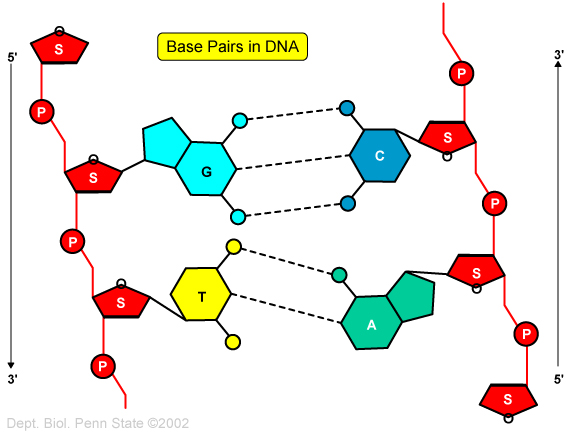


What is the process that makes a complementary mRNA strand from a DNA strand?
protein synthesis
transcription
translation
DNA Polymerase
The first step of protein synthesis is.....
replication
mitosis
translation
transcription
What is the central dogma of molecular biology?
RNA-protein-DNA
RNA-DNA-protein
DNA-protein-RNA
DNA-RNA-protein
What best explains the interaction between tRNA and mRNA during translation?
anticodons on the mRNA line up with complementary codons on the tRNA
anticodons on the tRNA line up with complementary codons on the mRNA
tRNA attach amino acids to the complementary mRNA sequence
mRNA attach amino acids to the complementary tRNA sequence

The following codon is translated into which amino acid?
AUG
Methionine
Isoleucine
Histidine
Arginine
The following codon is translated into which amino acid?
AUU
Methionine
Isoleucine
Histidine
Arginine
WHERE does TRANSLATION occur?
ribosome
cytoplasm
nucleus
cell
Which organelle makes proteins?
ribosome
nucleus
mitochondria
chloroplast
What is translation?
the process in which DNA is copied to make another molecule of DNA
the process in which DNA is coded into mRNA
the process in which mRNA is decoded into a protein
the process in which enzymes break down mRNA
The correct sequence of mitosis:
metaphase, anaphase, telophase, prophase
prophase, metaphase, anaphase, telophase
prophase, anaphase, metaphase, telophase
telophase, metaphase, prophase, anaphase
After mitosis the number of chromosomes in the newly created cells will be:
Half the number of the original cell
The same number as the original cell
Twice as much as the original cell
Uncontrolled growth can result in:
G0 phase
S phase
Replication
Cancer


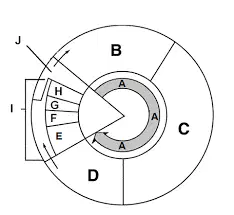
In the image, what is represented by F?
Prophase
Metaphase
Anaphase
Telophase
In the image, what is represented by I?
Mitosis
Interphase
Anaphase
Cytokinesis
In which phase does a cell spend most of its life?
Interphase
Prophase
Metaphase
Anaphase
Telophase
What mutation has occurred here?
Original DNA strand - T-G-A-C-C-A
Replicated DNA strand - A-C-A-G-G-T
Point mutation
Deletion
Insertion
Frameshift
DNA molecule segment is : TTACGCAAG
The mutated DNA segment is TTCGCAAG. This is an example of ___ mutation.
Substitution
Deletion
Insertion
Inversion
A mutation is defined as:
A change in the cell's structure
Anything that changes in an embryo
Any change in the physical features of a human
A change in the DNA sequence
ATTTGAGCC- Original
ATTGAGCC - Mutated
The example above is an example of a
Insertion- Frameshift
Deletion- Substitution
Deletion -Frameshift
All of the above

In humans, the haploid number of chromosomes is ____.
23
46
69
92
Which of the following is the best definition for MEIOSIS?
the process of two haploid cells uniting
the counting of chromosomes within a diploid cell
a two-step process that reduces the number of chromosomes in half such that there is only one copy of all the chromosomes
the equational division of a cell into two identical copies
How many cells are formed at the end of Meiosis II?
2
3
4
8
Which of the following are CORRECT observations about the differences between MITOSIS and MEIOSIS? (Check all that apply.)
Mitosis produces cells that identical to the parent cell.
Meiosis produces cells that have half the number of chromosomes as the parent cell.
All cells go through INTERPHASE as part of the cell cycle, whether it goes to mitosis or meiosis next.
In both types of cell division, the chromosomes are only duplicated once.
Only in Mitosis, do you see chromosomes pair up to form a tetrad.
What effect does crossing over has in terms of traits of offspring?
Results in identical traits of offsprings.
Causes variation in the traits of offsprings.
It really does nothing to the traits of offspring.
The four cells that are produced after Meiosis are _______.
haploid because they contain just half the number of chromosomes as the parent cell.
diploid because they contain as many chromosomes as the parent cell.
diploid because they contain twice as many chromosomes as the parent cell.
If an organism has 24 chromosomes in a body cell, how many will each daughter cell have at the end of meiosis?
6
12
23
24
The daughter cells produced by meiosis are also called __________.
somatic cells
stem cells
germ cells
gametes
How many chromosomes do sperm cells have?
(a)
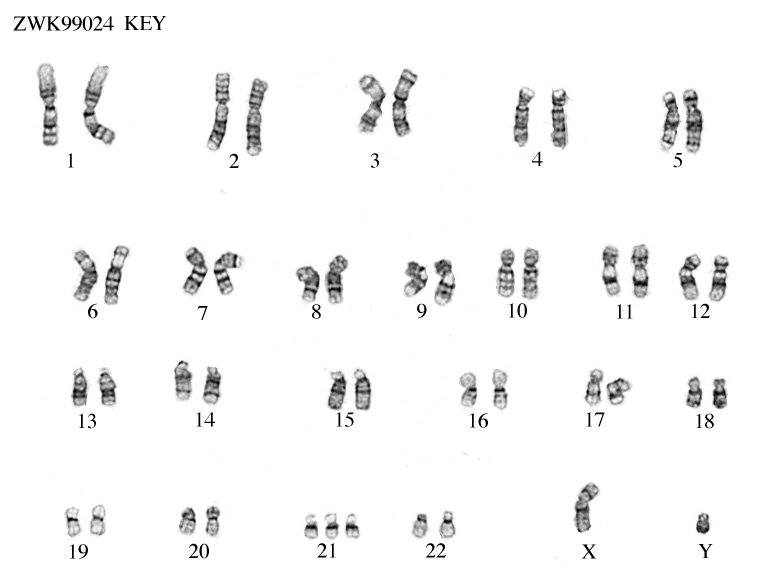
What is the mutation in this persons chromosomes?
There is only one X
7 is shaped like a hockey stick
There's an extra 21
1 is too curved
What is the primary cause of genetic variation during meiosis?
chromosomes lining up
"crossing over" of chromosomes
separation of chromosomes
chromosomes pulling apart
The failure of one or more pairs of homologous chromosomes or sister chromatids to separate "normally" during meiosis is called _____________________.
nondisjunction
anaphase I
nondiploidy
karyotype

In pea plants, tall (T) plant alleles are dominant to short (t) plant alleles. If two tall plants (each with the genotype Tt) are crossed, what is the probability that the cross would result in a short pea plant?
25%
50%
75%
100%

Patrick Star recently married Patti. He is considered a purebred for his tall head shape (T), which is dominant over a short head (t). If Patti is a short-headed woman, what type of heads would their children have? (HINT: do a Punnett Square on a piece of paper)
75% Tall and 25% short
25% Tall and 75% short
50% Tall and 50% short
100% Tall
Which statement below describes DOMINANT alleles?
expressed when at least one is present
only expressed when 2 are present

In pea plants, tall (T) is dominant over short (t). If two heterozygous tall pea plants are mated, what is the the expected genotypic ratio of their offspring?
3 tall : 1 short
1 TT : 2 Tt : 1 tt
The alleles for different traits are sorted separately and don't affect one another.
Law of Dominance
Law of Independent Assortment
Law of Conservation of Matter
Law of Segregation
A parent's 2 alleles for a trait are separated during meiosis to produce gametes.
Law of Dominance
Law of Independent Assortment
Law of Conservation of Matter
Law of Segregation
The alleles for different traits are sorted separately and don't affect one another.
Law of Dominance
Law of Independent Assortment
Law of Conservation of Matter
Law of Segregation
One allele is stronger and will be expressed over another.
Law of Dominance
Law of Independent Assortment
Law of Conservation of Matter
Law of Segregation
New traits usually occur due to:
Random genetic mutations
An organism adapting
Effects from the environment
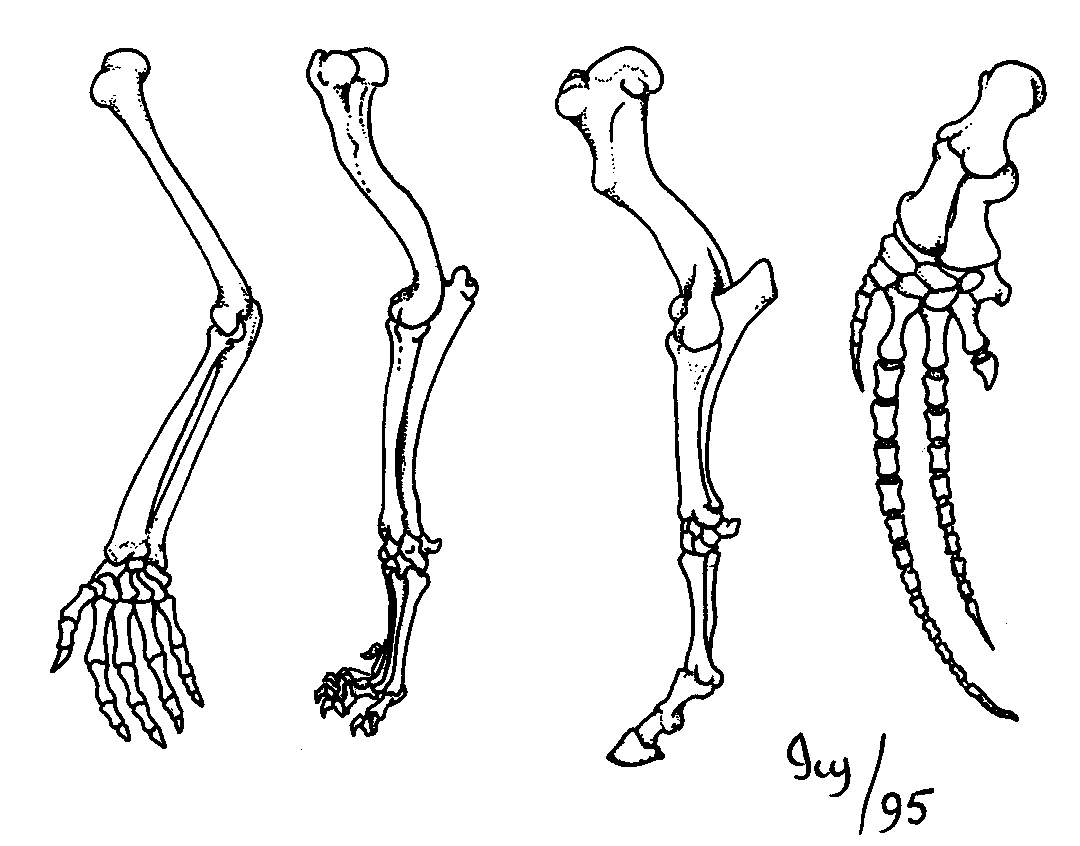

Whales are aquatic mammals that contain a pelvis (hip) bone. Even though it does not aid in its movement, the function must have been used by a common ancestor of the whale. Thus, the pelvis is referred to as a(n)
vestigial structure
analogous structure
homologous structure
What is the function of the excretory system?
to take in oxygen and excrete carbon dioxide
to excrete wastes from the body
to pump blood throughout the body
to break down food into useful nutrients
What is the function of the digestive system?
to take in oxygen and excrete carbon dioxide
to excrete wastes from the body
to pump blood throughout the body
to break down food into useful nutrients
What is the function of the respiratory system?
to take in oxygen and excrete carbon dioxide
to excrete wastes from the body
to pump blood throughout the body
to break down food into useful nutrients
Which system carries messages to and from different parts of the body?
the digestive system
the circulatory system
the muscular system
the nervous system
Protects the body, regulates body temperature
Integumentary
Nervous
Skeletal
Muscular
Allows movement in the body
Integumentary
Nervous
Skeletal
Muscular
Receives stimuli and transports impulses, coordinates actions and reactions in the body
Integumentary
Nervous
Circulatory
Respiratory
Supports and provides structure for the body
Skeletal
Muscular
Circulatory
Respiratory
The ________ system is made of glands that secrete hormones into the blood to maintain homeostasis (balance)
excretory
endocrine
digestive
circulatory


