wayground logo

Free Printable Worksheets

Font size

S
M
L
XL
Worksheets

3rd Nine Weeks CBA Review

Total questions: 93

Worksheet time: 4hrs 38mins

Name
Class
Date
1.

If you cross a black chicken with a white chicken, only black and white checkered chickens would be produced. What kind of inheritance pattern does this follow?

a)

Incomplete dominance

b)

Codominance

2.

This is an example of ---

a)

Incomplete dominance

b)

Codominance

3.
Which of the following is a trait that a virus shares with a living organism?
a)
They use oxygen
b)
They have genetic material
c)
They grow
d)
They digest food
4.
Which of the following is something bacteria and viruses have in common?
a)
they are both living
b)
they are both cells
c)
they can both cause disease
d)
they are both non-living
5.

The purple projections on the virus are used by the virus to

a)

attract a mate

b)

attack enemies

c)

swim through the water

d)

identify a host cell

6.

What do Eukaryotes and Prokaryotes both share?

a)

Ribosomes

b)

Cytoplasm

c)

DNA

d)

Ribosomes, Cytoplasm and DNA

7.
Which of the following is NOT something viruses and cells have in common?
a)
DNA
b)
nucleus
c)
has proteins
d)
has lipids
8.
What part of the virus protects the DNA and is made of protein?
a)
Nucleic Acid
b)
Tail Fibers
c)
Sheath
d)
Capsid
9.
Which of the following organisms are LEAST closely related?
a)
organisms that share a domain
b)
organisms that share a family 
c)
organisms that share a genus 
d)
organisms that share a species 
10.
The scientific name for an organism is made from the:
a)
class and family name
b)
genus and species name
c)
domain and kingdom name
d)
kingdom and phylum name
11.
The 8 levels of classification, most broad to most specific.
a)
Domain, Genus, Family, Order, Class, Phylum, Kingdom, Species
b)
Domain, Species, Kingdom, Genus, Phylum, Family, Class, Order
c)
Domain, Kingdom, Phylum, Class, Order, Family, Genus, Species
d)
Order, Kingdom, Species, Domain, Phylum, Family, Class, Genus
12.
The science of describing, classifying, and naming living things is called:
a)
Geology
b)
Biology
c)
Taxonomy
d)
Chemistry
13.
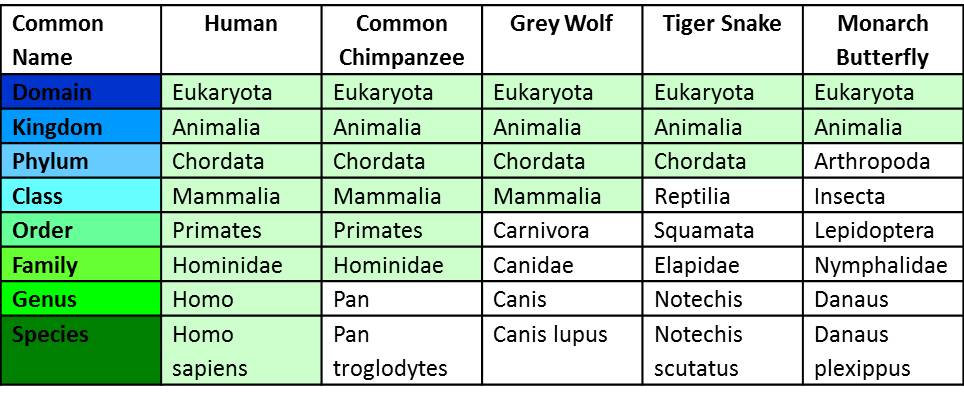
Which organism in the table is least closely related to the chimpanzee?
a)
human
b)
grey wolf
c)
tiger snake
d)
monarch butterfly
14.
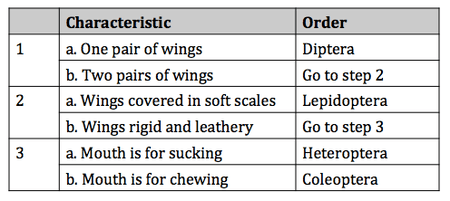
A dichotomous key for insects is given. To what order does an insect with two pairs of scaly wings belong?
a)
Coleoptera
b)
Heteroptera
c)
Diptera
d)
Lepidoptera
15.
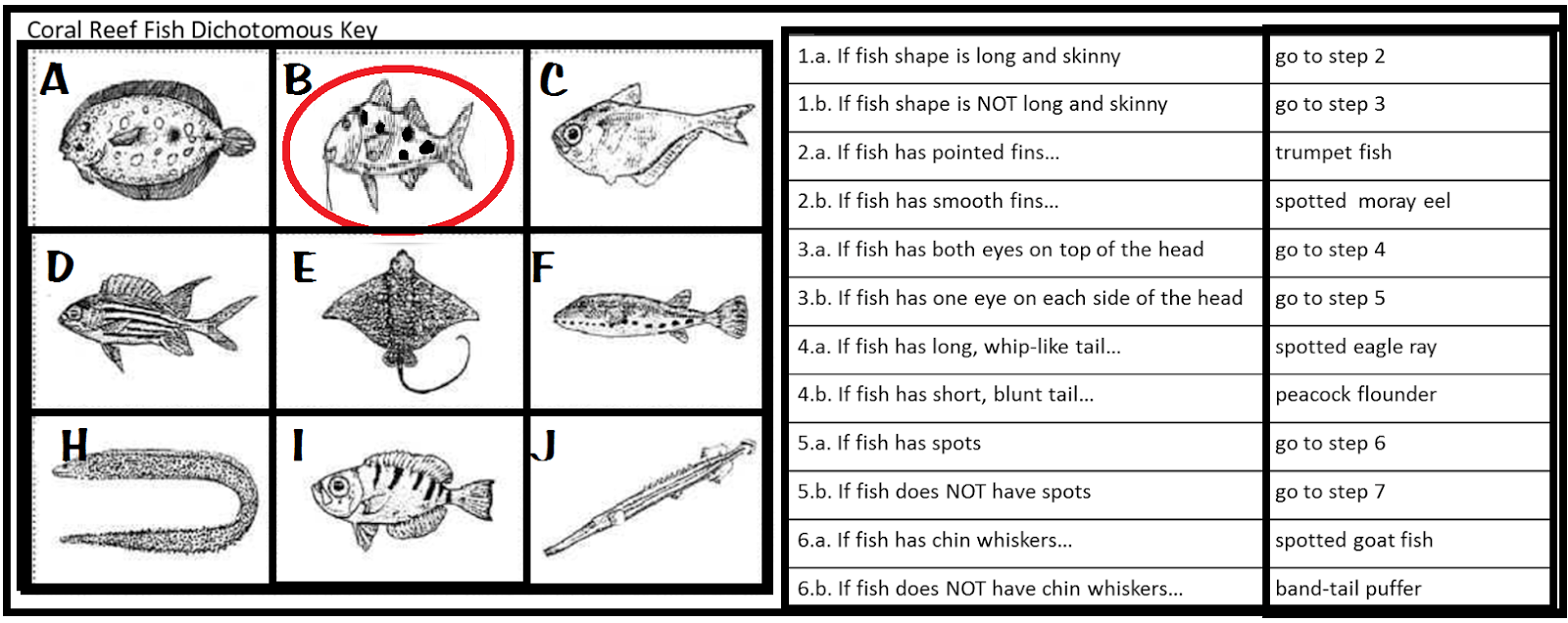
Using this dichotomous key, identity the name of the circled fish.
a)
band-tail puffer
b)
spotted goat fish
c)
peacock flounder
d)
trumpet fish
16.
True or False: All cells have DNA.
a)
True
b)
False
17.
What is the genus name here:
Canis lupus
a)
Canis
b)
lupus
18.

Animal cells can be distinguished from plant cells easily because of which of the following?

a)

Animal cells have mitochondria and plant cells do not.

b)

Plant cells have lysosomes and animal cells do not.

c)

Only plant cells have centrioles around their nucleus.

d)

Only plant cells have large central vacuoles and cell walls.

19.

What cell part is NOT found in all cells?

a)

Chloroplasts

b)

Cell Membrane

c)

Cytoplasm

d)

Nucleus

20.
What type of inheritance do two alleles have if their traits blend together? 
a)
Incomplete Dominance
b)
Co-Dominance
c)
Mendelian Inheritance
d)
Homozygous Inheritance
21.
This is an example of ___________?
a)
Incomplete dominance
b)
Co-Dominance
22.
Aa, DD, bB, yy are all examples of
a)
genotypes
b)
phenotypes
23.
What is the percentage of offspring that have green pods?
a)
100%
b)
75%
c)
50%
d)
25%
24.
What is the phenotype of the heterozygous parent in the punnett square?
a)
green
b)
yellow
c)
hybrid
d)
purebred
25.
Put in order smallest to largest:
a)
Chromosome - DNA - Gene
b)
Gene - DNA - Chromosome 
c)
DNA - Gene  Chromosome
d)
Chromosome - Gene  - DNA
26.

What genotype would go in box 1?

a)

AABb

b)

AABB

c)

aabb

d)

AaBb

27.

What genotype would go in box 3?

a)

AABb

b)

Aabb

c)

aabb

d)

AaBB

28.

What genotype would go in box 13?

a)

AaBb

b)

aabb

c)

AABB

d)

AAbb

29.
What causes genetic variation in meiosis?
a)
chromosomes lining up
b)
crossing over of chromosomes
c)
separation of chromosomes
d)
chromosomes pulling apart
30.
Which statement correctly describes meiosis?
a)
Cells divide only once.
b)
Meiosis does not occur in reproductive cells.
c)
The cells produced at the end of meiosis are genetically identical to the parent cell.
d)
The cells produced at the end of meiosis contain half the number of chromosomes as the parent cell.
31.
The result of meiosis is ______.
a)
two diploid cells
b)
two haploid cells
c)
four diploid cells
d)
four haploid cells
32.
Which process produces the most variation within a species? 
a)
mitosis
b)
cloning
c)
meiosis
d)
asexual reproduction
33.

What is the function of antibodies within the immune system?

a)

Antibodies kill off any antigen that enters the body.

b)

Antibodies are only made when you are given a vaccination for specific antigens.

c)

Antibodies bind to specific antigens to flag for destruction.

d)

Antibodies are part of an external defense mechanism.

34.

Which of the following statements are TRUE about vaccinations?

a)

Allow B cells to make antibodies for any type of antigen the body comes in contact with.

b)

Triggers the body to make memory cells for specific pathogens.

c)

They are substances prepared from killed or weakened pathogens.

d)

Always allows the body to resist an infectious disease any time it comes into contact with it.

35.

What happens after the second time you are exposed to a pathogen?

a)

The body will not be able to fight off the pathogen quickly, because it knows how to get into the body easier.

b)

The body's immune system will react the same was as it did during the first exposure.

c)

The body can only be exposed to a pathogen a second time if you do not have a vaccine.

d)

The body will know how to fight off the pathogen quickly, because memory cells have been created after the first encounter.

36.

How do T cells differ from B cells?

a)

T cells fight pathogens by killing pathogens directly, while B cells fight pathogens by making antibodies.

b)

T cells only make memory cells, and B cells only make antigens

c)

T cells fight pathogens by making antibodies, while B cells fight pathogens by killing pathogens directly.

d)

T cells can only fight off pathogens the body has encountered once, and B cells can fight off any pathogen the body comes across.

37.
A white blood cell that makes antibodies
a)
T cell
b)
bacteria
c)
B cell
d)
mast cell
38.

Another name for white blood cells is

a)

phagocytes

b)

leukocytes

c)

lymphocytes

d)

protozoa

39.
The two body systems that work together to protect you from foreign pathogens are...
a)
Integumentary and immune
b)
Reproductive and muscular
c)
Endocrine and digestive
d)
Respiratory and circulatory
40.
Protects our bodies from pathogens and fights disease
a)
Immune system
b)
Endocrine system
c)
Nervous system
d)
Circulatory system
41.

All _____ have DNA.

a)

Solid objects

b)

Human cells

c)

Living organisms

d)

Chemical compounds

42.

The genetic code is often referred to as blueprint of life. Which is correct about genetic code?

a)

Less complex organisms require additional sets of the genetic code.

b)

The nucleotide sequence of the genetic code is exact same for every organism.

c)

The genetic code for every living organism is made from the same component.

d)

Some simple organiosms do not have genetic code.

43.

All living organisms share the same DNA components. What makes each organism unique?

a)

The sequence of the nucleotides

b)

The double helix

c)

The amount of ATP

d)

The pattern of phosphates and sugars

44.

The sequence of nitrogenous bases in DNA varies widely. All organisms have the same nitrogenous bases. The sequence of bases in DNA is most important for which of the following?

a)

Providing the instructions for the traits of an organism.

b)

Preventing mutations for occurring during DNA replication

c)

Allowing the DNA to have the shape necessary for replication.

d)

Helping from the sugar-phosphate backbone of DNA molecules

45.
Who is the closest relative to the birds?
a)
crocodiles
b)
sharks
c)
fish
d)
amphibians
46.
The table shows some characteristics of four kingdoms.
Which characteristics would a taxonomist use to classify organisms as Archaebacteria or as Eubacteria?
a)
the internal organization of the cell
b)
the number of cells in an individual
c)
the chemical composition of the cell wall
d)
the nutritional requirements of the organism
47.
Heterotroph is when an organism...
a)
Has to eat other things
b)
has to make it's own food
48.
Multicellular means...
a)
an organism is made of many cells
b)
An organism is made of only one cell
c)
An organism is made of no cells
49.
Unicellular means...
a)
An organism is made of many cells
b)
An organism is made of one cell
c)
An organism is made of no cells
50.
Autotroph is when..
a)
An organism makes it's own food
b)
An organism has to eat other things
51.
Every time you see the word autotrophic, we are talking about______________.
a)
Animals 
b)
Fungi
c)
Plants
d)
Bacteria 
52.
Animas and bacteria both need to get energy from other organism. What is this called?
a)
Autotrophic 
b)
Heterotrophic 
c)
Carbon Dioxide 
d)
Plants 
53.

what kingdom?- eukaryotic, multi-celled-photosynthetic.

a)

animal

b)

plant

c)

protist

d)

fungi

54.

What kingdom-Prokaryotic-lives in hot,salts environments

a)

plants

b)

animals

c)

archaebacteria

d)

eubacteria

55.

What kingdom- eukaryotic-multi-celled-heterotrophic

a)

plant

b)

animal

c)

protista

d)

fungi

56.

What kingdom- prokaryotic-single celled-found on humans & other surfaces

a)

eubacteria

b)

archaebacteria

c)

protists

d)

fungi

57.
Which of the following best describes the overall structure of viruses?
a)
An outer protein coat and nucleic acid within the core.
b)
An outer carbohydrate coat and nucleic acid within the core.
c)
A protein tail and carbohydrate tail fibers.
d)
A carbohydrate tail and protein tail fibers.
58.

What is the first step to both cycles?

a)

The virus attaches to a host

b)

the virus injects genetic material

c)

the host gets sick

d)

the cell is destroyed

59.

When the viral DNA becomes active in the lysogenic cycle, which life cycle does it enter?

a)

lytic

b)

lysogenic

c)

cell cycle

d)

DNA replication

60.

What happens to cells when their membranes break apart?

a)

The virus dies

b)

The virus destroys and damages a host cell

c)

the capsid bursts

d)

the virus becomes dormant

61.
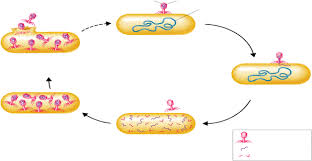
What is shown here?
a)
Lysogenic Cycle
b)
Lytic Cycle
c)
Binary Fission
d)
Conjugation
62.
What process is this?
a)
phagocytosis
b)
lytic cycle
c)
lysogenic cycle
d)
formation of antibodies
63.
What happens in the lysogenic cycle? 
a)
Virus goes in and leaves the host cell
b)
Virus quickly kills the host cell
c)
Virus inject the nucleic acid into the host cell, and the nucleic acid integrates into the host cell DNA, and stay dormant for a long time
d)
Bacteria injects DNA into a host cell
64.
Which biomolecule has sugars and starches?
a)
Lipids
b)
Proteins
c)
Carbohydrates
d)
Nucleic Acid
65.
Which biomolecule functions include enzymes­ which speeds the rate of chemical reactions, structural components in cells, mechanical functions in muscles and cytoskeleton, cell signaling, and immune response; provides structure and helps with chemical reactions 
a)
Protein
b)
Lipids
c)
Carbohydrate
d)
Nucleic Acid
66.
Which biomolecule is important source of energy for humans; glucose for human cells, tissues, and organs; provides fiber, sugar, and starches; provides structural support, cell wall, and cell membrane maker?
a)
Nucleic Acid
b)
Lipid
c)
Carbohydrate
d)
Protein
67.
Which biomolecule includes fats, such as triglycerides, oils, waxes, and steroids (cholesterol); insoluble in water; provides energy storage, insulation, part of cell membrane, and hormones 
a)
Nucleic Acid
b)
Lipids
c)
Carbohydrate
d)
Protein
68.
What is the monomer for a protein?
a)
Monosaccharide
b)
Triglyceride
c)
Amino Acid
d)
Nucleotide
69.
Lipids are made up of which of the following?
a)
glycerol and fatty acids tails
b)
glycerol and monolipids
c)
fatty acids and phosolipids
d)
amino acids and nucleotides
70.
What is the monomer of nucleic acids?
a)
Glycerol
b)
Monosaccharides
c)
Amino Acids
d)
Nucleotides
71.

An organism's reproductive cells, or sex cells, are called _____.

a)

bacteria

b)

prokaryotes

c)

gametes

d)

pathogens

72.
When can a mutation be passed on to offspring?
a)
only when the mutation is present during or occurs during mitosis
b)
only when the mutation is present during or occurs during meiosis
c)
when the mutation occurs during mitosis or meiosis
d)
when the mutation occurs in somatic cells
73.
What process occurs during meiosis that can result in chromosomal disorders?
a)
crossing over
b)
non-disjunction
c)
anaphase I
d)
prophase II
74.

What are the blood types of the possible children that a woman (type O) and man (type AB) can have?

a)

O and AB

b)

O and A

c)

O and B

d)

A and B

75.

There are multiple alleles for the ABO blood group. Why are only two of these alleles present in any one individual?

a)

Each parent contributes only one allele for the ABO blood group to the offspring.

b)

There are not enough nucleotides in a red blood cell to produce a third allele.

c)

Each allele in the ABO group must be dominant or recessive

d)

Blood group alleles are not segregated during meiosis.

76.

A personal with type AB blood has which genotype?

a)

type A

b)

AA

c)

IAIA

d)

IAIB

77.

Which term(s) best describes the inheritance of human blood types?

a)

incomplete dominance and multiple alleles

b)

codominance and epistasis

c)

codominance and multiple alleles

d)

incomplete dominance and codominance

78.

A man with type O blood is accused of being the father of a type B baby. The mother is type A. Could this man be the father?

a)

Yes

b)

No

79.
which process is shown?
a)
diffusion
b)
repiration
c)
recombination
d)
translation
80.
What is the relationship between a protein, the cell, and DNA?
a)
DNA is produced by protein which is produced in the cell
b)
Protein is composed of DNA which is produced in the cell
c)
DNA controls the production of protein in the cell
d)
A cell is composed of DNA and protein
81.
Which process?
a)
mutation
b)
transcription
c)
respiration
d)
translation
82.
What process is going on in this photo? 
a)
Transcription 
b)
Translation 
c)
Replication 
d)
All the above 
83.

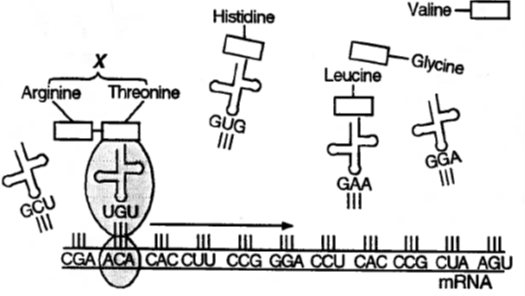
What process is happening in the diagram?

a)

transcription

b)

translation

c)

dna replication

d)

mitosis

84.

Each DNA molecule created contain one NEW strand and one OLD strand

a)

True

b)

False

85.
What is the purpose of DNA replication?
a)
Cut the DNA 
b)
Make more cells
c)
Apoptosis
d)
Duplicate the DNA
86.
What do we call DNA replication since new DNA has 1 parent strand and 1 new strand?
a)
Conservative 
b)
Semiconservative 
c)
Dispersive
87.
Why is it crucial that living things are able to replicate their DNA?
a)
Each cell must have its own DNA
b)
Less copies of DNA are needed when a new cell is created
c)
A cell needs multiple copies of DNA
d)
Only muscle cells need DNA 
88.

Which enzyme is responsible for checking DNA for errors, and fixing it?

a)

DNA Polymerase

b)

DNA Primase

c)

DNA Helicase

d)

RNA Polymerase

89.
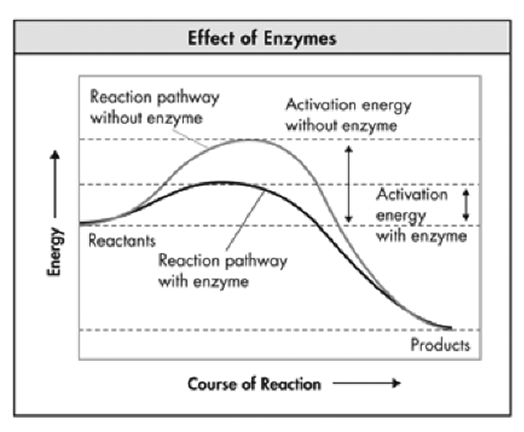
The graph shows how enzymes affect reactions in cells. Which statement best summarizes the information shown in the graph?
a)
Enzymes increase the energy of the reactants.
b)
Enzymes decrease the energy level of the products.
c)
Enzyme decrease the activation energy of the reaction.
d)
Enzymes reverse the direction of the reaction.
90.
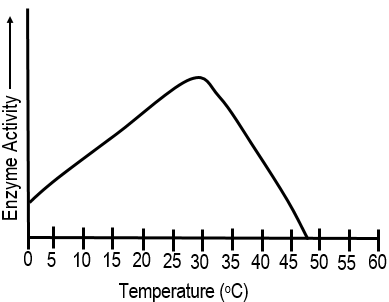
Based on the graph, what is the optimal temperature for this enzyme? 
a)
15oC
b)
40oC
c)
30oC
d)
35oC
91.
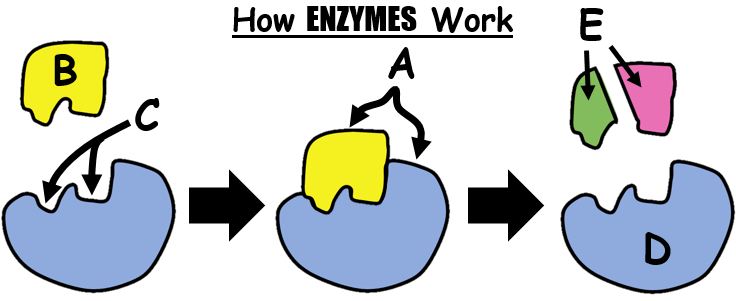
In the diagram, what is letter A? 
a)
product
b)
substrate
c)
enzyme-substrate complex
d)
active site
92.
Enzymes are...
a)
nucleic acids
b)
proteins
c)
lipids
d)
carbohydrates
93.
What is the function of an enzyme?
a)
enzymes break themselves into small pieces
b)
enzymes slow down chemical reactions
c)
enzymes speed up chemical reactions
d)
enzymes combine products to form reactants