
 Worksheets
Photosynthesis, Cellular Respiration, and Ecology EOC Review
Total questions: 89
Worksheet time: 2hrs 1mins
Name
Class
Date
1.
What is the function of autotrophs in the carbon cycle?
a)
to use oxygen to produce glucose
b)
to take in excess water
c)
to use carbon dioxide to produce glucose
d)
to feed on herbivores
2.
How does the amount of energy resulting from fermentation compare with that of aerobic respiration?
a)
Aerobic respiration results in less energy.
b)
Aerobic respiration results in more energy.
c)
Each process results in equal amounts of energy.
d)
Each process results in variable amounts of energy.
3.
In which organelle does photosynthesis occur?
a)
mitochondria
b)
ribosome
c)
xylem
d)
chloroplast
4.
The main source of energy for all life comes from ____.
a)
Plants
b)
ATP
c)
the Sun
d)
Glucose
5.
What are the products of photosynthesis? (What do plants produce?)
a)
Carbon dioxide and ATP
b)
Carbon dioxide and oxygen
c)
Glucose and oxygen
d)
Glucose and water
6.
Name the pigment that makes plants appear green:
a)
chloroplast
b)
ribosomes
c)
chlorophyll
d)
xylem & phloem
7.
The rate of photosynthesis is affected by all of the following except:
a)
the amount of salt.
b)
the availability of water.
c)
the availability of light.
d)
temperature (enzymes).
8.

Autotroph or heterotroph?
a)
Autotroph
b)
Heterotroph
9.
Which of the following carry out photosynthesis?
a)
birds
b)
algae
c)
humans
d)
mushrooms
10.

Autotroph or heterotroph?
a)
Autotroph
b)
Heterotroph
11.
Which gas is removed from the atmosphere during photosynthesis?
a)
hydrogen
b)
oxygen
c)
nitrogen
d)
carbon dioxide
12.
What is the purpose of the phloem in plants?
a)
To carry water up the plant from roots to leaves
b)
to carry nutrients down the plant
c)
to carry water down the plant
d)
to carry nutrients up the plant
13.
Plants need ________ for photosynthesis:
a)
oxygen
b)
soil
c)
carbon dioxide
d)
sugar
14.
What reactants are there in cellular respiration?
a)
Water and Glucose
b)
Oxygen and Glucose
c)
Carbon Dioxide and Water
d)
Twenty Jelly beans
15.
How many products are there in Cellular Respiration?
a)
17
b)
2
c)
3
d)
1
16.
What are the products of cellular respiration?
a)
Energy (ATP), Water, and Carbon DIoxide.
b)
Water and Oxygen
c)
Oxygen and Carbon Dioxide
d)
Water, Oxygen and Energy (ATP)
17.
What chemical reaction is the inverse of cellular respiration?
a)
Rusting
b)
Photosynthesis
c)
Combustion
d)
Symphonies
18.
Where does cellular respiration take place in the cell?
a)
Cell Membrane
b)
Nucleus
c)
Mitochondria
d)
Vacuole
19.
Another name for sugar is:
a)
ATP
b)
Energy
c)
Glucose
d)
CHOCOLATE!!
20.
Where is lactic acid produced?
a)
in muscles
b)
in bread
c)
in plants
d)
in cheese
21.
Which is not a product of cellular respiration?
a)
oxygen
b)
carbon dioxide
c)
water
d)
energy (ATP)
22.
Which organisms perform Photosynthesis?
a)
Only Autotrophs
b)
Only Heterotrophs
c)
Autotrophs and Heterotrophs
d)
Bacteria & Fungi
23.
Which of the following correctly describes the reactants involved in cellular respiration?
a)
oxygen and carbon dioxide
b)
carbon dioxide and glucose
c)
glucose and water
d)
oxygen and glucose
24.
Which of the following best describes cellular respiration?
a)
external breathing
b)
the breakdown of sugar to release energy in cells
c)
the movement of water from outside a cell to inside the cell
d)
the removal of water from a cell
25.

Which gas is filling the balloon in the experiment?
a)
Oxygen
b)
Carbon Dioxide
c)
Glucose
d)
Water
26.
The gopher snake uses its glottis to produce a hiss that sounds similar to a rattlesnake's rattle. What most likely reason a gopher snake would do this?
a)
to attract prey
b)
to attract a mate
c)
to confuse predators
d)
to increase adrenaline flow
27.
A population of salamanders that lice in a river require clear, fresh water to survive. A flood causes tons of sediment to be suspended in the river. Which of these most likely will happen to the salamander population?
a)
The salamanders will adapt to life on land
b)
The salamanders will move to another river
c)
The salamanders will adapt to living in the muddy water
d)
The salamanders will decrease in number because of the water quality
28.

A reduction in which of these would lead to a decrease in all other populations?
a)
Coyote
b)
Grass
c)
Grasshoppers
d)
Squirrel
29.
Which of these best explains the difference between the way animals and plants exchange gases with their environment?
a)
Animals use only photosynthesis, while plants use both photosynthesis and respiration
b)
Animals use only respiration, while plants use both photosynthesis and repiration
c)
Animals use both photosynthesis and respiration, while plants use only respiration
d)
Animals use both photosynthesis and respiration, while plants only use photosynthesis
30.
Which of these would lead to a lower rate of photosynthesis in a plant?
a)
an increase in the amount of oxygen in the air
b)
a decrease in the amount of oxygen in the air
c)
an increase in the amount of carbon dioxide in the air
d)
a decrease in the amount of carbon dioxide in the air
31.
A species of snake was introduced to a tropical region. Scientists then noticed a steady decline in the presence of a field mice and an increase in the number of snakes. Which of these is the most likely explanation about why the population size of each animal changed?
a)
The snakes introduced to the region dominated the habitat, forcing the mice to find another place to live
b)
The mice became prey to the introduced snakes, allowing the snake population to increase but decreasing the mice population
c)
The snakes introduced to the region competed with the mice for food, allowing the snake population to increase but decreasing the mice population
d)
The people in the surrounding are set traps that killed the mice, allowing the snakes to live without any predators and therefore to increase in number
32.
Which statement BEST describes an advantage of asexial reprofuction for a population of organisms?
a)
The population can increase in number more rapidly.
b)
the population can develop greater genetic diversity
c)
the population can maintain the same number of organisms
d)
the population can adapt more quickly to a changing environment
33.
How would a drop in temperature most likely affect the process of cellular respiration and photosynthesis?
a)
The rate of both would decrease
b)
the rates of both would remain constant
c)
the rate of PS would increase, the rate of CR would decrease
d)
the rate of PS would decrease, the rate of CR would increase
34.
Which abiotic factor limits the altitude at which plants can grow?
a)
the presence of a parasite
b)
the temperature of the area
c)
the presence of herbivorous animals
d)
the concentration of bacteria in the soil
35.
What will happen if an animal cell that has a solute concentration of 1% is placed in a 5% saltwater solution?
a)
It will shrink bacuse there is less water outside the cell
b)
it will burst because there is more water on the outside of the cell
c)
It will burst becuase there is more water inside the cell than outside
d)
It will remain the same size because there it an equal amount of water inside and outside the cell
36.
Which statement best describes the way DIFFERS from photosynthesis?
a)
Cellular respiration provides energy for the cell
b)
cellular respiration creates energy for the cell
c)
cellular respiration happens in the chloroplast
d)
Cellular respiration releases oxygen
37.

What do all of these organisms have in common?
a)
Universal genetic code
b)
Components that make up the genetic code
c)
Traits that are determined by genes that are translated into proteins
d)
Organisms have all of above in common
38.
What is the function of autotrophs in the carbon cycle?
a)
to use oxygen to produce glucose
b)
to take in excess water
c)
to use carbon dioxide to produce glucose
d)
to feed on herbivores
39.
Two different populations of birds live in the same area and eat the same types of food. Which most likely describes the relationship between these two populations of birds?
a)
competition
b)
mutualism
c)
parasitism
d)
predator-prey
40.
The yucca plant releases a strong scent at night when the yucca moth is active. The yucca moth, attracted by the scent, gathers pollen from the yucca flower. The yucca moth then deposits her eggs and the pollen on another plant. This ensures that the plant will be cross-pollinated and that the yucca moth larvae have a steady food supply. Which relationship does this best illustrate?
a)
commensalism
b)
mutualism
c)
parasitism
d)
predation
41.
Which environmental concern is most associated with burning fossil fuels?
a)
global climate change
b)
ozone layer destruction
c)
decrease in levels of atmospheric carbon dioxide
42.
1. Which substance is considered to be a factor affecting Earth’s ozone layer?
a)
chlorofluorocarbons
b)
ethyl alcohol
c)
nitrogen gas
d)
water vapor
43.

This graph represents changes in human population over a period of 2,000 years. What can be concluded from the graph?
a)
Human population grew at a constant rate over the last 2,000 years.
b)
Human population grew exponentially over the past 200 years
c)
Human population reached its carrying capacity around the year 1900
d)
Human population will begin to level off around 2010
44.
Which sequence shows increasing ecological levels of organization?
a)
organism, population, community, ecosystem
b)
ecosystem, population, organism, community
c)
community, ecosystem, population, organism
d)
population, organism, ecosystem, community
45.

What does a food web represent?
a)
All connections of energy flow throughout all organisms in a habitat.
b)
The specific ways that mutualism is carried out.
c)
A single pathway or energy flow between organisms.
d)
How carnivores get their food.
46.
Water temperature would be an example of ...
a)
A biotic factor
b)
An abiotic factor
47.
A collection of organisms that belong to different populations but all live in the same area and interact with one another.
a)
Population
b)
Ecosystem
c)
Community
d)
Ecosphere
48.
The energy at each trophic level in the pryamid of energy decreases by a factor of ____.
a)
10
b)
1
c)
100
d)
2
49.
A place where an organism lives.
a)
Terrain
b)
Habitat
c)
Community
d)
Population
50.
The living portions of the ecosystem.
a)
Biotic factors
b)
Abiotic factors
51.
Which of these could lead to global warming?
a)
recycling plastic
b)
conserving water
c)
deforestation
d)
bioaccumulation
52.

In an ecosystem, each trophic level receives energy from the level below it. What is the source of energy for the first trophic level?
a)
Energy is recycled to the first trophic level from all the higher levels
b)
The first trophic level receives a continuous supply of radiant energy from the sun
c)
The first trophic level produces energy without any input from the environment.
d)
the first trophic level converts nutrients in soil into energy.
53.

A population of elephants in a savannah ecosystem has reached its carrying capacity. Which statement best describes the population of elephants?
a)
the population has become too dense for the ecosystem to support
b)
the population will remain stable even if the ecosystem undergoes severe changes
c)
the population has grown to the largest size the ecosystem can support
d)
the population has decreased so much that it is in danger of not surviving.
54.
Choose the one item in the list which would NOT be an abiotic component of a wetland ecosystem.
a)
Water
b)
Air temperature
c)
Rocks
d)
Fish
55.
If worldwide deforestation is not regulated, what could most likely result?
a)
Acid rain could lower the pH of rivers and lakes to dangerous levels for aquatic life
b)
CO2 levels in the atmosphere could increase and contribute to global warming problems
c)
Plants and animals could become better adapted to living in desert conditions.
d)
Future generations of humans could have an excess of wood and paper products.
56.
Which of the following is an input of for cellular respiration?
a)
Glucose
b)
Water
c)
Sunlight
d)
Carbon Dioxide
57.
Do plants require carbon dioxide for photosynthesis?
a)
Yes
b)
No
c)
Sometimes
d)
Always
58.
Glucose enters cells through a protein. What do we call this?
a)
Facilitated Diffusion
b)
Diffusion
c)
Active Transport
d)
Osmosis
59.
Which of the following are likely to affect population growth?
a)
Number of Individuals in a Population
b)
Predators
c)
Disease
d)
All Affect Population Growth
60.
20 goats in 2 square miles. How many goats per square mile?
a)
10
b)
40
c)
2
d)
11
61.
100 Bengal tigers in 1000 square miles. How many Bengals per square mile?
a)
1
b)
10
c)
1/10 = .1
d)
1/100 = .01
62.
Which process of the carbon cycle removes carbon dioxide from the atmosphere?
a)
photosynthesis
b)
cellular respiration
c)
combustion of fossil fuels
d)
death and decomposing organisms
63.
What are the products of photosynthesis?
a)
glucose and oxygen
b)
glucose and carbon dioxide
c)
glucose and water
d)
water, carbon dioxide, and energy
64.
Which method would be most helpful in preventing eutrophication of lakes and waterways?
a)
recycling aluminum
b)
conserving fossil fuels
c)
reducing run-off from farms
d)
using less pesticide
65.
What type of growth is shown by the human population?
a)
Carrying capacity
b)
Logistical
c)
Exponential
d)
Stabilizing
66.

A team of ecologists observed feeding patterns of several populations in the desert. The energy pyramid shown below depicts the feeding patterns the ecologists observed. Which of the following best explains the difference in the amount of available energy in the trophic levels of the desert ecosystem?
a)
There is less energy available in the producers because their tissues are less dense than those at higher trophic levels.
b)
There is more energy available in the second trophic level because less energy is needed for hunting compared to the higher trophic levels.
c)
There is less available energy in the fourth trophic level because of the loss of energy through metabolism in each of the lower trophic levels.
d)
There is more available energy in the birds of prey because they have greater muscle mass for storing energy than organisms in lower trophic levels have.
67.
Organisms that makes its own food using sunlight or chemicals; producer
a)
decomposer
b)
autotroph
c)
heterotroph
d)
herbivore
68.

Identify a correct food chain that demonstrates the energy flow of this food web. (watch the arrows)
a)
Plant>Snail>Bluebird>Eagle
b)
Plant<Snail<Bluebird<Eagle
c)
Plant>Snail<Eagle>Bluebird
d)
Plant<Rabbit<Eagle
69.
In aquatic ecosystems, phytoplankton provide the energy for most food webs. Which organisms generally fulfill the same role in terrestrial (land) ecosystems?
a)
Fungi
b)
Bacteria
c)
Plants
d)
Animals
70.
Which is an example of an invasive species?
a)
rattlesnakes in the desert searching for prey
b)
the kudzu vine introduced to help prevent soil erosion
c)
bacteria decomposing dead organic matter in the soil
d)
algae that produces oxygen in fresh water
71.
The deer tick survives by feeding on the blood of deer. The animals are left with itchy bites and sometimes get Lyme disease as a result. How would a scientist most likely classify the deer tick?
a)
carnivore
b)
insectivore
c)
predator
d)
parasite
72.
Which is a limiting factor that is dependent on population size?
a)
disease
b)
human activity
c)
natural disasters
d)
weather patterns
73.
Which would result if two species shared the same niche at the same time?
a)
predation
b)
mutualism
c)
competition
d)
commensalism
74.

A population of foxes in a forest ecosystem has become stable, neither growing or becoming smaller. Which statement would best describe the population of foxes?
a)
the foxes are not dying or reproducing
b)
the fox population has reached its carrying capacity
c)
the foxes are moving into and out of the forest ecosystem
d)
the fox population has failed to change due to lack of food
75.

What Is This?
a)
Graph of predator-prey relationship
b)
Graph of relationship between CO2 and temperature
c)
Graph of mutualistic relationship between two species
d)
Graph of natural selection over time
76.

J-Shaped curves
a)
show a decline after an increase
b)
display populations that have reached carrying capacity
c)
represent exponential growth
d)
does not depend on the numbe rof resources
77.
Which process puts carbon dioxide back into the atmosphere?
a)
cellular respiration
b)
transpiration
c)
photosynthesis
d)
chemosynthesis
78.

A flower growing towards the light is an example of
a)
tropism
b)
kinesis
c)
learning
d)
emmigration
79.

What is the approximate population of men age 65-69 in the US in 2014? (see pyramid)
a)
7.5 million
b)
10.5 million
c)
5 million
d)
12 million
80.

anything that an organism needs to live, ex. food, water, space
a)
carrying capacity
b)
resource
c)
succession
d)
denitrification
81.

a species that takes over to live in an area where no other living thing lives and that starts a cycle in which many other species make that area the place where they live
a)
pioneer species
b)
succession
c)
nitrogen fixation
d)
cellular respiration
82.

the process by which a new community replaces another community that has been partially ot totally destroyed
a)
exponential growth
b)
primary succession
c)
secondary succession
d)
succesion
83.

the replacement of one type of community by another at a single place over a period of time
a)
succession
b)
symbiosis
c)
secondary succession
d)
mutualism
84.

the process by which a new community forms where no community lived before
a)
resource
b)
invasive (non- native) species
c)
primary succession
d)
competition
85.
Two organisms that are so similar they can interbreed in nature and produce fertile offspring
a)
biotic factor
b)
herbivore
c)
ecosystem
d)
species
86.
A collection of organisms that make up a community as well as all of the nonliving aspects of the environment.
a)
Population
b)
Community
c)
Habitat
d)
Ecosystem
87.
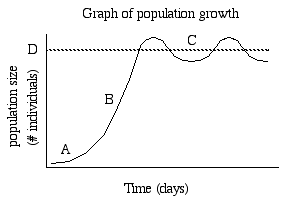
Which point on the graph represents carrying capacity?
a)
A
b)
B
c)
C
d)
D
88.
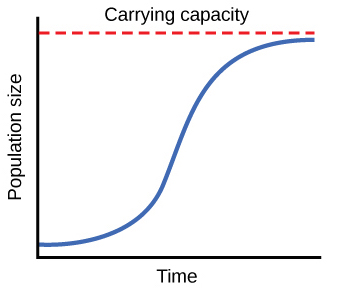
__________ growth shows growth of a population under environmental constraints (carrying capacity) that sets a maximum population size
a)
logistic
b)
exponential
c)
niche
d)
uniform
89.
The North American gray wolf is a placental mammal and the Tasmanian wolf was a marsupial. Despite being on different continents, they look and behave similarly. The most likely reason these two species occupy a similar niche is ___.
a)
They experienced the same type of selection pressure
b)
They are both carnivores
c)
They were exposed to similar diseases and parasites
d)
They are genetically identical
100 %

