
 Worksheets
Mills Biology Final Review
Total questions: 92
Worksheet time: 1hrs 26mins
Name
Class
Date
1.
Having two of the same genes for the trait (TT, tt); Both dominant or both recessive.
a)
homozygous or purebred
b)
heterozygous or hybrid
c)
twin offspring
d)
pairs of chromosomes
2.
Which of the following alleles is homozygous (purebred) recessive?
a)
Tt
b)
tt
c)
TT
d)
t
3.
Dominant alleles are represented by a:
a)
Male gene
b)
lowercase letter
c)
recessive trait
d)
capital letter
4.
Two brown eyed parents (Bb) have a baby. What is the chance the baby is blue eyed?
a)
0 %
b)
25%
c)
50%
d)
75%
5.
Which of the following is a phenotype?
a)
Aa
b)
red hair
c)
heterozygous genes
d)
mutated DNA
6.
Aa is
a)
homozygous (purebred)
b)
heterozygous (hybrid)
7.
In a heterozygous genotype, the ___________ allele takes over in the phenotype.
a)
recessive
b)
dominant
c)
lower case letter
d)
both
8.
G = green, g = yellow
The genotype for a yellow plant is...
The genotype for a yellow plant is...
a)
GG
b)
Gg
c)
gg
d)
all of the choices result in yellow
9.
the passing of genetic traits from parent to offspring.
a)
heredity
b)
trait
c)
gene
d)
allele
10.
What gender has an X and a Y chromosome?
a)
male
b)
female
c)
transgender
d)
all of the above
11.

Who is considered the "father of genetics"?
a)
Gregor Mendel
b)
Reginald Punnett
c)
James Watson
d)
Justin Bieber
12.
The scientific study of heredity is ____.
a)
Genetics
b)
Punnett squares
c)
Inheritance
d)
Biology
13.

What you see, or the physical appearance.
a)
Genotype
b)
Phenotype
c)
Homozygous
d)
Heterozygous
14.

T - tall and t = short
In the punnett square below, what belongs in the missing square
In the punnett square below, what belongs in the missing square
a)
tt
b)
Tt
c)
Bb
d)
TT
15.
A human usually has _____ total chromosomes.
a)
6
b)
22
c)
4
d)
46
16.

This type of inheritance pattern is a MIXTURE of both traits.
a)
incomplete dominance
b)
co-dominance
c)
complete dominance
d)
recessive pattern
17.

This type of inheritance pattern shows BOTH traits in possible offspring
a)
complete dominance
b)
incomplete dominance
c)
co-dominance
d)
dominant pattern
18.

Which process and type of resulting cells are represented?
a)
mitosis, gametes
b)
mitosis, body cells
c)
meiosis, gametes
d)
meiosis, body cells
19.
Which of the following cell types is formed by meiosis?
a)
muscle cells
b)
skin cells
c)
sperm cells
d)
blood cells
20.

Which cellular process is shown?
a)
meiosis
b)
endocytosis
c)
mitosis
d)
phagocytosis
21.
Which statement correctly describes meiosis?
a)
cells divide only once
b)
meiosis does not occur in reproductive cells
c)
the cells produced at the end of meiosis are genetically identical to the parent cell
d)
The cells produced at the end of meiosis contain half the number of chromosomes as the parent cell
22.

Which best describes the process shown?
a)
mutation in which the DNA content of the gene is ltered
b)
segregation of sister chromatids
c)
condensation and segregation of the alleles
d)
crossing-over which alleles are exchanged
23.
If an intestinal cell in a butterfly contains 24 chromosomes, a butterfly egg would contain
a)
3
b)
6
c)
12
d)
24
24.
The scrotum belongs to which reproductive system
a)
Male
b)
Female
c)
Both
25.
Epididymis belongs to which reproductive system?
a)
Male
b)
Female
c)
Both
26.
The penis belongs to which reproductive system?
a)
Male
b)
Female
c)
Both
27.
The cervix belongs to which reproductive system?
a)
Male
b)
Female
c)
Both
28.
The seminal vesicles belong to which reproductive system
a)
Male
b)
Female
c)
Both
29.
The vas deferens belongs to which reproductive system
a)
Male
b)
Female
c)
Both
30.
The fallopian tubes belongs to which reproductive system
a)
Male
b)
Female
c)
Both
31.
The ovaries belongs to which reproductive system
a)
Male
b)
Female
c)
Both
32.
The testes belongs to which reproductive system
a)
Male
b)
Female
c)
Both
33.
The purpose of the urethra in a male is to
a)
carry only urine
b)
carry only semen
c)
carry a mixture of semen and urine
d)
carry both semen and urine but not at the same time.
34.
Glands that produce the egg cells and hormones
a)
ovaries
b)
testes
c)
fallopian tubes
d)
scrotum
35.
After the egg leave the fallopian tube, it enters the
a)
vagina
b)
uterus
c)
ovaries
d)
ovum
36.
Where do the egg and sperm meet
a)
The ovary
b)
The fallopian tube
c)
The vas deferens
d)
At a party
37.
Which organ produces egg cells?
a)
The vagina
b)
The fallopian Tubes
c)
The uterus
d)
The ovaries
38.
The correct path of the egg is: ovary, fallopian tube, uterus, vagina
a)
true
b)
false
39.
Which organ stores sperm cells?
a)
Testes
b)
Epididymis
c)
Penis
40.
Which organ produces sperm cells?
a)
testes
b)
epididymis
c)
ovary
d)
prostate gland
41.
What reactants are there in cellular respiration?
a)
Water and Glucose
b)
Oxygen and Glucose
c)
Carbon Dioxide and Water
d)
Twenty One Pilots
42.
What are the products of cellular respiration?
a)
Energy (ATP), Water, and Carbon DIoxide.
b)
Water and Oxygen
c)
Oxygen and Carbon Dioxide
d)
Water and Energy (ATP)
43.
Where does cellular respiration take place in the cell?
a)
Cell Membrane
b)
Nucleus
c)
Mitochondria
d)
Vacuole
44.
Anaerobic respiration.....
a)
doesn't require CO2
b)
requires CO2
c)
doesn't require oxygen
d)
requires oxygen
45.
Cellular Respiration's goal is to?
a)
make water
b)
make ATP
c)
make glucose
d)
make oxygen
46.
How much ATP does cellular respiration ideally make?
a)
2 ATP
b)
0 ATP
c)
10 ATP
d)
36 ATP
47.
What process occurs in the cytoplasm?
a)
photosynthesis
b)
electron transport chain
c)
glycolysis
d)
krebs cycle
48.
Krebs cycle is known as what.......
a)
photosynthesis
b)
Carbon cycle
c)
calvin cycle
d)
citric acid cycle
49.
Which of the following aren't 3 forms energy?
a)
FADH
b)
NADH
c)
oxygen
d)
ATP
50.
Where is lactic acid produced?
a)
in muscles
b)
in bread
c)
in plants
d)
in cheese
51.
Fermentation is cellular respiration without which molecule?
a)
CO2
b)
O2
c)
C6H12O6
52.

1. What is the ability to do work?
a)
Energy
b)
Kinetic energy
c)
Potential energy
d)
Energy forms
53.
What do all cells use for energy?
a)
Carbs
b)
Protein
c)
Fat
d)
ATP
54.
How is energy released from ATP?
a)
adding a phosphate
b)
making a new bond
c)
removing the 3rd phosphate
d)
adding a protein
55.
What does the "TP" in ATP stand for?
a)
2 phosphates
b)
tri (3) phosphates
c)
Two proteins
d)
tri (3) proteins
56.
During which step of cellular respiration is the majority of the ATP created?
a)
fermentatio
b)
glycolysis
c)
Krebs Cycle
d)
ETC
57.
Which of the following things does a nucleotide NOT contain?
a)
a sugar
b)
a nitrogen base
c)
a phosphate
d)
a polymerase
58.
Which of the following is a base that is NOT contained in DNA?
a)
Adenine
b)
Thymine
c)
Uracil
d)
Guanine
59.
Which of the following does NOT describe the structure of DNA?
a)
double helix
b)
nucleotide polymer
c)
sugar-phosphate backbone
d)
contains adenine-uracil pairs
60.
Chargraff's Rule says that
a)
Adenine will be equal to Thymine
b)
Cytosine will be equal to Thymine
c)
Uracil will be equal to Guanine
d)
Adenine will be equal to Cytosine
61.
DNA is copied during
a)
Translation
b)
Transcription
c)
Reproduction
d)
Replication
62.
The enzyme that unzips the DNA to prepare for replication
a)
helicase
b)
replicase
c)
polymerase
d)
synthase
63.
DNA replication results in two DNA molecules,
a)
each one with two original strands
b)
each one with two new strands
c)
each one with one new strand and one original strand
d)
one with two new strands and the other with two original strands
64.
DNA and RNA are macromolecules in the category of
a)
Proteins
b)
Lipids
c)
Nucleic Acids
d)
Carbohydrates
65.
DNA is a polymer made of monomers called
a)
Nucleotides
b)
Proteins
c)
Amino Acids
d)
Lipids
66.
What does DNA stand for?
a)
Ribonucleic Acid
b)
Deoxyribonucleic Acid
c)
Both of these
d)
None of these
67.
What is the structure of DNA?
a)
A single helix
b)
Nitrogen bases
c)
A double helix
d)
It has no structure
68.
When do the chromosomes condense and become visible?
a)
Metaphse
b)
Telophase
c)
Anaphase
d)
Prophase
69.
What holds the two sides of the DNA ladder together?
a)
Ionic bonds
b)
Hydrogen bonds
c)
Covalent bonds
d)
Van der waals
70.
Fill in the complementary bases according to the base-pair rule in DNA: A T C C A G
a)
T U G G T C
b)
T A G G T C
c)
T A C G T G
d)
T A C C A C
71.
What part of the cell cycle is the DNA in a cell's nucleus replication?
a)
Prophase
b)
Metaphase
c)
Interphase
d)
Telophase
72.

DNA codes for...
a)
cholesterol
b)
proteins
c)
fatty acids
d)
a sandwich
73.

Name this structure
a)
double helix
b)
nucelotide
c)
twisted ladder
d)
hydrogen bond
74.
Guanine bonds with ______________.
a)
Adenine
b)
Guanine
c)
Cytosine
d)
Thymine
75.
Adenine bonds with ______________.
a)
Guanine
b)
Thymine
c)
Cytosine
d)
Adenine
76.
What sugar is in DNA?
a)
deoxyribose
b)
ribose
c)
oxyribose
d)
deoxyose
77.
The backbone of a DNA molecule is made of which two components?
a)
phosphate molecules and ribose sugars
b)
deoxyphosphate molecules and ribose sugars
c)
phosphate molecules and deoxyribose sugars
d)
deoxyphosphate molecules and deoxyribose sugars
78.
What type of RNA carries the DNA message out of the nucleus to the ribosomes?
a)
mRNA
b)
tRNA
c)
rRNA
79.
What do we call the process of turning DNA into mRNA?
a)
replication
b)
transcription
c)
translation
80.
when DNA is transcribed to RNA....
a)
A pairs with U
b)
G pairs with U
c)
C pairs with T
d)
A pairs with C
81.
Amino acids are the building blocks of...
a)
atoms
b)
DNA
c)
proteins
d)
a loving relationship
82.
When translating mRNA to amino acids, you work in triplet codons, which are sets of...
a)
1
b)
2
c)
3
d)
4
83.
How many amino acids are coded for by this sequence of nucleotides:
ATG GGA ACT CCA
ATG GGA ACT CCA
a)
4
b)
2
c)
6
d)
12
84.

Which phase of which process does this picture show?
a)
Transcription
b)
Translation
c)
Replication
85.
The job of tRNA is to
a)
carry amino acids to the ribisomes
b)
carry ribisomes to the ER
c)
carry glucose to mitochondria
d)
carry mRNA out of the nucleus
86.
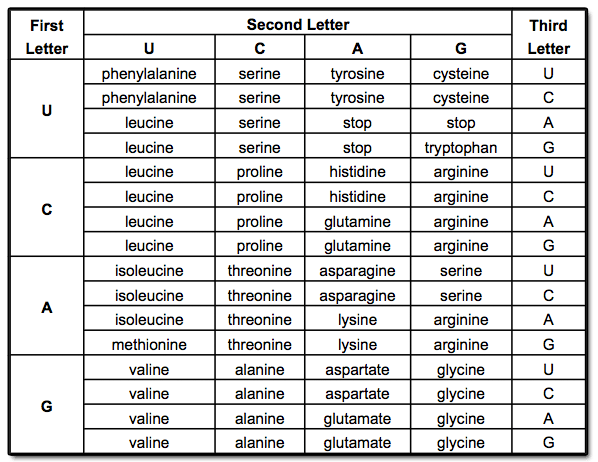
What is the correct amino acid sequence for the mRNA code AUGCCAGUAUGA
a)
Met-Pro-Ala-Val
b)
Met-Pro-Val
c)
Tyr-Gly-His
d)
Tyr-Gly-Arg-His
87.

Who is responsible for producing this image?
a)
Francis Crick
b)
James Watson
c)
Rosalind Franklin
d)
Watson and Crick
88.
Which two nucleotides are classified as pyrimidines?
a)
Adenine and Thymine
b)
Thymine and Guanine
c)
Thymine and Cytosine
d)
Cytosine and Guanine
89.

What is occurring in this picture?
a)
Translation
b)
DNA Replication
c)
Polymerase is unzipping the DNA
d)
Transcription
90.
In messenger RNA, each codon specifies a particular...
a)
Nucleotide
b)
Enzyme
c)
Amino Acid
d)
Promoter
91.
what does rRNA do?
a)
carry info from genes to ribosomes
b)
carry amino acids to ribosomes
c)
help with RNA splicing
d)
make up ribosomes
92.
Which type of RNA contains the codons?
a)
mRNA
b)
tRNA
c)
all RNA
d)
rRNA
100 %

