wayground logo

Free Printable Worksheets

Font size

S
M
L
XL
Worksheets

Ch 1 & 2 - Scientific Method & Biochemistry

Total questions: 91

Worksheet time: 2hrs 31mins

Name
Class
Date
1.

Students were investigating some properties of rocks. They wanted to compare the volumes of the rocks.


Which tool should the students use to accurately measure the volume of each rock?

a)
b)
c)
d)
2.

A scientist investigates the effect of carbon dioxide on plant height. The scientist grows plants in several closed containers. All the plants receive the same amounts of water and light, but the air in each container has a different amount of carbon dioxide. What is the independent variable in this experiment?

a)

the amount of carbon dioxide in each container

b)

the number of plants in each container

c)

the amount of water provided to the plants

d)

the height of each plant after a period of time

3.

Some researchers are developing a new fertilizer designed to improve the growth of plants in hot, dry climates. The fertilizer was applied to one hundred desert plants in a greenhouse. The average daytime temperature in the greenhouse was 90°F, and the humidity levels were low. Which is best for the researchers to do next?

a)

A compare plants that received fertilizer to similar plants that received none

b)

B begin selling the fertilizer to gardeners living in hot, dry climates

c)

C change the conditions in the greenhouse and retest the fertilizer

d)

D test the fertilizer on plants that are adapted to cooler climates

4.

The students concluded that the plants grown indoors grew faster because they received better quality light than the plants grown outdoors. Which is the most likely reason this conclusion may be flawed?

a)

The students measured the plants at different times.

b)

The students should have grown different types of plants.

c)

The growth of the plants in each set was affected by more than one factor.

d)

The outdoor plants grew faster than the indoor plants.

5.

Students in a science class plan to investigate a factor that affects the rate at which a pendulum swings.


In which way should the students manipulate the variables to get valid results in this investigation?

a)

use equal string lengths and different plumb bob masses

b)

use different string lengths and different plumb bob masses

c)

use equal string lengths and the same plumb bob shapes

d)

use different string lengths and different plumb bob shapes

6.

Information recorded in your experiment which is used to draw a conclusion is called

a)

reliable

b)

data

c)

hypothesis

d)

observation

7.

Which of the following are an important reason to do repeated trials?

a)

reliable

b)

accurate

c)

valid results

d)

reliable, accurate, and valid results

8.

The change that is tested in an experiment.

a)

hypothesis

b)

data

c)

variable

d)

observation

9.

Uses your senses to gather information.

a)

observation

b)

variable

c)

hypothesis

d)

data

10.

The general steps used when conducting an experiment.

a)

observation

b)

variable

c)

hypothesis

d)

scientific method

11.

A written explanation of what you think will happen, an idea that is tested in an experiment, and may be proven to be true.

a)

observation

b)

variable

c)

hypothesis

d)

data

12.

Study of the natural world through observation and investigation.

a)

Science

b)

Hypothesis

c)

Experiment

d)

Flying monkeys

13.

A plan on how you will conduct your experiment

a)

Data

b)

Procedures

c)

Monkeys

d)

Hypothesis

14.

Is something that is kept the same, remaining unchanged in an experiment.

a)

Control

b)

Variable

c)

Data

d)

P, B, & J

15.

Is a procedure carried out under controlled conditions to test a hypothesis.

a)

Science

b)

Watching YouTube

c)

Experiment

d)

Hypothesis

16.

The variable that you are measuring in the experiment (this is where your quantitative data comes from).

a)

independent variable

b)

dependent variable

c)

controlled variable

17.

Data that includes numbers (measurements and amounts).

a)

qualitative data

b)

quantitative data

18.

Data that does not include numbers, but describes things instead.

a)

qualitative data

b)

quantitative data

19.

Which step of the scientific method is this example-

After consistent results, I found that water increases in volume when it freezes.

a)

question

b)

hypothesis

c)

experiment

d)

data

e)

conclusion

20.

Biology is the study of _____________________.

a)

Bicycles

b)

Insects

c)

Life

d)

Plants

21.

Things that have all the characteristics of life are known as

a)

Environments

b)

Stimulus

c)

Species

d)

Organisms

22.

Reproduction is the ability to ______________________.

a)

breath in oxygen.

b)

grow taller than other species.

c)

make more of the same type of organism.

d)

live longer than other species.

23.

Who is responsible for making sure safety procedures are followed when conducting an experiment?

a)

Your parents

b)

The teacher

c)

Anyone doing an experiment

d)

Your doctor

24.
A plant growing towards the light is an example of 
a)
reproduction.
b)
responding to a stimuli.
c)
metabolism.
d)
homeostasis.
25.
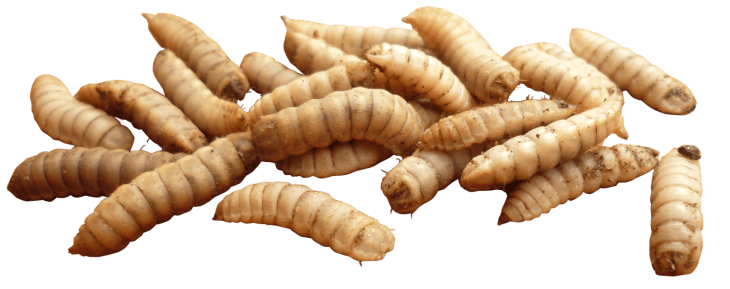
A maggot changing into a fly is an example of 
a)
reproduction.
b)
growth and development.
c)
homeostasis.
d)
evolution.
26.
The maintenance of an organism’s internal environment is called:
a)
compensating
b)
homeostasis
c)
balancing
d)
routine
27.
An amoeba is a unicellular organism. Which characteristic of life is this?
a)
All living things use energy
b)
All living things contain cells
c)
All living things respond to their environment
d)
All living things grow
28.
Rocks are not living because
a)
they never move
b)
they aren't needed for humans
c)
they are not made of cells
d)
they don't break down
29.
 All organisms contain instruction molecules that help determine which traits the organism will have is an example of 
a)
universal genetic code (DNA/RNA)
b)
metabolism
c)
evolution
d)
growth and development
30.
Water is classified as an inorganic compound because it
a)
does not contain carbon
b)
does not contain nitrogen
c)
contains hydrogen
d)
contains oxygen
31.
Which substance plays a major role in most of the chemical reactions that occur in a living cell?
a)
water
b)
glycogen
c)
glycerol
d)
maltose
32.
Which statement describes all enzymes?
a)
They control the transport of materials.
b)
They provide energy for chemical reactions.
c)
They affect the rate of chemical reactions.
d)
They absorb oxygen from the environment.
33.
The distortion (change in shape) of enzyme molecules which occurs at high temperatures is known as
a)
synthesis
b)
specificity
c)
replication
d)
denaturation
34.
An energy-rich organic compound needed by organisms is
a)
water
b)
salt
c)
oxygen
d)
glucose
35.
Two examples of carbohydrates are
a)
fatty acids and glycerol
b)
fats and waxes
c)
sugars and starches
d)
amino acids and alcohol
36.
What is the major component of plasma membranes?
a)
lipids
b)
carbohydrates
c)
nucleotides
d)
proteins
37.
The basic building blocks of a protein are
a)
glucose molecules
b)
amino acids
c)
hormones
d)
fats
38.
In the reaction illustrated in the diagram below, which structure represents the enzyme?
a)
A
b)
B
c)
C
d)
D
39.
In which type of molecule is the ratio of hydrogen to oxygen usually 2 to 1?
a)
lipid
b)
protein
c)
carbohydrate
d)
glycerol
40.
Vegetable oils, such as corn oil, belong to which general class of organic substances?
a)
lipids
b)
proteins
c)
carbohydrates
d)
salts
41.
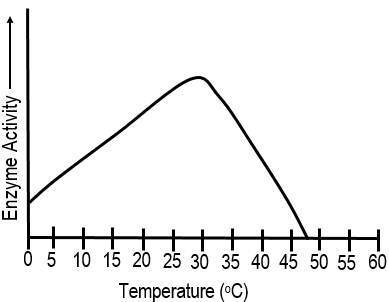
Based on the graph, what temperature does this enzyme work best? 
a)
15 C
b)
40 C
c)
30 C
42.
Which of the following binds to the active site of an enzyme? 
a)
substrate
b)
product
c)
codon
d)
none of the above
43.
Letter C...
a)
active site
b)
enzymes
c)
substrate
d)
products
44.
Enzymes are
a)
nucleic acids
b)
proteins
c)
lipids
d)
carbohydrates
45.
Which of the following is NOT a biomolecule?
a)
Water
b)
Nucleic Acid
c)
Protein
d)
Lipid
46.
Identify the biomolecule
a)
Lipid
b)
Protein
c)
Carbohydrate
d)
Nucleic Acid
47.
In the picture, which represents a fatty acid?
a)
F
b)
G
c)
H
d)
J
48.
Carbohydrates are more easily metabolized than lipids. However, on a gram-for-gram basis lipids provide cells with more-
a)
nitrogen
b)
proteins
c)
structure
d)
energy
49.
Which biomolecule contains Deoxyribonucleic acid; a sequence of bases that makes hereditary code; Ribonucleic acid; ­translate hereditary code into proteins that determine how the cell will function under various conditions; provides storage and retrieval of information­; encode genes, gene expression, helps make proteins 
a)
Nucleic Acid
b)
Lipid
c)
Carbohydrate
d)
Protein
50.
A monosaccharide is a:
a)
nucleic acid
b)
lipid
c)
carbohydrate
d)
protein
51.
The process used to split polymers; this is done by adding water
a)
Dehydration
b)
Hydrolysis
c)
Enzomatic
d)
Tetratonic
52.
The process/reaction used to link compounds/monomers together.  Releases water.
a)
Dehydration
b)
Hydrolysis
c)
Enzomatic
d)
Tetratonic
53.
Which macromolecule is shown?
a)
lipid
b)
protein
c)
nucleic acid
d)
carbohydrate
54.
Carbohydrates are made of... 
a)
C H O
b)
C H O N
c)
C H O N P
d)
C H O N S
55.
How many different amino acids are there?
a)
4
b)
20
c)
6
d)
46
56.
True of False. Glycogen is a starch that is found in animals. 
a)
True
b)
False
57.
What do disaccharides, such as sucrose, and polysaccharides, such as starch, have in common?
a)
They are lipids made of fatty acids.
b)
They are proteins made of amino acids.
c)
They are nucleic acids made of nucleotides.
d)
They are carbohydrates made of simple sugars.
58.
The building blocks of nucleic acids are called ...
a)
amino acids
b)
nucleotides
c)
carbohydrates
d)
proteins
59.
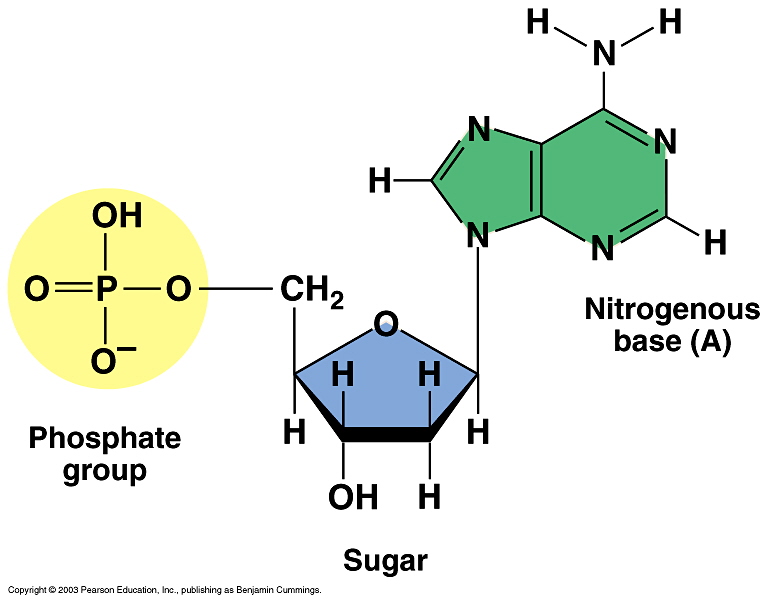
Nucleotides are made up of three parts. The three parts are...
a)
DNA, RNA, and a sugar
b)
a lipid, a fat, and an oil
c)
a carbohydrate, a protein, and a fat
d)
a sugar, a phosphate, and a base
60.
Which of the following elements make up nucleic acids?
a)
C, H, O
b)
C, H, O, N
c)
C, H, O, N, P
d)
C, H, O, Ca, S
61.

The bond that joins two amino acids together

a)

double bond

b)

hydrogen bond

c)

ionic bond

d)

peptide bond

62.
Which of the following is an organic compound?
a)
H2O
b)
C6H12O6
c)
NH2
d)
OH
63.
Enzymes are _________ that __________ chemical reactions.
a)
proteins, slow down
b)
proteins, speed up
c)
lipids, slow down
d)
lipids, speed up
64.
With what 3 letters do enzymes typically end?
a)
-ose
b)
-ase
c)
-ese
d)
-tic
65.
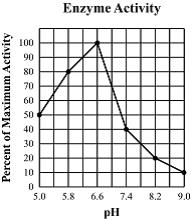
Which of the following conclusions can be drawn from this graph?
a)
The optimum pH of the enzyme is 6.6.
b)
The optimum pH of the enzyme is 5.8
c)
The enzyme’s activity increases as pH increases 5.0 to 9.0
d)
The enzyme’s activity is greater around pH of 8.0 .
66.
What property of water makes it the 'universal solvent'?
a)
it is a polar molecule
b)
it is an ionic compound
c)
it contains hydrogen bonds
d)
it steals electrons from other atoms
67.
The type of polysaccharide which serves as a strengthening tissue in the cell wall of plants is 
a)
cellulose
b)
glucose
c)
lactose
d)
fructose
68.
The primary purpose the body uses monosaccharides for is?
a)
Building muscles
b)
Helping the Immune System
c)
Immediate Energy
d)
Generating Heat
69.
Which of the following is LEAST likely to dissolve in water?
a)
nonpolar fats and oils
b)
polar sugar molecules
c)
salt made of a positive sodium ion and a negative chloride ion
d)
all of the substances will dissolve easily in water
70.
Building blocks of polymers.
a)
monomer
b)
polypeptide
c)
monosaccharide
d)
glycerol
71.
Attractions between water molecules are called
a)
Covalent bonds
b)
Ionic bonds
c)
Polar bonds
d)
Hydrogen bonds
72.
Types of disaccharides include following except for?
a)
Maltose
b)
Glucose
c)
Sucrose
d)
Lactose
73.

All living things on Earth use which element as the "backbone" of their molecules?

a)

Oxygen

b)

Hydrogen

c)

Nitrogen

d)

Carbon

74.

What kind of bond forms when atoms SHARE electrons?

a)

ionic

b)

covalent

c)

artificial

d)

Hydrogen

75.

Which letter represents the partially negative end?

a)

A

b)

B

c)

C

d)

D

76.

The attraction of water molecules to other water molecules.

a)

adhesion

b)

capillarity

c)

cohesion

d)

density

77.
A(n) ______ is a substance with a pH less than 7
a)
Acid
b)
Alkaline
c)
Base
d)
Buffer
78.

A base is a substance that

a)

releases Hydroxide ions when dissolved in water

b)

releases Hydrogen ions when dissolved in water

c)

does not release any ions when dissolved in water

79.

The enzyme known as catalase breaks down hydrogen peroxide molecules into separate water and oxygen molecules. During this reaction, what happens to the catalase?

a)

It becomes the products O2 and H20

b)

It is fully used up and discarded

c)

It remains unchanged

d)

It changes from catabolic to anabolic

80.

When an enzyme gets denatured, it

a)

slows down

b)

speeds up

c)

changes to a different chemical reaction

d)

gets permanently deformed and stops working

81.
How many valence electrons are present in Carbon?
a)
6
b)
4
c)
3
d)
8
82.
Atoms that have the same number of protons but differ in the amount of neutrons are called:
a)
Ions
b)
Isotopes
c)
Noble Gases
d)
Actinides
83.
NaCl is an example of a _____________ compound
a)
Ionic 
b)
Polar
c)
Non-Polar
d)
Organic
84.
Atoms that have gained or lost electrons are called:
a)
Ions
b)
Isotopes
c)
Isomers
d)
Neutrinos
85.

The basic unit of matter is...

a)

atom

b)

proton

c)

neutron

d)

electron

86.
What particles are found in the nucleus of an atom?
a)
electron and proton
b)
proton and neutron
c)
electron and neutron
87.
The _____________ is the positively charged particle in an atom.
a)
proton
b)
neutron
c)
electron
88.
The _____________ is the negatively charged particle in an atom.
a)
proton
b)
neutron
c)
electron
89.
The _____________ is the particle in an atom that has no charge.
a)
proton
b)
neutron
c)
electron
90.
The particle involved in chemical reactions is the
a)
proton
b)
neutron
c)
electron
91.

How many bonds can one carbon atom make?

a)

4

b)

3

c)

1

d)

unlimited