
 Worksheets
Genetics/Immunity/Populations
Total questions: 86
Worksheet time: 32mins
Name
Class
Date
1.

Based off this punnett square, what fraction of the offspring will have wrinkled, yellow seeds?
a)
9/16
b)
3/16
c)
1/16
d)
16/16
2.
If a gene is found only on the X chromosome and not the Y chromosome, it is said to be what?
a)
sex-linked trait
b)
polygenic trait
c)
codominant trait
d)
incomplete dominance trait
3.

What genotype is missing from this Punnett Square?
a)
RrYy
b)
RRYY
c)
rryy
d)
RrYY
4.
A woman heterozygous for A blood marries a man heterozygous for B blood. What is the probability that they will produce offspring with AB blood?
a)
0%
b)
25%
c)
50%
d)
75%
5.
What do you call the non-Mendelian inheritance pattern where both traits are dominant and both appear in the organism with heterozygous genotype?
a)
Codominance
b)
Incomplete dominance
c)
Polygenic traits
6.

What pattern of inheritance is shown in this image?
a)
Codominance
b)
Incomplete dominance
c)
Polygenic traits
7.
What do you call the non-Mendelian inheritance pattern where neither trait is dominant and the traits appear to blend together in heterozygous individuals?
a)
Codominance
b)
Incomplete dominance
c)
Polygenic traits
8.

BB, Bb, and bb are examples of _________________
a)
Dominant
b)
Homozygous
c)
Genotype
d)
Phenotype
9.
bb is a _________________ genotype
a)
Dominant
b)
Homozygous
c)
Genotype
d)
Phenotype
10.

Both parents in this Punnet square
a)
are homozygous dominant
b)
are homozygous recessive
c)
are heterozygous
d)
have blue eyes
11.

This type of inheritance pattern is a MIXTURE of both traits.
a)
incomplete dominance
b)
co-dominance
c)
complete dominance
12.

This is an example of ___________?
a)
Incomplete dominance
b)
Co-Dominance
13.

This is an example of ___________.
a)
Incomplete Dominance
b)
Codominance
14.
What type of inheritance do two alleles have if their traits blend together?
a)
Incomplete Dominance
b)
Co-Dominance
15.

A calico cat shows both the traits for orange fur and black fur. What kind of allele expression is this?
a)
Incomplete Dominance
b)
Co dominance
16.

This is an example of ___________.
a)
Incomplete Dominance
b)
Codominance
17.
A tall plant (TT) is crossed with a short plant (SS) and a medium plant (TS) results. This is what type of inheritance pattern?
a)
Incomplete Dominance
b)
Codominance
18.

If you cross a black chicken with a white chicken, only checkered chickens would be produced. What kind of inheritance pattern does this follow?
a)
incomplete Dominance
b)
Co-Dominance
19.
Which type of inheritance causes both traits to be expressed equally in the heterozygote?
a)
Complete Dominance
b)
Incomplete Dominance
c)
Co-Dominance
d)
Sex-linked
20.

How do phagocytes kill pathogens?
a)
By consuming them
b)
By wrapping them up in protein strings
c)
By releasing antigens
d)
By ANY MEANS NECESSARY
21.

Which two lymphocytes are associated with vaccines?
a)
B and T Cells
b)
Antigens and Progens
c)
Phagocytes
d)
Blood cells
22.

What do white blood cells do?
a)
Seek out and kill all living tissue
b)
Seek out and kill pathogens
c)
Transport food around the body
d)
Repair cuts and injuries
23.
What is a pathogen?
a)
A small group of viruses
b)
The name given to colds and flu's
c)
A microorganism that causes disease
d)
A microbes that cause infectious diseases
24.
What is a pathogen?
a)
A small group of viruses
b)
The name given to colds and flu's
c)
A microorganism that causes disease
d)
A microbes that cause infectious diseases
25.
Antibodies...
a)
destroy body cells
b)
destroy toxins
c)
make pathogens stick together
d)
destroy particular viruses and bacteria
26.

Name this process
a)
eating
b)
phagocytosis
c)
destruction
d)
ingesting
27.
A vaccine contains...
a)
cow pox
b)
an inactive strain of the pathogen
c)
a small amount of the pathogen
d)
small pox
28.
How do vaccines help to fight infection?
a)
the body creates memory cells that stay in the blood to fight infection if they are exposed again
b)
the body creates brain cells that stay in the blood to fight infection if they are exposed again
c)
the body creates antibiotics that stay in the blood to fight infection if they are exposed again
29.
Antibiotics do not work on
a)
bacteria
b)
viruses
c)
fungi
d)
children
30.
antibiotic resistance is caused by...
a)
too many drugs
b)
selection
c)
a mutation
d)
illness
31.
What do antibodies do?
a)
bind and flag infectious agents
b)
destroys infectious agents
c)
recognizes infectious agents
32.
Which of the following can cause infections to open cuts?
a)
Baceteria
b)
Viruses
c)
Fungi
d)
All of them
33.
Cancer is what kind of disease?
a)
Infectious
b)
Non-infectious
34.
A disease spread through the air is called...
a)
Airborne
b)
Dropletborne
c)
Bareborne
d)
Waterborne
35.
What is the scientific term for spreading a disease?
a)
Passing
b)
Catching
c)
Transmitting
d)
Giving
36.
Which disease is caused by a bacteria?
a)
flu
b)
cold
c)
athletes foot
d)
strep throat
37.

Which of the following is NOT one of the four major types of human pathogens
a)
Bacteria
b)
Viruses
c)
fungi
d)
plants
38.

What are pathogens?
a)
organisms that cause disease
b)
organisms that are not living
c)
viruses
d)
Organisms that can be seen without a microscope
39.

What is one way a pathogen can enter the body?
a)
Nose
b)
Mouth
c)
Broken Skin
d)
All of the Aove
40.
What pathogen causes the common cold?
a)
Virus
b)
Bacteria
c)
Fungi
d)
Protista
41.
How is artificially acquired immunity usually attained?
a)
Pills
b)
Shots
c)
Inhaler
d)
Food
42.
True or False?
Macrophages are engulfers
Macrophages are engulfers
a)
True
b)
False
43.
Lymphocytes are which type of cell?
a)
White blood cells
b)
T-cells and B-cells
c)
Nerve cells
d)
Red blood cells
44.
The first time your body defends against an invader is called a___.
a)
Secondary Immune Response
b)
Passive Immunity
c)
Primary Immune Response
d)
Immunoattack
45.
These cells are responsible for identifying the "enemy" in an immune response.
a)
Killer-T Cells
b)
Antibodies
c)
Helper-T Cells
d)
B Cells
46.
These cells are responsible for making antibodies.
a)
Helper T Cells
b)
Killer T Cells
c)
B Cells
d)
Macrophages
47.
These cells remain in the blood stream after an immune response.
a)
Meory B and T Cells
b)
Killer T Cells and B Cells
c)
Helper T and B Cells
d)
Suppressor Cells and Macrophages
48.
The first cells the respond to an immune attack are-
a)
Helper T Cells
b)
Suppressor Cells
c)
Macrophage
d)
Killer B Cells
49.
THE HEART AND THE BLOOD VESSELS AND THE BLOOD MAKE UP WHAT SYSTEM?
a)
URINARY
b)
SKELETAL
c)
CIRCULATORY
d)
MUSCULAR
50.
THE TYPE OF BLOOD VESSELS THAT RETURNS BLOOD TO THE HEART
a)
ARTEY
b)
VEIN
c)
CAPILLARIES
d)
BLOOD VESSEL
51.
What do the arteries do?
a)
pumps blood to the heart
b)
pumps blood to and from the heart
c)
carry's blood away from the heart
d)
a muscle
52.
What is the function of the heart?
a)
To pump blood around the body
b)
To remove oxygen from the blood
c)
To allow blood to flow through it
d)
To breath
53.
The heart is divided into how many parts.
a)
2
b)
4
c)
8
d)
1
54.
Name one blood vessel.
a)
Nerves
b)
Skin
c)
Artery
d)
Eyes
55.
Veins carry oxygen poor blood back to the heart.
a)
False
b)
True
56.
Arteries carry oxygen rich blood away from the heart.
a)
True
b)
False
57.
The rate at which blood flows through the human body changes in response to many factors. Which statement describes one of these factors and its effect on blood flow?
a)
A high viscosity of blood causes an increased resistance in the blood vessels and leads to slow blood flow.
b)
A low blood pH decreases the rate of diffusion through the blood vessels and leads to slow blood flow.
c)
The changing of the shape of red blood cells to a crescent shape decreases resistance and lead to a faster blood flow.
d)
The narrowing of blood vessels increases pressure and leads to a faster blood flow.
58.
Which of the following factors would most directly affect blood flow through the circulatory system?
a)
blood pressure
b)
blood sugar
c)
respiratory rate
d)
outside temperature
59.
What causes blood pressure?
a)
cholesterol in the blood
b)
stress that exercise puts on heart muscle
c)
contraction of the ventricles in the heart
d)
removal of oxygen from the blood
60.
Which of the following best describes the connection between cardiovascular disease and age?
a)
As people age, their blood vessels become more elastic leading to less cardiovascular disease.
b)
As people age, the heart becomes more efficient with each pump, increasing cardiac output.
c)
As people age, blood pressure decreases leading to more cardiovascular disease.
d)
As people age, plaque builds up in the arteries increasing vessel resistance, which leads to disease.
61.
Which part of the heart pumps deoxygenated (oxygen-poor) blood?
a)
Left side
b)
Right side
c)
Top side
d)
Bottom side
62.
What is a pulmonary vein?
a)
a aorta
b)
a main blood vessel
c)
the blood vessel that carries newly oxygenated blood from the lungs
d)
it is a heart valve
63.
Carbon dioxide is considered a _________________
a)
food
b)
waste
c)
energy
d)
fun party favor
64.
Which of the following blood vessels are the SMALLEST?
a)
Arteries
b)
Veins
c)
Arterioles
d)
Capillaries
65.

Which of the following terms matches with A?
a)
Right ventricle
b)
Left ventricle
c)
Right atrium
d)
Left atrium
66.
The rate at which blood flows through the human body changes in response to many factors. Which statement describes one of these factors and its effect on blood flow?
a)
A high viscosity of blood causes an increased resistance in the blood vessels and leads to slow blood flow.
b)
A low blood pH decreases the rate of diffusion through the blood vessels and leads to slow blood flow.
c)
The changing of the shape of red blood cells to a crescent shape decreases resistance and lead to a faster blood flow.
d)
The narrowing of blood vessels increases pressure and leads to a faster blood flow.
67.
Which of the following best describes the connection between cardiovascular disease and age?
a)
As people age, their blood vessels become more elastic leading to less cardiovascular disease.
b)
As people age, the heart becomes more efficient with each pump, increasing cardiac output.
c)
As people age, blood pressure decreases leading to more cardiovascular disease.
d)
As people age, plaque builds up in the arteries increasing vessel resistance, which leads to disease.
68.

Which line in the graph above best illustrates an effect of the carbon dioxide level in the blood on breathing rate before, during and after a period of exercise?
a)
A
b)
B
c)
C
d)
D
69.
According to the theory of natural selection, why are some individuals more likely than others to survive and reproduce?
a)
Some individuals pass on to their offspring new characteristics they have acquired during their lifetimes.
b)
Some individuals are better adapted to exist in their environment than others are.
c)
Some individuals do not pass on to their offspring new characteristics they have acquired during their lifetimes.
d)
Some individuals tend to produce fewer offspring than others in the same environment.
70.
Base your answer(s) to the following question(s) on the information below and on your knowledge of biology. The diagram below represents the relationship between beak structure and food in several species of finches in the Galapagos Islands.
Which factor most directly influenced the evolution of the diverse types of beaks of these finches?
Which factor most directly influenced the evolution of the diverse types of beaks of these finches?
a)
predation by humans
b)
available food sources
c)
oceanic storms
d)
lack of available niches
71.
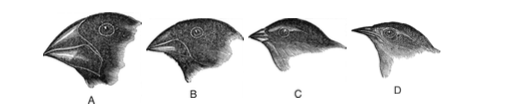
Base your answer(s) to question(s) on the diagram below and on your knowledge of biology. The diagram shows the heads of four different species of Galapagos Islands finches.
The four different types of beaks shown are most likely the result of
The four different types of beaks shown are most likely the result of
a)
gene manipulation
b)
natural selection
c)
unchanging environmental conditions
d)
patterns of behavior learned from parents
72.
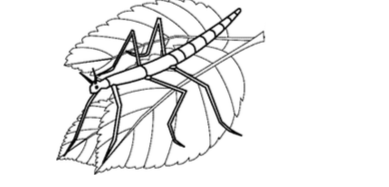
The illustration below shows an insect resting on some green leaves.
The size, shape, and green color of this insect are adaptations that would most likely help the insect to
The size, shape, and green color of this insect are adaptations that would most likely help the insect to
a)
compete successfully with all birds
b)
make its own food
c)
hide from predators
d)
avoid toxic waste materials
73.
Which characteristic is necessary for natural selection to occur in a species?
a)
stability
b)
variation
c)
complex cellular organization
d)
a very low mutation rate
74.
The peppered moth started out light in color, but during the industrial revolution, there was a change in the environment, and the darker moths were more likely to survive. Now, generations later, the peppered moths are darker in color.
a)
Adaptation
b)
Acclimatization
75.
Why did the population of peppered moths in England change from the light variation to the dark variation after the Industrial Revolution?
a)
The soot from industrial revolution caused the light peppered moth to fly away, and only the dark variation was left.
b)
The industrial revolution made the trees darker, which made white moths easier to catch by predators, so only the light moths were left.
c)
The industrial revolution made the trees darker, which made white moths easier to catch by predators, so only the dark moths were left.
d)
The soot from industrial revolution caused the light peppered moth to fly away, and only the light variation were left.
76.
What characteristic did Darwin observe about the finches on the Galapagos Islands?
a)
Their feathers
b)
Genotypes
c)
Their beaks
d)
Their body sizes
77.

Charles Darwin came up with this theory
a)
Natural Selection
b)
Mutation
78.
What is another name for natural selection?
a)
survival of the smartest
b)
survival of the fastest
c)
survival of the biggest
d)
survival of the fittest
79.
What is a change in an organism that allows for it to survive in its environment?
a)
homologous
b)
vestigial
c)
variation
d)
adaptation
80.
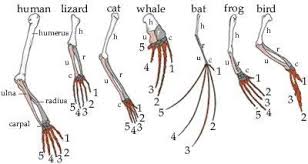
What is this an example of?
a)
vestigial structures
b)
embryology
c)
homologous structures
d)
fossil record
81.
The ability of an organism to survive and reproduce in its specific environment
a)
diversity.
b)
evolution
c)
adaptation
d)
fitness
82.
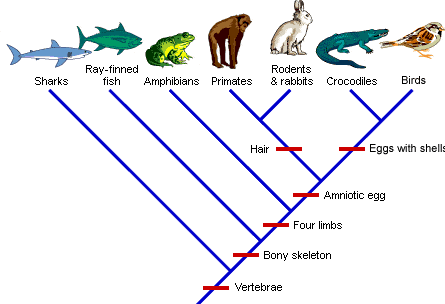
According to this cladogram, sharks are MOST closely related to which organism?
a)
Amphibians
b)
Ray finned fish
c)
Crocodiles
d)
Birds
83.
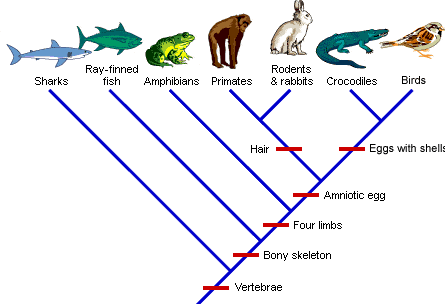
Which two orgainsms have hair?
a)
Sharks & Ray Finned Fish
b)
Primates & Rodents
c)
Birds & Crocodiles
d)
Rabbits & Birds
84.
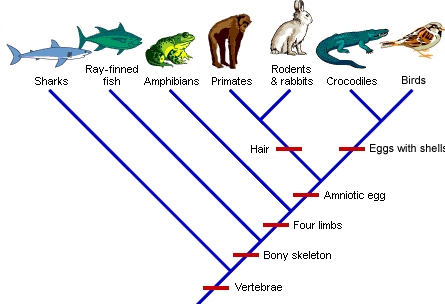
According to this cladogram, birds are LEAST related to:
a)
Amphibians
b)
Sharks
c)
Ray Finned Fish
d)
Crocodiles
85.
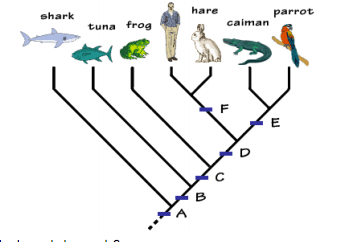
On the cladogram, which organism is the closest relative of the human?
a)
Frog
b)
Hare
c)
Caiman
d)
Parrot
86.
Natural selection
a)
process by which individuals that are better suited to their environment survive and reproduce most successfully; also called survival of the fittest
b)
Humans select which animals live and die
c)
both
d)
IDK
100 %

