wayground logo

Free Printable Worksheets

Font size

S
M
L
XL
Worksheets

Unit 3 Test Review

Total questions: 90

Worksheet time: 1hrs 11mins

Name
Class
Date
1.

In what process is mRNA synthesized?

a)

Transcription

b)

Translation

c)

DNA Replication

d)

Mitosis

2.

Where does TRANSCRIPTION occur?

a)

Nucleus

b)

Ribosome

c)

Cytoplasm

d)

Mitochondria

3.

Why must transcription occur where DNA can be found?

a)

because DNA can't leave the nucleus

b)

because ribosomes are in the nucleus

c)

because DNA polymerase is found there

d)

because helicase unzips the DNA

4.

Which of the following is a codon (think RNA)?

a)
b)

ATG

c)

AUG

d)

AUT

5.

On which molecule can an anticodon be found?

a)

mRNA

b)

DNA

c)

tRNA

d)

rRNA

6.

What is the purpose for anti-codons?

a)

to ensure the correct amino acid is dropped off

b)

to match the strand of DNA

c)

to decode a sequence of 4 nucleotides into an amino acid

d)

to make me hate biology

7.

A polypeptide is a sequence of ____________________ held together by a ______________ bond.

a)

amino acids; peptide

b)

fatty acids; ionic

c)

proteins; hydrogen

d)

fatty acids; covalent

8.

Which two thing are found on a molecule of tRNA?

a)

amino acids; anticodons

b)

amino acids; codons

c)

ribose sugar; proteins

d)

deoxyribose sugar; codons

9.

How do you know when to begin translating a strand of mRNA?

a)

look for AUG

b)

start at the beginning

c)

look for ATG

d)

when Ms. H tells me to

10.

How do you know when to STOP translating a strand of mRNA?

a)

look for STOP on the decoder

b)

stop at the end of the strand

c)

you don't

d)

when Ms. H tells me to

11.

TRANSCRIBE this DNA sequence: TACGTTACT

a)

AUGCAAUGA

b)

ATGCAATGA

c)

AUGGATUGA

d)

TACGTTACT

12.

TRANSLATE this RNA sequence: AUGCAAUGA

a)

Met-Glu-Stop

b)

Met-His-Stop

c)

Thr-Glu-Stop

d)

Thr-Pro-Stop

13.
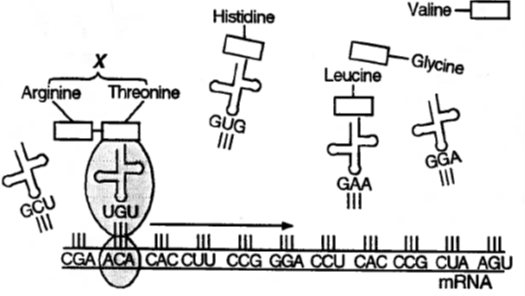
What process is going on in this photo? 
a)
Transcription 
b)
Translation 
c)
Replication 
d)
All the above 
14.
Does the order of amino acids in a protein matter?
a)
YES!
b)
NO!
15.

A DNA nucleotide may be made up of a phosphate group, along with

a)

deoxyribose sugar and uracil

b)

ribose sugar and cytosine

c)

deoxyribose sugar and thymine

d)

ribose sugar and adenine

16.

Which of the following units are repeatedly joined together to form a strand of DNA? (This is the MONOMER of DNA.)

a)

amino acids

b)

nucleotides

c)

fatty acids

d)

polysaccharides

17.

Which of the following are differences in the structure between RNA and DNA

a)

DNA uses deoxyribose sugar, RNA uses sugar ribose

b)

DNA pairs Adenine with Uracil, RNA pairs Adenine with Thymine

c)

DNA is a double helix, RNA is a single helix

d)

DNA pairs Adenine with Thymine, RNA pairs Adenine with Uracil

18.

Which organelle is the location where protein is made?

a)

Ribosome

b)

Nucleus

c)

Cytoplasm

d)

Nucleotide

19.

During transcription, this type of ribonucleic acid is responsible for copying the DNA and brining it out of the nucleus.

a)

tRNA

b)

mRNA

c)

rRNA

d)

dRNA

20.

When these bond together, they form a protein

a)

Amino Acids

b)

Peptide Bonds

c)

Ribose

d)

Nucleotides

21.

These building blocks consist of a sugar, phosphate, and nitrogen base.

a)

Ribose

b)

Nucleotide

c)

Gene

d)

Protein

22.

A string of nucleotides that contain the information to make a specific protein

a)

Ribose

b)

Amino Acids

c)

tRNA

d)

Gene

23.

During translation, this type of ribonucleic acid is responsible for delivering amino acids to help make a protein.

a)

mRNA

b)

rRNA

c)

tRNA

d)

dRNA

24.

mRNA occurs during this process

a)

Translation

b)

Transcription

c)

Replication

d)

Delivery

25.

Which of the following is the complementary mRNA sequence to this DNA strand: AACTGAA

a)

UUGACUU

b)

TTGACTT

c)

AACTGAA

d)

AACUGAA

26.

Which is not a phase of the cell cycle?

a)

Interphase

b)

Mitosis

c)

Cytokinesis

d)

Duplication

27.

Select all stages of interphase?

a)

G1

b)

S

c)

G2

d)

Mitosis

28.

In which stage of the cell cycle does the cell grow in size?

a)

G1

b)

S

c)

G2

d)

Mitosis

29.

In which stage of the cell cycle does the cell duplicate its DNA?

a)

G1

b)

S

c)

G2

d)

Mitosis

30.

In which stage of the cell cycle does the cell split into two?

a)

Mitosis

b)

G1

c)

Cytokinesis

d)

S

31.

In which stage of the cell cycle does nuclear splitting take place?

a)

G2

b)

S

c)

Mitosis

d)

Cytokinesis

32.

In which stage of the cell cycle is protein and organelle synthesis?

a)

G1

b)

G2

c)

S

d)

Cytokinesis

33.

_____ is the uncontrolled growth of cells, often resulting in a tumor or mass of abnormal cells

a)

Cancer

b)

Apoptosis

c)

Radiation

34.

DNA is replicated during the ______ phase of the cell cycle.

a)

G1

b)

S phase

c)

G2

d)

G0

35.
Fruit fly body cells have 8 chromosomes. After mitosis, you would expect a resulting fruit fly daughter cell to have ...
a)
16 chromosomes.
b)
46 chromosomes.
c)
8 chromosomes.
d)
4 chromosomes.
36.
Identify the phase of mitosis.
a)
prophase
b)
metaphase
c)
anaphase
d)
telophase
37.
Which phase comes NEXT?
a)
prophase
b)
metaphase
c)
anaphase
d)
telophase
38.
a)
Prophase
b)
Interphase
c)
Anaphase
d)
Telophase
39.
a)
Anaphase
b)
Cytokinesis
c)
Telophase
d)
Metaphase
40.
a)
Cytokinesis
b)
Interphase
c)
Anaphase
d)
Metaphase
41.
a)
Anaphase
b)
Cytonkinesis
c)
Interphase
d)
Prophase
42.
a)
Cytokinesis
b)
Anaphase
c)
Telophase
d)
Prophase
43.
A process where one cell forms two identical daughter cells is called...
a)
cell cycle
b)
cell division (mitosis)
c)
interphase
d)
cytokinesis
44.
The cell cycle is ______________.
a)
the process of cells circling throughout the body
b)
the process of splitting the organelles
c)
a process where one cell gets energy
d)
the sequence of stages of growth and division that a cell undergoes
45.

During interphase the cell ___________.

a)

divides into two cells

b)

divides its nucleus

c)

replicates its DNA (S phase)

d)

replicates the organelles within the cell (G2 phase)

46.
What does DNA stand for?
a)
DeNatured Acid
b)
DomiNant Acid
c)
DeoxyriboNucleic Acid
d)
DiriboNucleic Acid
47.
Replication is when __________.
a)
the cell makes a copy of its DNA in nucleus 
b)
the cell forms 2 identical cells
c)
the cell produces 2 sets of organelles
d)
the cell continues to complete the same function
48.
Where does replication occur within the cell?
a)
in the cytoplasm
b)
in the nucleus 
c)
in the ribosome
d)
in the chromatin
49.
After interphase is completed the cell moves into the next stage of the cell cycle called _________.
a)
anaphase
b)
cytokinesis
c)
metaphase
d)
mitosis
50.
Mitosis is made up of how many phases?
a)
4
b)
5
c)
6
d)
7
51.
The following describes __________ during mitosis. The chromatin condenses and spindle fibers form at each side of the cell. The nuclear membrane breaks apart.
a)
prophase
b)
metaphase
c)
anaphase
d)
telophase
52.
The following describes ________  during mitosis. The chromosomes line up along the center of the cell and the spindle fibers attach to each chromosome at the centromere.
a)
prophase
b)
metaphase
c)
anaphase
d)
telophase
53.
The following describes _________ during mitosis. The spindle fiber splits the centromere and the chromatids move to opposite sides of the cell.
a)
prophase
b)
metaphase
c)
anaphase
d)
telophase
54.
What is the correct term for "the basic building block of all living organisms"?
a)
cell
b)
cell cycle
c)
cell plate
d)
centriole
55.
What is the correct term for "contains the genetic material (DNA) and serves as the control center of the cell"?
a)
centriole
b)
nucleus
c)
spindle fibers
d)
cytokinesis
56.
What process does a multi-cellular organism use to replace its damaged body cells?
a)
mitosis
b)
meiosis
c)
replication
d)
transcription
57.
Which of these lists presents the stages of the cell cycle in the correct order?
a)
interphase, mitosis, cytokinesis
b)
cytokinesis, mitosis, interphase
c)
mitosis, interphase, cytokinesis
d)
interphase, cytokinesis, mitosis
58.
Which of these phases of mitosis take place first?
a)
anaphase
b)
telophase
c)
prophase
d)
metaphase
59.
Matt uses a microscope to look at slides of plant cells.  He sees a cell with two nuclei that have visible chromosomes. In which stage of cell division is this cell?
a)
anaphase
b)
prophase
c)
telophase
d)
interphase
60.
Identify the stage.
a)
interphase
b)
metaphase
c)
anaphase
d)
telophase
61.
Identify the stage of mitosis.
a)
interphase
b)
prophase
c)
metaphase
d)
anaphase
62.
Identify the stage of mitosis.
a)
interphase
b)
prophase
c)
anaphase
d)
cytokinesis
63.
Identify the stage of mitosis. 
a)
interphase
b)
prophase
c)
anaphase
d)
cytokinesis
64.
During interphase the cell ___________.
a)
divides into two cells
b)
divides its nucleus
c)
replicates its DNA
d)
replicates the organelles within the cell
65.
Replication is when __________.
a)
the cell makes a copy of its DNA in nucleus 
b)
the cell forms 2 identical cells
c)
the cell produces 2 sets of organelles
d)
the cell continues to complete the same function
66.
Which sequence of DNA bases would pair with this partial strand
CAT TCA CTG
a)
ATG TGA CAG
b)
TAC ACT GTC
c)
GTA AGT GAC
d)
CAT TCA CTG
67.
Which of the following units are repeatedly joined together to form a strand of DNA?
a)
amino acids
b)
nucleotides
c)
fatty acids
d)
polysaccharides
68.
The enzyme that unwinds the DNA to prepare for replication
a)
helicase
b)
replicase
c)
polymerase
d)
synthase
69.
The enzyme that unwinds the DNA to prepare for replication
a)
helicase
b)
replicase
c)
polymerase
d)
synthase
70.
DNA replication results in two DNA molecules,
a)
each one with two original strands
b)
each one with two new strands
c)
each one with one new strand and one original strand
d)
one with two new strands and the other with two original strands
71.
order of replication
a)
3, 4, 2, 1
b)
3, 1, 4, 2
c)
2, 1, 4, 3
d)
3, 4, 1, 2
72.
A process in which DNA has the unique ability to make an exact copy of itself.
a)
Replication
b)
Translation
c)
Transcription
73.
In what phase of the cell cycle does DNA replication take place?
a)
G1
b)
S
c)
G2
d)
M
74.
Which enzyme is responsible for adding nucleotides?
a)
Topoisomerase
b)
DNA Polymerase
c)
Ligase
d)
Primase
75.
The process of DNA replication is called semi conservative because it results in
a)
none of these
b)
Two DNA molecules.  One original molecule and one with two new strands
c)
two exact copies with new strands
d)
two identical molecules, each with 1 original strand and one new.
76.
Place the following in sequential order
1. Recoil
2. Straightens the double helix
3. Breaks Hydrogen bonds
4. Adds Free nucleotides
a)
1, 2, 3, 4
b)
3, 4, 2, 1
c)
3, 2, 4, 1
d)
2, 3, 4, 1
77.
Based on the diagram, the enzyme (represented in gray) is most likely...
a)
DNA polymerase
b)
DNA Ligase
c)
Nuclease
d)
Helicase
78.
What will the first four bases of the new DNA strand look like if copying the template strand?
a)
TGGT
b)
ACCA
c)
GTTG
d)
CAAC
79.
Why does DNA replicate?
a)
To create another copy for the new cell
b)
To create a duplicate copy in case the original gets damaged
c)
To create a new copy to replace the damaged original
80.
If the percentage of DNA is made of 30% Thymine, what is the correct percentage of Guanine?
a)
30
b)
15
c)
20
d)
60
81.
Replicate the following strand of DNA: 
AATCATGGA
a)
AATCATGGA
b)
TTAGTACCT
c)
UUAGUACCU
d)
GGATAUCUA
82.
The enzyme that unzips the DNA to prepare for replication
a)
helicase
b)
replicase
c)
polymerase
d)
synthase
83.
A scientist observes a base sequence of AGCTAGCTAGCT.  Which of the following would be the complimentary strand?
a)
TGCATGCATGCA
b)
TCGATCGATCGA
c)
TAGCTAGCTAGC
d)
TTAAGGCCTTCC
84.
The bonds that hold the two strands of DNA together come from...
a)
the attraction of phosphate groups 
b)
strong bonds between  bases and sugars
c)
carbon to carbon bonds in the sugar
d)
weak hydrogen bonds between the bases
85.
The DNA nucleotide is composed of three parts. Which two components make up the nucleotide backbone?
a)
ribose sugar and base
b)
ribose sugar and phosphate group
c)
nitrogen base and deoxyribose sugar
d)
deoxyribose sugar and phosphate group
86.
Why is DNA important?
a)
it is very small and very complicated
b)
it's in everything
c)
it serves as the blueprint for traits of all living things
d)
because we eat it every day for energy
87.
Which organelle is DNA usually found in?
a)
cell membrane
b)
vacuole
c)
chloroplast
d)
nucleus
88.
Which component of DNA specifies the traits of an organism?
a)
5-carbon sugar (deoxyribose)
b)
hydrogen bonds
c)
phosphate groups
d)
nitrogenous base pairs
89.
What term names the process during which DNA is copied prior to cell division?
a)
DNA polymerase
b)
DNA replication
c)
DNA regneration
d)
DNA redistribution
90.
After analyzing a sample of DNA, a scientist recorded the data shown in the table. What percentage of the DNA sample is cytosine?
a)
22%
b)
25%
c)
28%
d)
56%