
 Worksheets
Biology B Review
Total questions: 84
Worksheet time: 1hrs 9mins

Which organelle is responsible making food (Glucose) using sunlight?
Ribosomes
Nucleus
Chloroplast
Mitochondria
Select all that are raw materials for Photosynthesis.
Water
Carbon Dioxide
Oxygen
Sunlight (Light Energy)
Glucose (Sugar/food)
Select all that are products of Photosynthesis.
Water
Carbon Dioxide
Oxygen
Sunlight (Light Energy)
Glucose (Sugar/food)
What is the green pigment that "traps" sunlight?
Chlorophyll
Chloroplasts
Photosynthesis
ATP
Which organelle stores water for use in photosynthesis?
Chloroplast
Golgi
Vacuole
Canteen
How many raw materials (ingredients) does photosynthesis require?
1
2
3
4
How many products are produced during photosynthesis?
1
2
3
4
Is Oxygen a Raw Material (Ingredient) or Product of Photosynthesis?
Product
Raw Material
Niether
What's Photosynthesis?
Is Glucose (C6H12O6) a Raw Material (Ingredient) or Product of Photosynthesis?
Product
Raw Material
Niether
What's Photosynthesis?
What is the energy that is produced in cell respiration?
ADP
Sugar
ATP
What are the reactants in cell respiration?
water, carbon dioxide, light
oxygen, sugar
sugar, water, carbon dioxide
Where does Kreb's Cycle occur?
mitochondria inner membrane
mitochondria matrix
cytoplasm
Which process will always occur no matter what?
E.T.C.
Kreb's Cycle
Glycolysis
Your body needs energy, there is enough oxygen present so after glycolysis it goes to...
lactic acid fermentation
Kreb's Cycle
E.T.C.
Aerobic means
without oxygen
with oxygen
without effort
Anaerobic means
with oxygen
without oxygen
to run for a long time
Billy is sprinting the 40 yard dash, what pathway would he take?
aerobic
anaerobic
Billy then heads to the pool for a long 200 meter swim for a cool down. What pathway did he take then?
aerobic
anaerobic
If you wanted to produce more energy, what pathway would you choose?
aerobic
anaerobic
What are the products of cell respiration?
water, light, and sugar
water, carbon dioxide, ATP
oxygen, water, sugar
Photosynthesis _________ the energy that cell respiration ______.
builds ; breaks
breaks ; build
eats ; builds
Carbon dioxide levels will _______ during exercise.
increase
decrease
see no change
The CO2 you breathe out comes out of which process?
Glycolysis
lactic acid fermentation
Kreb's Cycle
Plants can only go through photosynthesis not respiration.
True
False
What product(s) coming out of photosynthesis can straight to mitochondria for energy?
carbon dioxide and sugar
sugar and oxygen
water and light
Where does food store chemical energy?
in the bonds
in the elements (C, H, O, etc)
in the protein
in the fat
When organisms use 'chemicals' to make carbon-based molecules, this is called__________?
photosynthesis
chemotherapy
chemosynthesis
phototherapy



---The large spiders are easily seen by predators.
---Small spiders have a difficult time finding food.
What will most likely happen to this population of spiders after many generations?
Why is genetic biodiversity important in fighting disease in food crops?
It prevents one disease from wiping out an entire food crop.
It prevents habitat loss of native species.
It provides different foods for different populations.
It prevents fungal disease from wiping out corn crops.
Biodiversity, aka biological diversity, usually refers to
the same species in a general location
the number of different species in a given area
the number of animal species in a given area
the number of plant species in a given area
A population is
a group of similar species in different areas
a group of the same species in the same geographic area.
a group of several species in the same geographic area
a group of several species along with their abiotic factors in a small area.
A population is
a group of similar species in different areas
a group of the same species in the same geographic area.
a group of several species in the same geographic area
a group of several species along with their abiotic factors in a small area.
A stable ecosystem typically has high biodiversity.
True
False

Which is the best description of the two communities shown?
Community 1 has a higher evenness but lower richness than Community 2.
Community 1 has a higher evenness and equal richness to Community 2.
Community 2 has a higher evenness and higher richness than Community 1.
Community 2 has a higher evenness but lower richness than Community 1.
What are the three levels of biodiversity from smallest to largest?
genetic, natural selection, community
species evenness, relative abundance, genetic
genetic, species, ecosystem
species, evolution, genetic
The threat to biodiversity that occurs when the homes of different species are destroyed
pollution
habitat destruction
overexploitation
climate change
When human-made chemicals and garbage find their way into nature and harm the air, soil, and water it is called
pollution
habitat destruction
overexploitation
climate change

If a species in no longer found living on Earth it is
pollutants
extinct
species
endangered

According to the graph, what material’s recycling would reduce the largest portion of America’s trash?
Metals
paper
plastics
Yard trimmings

How do plants make their own food?
by using light energy to make glucose
by using chemical energy to make glucose
by changing water into carbon dioxide
by breaking down remains to make carbon dioxide
Which chemical reaction shows the correct equation for photosynthesis?
oxygen + glucose -> carbon dioxide + water + ATP
oxygen + glucose + ATP -> carbon dioxide + water
carbon dioxide + water -> oxygen + glucose + sunlight
carbon dioxide + water + sunlight -> oxygen + glucose

What are the "products" of cellular respiration?
carbon dioxide, water, ATP
carbon dioxide, oxygen
oxygen, glucose
oxygen, water, ATP
What is the major difference between a community and an ecosystem?
A community involves only the biotic and the abiotic
An ecosystem only includes herbivores and carnivores-- no decomposers
An ecosystem involves the biotic, AND the abiotic
An ecosystem is just a larger community


All of the carbon in existence is continually recycled in the carbon cycle.
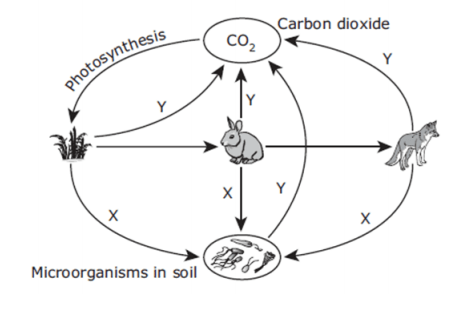
Y : Predation
Y : Decomposition
Y : Nitrogen Fixation
Y : Respiration

