wayground logo

Free Printable Worksheets

Font size

S
M
L
XL
Worksheets

Unit 9 Exam

Total questions: 82

Worksheet time: 3hrs 40mins

Name
Class
Date
1.

Organisms in this smallest taxonomic group share many characteristics.

a)

domain

b)

kingdom

c)

species

d)

class

2.

The science of describing, classifying, and naming living things is called:

a)

Geology

b)

Biology

c)

Taxonomy

d)

Chemistry

3.

The scientific name for an organism is made from the:

a)

class and family name

b)

genus and species name

c)

domain and kingdom name

d)

kingdom and phylum name

4.

What kingdom do unicellular, prokaryotic organisms that live in extreme environments?

a)

Animal

b)

Archaebacteria

c)

Eubacteria

d)

Plant

5.

This organism is found in pond water. It has a nucleus, is microscopic, unicellular and can perform photosynthesis. What kingdom does it belong in?

a)

protista

b)

eubacteria

c)

archaebacteria

d)

plantae

6.

Who first proposed binomial nomenclature as a way of classifying organisms?

a)

Carolus Linnaeus

b)

Aristotle

c)

Charles Darwin

d)

Louis Pasteur

7.

Which of the following scientific names is written correctly? Assume all are in italics!

a)

Homo Sapien

b)

Homo sapien

c)

homo sapien

d)

Homosapien

8.

What is the correct order of taxonomy?

a)

Kingdom, pylum, class, species, genus, family, class

b)

Species, genus, family, order, class, phylum, kingdom

c)

Kingdom, phylum, class, order, family, genus, species

d)

species, phylum, order, class, kingdom, family, genus

9.
The most general in the order of classification is?
a)
Kingdom 
b)
Phylum 
c)
Class 
d)
Order
10.
The 2 kingdoms that make up Prokaryotes are?
a)
Animals and Plants 
b)
Protists and Fungi
c)
Archea and Bacteria
11.

The only thing that all protist have in common is that

a)

they have a nucelus

b)

they are unicellular

c)

they are multicellular

d)

they lack a nucleus

12.
The earliest form of life known on Earth was...
a)
Leafy Plants
b)
Bacteria
c)
Fossils
d)
Single-Celled Organisms
13.
The first evidence of life was approximately
a)
3.4 billion years ago
b)
2.2 billion years ago
c)
3.4 million years ago
d)
5 billion years ago
14.
There was very little __________ in the early atmosphere
a)
oxygen
b)
carbon dioxide
c)
water vapor
d)
iron
15.
What happened when oxygen accumulated in the atmosphere?
a)
ozon layer formed
b)
no change
c)
sky turned brown
d)
iron oxide formed
16.

In the Miller and Urey experiment, what was found in the liquid that they collected?

a)

amino acids

b)

lipids

c)

RNA

d)

DNA

17.
Which portion of the timeline is known as the "Age of Mammals"?
a)
Precambrian Time
b)
Paleozoic Era
c)
Mesozoic Era
d)
Cenozoic Era
18.
Which portion of the timeline is known as the "Age of Dinosaurs"?
a)
Precambrian Time
b)
Paleozoic Era
c)
Mesozoic Era
d)
Cenozoic Era
19.
Place the following in order starting with the OLDEST
1  Paleozoic
2  Cenozoic
3  Precambrian
4  Mesozoic
a)
1 3 2 4 
b)
3 1 4 2
c)
4 3 2 1 
d)
2 3 1 4
20.
Precambrian Time accounts for ___% of Earth's History.
a)
10%
b)
25%
c)
50%
d)
90%
21.
Which type of animal appears earliest in the fossil record?  (OLDEST)
a)
Reptiles
b)
Birds
c)
Dinosaurs
d)
Fish
22.
Which type of life dominates the Precambrian Time?
a)
Dinosaurs
b)
Mammals
c)
Bacteria
d)
Humans
23.
Which is the most recent era of time- the one that we are currently in?
a)
Mesozoic 
b)
Paleozoic 
c)
Cenozoic 
d)
Precambrian 
24.
Which era is known as the "age of reptiles"
a)
Paleozoic Era
b)
Cenozoic Era
c)
Mesozoic Era
d)
Precambrian Era
25.

Jellyfish are one of the oldest species on Earth. In what time period did they first appear?

a)

Precambrian

b)

Paleozoic

c)

Mesozoic

d)

Cenozoic

26.

The end of the Mesozoic Era was most likely caused by?

a)

A meteor

b)

Too much oxygen

c)

Lowering sea levels

d)

An ice age

27.

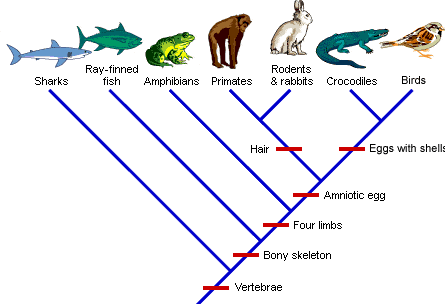
According to this cladogram, primates are most closely related to....

a)

Amphibians

b)

Rodents & rabbits

c)

Crocodiles

d)

Birds

28.

Which trait do only humans have, according to the cladogram?

a)

jaws

b)

mammary glands & hair

c)

terrestrial during all life stages

d)

bipedal & opposable thumbs

29.
Is a virus considered living or non-living?
a)
Living
b)
Non-Living
c)
Neither
30.
What is a host?
a)
Organism that lives on the cell and causes it harm 
b)
Something that causes harm to the cell 
c)
Cell that the virus invades and takes over
31.
What is the first step of the virus reproduction cycle?
a)
The viruses genetic material (DNA) starts to take over the functions of the cell
b)
The host cell bursts open, releasing the new viruses
c)
The virus injects its genetic material into the cell
d)
A virus attaches to the surface of a host cell
32.
Where do viruses reproduce?
a)
Outside of a cell
b)
Inside of a cell
c)
They do not reproduce
33.

Which of the following helps prevent the spread of viral diseases?

a)

Surgery

b)

Medication

c)

Vaccines

34.
Antibiotics kill viruses
a)
True
b)
False
35.
Which can be treated with antibiotics?
a)
Virus
b)
Bacteria
c)
Mutagen
d)
Parasite
36.
What do viruses have in common with living cells? They both...
a)
store genetic information
b)
have chloroplasts
c)
use glucose for cellular respiration
d)
have endoplasmic reticulum
37.
What do viruses need to reproduce?
a)
they need genetic material
b)
They need a host cell
c)
They need  bacteria
d)
They need insulin
38.
What part of the virus is number 1?
a)
Capsid
b)
DNA
c)
Surface Markers
d)
Envelope
39.
What part of the virus is number 3?
a)
Capsid
b)
DNA
c)
Surface Markers
d)
Envelope
40.
What happens in the lysogenic cycle? 
a)
Virus goes in and leaves the host cell
b)
Virus quickly kills the host cell
c)
Virus inject the nucleic acid into the host cell, and the nucleic acid integrates into the host cell DNA, and stay dormant for a long time
d)
Bacteria injects DNA into a host cell
41.
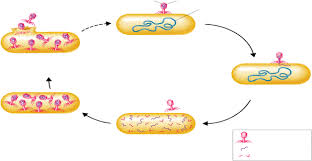
What is shown here?
a)
Lysogenic Cycle
b)
Lytic Cycle
c)
Binary Fission
d)
Conjugation
42.
What process is this?
a)
phagocytosis
b)
lytic cycle
c)
lysogenic cycle
d)
formation of antibodies
43.
What is one way that a lysogenic infection differs from a lytic infection?
a)
A lysogenic virus does not act on bacteria as a lytic virus does.
b)
A lysogenic virus can remain in the host DNA for a longer period without becoming active.
c)
A lysogenic virus contains RNA instead of DNA.
d)
A lysogenic virus directs the production of new viruses right away.
44.
The lysing of a cell occurs in which phase?
a)
1
b)
2
c)
4
d)
5
45.
During the lytic infection by a virus, the host cell is-
a)
destroyed
b)
copied
c)
passed on to the lysogenic cycle
d)
not affected
46.
A(n) _____ is a virus that enters a bacterial cell.
a)
endospore
b)
decomposer
c)
plasmid
d)
bacteriophage
47.
Which viral life cycle allows viral genetic material to lay dormant while the host cell reproduces?
a)
lytic
b)
mitosis
c)
lysogenic
d)
S phase
48.
Name this bacteria shape
a)
coccus
b)
spirillum
c)
bacillus
49.
Name this bacteria shape
a)
coccus
b)
bacillus
c)
spirillum
50.
Which statement about bacteria is true?
a)
All bacteria are prokaryotes
b)
All bacteria are eukaryotes
c)
All bacteria are autotrophs
d)
All bacteria are heterotrophs
51.
Bacteria cells share which of the following organelles in common with plant and animal cells?
a)
cell membrane, RER
b)
cell wall, mitochondria
c)
nucleus, ribosomes
d)
ribosomes, cytoplasm
52.
The reason the are classified prokaryotes is because they lack ?
a)
ribosomes
b)
a nucleus
c)
a cell wall
d)
a cell membrane
53.

A ________________________ requires oxygen to live.

a)

Obligate Aerobe

b)

Obligate Anaerobe

c)

Facultative Anaerobe

54.

A ________________________________ cannot live with oxygen.

a)

Obligate Aerobe

b)

Obligate Anaerobe

c)

Facultative Anaerobe

55.

A ________________________ does not need oxygen to survive but won't be killed by it.

a)

Obligate Aerobe

b)

Obligate Anaerobe

c)

Facultative Anaerobe

56.

This kind of reproduction results in identical cells.

a)

Binary Fission (asexual)

b)

Conjugation (sexual)

57.

Eubacteria cell walls are made out of ______.

a)

Chitin

b)

Cellulose

c)

Peptidoglycan

d)

Glucose

58.

___________ is a retrovirus.

a)

Hepatitis B

b)

HPV

c)

Herpes

d)

HIV

59.
Which letter on the diagram points to the capsid?
a)
b)
B
c)
C
d)
D
60.
A relationship between two organisms in which one organism benefits and the other is unharmed...
a)
Mutualism 
b)
Competition
c)
Parasitsm 
d)
Commensalism 
61.
A relationship between two organisms in which both organisms benefit. 
a)
Mutualism 
b)
Competition
c)
Parasitsm 
d)
Commensalism 
62.

A relationship between two organisms in which one benefits and the other is harmed

a)

Mutualism

b)

Competition

c)

Parasitsm

d)

Commensalism

63.

What is Flagella?

a)

A tail like structure that help cells move

b)

Hair like fibers that help cells move

c)

A place where spores are kept

d)

A fake foot that help cells move

64.
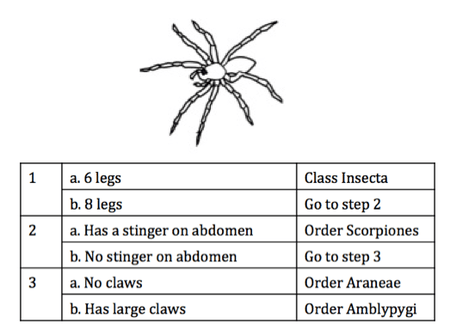
An illustration and a dichotomous key are given. What is the correct classification for this organism?
a)
Class Insecta
b)
Order Amblygygi
c)
Order Araneae
d)
Order Scorpiones
65.

A student discovers an arachnid without a segmented abdomen, and legs longer than its body. The student uses the dichotomous key below to identify it. Which arachnid has the student found?

a)

Whip Scorpion

b)

Wind Scorpion

c)

Daddy long legs

d)

Scorpion

66.

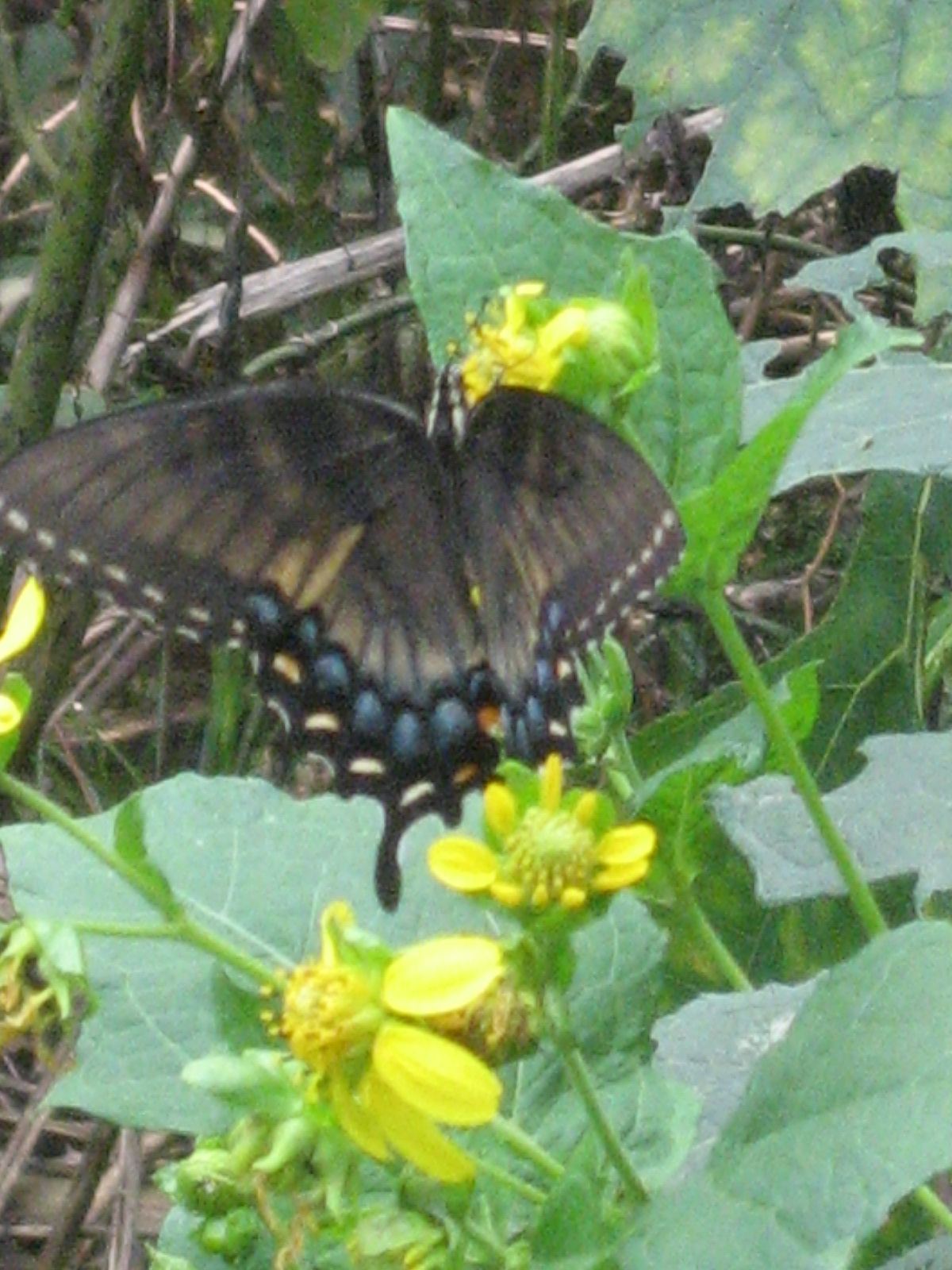
To what order does a two pairs of wings, rigid and leathery and mouth for sucking belong to?

a)

Diptera

b)

Lepidoptera

c)

Heteroptera

d)

Coleoptera

67.

a structure produced by prokaryotes, such as bacteria, in unfavorable conditions; a thick wall encloses the DNA and some of the cytoplasm.

a)

bacteria

b)

cell wall

c)

endospore

d)

microscope

68.

a form of asexual reproduction in which one cell divides, forming two identical cells.

a)

binary fission

b)

conjugation

c)

decomposer

d)

pasteurization

69.

The scientist who discovered penicillin (a type of anitbiotic).

a)

Bill Nye

b)

Alexander Flemming

c)

Edward Jenner

d)

Bill Gates

70.

Bacillus fusiformis would be shaped like a

a)

circle

b)

rod

c)

spiral

d)

rectangle

71.

Micrococcus luteus would be shaped like a

a)

circle

b)

rod

c)

spiral

d)

rectangle

72.

Spirillum volutans would be shaped like a

a)

circle

b)

rod

c)

spiral

d)

rectangle

73.
The most specific of the classifications is?
a)
class 
b)
order 
c)
genus 
d)
species
74.
What kingdom's organisms often live in super harsh environments?
a)
archea
b)
animalia
c)
plantae
d)
protista
75.
Kingdom, Phylum, Class, _______
a)
Family 
b)
Order
c)
Genus 
d)
Species
76.
Which of the following organisms are LEAST closely related?
a)
organisms that share a domain
b)
organisms that share a family 
c)
organisms that share a genus 
d)
organisms that share a species 
77.
The 8 levels of classification, most broad to most specific.
a)
Domain, Genus, Family, Order, Class, Phylum, Kingdom, Species
b)
Domain, Species, Kingdom, Genus, Phylum, Family, Class, Order
c)
Domain, Kingdom, Phylum, Class, Order, Family, Genus, Species
d)
Order, Kingdom, Species, Domain, Phylum, Family, Class, Genus
78.
Which organisms are most closely related?
a)
Equus caballas (Horse) & Equus burchellii (Zebra)
b)
Cyanea artica (Jellyfish) &
Ctenodiscus crispatus (Mud Starfish)
c)
Naja naja (cobra) & Glycine max (soya bean)
d)
Ophiocomina nigra (black brittle star) & Brassica nigra (black mustard)
79.
The science of describing, classifying, and naming living things is called:
a)
Geology
b)
Biology
c)
Taxonomy
d)
Chemistry
80.
From the table, which two animals are MOST CLOSELY related
a)
House Cate and Red Fox
b)
Red Fox and Dog
c)
Dog and Wolf
d)
Wolf and Gopher
81.
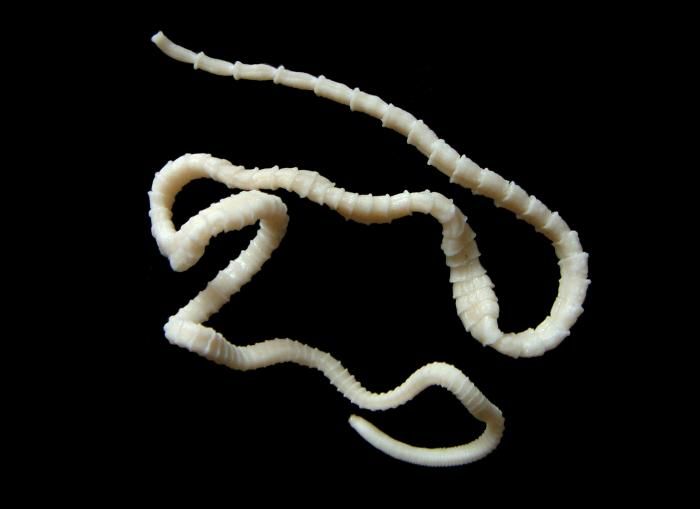
A tapeworm and a cat have this type of relationship.
a)
mutualism
b)
parasitism
c)
commensalism
d)
competition
82.
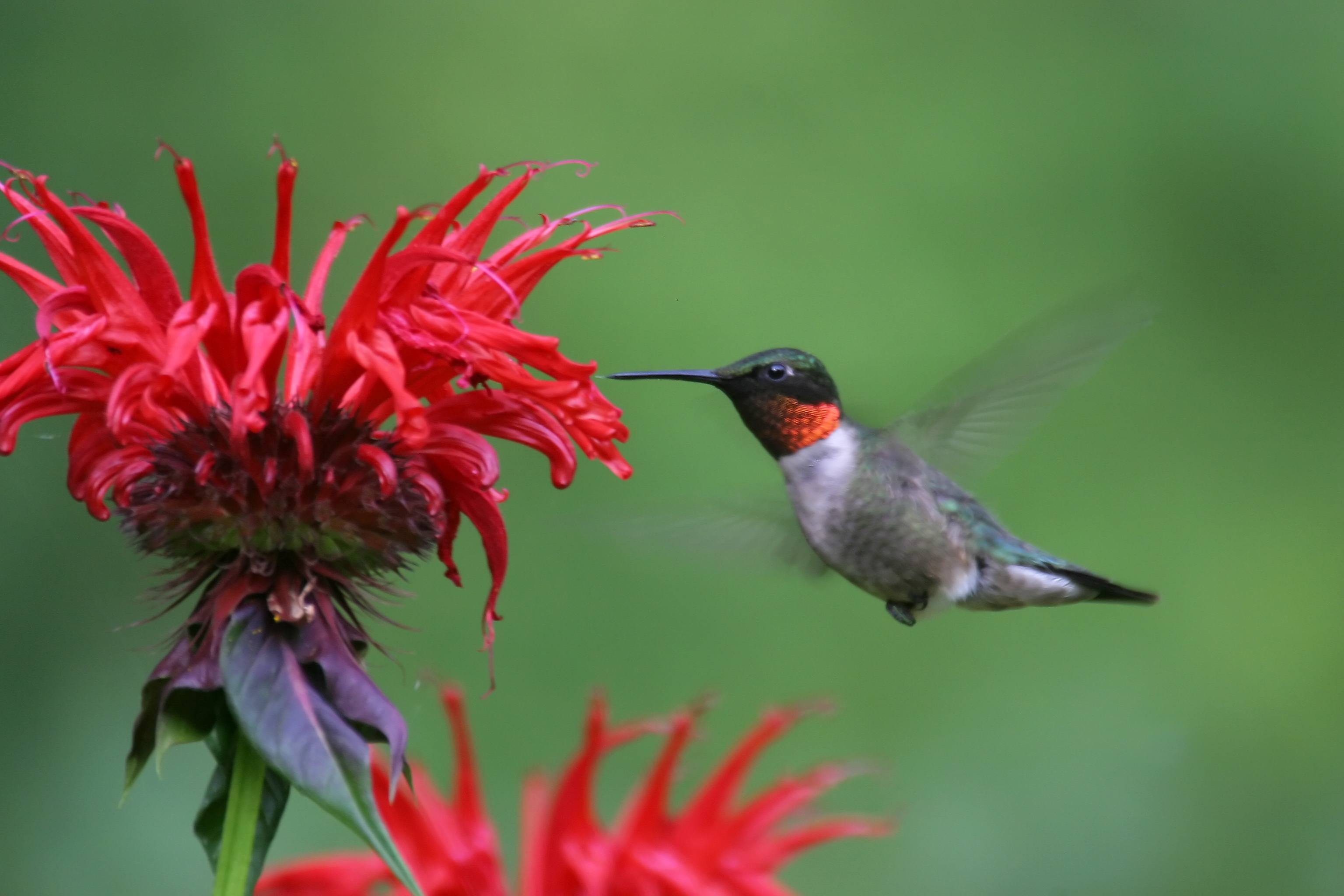
What type of symbiosis?  Hummingbirds feed on nectar from flowers.  The flowers are pollinated by hummingbirds as they move from flower to flower.
a)
commensalism
b)
mutualism
c)
parasitism
d)
predation