Worksheets
Unit 2 and 3 Review
Total questions: 84
Worksheet time: 2hrs 56mins
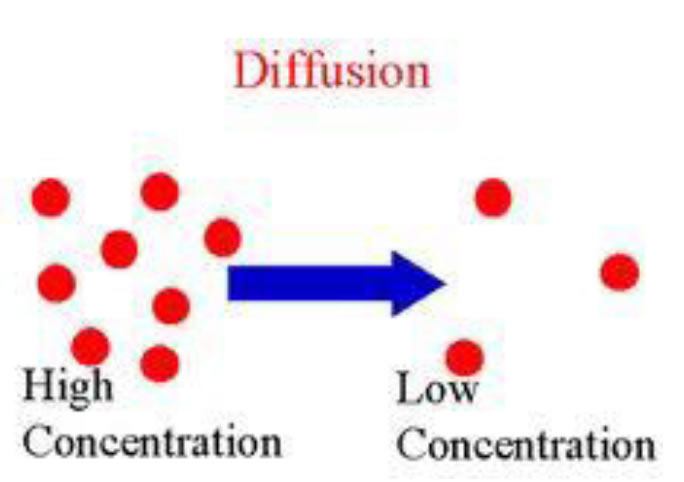
Particle of movement from an area of lower concentration to an area of higher concentration.
Active transport
Passive transport
Particle of movement from an area of higher concentration to an area of lower concentration.
Active transport
Passive transport
Which type of transport uses energy in the form of ATP to transport substances?
Active transport
Passive transport
Which type of transport does not use energy to transport substances?
Active transport
Passive transport
Which type of passive transport uses transport proteins to transport items such as glucose through the membrane?
Facilitated diffusion
Osmosis
Diffusion
Which type of passive transport focuses on the movement of water through the membrane?
Facilitated diffusion
Osmosis
Diffusion
Which type of passive transport occurs when molecules move randomly from high to low concentration like color dye in a beaker?
Facilitated diffusion
Osmosis
Diffusion

Which type of diffusion is represented?
Facilitated diffusion
Osmosis
Diffusion

Which type of diffusion is represented?
Facilitated diffusion
Osmosis
Diffusion

Which type of diffusion is represented?
Facilitated diffusion
Osmosis
Diffusion
Which type of solution has a greater solute concentration INSIDE of the cell?
Hypertonic
Hypotonic
Isotonic
Which type of solution has a greater solute concentration OUTSIDE of the cell?
Hypertonic
Hypotonic
Isotonic
Which type of solution has the same solute concentration inside of and outside of the cell?
Hypertonic
Hypotonic
Isotonic

The cell shrunk in size, which means it was placed in a ____ solution.
Isotonic
Hypertonic
Hypotonic

The cell expanded in size to the point of lysing (bursting), which means it was placed in a ____ solution.
Isotonic
Hypertonic
Hypotonic

The cell shows water moving in and out equally, which means it was placed in a ___ solution.
Isotonic
Hypertonic
Hypotonic
Which type of active transport uses transport proteins to help pump molecules across the membrane?
Membrane pumps
Endocytosis
Exocytosis

Which type of active transport is displayed?
Endocytosis
Exocytosis
Which type of active transport uses a vesicle to allow a large molecule to exit the cell?
Endocytosis
Exocytosis
___ is reached when there are stable internal and external cell conditions.
Energy
Active transport
Homeostasis
Passive transport
The substance that binds to an enzyme is called a?
Polypeptide
Co-enzyme
Vitamin
Substrate
Which of the following best explains why enzymes are necessary for reactions in our cells?
The reactions are too slow to meet the needs of the cell if enzymes are missing.
Enzymes supply the oxygen necessary for the reactions.
Enzymes change reactants from solid to liquid during the reactions.
The reactions take up too much space in the cell if enzymes are missing.
Changes in pH and temperature can ___________________ an enzyme which causes it to lose its shape and affects its function.
puncture
denature
double
delete
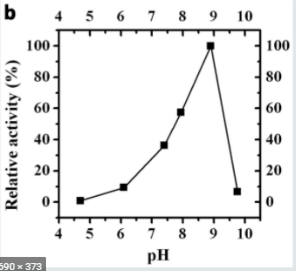
What is the optimal pH for this enzyme?
6
10
9
7
The ____________________ mechanism describes how each substrate must fit into the enzyme.
lock and key
hammer and nail
jigsaw puzzle
seesaw
What is the purpose of an enzyme?
control how many reactions occur
raise activation energy
give permission for the reaction
speed up chemical reactions
Where do substrates bind to an enzyme?
calcium channels
active site
receptor molecules
voltage-gated channels
Once a new product leaves an enzyme, the enzyme is unchanged and ready for the next substrate. What is this called?
fragile
reusable
specific
catalyst
After the enzyme and substrate bind together and perform the reaction, what does the substrate become?
a substrate
an active site
an enzyme
a product
Enzymes are _______________ that _____________________ chemical reactions by ____________ the amount of activation energy required to start the reaction.
carbohydrates, slow down, lowering
proteins, speed up, increasing
lipids, speed up, lowering
proteins, speed up, lowering

What is the optimal temperature of this enzyme?
60
40
70
30

Which letter represents the product?
A
B
C
D

Which enzyme represents the substrate?
A
B
C
D

Which letter represents the enzyme?
A
B
C
D
Exothermic reactions:
release energy
absorb energy
Endothermic reactions:
release energy
absorb energy
Why is the sensation of thirst important to maintaining homeostasis?
Water removed by the kidneys must be replaced
Oxygen cannot diffuse into cells if a person is dehydrated
Water molecules are needed to carry carbon dioxide waste to the kidneys

Why does pulse rate increase during exercise?
Oxygen and carbon dioxide must be removed from the body ASAP
Gas exchange must happen more quickly than when a person is at rest
Oxygen must be moved to the lungs and carbon dioxide must be moved to cells more quickly
Carbon dioxide must be moved to the kidneys to be excreted
The group of organisms that use the process of homeostasis includes
mammals, only
animals, only
plants and animals
all living things


If a person's blood cells shrivel (shrink) their blood is likely
isotonic
hypotonic
hypertonic

Which of the following is most likely to cause a person's blood cells to burst?
eating many salty foods
eating many greasy foods
drinking small amounts of water
drinking very large amounts of water
Which of the following is NOT an example of homeostasis?
A human producing gametes
A plant bending toward sunlight
A bird drinking water when thirsty
A dog stealing chicken off the kitchen counter when hungry


Where do the dark reactions (Calvin cycle) take place?
thylakoid membrane
lumen
stroma

Which equation represents Cellular Respiration


Which of the following is a reactant Cellular Respiration?
Oxygen
Carbon Dioxide
Water
Sunlight
Which of the following is a reactant Cellular Respiration?
Sunlight
CO2
H20
C6 H12 O6
Which of the following is the symbol for Glucose?
O2
CO2
H20
C6 H12 O6
Cellular Respiration is an aerobic process which means it requires Oxygen.
True
False
What organelle does cellular respiration take place?
Chloroplast
Cell Wall
Mitochondria
Central Vacuole
What type of organism makes it's own food?
Autotroph
Heterotroph
Consumer
Omnivore
What type of organism has to consume energy?
Producers
Plant
Autotroph
Heterotroph
Which kind of organism undergoes Cellular Respiration?
Autotroph
Heterotroph
Plant
Producers
What is the best definition for cellular respiration?
A process in which glucose is broken down to be used for energy.
A process in which Carbon Dioxide is used to break down Glucose.
The process in which animals make their own energy.
Click on the two products of Cellular Respiration?
H2O
O2
CO2
C6 H12 O6

According to the graph, what happens when the temperature increases?
respiration rate decreases
respiration rate increases
respiration rate levels off
respiration rate increases then decreases

Based of the information in the graph, what inference can be made?
There were 10 measurements taken.
Average respiration rate is measured in beats per minute.
As the respiration rate increases the amount of oxygen produced increases.
As the temperature increases more carbon dioxide is produced.
What do photosynthesis and cellular respiration have in common?
They both require Sun light.
Both are carried on by heterotrophs
They both create energy for an organism to use.
They both transform energy for an organism to use.
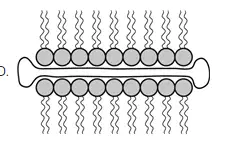
In 1940, Danielli and Davson proposed that the cell membrane was a bilayer of phospholipids. These phospholipids were sandwiched between two continuous layers of proteins as shown.
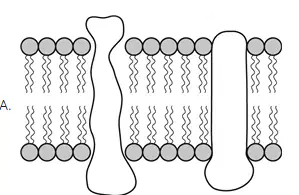
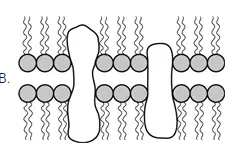
Which of the following BEST modifies the Danielli-Davson model of the cell membrane?