wayground logo

Free Printable Worksheets

Font size

S
M
L
XL
Worksheets

Natural Selection & Evolution

Total questions: 85

Worksheet time: 1hrs 7mins

Name
Class
Date
1.
Where the better adapted organisms survive to pass traits along to offspring.
a)
Evolution
b)
Natural Selection
c)
Extinction
d)
Artifical Selection
2.
The theory of evolution by natural selection means that what is changing over time?
a)
The inherited traits of a population.
b)
The acquired traits of a population.
c)
Hair color and eye color
d)
Attractive features.
3.
Why are advantageous traits more likely to be passed onto offspring?
a)
Because they are more likely to survive and reproduce.
b)
Because they come from dominant alleles.
c)
Because they come from recessive alleles.
d)
Because the trait is an acquired phenotype.
4.

What word describes a trait that helps an organism survive in its environment?

a)

natural selection

b)

mutation

c)

camouflage

d)

adaptation

5.
Why do frogs and other organism reproduce so many eggs or offspring?
a)
so that their babies can have friends to play with
b)
the more offspring the more likely the offspring will survive
c)
the more offspring the less likely offspring will survive 
d)
the more offspring the less competition
6.
Which organisms are most likely to survive?
a)
the best adapted
b)
the fastest
c)
the strongest
d)
the most domesticated (tamed)
7.
Almost all adaptations started off as?
a)
selective breeding
b)
physiological
c)
structural
d)
mutation
8.
Any inherited trait that gives an organism an advantage in its environment is called ___.
a)
a mutation
b)
an adaptation
c)
evolution
d)
natural selection
9.
Which of the following means "genetic change over time"
a)
natural selection
b)
speciation
c)
evolution
d)
fitness
10.
Do organisms "decide" to evolve and change?
a)
Yes, they know they need to change to survive 
b)
No, they change because of natural selection
11.
The differences among a species, like different bird beaks, are called
a)
genes.
b)
variations.
c)
traits.
d)
theories.
12.
What is the advantage of having different shaped beaks?
a)
To look different from other species.
b)
To be able to eat the food readily available in the environment.
c)
To protect itself against predators.
d)
To protect itself against prey.
13.
Mutations are a change in what?
a)
DNA
b)
tRNA
c)
genotype
d)
phenotype
14.
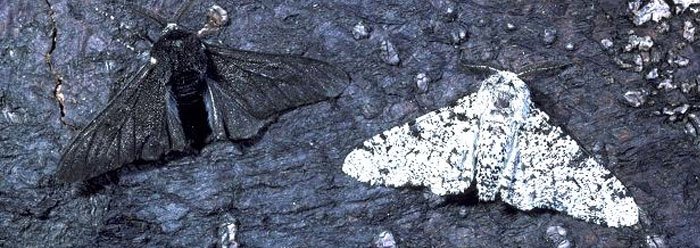
The trees these moths used to live on were white, but have been covered in soot from coal factories. Which moth will be more successful in this environment?
a)
Dark moth
b)
Light moth
c)
Both will be equally successful
d)
Neither will be successful
15.
Since the 1800s humans have stopped burning coal, and the trees have returned to their original color. Which moth will be more successful in this environment?
a)
Dark moth
b)
Light moth
c)
Both will be equally successful
d)
Neither will be successful
16.
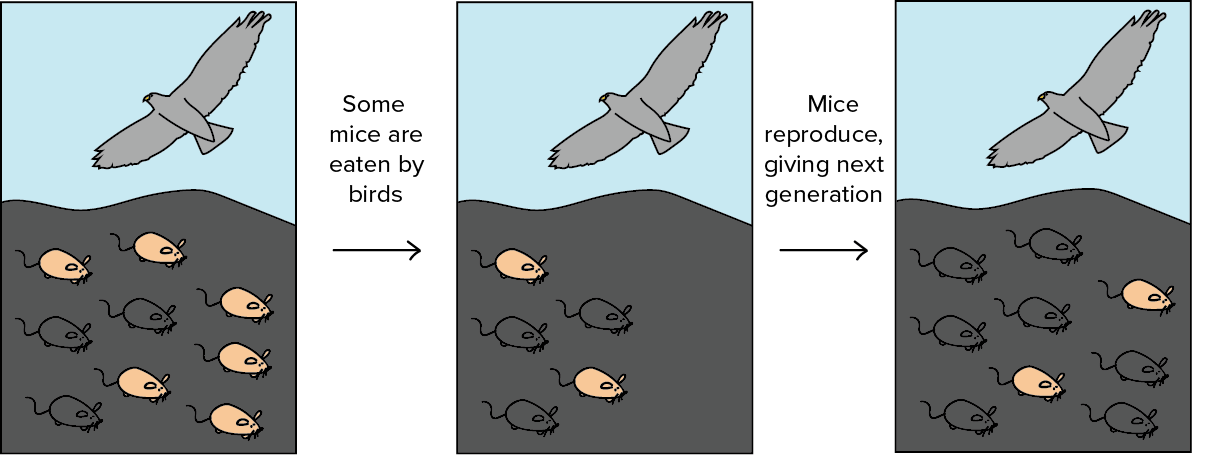
What process is being shown in this image?
a)
Variation
b)
Natural Selection
c)
Selective Breeding
d)
Homeostasis
17.
Why is the mouse population changing over time?
a)
The light mice can reproduce more successfully than the dark mice
b)
The hawks eat more dark mice than light mice because the dark mice taste better
c)
The hawks eat more light mice than dark mice because they can see the light mice more easily
d)
The hawks eat more dark mice than light mice because they can see the dark mice more easily
18.
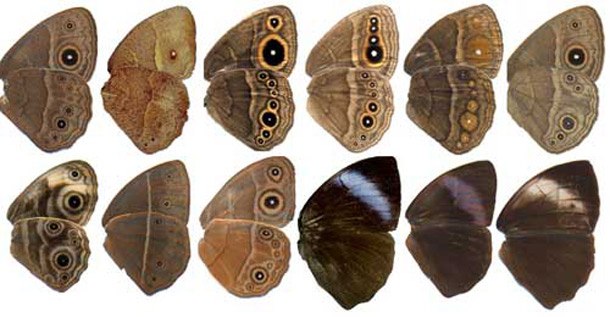
These moths are all the same species. The differences between their wings is an example of ________________
a)
Natural Selection
b)
Variation
c)
Homeostasis
d)
Extinction
19.
Organisms that are better adapted to the environment survive to pass traits to their offspring
a)
Natural Selection
b)
Homeostasis
c)
Selective Breeding
d)
Extinction
20.

Selective breeding is where ___________ decides which traits should be passed on

a)

Nature

b)

A human

c)

Ms. Greene

d)

The illuminati

21.

Natural selection is where ___________ decides which traits should be passed on

a)

Nature

b)

A human

c)

Ms. Greene

d)

The illuminati

22.
All rabbits living in a particular area would be an example of a(n)
a)
population
b)
species
c)
fossil
d)
individual organism
23.
a bird that can easily outcompete other birds for food and that can produce many eggs has a high
a)
life expectancy
b)
mutation rate
c)
fitness
d)
adaptability
24.

The more genetic variation a population has,

the more likely it is for some individuals to

a)

evolve

b)

migrate

c)

survive

d)

mutate

25.
Mutations are important because they bring about
a)
death of the organism in which they develop
b)
genetic variation needed for a population to evolve
c)
benefits for the individual, not for the population
d)
Hardey-Weinberg equilibrium within a population
26.
An organism's appearance or other observable characteristics:
a)
phenotype
b)
recessive
c)
genotype
d)
dominant
27.
An organism's genetic make-up:
a)
phenotype
b)
recessive
c)
genotype
d)
dominant
28.
"Survival of the Fittest" describes which theory
a)
a) natural selection
b)
b) gravity
c)
c) heredity
d)
d) string theory
29.
Modern whales developed their traits through natural selection.  What occurs during the process of natural selection?
a)
Organisms choose mates from other species to create new species
b)
Breeders selectively cross organisms with desired traits
c)
Only the fittest organisms can survive and reproduce
d)
Organisms remain exactly the same over time.
30.
Which of the following is a term for a group of similar organisms that can reproduce fertile offspring?
a)
individual
b)
population
c)
species
d)
fossil
31.
The difference in the physical traits of an individual from those of other individuals in a group is called a(n)
a)
change
b)
adaption
c)
species
d)
variation
32.
Over time, adaptions can lead populations to experience 
a)
environmental changes
b)
genetic changes
c)
geological changes
d)
extinction
33.
In natural selection, the selective agent is the
a)
humans
b)
mutations
c)
breeders
d)
environment
34.

Which of the following describes natural selection?

a)

it acts on genetic material directly

b)

it acts on existing physical traits

c)

it forms new traits

d)

it forms new genetic material

35.
which of the folllowing is an exammple of a vestigial structure?
a)
the wings of a red-tailed hawk
b)
the hind limbs of a house cat
c)
the fins of sharks
d)
the wings of an ostrich
36.

What is suggested by the anatomical similarity of different species of vertebrates?

a)

no evolutionary relationships between the groups

b)

recent common ancestry

c)

similar environments in the past

d)

evolution from a distant common ancestor

37.
Some organisms that share a common ancestor have features that have different functions, but similar structures.  These are known as
a)
vestigial structures
b)
analogous structures
c)
homologous structures
d)
fossil structures
38.
If an organism has a vestigial structure, that structure likely once had a function in a(n)
a)
close relative
b)
early ancestor
c)
unrelated organism
d)
embryological stage
39.
Two organisms that are closely related would have
a)
very similar DNA sequence
b)
exactly the same DNA sequences
c)
no proteins in common
d)
completely different DNA sequence
40.
protein sequences in one organism that resemble those of another suggest a 
a)
coincidence
b)
lack of evolutionary relationship
c)
great number of mutations
d)
shared ancestry
41.
a measure of how commonly a particular allele occurs in a population is known as the 
a)
gene pool
b)
allele frequency
c)
mutation rate
d)
phenotype
42.
Genetic variation can arise from a random change in the DNA of a gene.  The change is called a(n)
a)
mutation
b)
gene flow
c)
gene pool
d)
allele
43.

Which of the following is an example of speciation?

a)

when two species can interbreed and create infertile offspring

b)

isolation that affects mating behaviors

c)

timing of mating that prevents normal sexual selection

d)

divergence of two or more species from an existing one

44.
asexual reproduction produces offspring with
a)
half of a single parent's genes
b)
the same genes as the parent
c)
a mix of genes from two parents
d)
lots of genetic variation
45.

What is the term for a feature that allows an organism to survive better in its environemtn?

a)

variation

b)

adaptation

c)

homologous structure

d)

vestigial structure

46.
the hind leg bones in a whale are examples of
a)
homologous structures
b)
analogous structures
c)
fossils
d)
vestigals
47.
What is the process in which humans breed organisms for certain traits?
a)
natural selection
b)
inheritance
c)
artificial selection
d)
descent withOUT modification
48.
Natural selection results in change over time by acting on traits that are
a)
heritable
b)
new
c)
mutated 
d)
better than the best
49.

The combined alleles of all individuals in a population is called the population's

a)

phenothype

b)

gene pool

c)

mutation rate

d)

allele frequency

50.

Natural selection could not occur without

a)

geographic isolation

b)

variation in the population

c)

stable environments

d)

competition for unlimited resources

51.
The study of the early stages of development that is one evidence of evolution is:
a)
Homologous Structures
b)
Embryology
c)
Vestigial Organs
52.
Evolutionary Similarities that can be seen in organisms by comparing their DNA is called-
a)
Biochemical Similarities
b)
Embryology
c)
Vestigial Structures
d)
Homologous Structures
53.
Some organisms have genes that improve their ability to survive and reproduce. If the gene also help their offspring survive and reproduce, then which of the following will most likely increase?
a)
The number of genes in a species
b)
The frequency of genes in a population
c)
The frequency of genes in one individual 
54.
The opossum and kangaroo both incubate their young in a pouch. This provides evidence that they---
a)
are descended from a common ancestor
b)
Have very similar skeletal structures
c)
belong to the same species
d)
must range great distances to eat
55.
What do these three organisms have in common?
a)
They have stomachs of the same size
b)
They have DNA made up of the same components
c)
They have eyes that see the same ways
d)
They have brains that are the same size
56.
The white feathers of a snowy owl allow it to blend in with its environment during the winter months (snow). This is an example of ________________
a)
Species
b)
Environmental Change
c)
Adaptation
d)
Variation
57.
The DNA of an advanced species of grasshoppers contains---
a)
New types of bases, all formed from mutations in a primitive species of algae
b)
Different bases than the DNA of a primitive species of algae
c)
The same bases as the DNA of a primitive species of algae
58.
Which of the following statements best explains why some mosquitoes survived after the first spraying?
a)
Some mosquitoes had a genetic mutation that made them resistant to the insecticide
b)
A.  All mosquitoes had a genetic mutation that made them resistant to the insecticide
c)
A.  None of the mosquitoes had a genetic mutation that made them resistant to the pesticide
59.
A trait that an organism expresses during its lifetime will only cause its species to become better adapted if the trait—
a)
A.  Results from isolation of the organism from the rest of the population 
b)
A.  Is caused by the genetic code that is present in the gametes of the organism
c)
A.  Causes a change in the environment surrounding the organism
d)
A.  Decreases the number of genes in the body cells of the organism
60.
A graph regarding the effect of agricultural bioengineering on insect pests is shown below How has natural selection affected species of insect pests?
a)
A.  Natural selection has not affected the number of species that are resistant to pesticides
b)
A.  Natural selection has rapidly increased the number of species that are resistant to pesticides
c)
A.  Natural selection has only affected the number of species that are resistant to pesticides
61.
The table shows the survival rate of two types of beetles in the same environment over a period of three years.  

Which statement about the beetles in this environment is best supported by the data?
a)
Brown beetles have a shorter life cycle than green beetles have
b)
Green beetles are more fit for their environment than brown beetles
c)
 brown beetles are undergo more unfavorable mutations than green beetles
62.
The similarities of the bones in the diagram provide evidence that---
a)
The organisms shown lived in the same natural envionrment
b)
The organisms shown may have developed from a common ancestor
c)
The organisms shown have the same genetic diseases
d)
All vertebrate species have identical forelimbs
63.
The green frog (Lithobates clamitans clamitans) is found in many parts of the United States. The table contains some information about this frog.
Why does the ability to lay 1,000 to 5,000 eggs increase the fitness of the species L. clamitans clamitans?
a)
A.  It increases the probability that some offspring will survive long enough to reproduce.
b)
It increases the chance of the recombination of alleles, leading to genetic drift in the population.
c)
A.  It increases opportunities for offspring to compete for limited resources.
64.
A prey population consists of individuals with a variety of running speeds.
The adaptation that allows some of these animals to run fast would be an example of natural selection if it helps them —
a)
survive and undergo mutations in their DNA
b)
produce offspring that run at average speeds
c)
reproduce and increase the frequency of their genes in the population
d)
lower the mortality rates of the population
65.
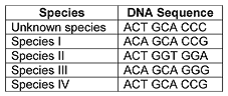
According to this data, the unknown bacterial species is most closely related to: 
a)
Species I
b)
Species II
c)
Species III
d)
Species IV
66.
Certain insects resemble (look like) the bark of the trees on which they live. Which statement provides the best explanation  for this resemblance? (Peppered Moths)
a)
The trees caused mutations in the insects
b)
Natural selection played a role in this protective coloration
c)
The insect camouflage so they developed this coloration
67.
Which statement best describes a relationship between these organisms?
a)
Organism A was probably more primitive than Organisms B and C
b)
Organism A was probably more complex than organism B and C
c)
All of these organisms probably lived at the same time
68.

Scientist sometimes compare the limbs of these organisms to look for evidence of common ancestry.

These limbs provide evidence of common ancestry because they...

a)

have the same basic structure

b)

are the same size

c)

are parts of mammals

d)

perform the same function

69.
Genetic variation can aid in the survival of species when the environment changes.
Which of the following is the best example of an organism with a genetic variation that could improve survival chances over time?
a)
an ant that is resistant to pesticide
b)
a cactus that has no spikes
c)
a mouse that has learned to avoid mouse traps
70.

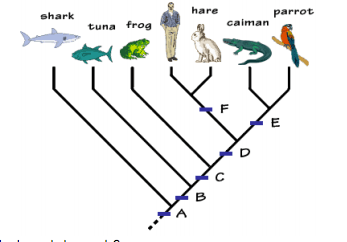
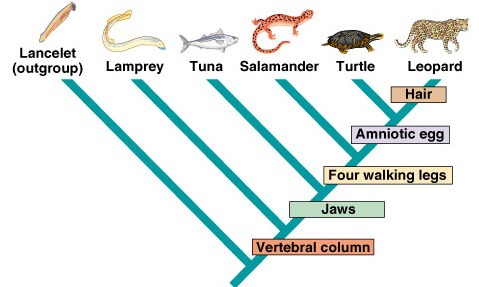
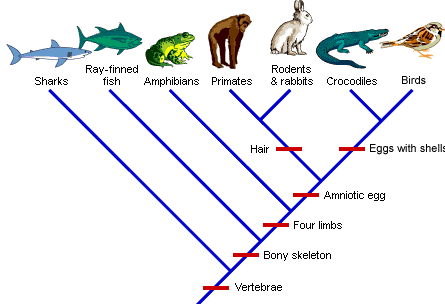
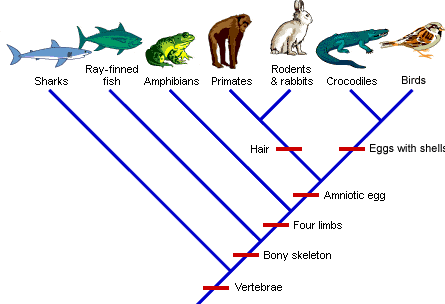
According to this cladogram, primates are most closely related to....

a)

Amphibians

b)

Rodents & rabbits

c)

Crocodiles

d)

Birds

71.

Which trait do only humans have, according to the cladogram?

a)

jaws

b)

mammary glands & hair

c)

terrestrial during all life stages

d)

bipedal & opposable thumbs

72.

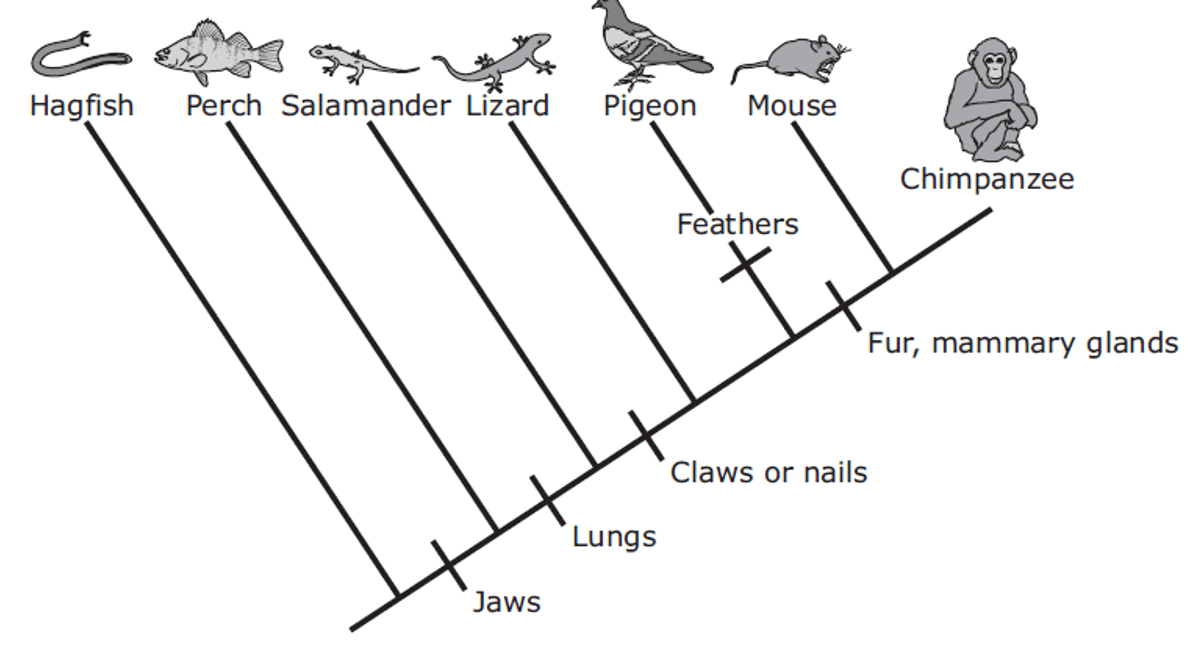
On the cladogram, which organism is the closest relative of the parrot?

a)

Frog

b)

Hare

c)

Caiman

d)

Parrot

73.

All the animals to the right of the salamander would have the common characteristic of...

a)

Fur

b)

Claws or nails

c)

Lungs

d)

Jaws

74.

Which is the newest trait?

a)

Amniotic egg

b)

Walking legs

c)

Jaws

d)

Hair

75.

According to this cladogram, sharks are MOST closely related to which organism?

a)

Amphibians

b)

Ray finned fish

c)

Crocodiles

d)

Birds

76.

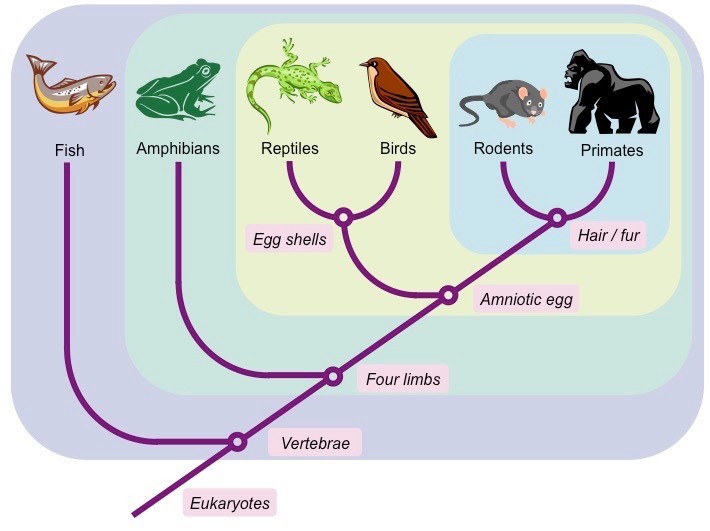
What is this a picture of?

a)

Pedigree

b)

Cladogram

c)

Family Tree

d)

Oak Tree

77.

What characteristic distinguishes amphibians from birds and reptiles?

a)

Amniotic egg

b)

Egg shells

c)

Vertebrae

d)

Hair/fur

78.

What distinguishes zebras from giraffes?

a)

un-branching horns (in males)

b)

even number of toes

c)

fur

d)

carnivorous teeth

79.

What characteristic do all the organisms on this cladogram share?

a)

Being bi-pedal & having language

b)

Complex brains

c)

Fully binocular vision

d)

Partial binocular vision & opposable thumbs

80.

A structure in an organism that has lost all or most of its original function in the course of evolution, such as human appendixes.

a)

homologous structures

b)

analogous structures

c)

vestigial structures

81.

Structures that have similar features such as bone types and locations are called due to common ancestry are called

a)

homologous structures

b)

analogous structures

c)

vestigial structures

82.
If an organism has a vestigial structure, that structure likely once had a function in a(n)
a)
close relative
b)
early ancestor
c)
unrelated organism
d)
embryological stage
83.
Whales are aquatic mammals that contain a pelvis bone.  Even though it does not aid in its movement, the function must have been used by a common ancestor of the whale.  Thus, the pelvis is referred to as a(n)
a)
vestigial structure
b)
analogous structure
c)
homologous structure
84.
The diagram shows fossils in different rock layers. Which of these statements about the age of these fossils is most likely correct?
a)
Fossil A and C are the same age
b)
Fossil B is older than fossil C
c)
Fossils A is older than fossil B
d)
Fossil D is older than fossil C
85.
If species A and B have very similar genes and proteins, what is probably TRUE?
a)
species A and B share a relatively recent common ancestor
b)
species A evolved independently of species B for a long period
c)
species A is younger than species B
d)
species A is older than species B