wayground logo

Free Printable Worksheets

Font size

S
M
L
XL
Worksheets

Unit 3 S3 Biology LW

Total questions: 82

Worksheet time: 2hrs 40mins

Name
Class
Date
1.
What does the cell membrane do?
a)
controls activities of cell
b)
releases energy
c)
stores food, water, and waste
d)
controls movement in and out of cell
2.
What is the function of the nucleus?
a)
store food, water, and waste
b)
control cell activities
c)
take in energy from the sun
d)
give the cell shape
3.
In what kind of cell can you find a cell wall?
a)
plant 
b)
animal 
c)
both
d)
neither
4.
What does cytoplasm do?
a)
protects & supports organelles, and helps transport material
b)
controls cell activities
c)
releases energy from food
d)
contains chlorophyll
5.
Why is the mitochondria called the powerhouse of the cell?
a)
because it releases energy from food 
b)
because it creates food
c)
because it stores food
d)
because it makes proteins
6.
What is the function of vacuoles?
a)
store food, waste, and water
b)
make proteins
c)
create food from sun's energy and CO2
d)
control cell activities
7.
What is the function of chloroplasts?
a)
make proteins
b)
collect sun's energy
c)
create food (sugar) from sun's energy
d)
control cell activities
8.
Which structure is not in a bacteria cell?
a)
nucleus
b)
cytoplasm
c)
cell membrane
d)
DNA
9.
Which type of cell is not eukaryotic?
a)
plant
b)
animal
c)
bacteria 
d)
they all are
10.
Which type of cells have a cell membrane?
a)
plants
b)
animals
c)
bacteria
d)
all of them
11.
Which of the following best describes a DNA molecule?
a)
double helix
b)
contains ribose
c)
made of amino acids
d)
contains Uracil
12.
Why is DNA important?
a)
it is very small and very complicated
b)
it's in everything
c)
it serves as the blueprint for traits of all living things
d)
because we eat it every day for energy
13.
Which 2 molecules form the sides (backbone) of the DNA ladder?
a)
deoxyribose sugar and adenine
b)
deoxyribose sugar and a hydrogen bond
c)
deoxyribose sugar and the nucleus
d)
deoxyribose sugar and phosphate
14.
What are the three components of a nucleotide?
a)
sugar, hydrogen, nitrogen base
b)
sugar, oxygen, nitrogen base
c)
sugar, phosphate, nitrogen base
d)
sugar, phosphate, protein
15.
Cytosine always pairs with
a)
Adenine
b)
Thymine
c)
Uracil
d)
Guanine
16.
Which organelle is DNA usually found in?
a)
cell membrane
b)
vacuole
c)
ribosome
d)
nucleus
17.
Guanine bonds with ______________.
a)
Adenine
b)
Guanine
c)
Cytosine
d)
Thymine
18.

Which of the following is a base pair?

a)

Adenine - Cytosine

b)

Cytosine - Thymine

c)

Deoxyribose - Cytosine

d)

Cytosine - Guanine

19.
Which of the following is not a nitrogen base found in DNA?
a)
Thymine
b)
Uracil 
c)
Guanine
d)
Adenine
20.
DNA contains the instructions for 
a)
lipids
b)
proteins
c)
saturated fats
d)
carbohydrates
21.
DNA is
a)
ribonucleic acid
b)
deoxyribonucleic acid
c)
deoxyribonucleic atom
d)
dinitrogenous acid
22.
Adenine bonds with
a)
adenine
b)
thymine
c)
guanine 
d)
cytosine
23.

DNA provides the code for proteins such as (choose 3)

a)

enzymes

b)

hormones

c)

cell membranes

d)

antibodies

e)

digestive acids

24.

How many codons equals 1 amino acid?

a)

1

b)

2

c)

3

d)

4

25.

How many nucleotides equal 1 amino acid?

a)

1

b)

2

c)

3

d)

4

26.
The DNA sequence ATCAGCGCTGGC is part of a gene. how many amino acids are coded for by this message?
a)
4
b)
8
c)
12
d)
20
27.
In DNA, Adenine pairs with ___________. 
a)
Guanine
b)
Cytosine
c)
Thymine
d)
Uracil
28.

"transgenic" refers to an animal that:

a)

Has DNA from another organism spliced into its genome

b)

Has undergone DNA modification

c)

Has unique genes for its species

29.

A circular piece of DNA, found in bacteria, is called:

a)

A plasmid

b)

mRNA

c)

Ribosome

d)

Nucleotide

30.
When DNA is manipulated and moved from one source to another it is known as
a)
genetic engineering
b)
electrophoresis
c)
gene therapy
d)
GMO
31.
Making changes in the DNA of an organism is
a)
selective breeding
b)
artificial selection
c)
genetic engineering
d)
genetic transformation
32.

The flowchart represents some of the stages of genetic engineering. A suitable description of stage X would be

a)

insert bacterial plasmid into required gene

b)

insert bacterial plasmid into source chromosome

c)

insert required gene into host bacterial cell

d)

insert required gene into bacterial plasmid.

33.

Which row in the table identifies the order of stages involved in genetic engineering?

a)

A

b)

B

c)

C

d)

D

34.

Some stages of genetic engineering are shown below. Which letter indicates the stage where the plasmid is inserted into a bacterial cell?

a)

A

b)

B

c)

C

d)

D

35.

The diagram below represents a genetically engineered bacterial cell. The structure labelled X is a

a)

Chromosome

b)

Plasmid

c)

Ribosome

d)

Nucleus

36.

The diagram below shows stages in the production of a substance, such as insulin, by genetic engineering. Which line in the table below correctly identifies S and T?

a)

S - Gene, T - Plasmid

b)

S - Gene, T - Bacterium

c)

S - Chromosome, T - Plasmid

d)

S - Chromosome, T - Bacterium

37.

The diagram below shows a stage in the genetic engineering of a bacterium to allow it to produce human insulin. Which stage of the genetic engineering process is represented in the diagram?

a)

Human insulin gene is inserted into a bacterium

b)

Human insulin gene is inserted into a plasmid

c)

Plasmid is inserted into a human bacterium

d)

Bacterial gene is inserted into a human chromosome

38.

Name a human hormone which has been produced by genetically engineered bacteria.

(a)  

39.

The diagram below shows a genetically modified bacterial cell that contains a human gene. Structure Y, which contains the human gene, is

a)

the nucleus

b)

a chromosome

c)

a ribosome

d)

a plasmid

40.

The following are stages in the genetic engineering of bacteria. Which is the correct sequence of stages that would be carried out during the process of genetic modification of the bacteria?

a)

2,4,1,3

b)

2,4,3,1

c)

3,4,1,2

d)

3,1,4,2

41.
This scientist came up with the idea of natural selection.
a)
Jean Baptiste Lamarck
b)
Gregor Mendel
c)
Charles Darwin
d)
Thomas Malthus
42.
Inherited trait that helps an organism survive is a(n) __________.
a)
Fossil
b)
Adaptation
c)
Ancestor
d)
Natural selection
43.
Survival of the fittest or when favorable adaptations reproduce faster is called what?
a)
Evolution
b)
Adaptation
c)
Natural selection
d)
Fossilization
44.

What do we call a change in a species over time?

a)

Adaptation

b)

Evolution

c)

Extinction

d)

Environmental influences

45.
The environment around Manchester, England, changed during the Industrial Revolution.  How did this change affect peppered moths living in the area?
a)
Natural selection favored moths with dark wings because predators could not see them on the soot-colored trees.
b)
Natural selection favored moths with white wings that were easy for predators to see.
c)
Natural selection favored moths with white wings because predators could not see them on the soot-colored trees.
d)
Natural selection caused moths with white wings to become extinct.
46.

Based on the number of differences in amino acid sequence, which pair of organisms is least related to each other?

a)

Fruit fly-wheat

b)

Human - wheat

c)

Fruit fly- pigeon

d)

Human-horse

47.

What is the largest and most advanced brain structure?

a)

cerebrum

b)

cerebellum

c)

brain stem

d)

thalamus

48.

Name the structure

a)

brain stem

b)

thalamus

c)

cerebrum

d)

cerebellum

49.

Name of the structure.

a)

thalamus

b)

cerebrum

c)

cerebellum

d)

brain stem

50.

Which structure does all your thinking, feeling, planning etc.

a)

brain stem

b)

thalamus

c)

hypothalamus

d)

cerebrum

e)

cerebellum

51.

Which structure controls basic vital functions like breathing, resting heart rate and blood pressure?

a)

brain stem

b)

thalamus

c)

hypothalamus

d)

cerebrum

e)

cerebellum

52.

1) What does the brain do?

a)

Store memories

b)

Form emotions

c)

Solve problems

d)

Control the body

e)

All of the Above

53.

The brain is part of which system?

a)

Cardiovascular System

b)

Nervous System

c)

Digestive System

d)

Respiratory System

e)

Endocrine System

54.

The long, fiber like part of a neuron which the cell sends information to receiving neurons

a)

axon

b)

dendrite

c)

myelin

d)

Node of Ranvier

55.
This insulating material forms a layer, around the axon of a neuron.  It enables electrical signals to travel down the axon at higher speeds.
a)
neuron
b)
myelin sheath
c)
dendrite
d)
neurotransmitter
56.

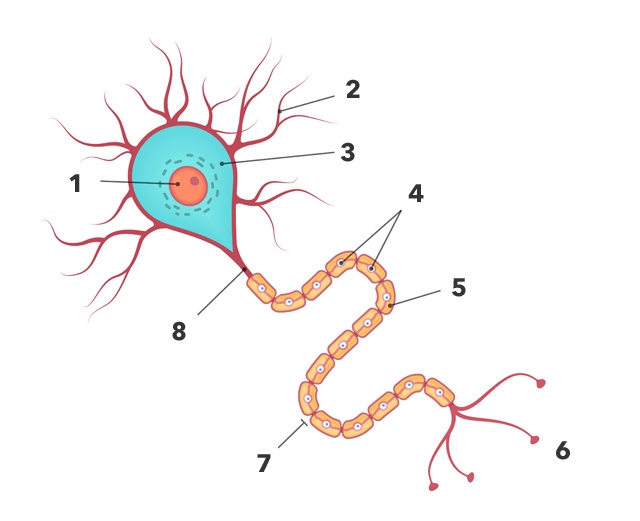
Identify #1

a)

axon

b)

cell body

c)

myelin sheath

d)

nucleus

57.

Identify #2

a)

axon

b)

cell body

c)

dendrite

d)

myelin sheath

58.

Identify #3

a)

axon

b)

cell body

c)

dendrite

d)

myelin sheath

59.
Which number is the vena cava?
a)
1
b)
2
c)
3
d)
8
60.
What does letter D represent?
a)
aorta
b)
left atrium
c)
left ventricle
d)
right atrium
61.
What carries the oxygenated blood from the lungs to the left atrium of the heart?
a)
vena cava 
b)
aorta
c)
pulmonary vein
d)
pulmonary artery
62.
The most muscular chamber of the heart is the 
a)
left ventricle
b)
left atrium
c)
right atrium
d)
right ventricle
63.
As the right ventricle contracts, the blood flows into the 
a)
Heart
b)
Pulmonary arteries 
c)
Atrium
d)
Ventricle 
64.

The right side of the heart contains...

a)

Oxygenated Blood

b)

De-oxygenated Blood

c)

Both Oxygenated and De-oxygenated Blood

d)

Water

65.

Which blood vessels has a thicker wall?

a)

Arteries

b)

Veins

c)

Neither both have the same thickness

d)

I'm not sure

66.

The first chamber that blood enters in the Heart is...

a)

The Atrium

b)

The Ventricle

c)

The Septum

d)

The Aorta

67.
Identify the structure the arrow is pointing to
a)
right atrium
b)
right ventricle
c)
left atrium
d)
left ventricle
68.
Enzymes are considered to be 
a)
Lipids
b)
Carbohydrate
c)
Protein
d)
Nucleic Acid
69.
What is the purpose  of an enzyme?
a)
give permission for the reaction
b)
raise activation energy
c)
speed up reactions
d)
control how many reactions occur
70.
Where do substrates bind on an enzyme?
a)
voltage-gated channels
b)
surface receptor
c)
calcium channels
d)
active site
71.
After the enzyme and substrate bind together and perform the reaction, what does the substrate become?
a)

asubstrate (s)

b)

enzyme(s)

c)

product(s)

d)

inhibitor(s)

72.
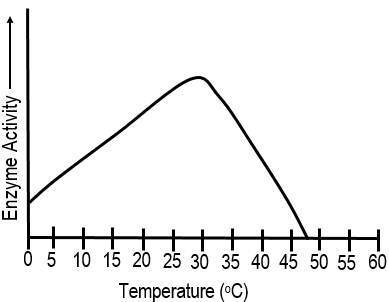
Based on the graph, what temperature does this enzyme work best? 
a)
15 C
b)
40 C
c)
30 C
d)
47 C
73.
Letter D...
a)
active site
b)
enzyme
c)
substrate
d)
products
74.
Letter B...
a)
active site
b)
enzyme
c)
substrate
d)
products
75.

A segment of DNA on a chromosome that codes for a specific trait

a)

allele

b)

phenotype

c)

gene

d)

genotype

76.

Different forms of a gene

a)

recessive

b)

dominant

c)

gene

d)

allele

77.

An organism's genetic makeup, or allele combinations.

a)

heterozygous

b)

genotype

c)

phenotype

d)

homozygous

78.

An organism's physical appearance, or visible traits.

a)

phenotype

b)

genotype

c)

dominant

d)

recessive

79.

An organism that has two identical alleles for a trait

a)

recessive

b)

dominant

c)

heterozygous

d)

homozygous

80.

An organism that has two different alleles for a trait

a)

homozygous

b)

heterozygous

c)

genotype

d)

phenotype

81.

An allele that is always expressed when present

a)

Recessive Allele

b)

Genetics

c)

Dominant Allele

d)

Heredity

82.

An allele that is masked or not expressed when a dominant allele is present

a)

Genotype

b)

Phenotype

c)

Dominant Allele

d)

Recessive Allele