
 Worksheets
Ecology Part 2 Biology
Total questions: 78
Worksheet time: 51mins
Name
Class
Date
1.
Temperature, light, air, water, and soil are all _____ parts of the environment
a)
alive
b)
biotic
c)
abiotic
d)
living
2.
Is a deer an abiotic or biotic factor?
a)
abiotic
b)
biotic
3.
Is a fern an abiotic or biotic factor?
a)
abiotic
b)
biotic
4.
Is a weather an abiotic or biotic factor?
a)
abiotic
b)
biotic
5.
Which of the following is not an abiotic factor?
a)
sun
b)
temperature
c)
soil
d)
grass
6.
a fish
a)
bitoic
b)
abiotic
7.
Individuals of a population who exit an area.
a)
Immigration
b)
Emigration
c)
Mitigation
d)
Lingation
8.
Individuals of a population who move into an area.
a)
Immigration
b)
Emigration
c)
Litigation
d)
Mastication
9.
The point in which an area cannot hold any more individuals in an area is called its what?
a)
carrying capacity
b)
capital capacity
c)
carrying capability
d)
limiting point
10.
Which of the following is NOT a resource needed for an organism to survive?
a)
food
b)
shelter
c)
water
d)
cell phone (unless you're Haley Ward)
11.
If the number of births in a population is the same as the number of deaths in a population, what will happen to the growth of the population?
a)
It will increase
b)
It will decrease
c)
It will stay the same
d)
It don't matter
12.
If the number of births is greater than the number of deaths in a population, what will happen to the growth of the population?
a)
It will increase
b)
It will decrease
c)
It will stay the same
d)
It don't matter
13.
What is the characteristic shape of a curve illustrating logistic growth?
a)
A. J-shaped
b)
B. U-shaped
c)
C. S-shaped
d)
D. L-shaped
14.

What type of growth model is this?
a)
exponential growth model
b)
logistic growth model
c)
Type I curve
d)
Type III curve
15.
Non-living factor that affects an ecosystem
a)
biotic factor
b)
abiotic factor
c)
food chain
d)
biome
16.
An environmental factor such as storms and extreme heat or cold that affects population regardless of their density
a)
density- dependent factor
b)
population density
c)
dispersion
d)
density- independent factor
17.
What is it called when a population's numbers get too large for the environment to support it?
a)
Exponential growth
b)
Logistic growth
c)
Natality
d)
Emigration
18.

What type of population growth does this graph represent?
a)
Abiotic growth
b)
Logistic growth
c)
Maximum growth
d)
Exponential growth
19.

Which habitat shows a population in uniform pattern?
a)
1
b)
2
c)
3
d)
None of them
20.
Which of the following is a density-independent factor?
a)
Rainfall
b)
Food
c)
Predation
d)
Shelter
21.
Which of the following is a density-dependent factor?
a)
Rainfall
b)
Flood
c)
Disease
d)
Natural Disasters
22.

What type of population growth does this graph represent?
a)
Minimum growth
b)
Logistic growth
c)
Exponential growth
d)
Carrying capacity growth
23.
What term describes when a population reaches its maximum number that the environment can support?
a)
Abiotic capacity
b)
Maximum growth level
c)
Carrying capacity
d)
Exponential capacity
24.

When is competition lowest?
a)
Lag phase
b)
Exponential phase
c)
Deceleration phase
d)
Stable phase
25.
What type of population growth does this graph represent?
a)
Minimum growth
b)
Logistic growth
c)
Exponential growth
d)
Carrying capacity growth
26.
What term describes when a population reaches its maximum number that the environment can support?
a)
Abiotic capacity
b)
Maximum growth level
c)
Carrying capacity
d)
Exponential capacity
27.
If the birthrate is greater than the deathrate, what will happen to the size of the population?
(birthrate > deathrate)
(birthrate > deathrate)
a)
It will increase
b)
It will decrease
c)
It will stay the same
d)
It will take over the world
28.
When is competition lowest?
a)
Lag phase
b)
Exponential phase
c)
Deceleration phase
d)
Stable phase
29.
A population is...
a)
A group of one species in one area
b)
Multiple species that live in one area
c)
All of the living and nonliving things in an area
d)
None of these
30.
Which kind of growth does the human population follow? It is described as a J-shaped curve.
a)
Exponential Growth
b)
Logistic Growth
c)
Outstanding Growth
31.

What type of growth is represented in the picture?
a)
exponential
b)
logistics
c)
representative
32.

What is the carrying capacity of the following graph?
a)
1000
b)
8000
c)
800
33.

What point on the graph represents the carrying capacity?
a)
A
b)
B
c)
C
d)
D
34.

What does the graph represent?
a)
Emigration
b)
Exponential growth
c)
Logistic Growth
35.
Which limiting factor is density independent?
a)
competition
b)
disease
c)
natural disasters
36.
What causes growth to stop in logistic growth?
a)
Emigration
b)
Immigration
c)
Carrying Capacity
37.
The graph of logistic growth can be described as...
a)
S-shaped
b)
J-shaped
c)
U-shaped
38.
An environmental factor such as predation, disease, and competition that depends on the number of members in a population per unit
a)
dispersion
b)
density- independent factor
c)
density- dependent factor
39.

An ecosystem is
a)
a community of biotic factors and their abiotic environment
b)
all living things on earth
c)
only animals that live in the ocean
d)
only animals that live on land
40.

Carrying capacity is
a)
the number of individuals an environment can support long term
b)
How long humans can reproduce
c)
the heaviest object a human can carry
41.
Limiting factors are
a)
energy, water, oxygen, space
b)
food and water
c)
only predators
d)
how many humans live in an environment
42.

When a population is under the carrying capacity
a)
the species will reproduce and grow
b)
the species will start to die off
c)
the species will become invasive
d)
the species will adapt
43.
Limiting factors
a)
keep a population balanced and healthy
b)
only allow the strongest species to survive
c)
only allow predators to survive
d)
allow populations to grow too large
44.
What kind of factor: predation?
a)
density-independent
b)
density-dependent
45.
What kind of factor: temperature?
a)
density-independent
b)
density-dependent
46.
What kind of factor: resource scarcity?
a)
density-independent
b)
density-dependent
47.
What kind of factor: flood?
a)
density-independent
b)
density-dependent
48.
What kind of factor: predation?
a)
density-independent
b)
density-dependent
49.

Predator population lags behind prey population because:
a)
Increase in predators leads to decrease in prey
b)
Increase in predators leads to increase in prey
c)
Increase in predators leads to decrease in producers
50.
What statement is TRUE about the graph?
a)
The prey is the green line because there needs to be more prey than predators.
b)
The prey is the red line because there needs to be more predators than prey.
c)
The green line is the producers
d)
The red line is the producers
51.
This is an example of a:
a)
Nitrogen Cycle
b)
Water Cycle
c)
Biosphere
d)
Predator Prey Relationship
52.

What is the carrying capacity of the following graph?
a)
1000
b)
8000
c)
800
d)
600
53.
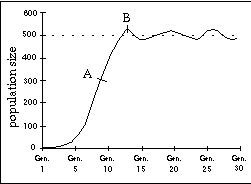
What is the carrying capacity of the graph?
a)
around 500
b)
more than 500
c)
less than 500
d)
around 600
54.
All of the following statements concerning characteristics of predator-prey relationship are correct EXCEPT:
a)
The population of predators most often eliminates the population of prey
b)
A rise in the population of predators is followed by a decrease in the population of prey.
c)
A rise in the population of prey is often followed by a rise in the population of predators.
55.

What is the carrying capacity of the predator?
a)
40
b)
80
c)
12000
d)
6000
56.

What is the carrying capacity of the prey?
a)
1000
b)
1500
c)
20
d)
40
57.
Which definition best matches the term population?
a)
A measurement of people for a specific area
b)
All the inhabitants of a particular area
c)
human beings in general
d)
the increase in the number of people in a particular area
58.

The number of people in a certain space such as a mile or kilometer is...
a)
population
b)
population density
c)
population distribution
59.

Population density in a desert would be...
a)
high
b)
low
c)
stable
60.
Which definition best matches the term population density?
a)
human beings in general
b)
number of people in a particular area
c)
A measurement of people per square mile/kilometer
d)
All the inhabitants of a particular area
61.
There are approximately 17,620 people per square mile in New York City. If New York City is 468 square miles, approximately how many people live in New York City?
a)
17,620
b)
8,246,160
c)
37
d)
.027
62.
A city has a population of 8792 people. The area of the city is approximately 6.5 square miles. Approximately, how many people per square mile live in the city?
a)
57148
b)
208
c)
1353
d)
135
63.
When many organ systems work together it can form...
a)
organ
b)
cells
c)
organ system
d)
organism
64.
What is it called when a group of the same organisms living together in the same place at the same time?
a)
An organism
b)
A population
c)
A community
d)
A biome
65.
The smallest unit of life that can sustain itself is called...
a)
an organism.
b)
the biosphere.
c)
a population.
d)
a community.
66.
What are groups of different populations living togther in the same place at the same time called?
a)
An organism
b)
A population
c)
A community
d)
A biosphere
67.
What is it called when you have groups of different populations along with their abiotic factors?
a)
An organism
b)
A population
c)
A community
d)
An ecosystem
68.
What is it called when you have groups of different populations along with their abiotic factors?
a)
An organism
b)
A population
c)
A community
d)
An ecosystem
69.
When all the ecosystems on Earth are combined it is called...
a)
a community.
b)
a biome.
c)
a biosphere.
d)
an Earthsphere.
70.
Andrea is on the grils cross country tream. She is heading out for a run when she comes across 20 Canadian geese. What level of organization is this group of Canadian geese?
a)
organism
b)
population
c)
community
d)
biome
71.
Jacob is going out to his grandparents fram. On the farm is a stream that he likes to fish at. When he is fishing he sees many differernt speacies of fish as well as maple and oak trees and dragonflies. What Jacob is seeing is an example of what level of organization?
a)
organism
b)
population
c)
community
d)
ecosystem
72.
A duck, a dragonfly, a morel mushroom and a bobcat are all examples of...
a)
organisms.
b)
populations.
c)
communties.
d)
ecosystems.
73.
Abby is walking to school with her best friend Jaylyn. They begin talking about everything they see including the ash trees, grass, weeds, ants, and people. They also notice how cold it is, how there are several large puffy clouds out, and how the sun is just starting to come up. What level of organization are they discussing?
a)
community
b)
ecosystem
c)
biome
d)
biosphere
74.
All of the student, faculty and staff at Hazelwood West high school are considered what level of organization?
a)
A population
b)
A community
c)
A biome
d)
An ecosystem
75.
What are the ecological levels of organization from smallest to the largest?
a)
organism, population, community, ecosystem, biome, biosphere
b)
organism, community, population, ecosystem, biome, biosphere
c)
organism, population, community, biome, ecosystem, ecosphere.
d)
organism, community, population, biome, ecosystem, ecosphere
76.
A group of the same species living together is a(n)
a)
population
b)
community
c)
ecosystem
d)
biome
77.
Living factors or organisms that affect an ecosystem
a)
abiotic factors
b)
species
c)
trophic level
d)
biotic factors
78.
Which of the following correctly lists the levels of organization from least complex to most complex?
a)
Community, Biome, Organism, Population, Ecosystem
b)
Biome, Population, Community, Ecosystem, Organism
c)
Organism, Population, Community, Ecosystem, Biome
d)
Ecosystem, Population, Organism, Biome, Community
100 %

