wayground logo

Free Printable Worksheets

Font size

S
M
L
XL
Worksheets

Biology Midterm Review

Total questions: 80

Worksheet time: 1hrs 2mins
Name
Class
Date
1.
Which of the following statements is not part of the cell theory?
a)
Cells are the basic unit of structure and function in all living things.
b)
All cells are produced from other cells.
c)
Only animal cells are composed of cells.
d)
All living things are composed of cells.
2.
All cells come from___________ cells.
a)
pregnant
b)
pre-existing
c)
paternal
d)
pin size
3.

During the process of photosynthesis, plants use energy from the Sun to transform carbon dioxide from the air into

a)

oxygen gas and molecules of sugar.

b)

protein and minerals.

c)

minerals and liquid carbon dioxide.

4.

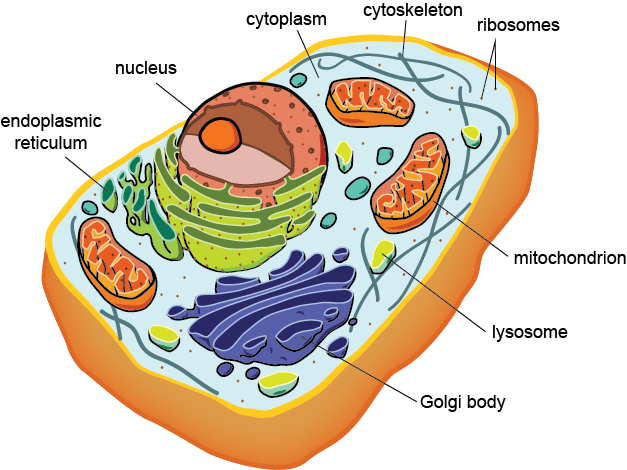
The organelle picture is

a)

Cell Wall

b)

Mitochondrian

c)

Cytoplasm

5.

converts sunlight to energy

a)

cytoskeleton

b)

chloroplast

c)

nucleus

d)

ribosome

6.

contains DNA and directs activities of the cell

a)

chloroplast

b)

chromosome

c)

ribosome

d)

nucleus

7.

converts chemical energy into ATP

a)

endoplasmic reticulum

b)

golgi apparatus

c)

vacuole

d)

mitochondria

8.
What structures distinguish a plant cell from an animal cell?
a)
Plant cells have cell walls and ribosomes.
b)
Plant cells have cell walls and chloroplasts.
c)
Plant cells have chloroplasts and ribosomes.
d)
Plant cells have chloroplasts and mitochondria.
9.

What structures do all cells have in common?

a)

cytoplasm

b)

Ribosomes

c)

DNA

d)

cell membrane

e)

nucleus

10.
Bacteria is what kind of cell?
a)
Eukaryotic
b)
Prokaryotic
11.
What kind of cell is this?
a)
Eukaryotic
b)
Prokaryotic
12.
What type of cell has a nucleus? 
a)
eukaryotic
b)
prokaryotic 
13.
Plants and animal cells are examples of ___ cells 
a)
prokaryotic cells 
b)
eukaryotic cells 
14.
Which of the following is a characteristic of both Eukaryotic and Prokaryotic cells?
a)
ribosomes
b)
nucleus
c)
membrane bound organelles
d)
simple
15.
Which of the following is found inside a prokaryote?
a)
cytoplasm
b)
DNA
c)
ribosomes
d)
all of these
16.

Which is true of prokaryotic and eukaryotic cells?

a)

Prokaryotic cells are larger than eukaryotic cells.

b)

Eukaryotic cells do not have nuclei, and prokaryotic cells do have nuclei.

c)

Prokaryotic cells lack membrane-bound organelles, and eukaryotic cells contain membrane-bound organelles.

d)

Eukaryotic cells are simpler than prokaryotic cells.

17.
What does "bilayer" mean?
a)
one layer
b)
two layers
c)
laminated
d)
bilateral
18.
Describes the arrangement of the cell membrane as bendable and made of many parts. 
a)
The Fluid Mosaic Model 
b)
The Major Mobility Model 
c)
The Crazy Cell Model
d)
The Maze Model
19.
___________ allow cells to recognize each other and act like ID tags. 
a)
Carbohydrates 
b)
Proteins
c)
Phospholipids 
d)
Cholesterol
20.
___________ strengthens and stabilizes the cell membrane.
a)
Carbohydrates 
b)
Proteins 
c)
Phospholipids 
d)
Cholesterol
21.
___________ form the two layers of the cell membrane. 
a)
Carbohydrates 
b)
Proteins 
c)
Phospholipids 
d)
Cholesterol
22.
Something is ___________ ____________
when some molecules can cross the membrane while others cannot. 
a)
Selectively (or Semi) Permeable 
b)
Totally Transparent
c)
Liquid Licorice 
d)
Heavily Patrolled 
23.
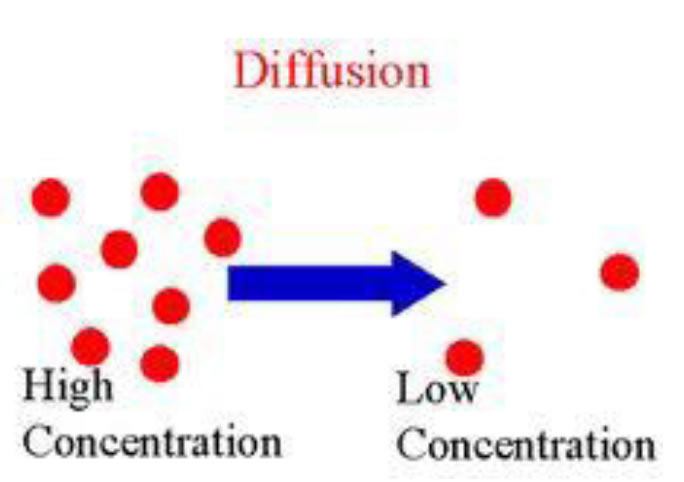
Movement of particles from high to low concentration. 
a)
Passive Transport
b)
Active Transport
24.
Osmosis is a form of ______________. 
a)
Passive Transport
b)
Active Transport
25.
What is it called when molecules move across the cell membrane from an area of high concentration to an area of low concentration through a carrier protein?
a)
Diffusion
b)
Osmosis
c)
Active Transport
d)
Facilitated Diffusion
26.
This picture represents what type of cell transport?
a)
endocytosis
b)
exocytosis
c)
osmosis
d)
passive transport
27.
Osmosis is the movement of _____ across a membrane.
a)
food
b)
energy
c)
oxygen
d)
water
28.
This picture represents which type of cellular transport?
a)
passive transport
b)
endocytosis
c)
exocytosis
d)
osmosis
29.
Which is true about active transport?
a)
It requires energy
b)
it does not require energy
c)
It moves substances down the concentration gradient
d)
it moves material from high to low concentration
30.
In a nerve cell, ATP energy is used to pump sodium (Na) out of the cell and potassium (K) into the cell. This is an example of...
a)
Facilitated Diffusion
b)
Simple Diffusion
c)
Active Transport
d)
Osmosis
31.
The cell below is in a _________ solution.
a)
Hypotonic
b)
Hypertonic
c)
Isotonic
32.
The cell below is in a _____________ solution.
a)
Hypertonic
b)
Hypotonic
c)
Isotonic
33.
A cell in an isotonic solution will
a)
swell
b)
shrink
c)
stay the same size
d)
impossible to tell
34.
A cell in a hypotonic solution will
a)
swell
b)
shrink 
c)
stay the same size
d)
impossible to tell
35.
Which organelle performs PHOTOSYNTHESIS?
a)
Chloroplast
b)
Mitochondria
36.
Which of the following is the correct equation for PHOTOSYNTHESIS?
a)
CO+ light + H2O --> O+ Sugar
b)
CO+ sugar + H2O --> O+ light
c)
O2 + light + H2O --> CO+ Sugar
d)
CO+ O2 + H2O --> Light+ Sugar
37.
What are the products of photosynthesis?
a)
water and carbon dioxide
b)
oxygen and glucose
c)
oxygen and carbon dioxide
d)
oxygen and water
38.
What is one of the reactants of cellular respiration?
a)
energy
b)
glucose
c)
carbon dioxide
d)
water
39.
In which way are photosynthesis and cellular respiration different?
a)
Cellular respiration stores ATP, while photosynthesis releases ATP.
b)
Cellular respiration produces oxygen, while photosynthesis uses oxygen.
c)
Photosynthesis releases energy, while cellular respiration stores energy.
d)
Photosynthesis used carbon dioxide, while cellular respiration produces carbon dioxide.
40.
What is the correct equation for cellular respiration?
a)
6O2 + C6H12O6 -> 6CO2 + 6H2O + Energy
b)
6O2 + C6H12O6 + Energy -> 6CO2 + 6H2O
c)
6CO2 + 6H2O -> 6O2 + C6H12O6 + Energy
d)
6CO2 + 6H2O + Energy -> 6O2 + C6H12O6
41.
This process releases chemical energy from sugars and other carbon-based molecules to make ATP when oxygen is present.
a)
photosynthesis
b)
light-independent reaction
c)
cellular respiration
d)
light-dependent reaction
42.
Cellular respiration takes place in the
a)
nucleus
b)
cytoplasm
c)
ribosomes
d)
mitochondria
43.
The first stage of the cell cycle during which the cell matures and prepares to divide and copies its DNA; The stage the cell stays in the most
a)
interphase
b)
prophase
c)
metaphase
d)
anaphase
44.
Which of the following describes the purpose of the mitosis cell cycle?
a)
To make more of the same cells.
b)
For growth and repair.
c)
To prevent the cell from becoming too large.
d)
All of the above.
45.
What is the result of mitosis?
a)
1 cell
b)
2 genetically identical cells
c)
2 genetically different cells
d)
4 genetically identical cells
46.
Fruit fly body cells have 8 chromosomes. After mitosis, you would expect a resulting fruit fly daughter cell to have -
a)
16 chromosomes.
b)
46 chromosomes.
c)
8 chromosomes.
d)
4 chromosomes.
47.
The cells produced via meiosis are called:
a)
sex cells
b)
somatic cells
c)
body cells
d)
skin cells
48.
If a body cell in a butterfly contains 24 chromosomes, a butterfly egg would contain
a)
3
b)
6
c)
12
d)
24
49.
How many daughter cells are produced from meiosis ?
a)
10
b)
6
c)
4
d)
2
50.
What process, and which type of resulting cells are represented?
a)
mitosis, gametes
b)
mitosis, body cells
c)
meiosis, gametes
d)
meiosis, body cells
51.
Meiosis makes sperm and egg cells. In humans, sperm and egg cells each have _____ chromosomes. Therefore a fertilized human egg cell (sperm and egg cell combined) would create a cell with _____ chromosomes.
a)
23, 46
b)
46, 23
c)
2, 4
d)
50, 100
52.
Proteins are made of monomers called ___________
a)
Nucleotides
b)
Monosaccharides
c)
Amino Acids
d)
Glycerol and fatty acids
53.
DNA and RNA are examples of 
a)
Carbohydrates
b)
Lipids
c)
Proteins
d)
Nucleic Acids
54.
Monosaccharides are monomers of
a)
Carbohydrates
b)
Lipids
c)
Proteins
d)
Nucleic Acids
55.
Glycerol and fatty acids are the monomers of
a)
Carbohydrates
b)
Lipids
c)
Proteins
d)
Nucleic Acids
56.
What type of macromolecule are enzymes?
a)
Protein
b)
Carbohydrate
c)
Lipid
d)
Nucleic Acid
57.
What is the purpose  of an enzyme?
a)
give permission for the reaction
b)
raise activation energy
c)
speed up reactions
d)
control how many reactions occur
58.
Where do substrates bind on an enzyme?
a)
voltage-gated channels
b)
surface receptor
c)
calcium channels
d)
active site
59.
Enzymes are capable of increasing the rate of a chemical reaction within a living cell.  Enzymes accomplish this through which of the following means?
a)
reducing the number of products   
b)
reducing the activation energy
c)
increasing the temperature of the cell
d)
increasing the concentration of reactants 
60.
How do enzymes speed up chemical reaction?
a)
Increasing activation energy
b)
Decreasing activation energy
c)
Increasing deactivation energy
d)
Decreasing deactivation energy
61.
What is a substance called if it speeds up a chemical reaction?
a)
reusable
b)
catalyst
c)
specific
d)
fragile
62.
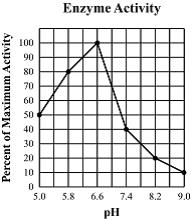
Which of the following conclusions can be drawn from this graph?
a)
The optimum pH of the enzyme is 6.6.
b)
The optimum pH of the enzyme is 5.8
c)
The enzyme’s activity increases as pH increases 5.0 to 9.0
d)
The enzyme’s activity is greater around pH of 8.0 .
63.
What happens when enzymes are heated to a high temperature?
a)
The enzymes die.
b)
The shapes of the enzyme are altered denature
c)
The enzymes' amino acid sequence changes.
d)
The enzymes remain the same
64.
The pH at which an enzyme is most efficient is called the _________ pH of an enzyme.
a)
neutral
b)
optimum
c)
minimum
d)
experimental 
65.

Phenotype refers to the ______________________ of an individual.

a)

genetic makeup

b)

actual physical appearance

c)

recessive alleles

66.
The observable traits of an organism are known as its
a)
allele
b)
dominance
c)
phenotype
d)
genotype
67.
In snapdragons, Tallness (T) is dominant to dwarfness (t). In a cross between two plants that are heterozygous for this trait, the percent of offspring expected to exhibit dwarfness is
a)
 25%
b)
100%
c)
50%
d)
0%
68.
An organism that has two identical genes for a trait is said to be
a)
heterozygous
b)
homozygous
c)
a hybrid
d)
incompletely dominant
69.
Which of these would best be described as a phenotype?
a)
Bb
b)
Pp
c)
brown hair
d)
mutation
70.
A Heterozygous yellow pea plant's genotype would be:
a)
YY
b)
yy
c)
Yy
d)
Yg
71.
The passing of traits from parents to offspring
a)
Genetics
b)
Geneology
c)
Heredity
d)
Allele
72.
The study of heredity is known as
a)
Hereditology
b)
Genetics
c)
Biology
d)
Law of Heredity
73.
What is an organism's genetic makeup known as?
a)
Phenotype
b)
Chromosome
c)
DNA
d)
Genotype
74.
If B=brown & and b=red, what would the genotype(s) be for an individual with brown hair?
a)
bb
b)
Bb
c)
BB
d)
BB and Bb
75.
Your gametes are your:
a)
sperm & egg
b)
body cells
c)
somatic cells
d)
organ and tissue cells
76.
Which of the following genotypes is homozygous dominant?
a)
A
b)
Aa
c)
AA
d)
aa
77.
Which of the following genotypes is heterozygous?
a)
Bb
b)
BB
c)
bb
d)
B
78.
Which of the following genotypes is homozygous recessive?
a)
Tt
b)
tt
c)
TT
d)
T
79.
Cross Two Homozygous plants
(
RRYY x rryy)
R = round seeds, r  = wrinkled seeds Y = yellow seeds, y = green seeds
What percent will have Round and Yellow seeds? 

a)
0%
b)
25%
c)
50%
d)
100%
80.
How many alleles (letters) does a child get from each parent for each trait?
a)
1
b)
2
c)
3
d)
4