wayground logo

Free Printable Worksheets

Font size

S
M
L
XL
Worksheets

Year 10 Biology End of Year

Total questions: 85

Worksheet time: 1hrs 1mins
Name
Class
Date
1.
An organism that can make its own food
a)
Heterotroph
b)
Autotroph
c)
Herbivore
d)
Vegetarian
2.
Organisms that cannot make their own food and must obtain energy from external sources are called
a)
autotrophs
b)
heterotrophs
c)
thylakoids
d)
plants
3.
An organism that is composed of more than one cell is also known as a _____ organism.
a)
Prokaryotic
b)
Unicellular
c)
Multicellular
d)
Autotrophic
4.
Multicellular organisms that use sunlight to create food are grouped into the _____________  kingdom.
a)
plant
b)
animal
c)
fungi
d)
protist
5.
What can an autotrophic organism do that a heterotrophic organism can NOT?
a)
Make their own food 
b)
Have a nuclues
c)
Reproduce through binary fission
d)
They're the same
6.
An organism made up of one cell
a)
Multicelluar
b)
Eukaryotic
c)
Unicellular
d)
Prokaryotic
7.

Which process releases the most energy from one molecule of glucose?

a)

aerobic respiration

b)

anaerobic respiration in muscle

c)

anaerobic respiration in yeast

d)

photosynthesis

8.

What is a characteristic of all living organisms?

a)

breathing

b)

circulation

c)

egestion

d)

sensitivity

9.

A student was walking along a road when he saw an object under a tree.When the student touched the object it changed colour, rolled over and divided into two.

Which characteristics of living organisms has the object shown?

a)

excretion movement nutrition

b)

growth reproduction sensitivity

c)

movement reproduction respiration

d)

movement reproduction sensitivity

10.

organ systems are...

a)

livning things working together

b)

organs working together to perform a task

c)

cells working together to perform a task

d)

molecules working together to perform a task

11.

a heart is an example of

a)

a cell

b)

an organ system

c)

a tissue

d)

an organ

12.
During Respiration carbon dioxide gas (CO2) is produced.  When we exhale(breathe out) we expel(get rid of) the carbon dioxide gas from our bodies.  This is an example of
a)
Excretion
b)
Development
c)
Nutrition
d)
Movement
13.
A fox is chasing a rabbit to catch and eat it.  The rabbit is running away so it can survive.
Both animals are showing examples of
a)
Nutrition
b)
Reproduction
c)
Movement
d)
Sensitivity
14.
Some prokaryotes and eukaryotes have a cellular structure called a flagella.  What is the purpose of the flagella?
a)
to transport molecules across the cell membrane
b)
to propel the cell through liquid
c)
to collect food for the cell
d)
to tell the cell the direction of a food source
15.
Which type of cell has no nucleus?
a)
Eukaryote
b)
Prokaryote
c)
Animal
d)
Plant
16.
 You would find mushrooms in which kingdom?
a)
Plantae
b)
Protists
c)
Fungi
d)
Animalia
17.
What do viruses need to reproduce?
a)
they need genetic material
b)
They need a host cell
c)
They need  bacteria
d)
They need insulin
18.
True or False
The flu is caused by a virus.
a)
true
b)
false
19.
A pathogen.........
a)
makes proteins
b)
causes infection or disease
c)
is made of cells
d)
is a living thing
20.

Are viruses made of cells?

a)

YES

b)

NO

21.
Which are examples of fungi?
a)
mold
b)
yeast
c)
mushrooms
d)
all of the above
22.
What part of a fungus is described as long, thread-like structures that absorb nutrients?
a)
roots
b)
fruit body
c)
hyphae
d)
spores
23.
Protoctists are one-celled organisms with a ______________ that are not fungi, plants, or animals.
a)
hard outer shell
b)
chromosome
c)
flagella
d)
nucleus.
24.
One sporozoan, Plasmodium, causes the disease _________.
a)
mumps
b)
measles
c)
chicken pox
d)
malaria
25.
Many cells of the same type form a _____.
a)
Organism
b)
Chloroplast
c)
Tissue
d)
Organ system
26.
Two or more kinds of tissues together form an _____.
a)
Organ
b)
Chloroplast
c)
Cell
d)
Tissue
27.
Organ systems working together form a living _____.
a)
Chloroplast
b)
Tissue
c)
Cell
d)
Organism
28.
Which organelle belongs in plant cells only?
a)
Cell Membrane
b)
Mitochondrion
c)
Chloroplast
d)
Nucleus
29.
Which organelle belongs in plant cells only?
a)
Cytoplasm
b)
Mitochondrion
c)
Cell Wall
d)
Nucleus
30.
Which organelle belongs in plant cells only?
a)
Cytoplasm
b)
Mitochondrion
c)
Large Central Vacuole
d)
Cell Membrane
31.
Which organelle belongs in both plant and animal cells?
a)
Chloroplast
b)
Cell Wall
c)
Large Central Vacuole
d)
Cell Membrane
32.
Which of the following lists these levels in the correct order of organization from the simplest to the most complex?
a)
cells, tissues, organs, organ systems, organisms
b)
organisms, organ systems, organs, tissues, cells
c)
tissues, cells, organs, organisms, organ systems
d)

organs, organ systems, organisms, cells, tissues

33.
What organelle is called the "powerhouse" of a cell?

a)
Endoplasmic Reticulum
b)
Nucleus
c)
Mitochondria
d)
Nucleolus
34.
This organelle is in both plants and animals. It is a barrier between the cell and the environment.  It controls what goes in and out of a cell.
a)
cell wall
b)
cell membrane
c)
cell organelles
d)
mitochondria
35.
This cell part is in ALL cells. It is the gel-like substance that provides cell shape.
a)
Chloroplasts
b)
Chromosomes
c)
Cytoplasm
d)
Mitochondria
36.
What cells have NO nucleus?
a)
Leaf cells
b)
Animal cells
c)
Red blood cells
d)
egg cells
37.
What cells carry electrical signals?
a)
Red Blood Cells
b)
Palisade Cells
c)
Sperm cells
d)
Nerve Cells
38.
The role of these specialised cells is to help fight off infection and foreign bodies.
a)
Palisade Cells
b)
Nerve Cells
c)
White Blood Cells
d)
Red Blood Cells
39.
 What is another name for a palisade cell?
a)
Egg cell
b)
Sperm Cell
c)
Leaf cell
d)
Animal cell
40.
Diffusion is...
a)
movement of a substance from high concentration to low concentration
b)
movement of a substance from low concentration to high concentration
c)
Movement of a substance
41.
Medical researchers are interested in stem cells because they?
a)
are found in all types of tissues
b)
can produce different cells types
c)
are highly specialized
d)
are found only in embryos
42.
The process by which cells become specialized is known as?
a)
stem cell research
b)
embryonic development 
c)
totipotent cell strucutre
d)
cell differentiation 
43.
What is a stem cell?
a)
a cell that has a stem
b)
an unspecialized cells from which differentiated cells develop 
c)
cells that are found in plant stem
d)
cells that are found in bacteria only
44.
A biological polymer made of amino acid monomers is a 
a)
protein
b)
lipid
c)
carbohydrate
d)
nucleic acid
45.
What is the primary function of carbohydrates in your body?
a)
Speed up chemical reactions.
b)
Transfer immediate energy.
c)
Help to store energy.
d)
Build cell walls in plants.
46.
A group of organic molecules that includes sugars, starch, and cellulose care called...
a)
proteins
b)
carbohydrates
c)
nucleic acids
d)
lipids
47.
A class of biological molecules whose defining characteristic is their relative insolubility in water. Examples of these include steroids, oils, fats, and fatty acids.
a)
protein
b)
monomer
c)
lipids
d)
glycogen
48.
What is the formula of Glucose?
a)
C3H16O36
b)
C632H123O239
c)
C6H12O6
d)
C12H6O12
49.
Which of the following tests for starch?
a)
Iodine
b)
Benedicts
c)
Biuret
50.
Which of the following tests for protein?
a)
Iodine
b)
Benedicts
c)
Biuret
51.
Which of the following tests for glucose?
a)
Iodine
b)
Benedicts
c)
Biuret
52.
When starch is present iodine turns...
a)
purple
b)
blue-black
c)
orange
53.
When protein is present Biuret turns...
a)
purple
b)
blue-black
c)
orange
54.
When small amounts of glucose is present Benedicts turns...
a)
purple
b)
blue-black
c)
orange
d)
green
55.
When large amounts of glucose is present Benedicts turns...
a)
purple
b)
blue-black
c)
brick-red
d)
green
56.

How do enzymes speed up chemical reaction?

a)

Increasing activation energy

b)

Decreasing activation energy

c)

Increasing deactivation energy

d)

Decreasing deactivation energy

57.
What is a substance called if it speeds up a chemical reaction?
a)
reusable
b)
catalyst
c)
specific
d)
fragile
58.
Each enzyme only has 1 substrate that will fit its active site.  What is this called?
a)
reusablility
b)
denaturation
c)
specificity
d)
fragility
59.
With what 3 letters do enzymes typically end?
a)
-ose
b)
-ase
c)
-ese
d)
-tic
60.
Any substance that is acted upon by an enzyme is called a(n)?
a)
Coenzyme
b)
Substrate
c)
Vitamin
d)
Polypeptide
61.
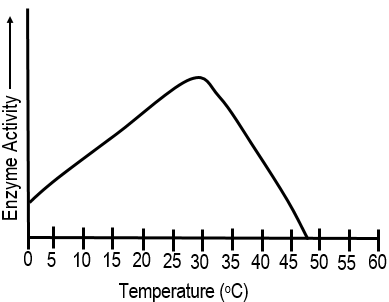
Based on the graph, what is the optimal temperature for this enzyme? 
a)
15oC
b)
40oC
c)
30oC
d)
35oC
62.
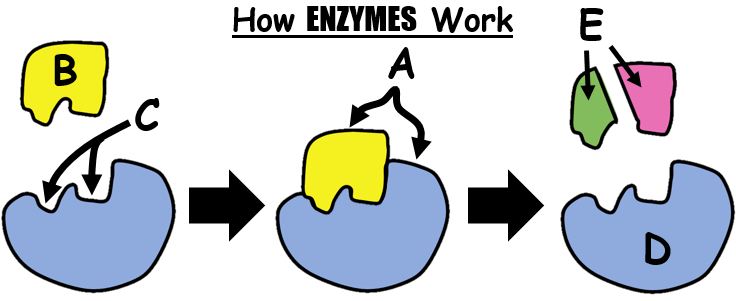
In the diagram, what is letter A? 
a)
product
b)
substrate
c)
enzyme-substrate complex
d)
active site
63.
An enzyme speeds up a chemical reaction in the cell but can only be used once.  True or False? 
a)
true
b)
false
64.
What happens when enzymes are heated to a high temperature?
a)
The enzymes die.
b)
The shapes of the enzyme are altered denature
c)
The enzymes' amino acid sequence changes.
d)
The enzymes remain the same
65.
Which of these is most likely an enzyme?  
a)
Sucrose
b)
Galactose
c)
Fructose
d)
Amylase
66.
Babies do not have well developed digestive systems for breaking down proteins; therefore baby food is prepared after treatment with which enzyme? 
a)
protease
b)
lipase
c)
carbohydrase
d)
synthase
67.
The pH at which an enzyme is most efficient is called the _________ pH of an enzyme.
a)
neutral
b)
optimum
c)
minimum
d)
experimental 
68.
What is the term that describes the movement of molecules that require no energy (ATP)?
a)
active transport
b)
cell transport
c)
passive transport
d)
all cells require energy for transport.
69.
What is the process where molecules move from areas of high concentration to low concentration?
a)
osmosis
b)
active transport
c)
diffusion
d)
plasmolysis
70.
What will happen to the dye molecules in the beaker over time?
a)
all stay at top 
b)
all sink to the bottom
c)
spread out evenly (equilibrium)
d)
nothing will happen
71.
Osmosis is the movement of what kind of molecule?
a)
dye
b)
water
c)
oxygen
d)
cells
72.
When a cell collapses, they lose cell pressure or ....
a)
memory
b)
turgor
c)
color
d)
strength
73.
The movement of molecules from an area of LOW concentration to HIGH and that requires energy is....
a)
osmosis 
b)
passive transport 
c)
active transport
d)
plasmolysis
74.
The _______ regulates what enters and leaves the cell.  
a)
cell membrane
b)
nucleus
c)
mitochondria
d)
cytoplasm
75.
Looking at the diagram, which way will the water molecules move during osmosis?
a)
Out of the cell, so the cell swells.
b)
Out of the cell, so the cell shrinks.
c)
Into the cell, so the cell shrinks.
d)
Into the cell, so the cell swells.
76.

The mode of taking food by an organism and its utilization by the body is known as

a)

Nutrition

b)

Digestion

c)

Photosynthesis

d)

None of the above

77.

The ultimate source of energy for all living organisms is

a)

the Sun

b)

Plants

c)

Animals

d)

None of the above

78.
There are more chloroplasts in the palisade mesophyll cells than in spongy mesophyll cells.
a)
True
b)
False
79.
Stomata open to allow gas exchange to take place during photosynthesis. 
a)
True
b)
False
80.
The equation for photosynthesis is
a)
oxygen + water --> glucose + carbon dioxide
b)
oxygen + glucose --> carbon dioxide + water
c)
carbon dioxide + water --> glucose + oxygen
d)
carbon dioxide + glucose --> oxygen + water
81.
Why does temperature have an effect on the rate of photosynthesis?
a)
Higher temperature allows carbon dioxide to diffuse into the leaves faster.
b)
Higher temperature allows water to be transported to the leaves faster.
c)
Higher temperature allows the stomata to open wider.
d)
Higher temperature allows the enzymes to function better.
82.
Which organelle performs PHOTOSYNTHESIS?
a)
Chloroplast
b)
Mitochondria
83.
What is the pigment in chloroplasts that performs photosynthesis?
a)
Chlorosynthesis
b)
Chlorophyll
c)
ADP
d)
Electron Transport
84.
Villi present in the small intestine are important because they create more ______ so that more digested food can be abosrbed into the blood stream.
a)
feces
b)
enzymes
c)
lipids
d)
surface area
85.
Food is moved slowly through the digestive system though muscular contraction.
a)
mechanical
b)
peristalsis
c)
surface area
d)
feces