wayground logo

Free Printable Worksheets

Font size

S
M
L
XL
Worksheets

EOC Review

Total questions: 90

Worksheet time: 2hrs 49mins

Name
Class
Date
1.
Proteins are made of monomers called ___________
a)
Nucleotides
b)
Monosaccharides
c)
Amino Acids
d)
Glycerol and fatty acids
2.
_________ are composed out of carbon (C), hydrogen (H), oxygen (O), nitrogen (N), and phosphorus (P)
a)
Carbohydrates
b)
Lipids
c)
Proteins
d)
Nucleic Acids
3.
DNA and RNA are examples of 
a)
Carbohydrates
b)
Lipids
c)
Proteins
d)
Nucleic Acids
4.
Which macromolecule is shown?
 View Figure 1 (if not visible)
a)
lipid
b)
protein
c)
nucleic acid
d)
carbohydrate
5.
Which macromolecule is shown?
 View Figure 3 (if not visible)
a)
lipid
b)
protein
c)
nucleic acid
d)
carbohydrate
6.
Which macromolecule is shown?
 View Figure 4 (if not visible)
a)
lipid
b)
protein
c)
nucleic acid
d)
carbohydrate
7.
Which macromolecule stores energy, insulates us, and makes up the cell membrane?
a)
lipids
b)
proteins
c)
carbohydrates
d)
nucleic acids
8.
This is one job proteins do NOT have in the body
a)
insulation
b)
structure for tissues and organs
c)
speed up chemical reactions
d)
transport things through cell membrane
9.
The equation below represents a biological process. Where is this process completed?

carbon dioxide + water ->  glucose + oxygen
a)
mitochondria
b)
ribosomes
c)
cell membrane
d)
chloroplasts
10.
What function does ATP carry out in living things?
a)
aids in protein folding and coiling
b)
used to capture and transfer energy
c)
identifies DNA start sequences for transcription
d)
helps maintain the fluidity of cell membranes
11.
The reactant(s) for photosynthesis are
a)
C6 H12 O6 + 6O2
b)
6CO2 + 6 H2O
c)
ATP
d)
C6 H12 O6
12.
A plant species lives in an area with limited sunlight. Which physiological adaptation would be most useful to the plant?
a)
colorful flowers
b)
 large leaves
c)
deep roots
d)
thin cuticle
13.
Where does growth happen in a plant?
a)
Dermal Tissue
b)
Ground Tissue
c)
Vascular Tissue
d)
Meristem
14.
Cellular Respiration occurs in
a)
only plants
b)
only animals
c)
both plants and animals
d)
neight plants nor animals
15.
Which of the following structure is where photosynthesis occurs in the cell?
a)
nucleus
b)
chloroplast
c)
mitochondria
d)
endoplasmic reticulum
16.
A diagram representing the relationship between photosynthesis and cellular respiration is shown.
The numbered boxes in the diagram represent which of the following?
a)
1 - water; 2 - nitrogen
b)
1 - nitrogen; 2 - oxygen
c)
1 - oxygen; 2 - carbon dioxide
d)
1 - carbon dioxide; 2 – water
17.
What causes ATP to increase over time?
a)
Active transport
b)
Cell movement
c)
Cellular Respiration
d)
Photosynthesis
18.
What is the male part of a flower called?
a)
Pistil
b)
Petal
c)
Sepal
d)
Stamen
19.
What is the female part of a flower called?
a)
Stamen
b)
Pistil
c)
Petal
d)
Anther
20.
Why is DNA important? Pick the best answer. 
a)
It makes bacteria proteins
b)
it serves as the universal blueprint for traits for humans.
c)
it serves as the universal blueprint for traits of all living things
d)
it serves as the universal blueprint for traits for animals only.
21.
Which of the following identifies the processes correctly?
a)
X;Translation; Y:Replication; Z:Transcription 
b)
X:Replication; Y:Transcription; Z:Translation
c)
X:Transcription; Y:Replication; Z:Mutation
d)
X:Replication; Y:Mutation; Z:Translation
22.
Which sequence of DNA bases would pair with this partial strand
ATG TGA CAG
a)
ATG TGA CAG
b)
TAC ACT GTC
c)
GTA AGT GAC
d)
CAT TCA CTG
23.
In a molecule of double-stranded DNA, the amount of Adenine present is always equal to the amount of
a)
cytosine
b)
guanine
c)
thymine
d)
uracil
24.
Which is the mRNA molecule that would be transcribed from this DNA template:
TGGCAAGTACGT
a)
ACCGTTCATGCA
b)
UGGCAAGUACGU
c)
UCCGUUCUUGCU
d)
ACCGUUCAUGCA
25.
order of replication
a)
3, 2, 1, 4
b)
2, 1, 4, 3
c)
2, 3, 1, 4
d)
3, 4, 1, 2
26.
What is the correct amino acid for the following codon:
 AUG 
a)
Val
b)
Met
c)
Tyr
d)
Gly
27.
Which of the following best illustrates natural selection? 
a)
An organism with favorable genetic variations will tend to survive and breed successfully
b)
A population monopolizes all of the resources in its habitat, forcing other species to migrate
c)
A community whose members work together utilizing all existing resources and migratory routes
d)
The largest organism in the species receive the only breeding opportunities
28.
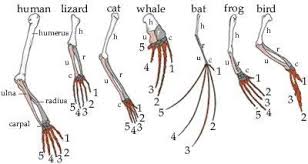
What is this an example of?
a)
vestigial structures
b)
embryology
c)
homologous structures
d)
fossil record
29.
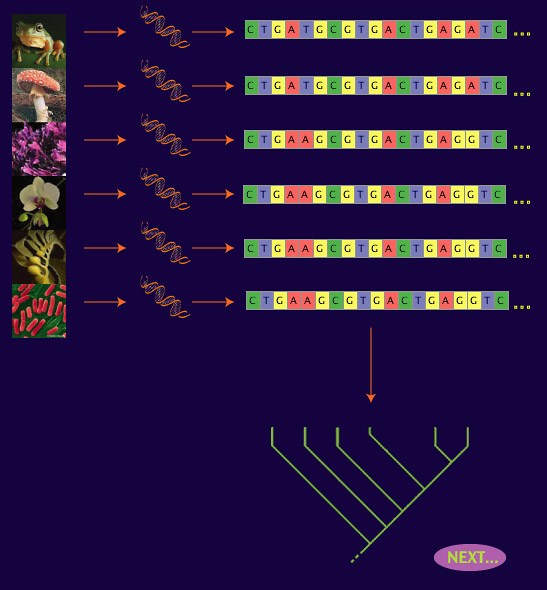
Two organisms that are closely related would have
a)
very similar DNA sequence
b)
exactly the same DNA sequences
c)
no proteins in common
d)
completely different DNA sequence
30.
What is suggested by the similarity of early embryos of different species of vertebrates?
a)
no evolutionary relationships between the groups
b)
recent common ancestry
c)
similar environments in the past
d)
evolution froma distant common ancestor
31.
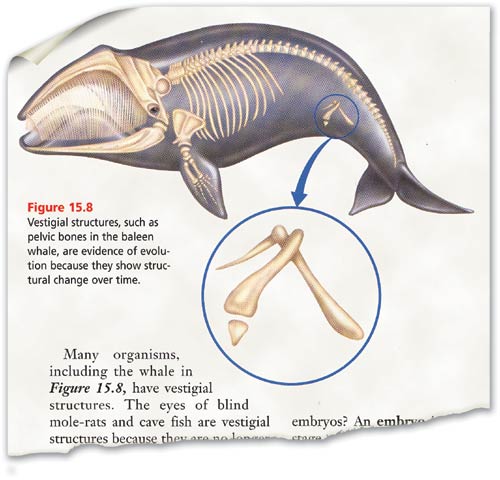
Which of the following is an example of a vestigial structure?
a)
the wings of a red-tailed hawk
b)
the hind limbs of a house cat
c)
the fins of sharks
d)
the tailbone of a human
32.
According to the law of superposition, the oldest fossils are found 
a)
At the top of the rock layers
b)
Near the bottom of the rock layers
c)
In the middle of the rock layers
d)
Somewhat near the surface
33.
According to the data, the unknown bacterial species is most closely related to...
a)
Species I
b)
Species II
c)
Species III
d)
Species IV
34.
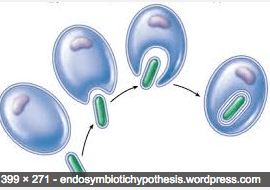
What is the belief of the theory shown
a)
Natural selection is the main mechanism of evolution
b)
Prokaryotes might have entered the host cell as prey or parasites.
c)
Life can come from non-living matter 
d)
Life can only arise from life. 
35.
Miller/Urey and other scientists have shown that:
a)
 Life on early Earth required material from space
b)
Cells survived in the primitive atmosphere
c)
Amino acids could be produced from inorganic molecules 
d)
Simple cells can be produced in a laboratory
36.
What does this suggest about hominid evolution and jaw size?
a)
They evolved to be smaller over time
b)
They evolved to be larger over time
c)
There is no change
d)
Jaws changed because of a change in brain size
37.
Looking at the fossil record, horses have gotten bigger over time. What does this suggest?
a)
Horses have increased in number
b)
Horses have changed as a result of natural selection
c)
Horses do not appear in the fossil record
d)
Small horses were selccted for and had an advantage
38.
 You would find mushrooms in which kingdom?
a)
Plantae
b)
Protists
c)
Fungi
d)
Animalia
39.
Which kingdom do humans belong to?
a)
Plantae
b)
Fungi
c)
Animalia
d)
Protista
40.
According to this cladogram, sharks are MOST closely related to which organism? 
a)
Amphibians
b)
Ray finned fish
c)
Crocodiles
d)
Birds
41.
According to this cladogram, birds are LEAST related to: 
a)
Amphibians
b)
Sharks
c)
Ray Finned Fish
d)
Crocodiles
42.
Which trait do only humans have, according to the cladogram?
a)
jaws
b)
mammary glands & hair
c)
terrestrial during all life stages
d)
bipedal & opposable thumbs
43.
The diagram below represents a possible evolutionary pathways of certain organisms. Which species is most closely related to species L? 
a)
E
b)
F
c)
G
d)
44.
Organisms classified as fungi have unique characteristics. Which of the following characteristics is found only in organisms classified in the kingdom fungi? 
a)
single cells without a nucleus
b)
multicellular with chloroplasts
c)
heterotrophs that use multicellular filaments to absorb nutrients
d)
colonies of single, photosynthetic cells that reproduce asexually
45.
What are the three domains?
a)
Green, Blue, Red
b)
Autotrophic, Heterotrophic, Both
c)
Archea, Eukarya, Bacteria
d)
Marine Organism, Land Organism, or Both
46.
Which kingdom contains members who are prokaryotic?
a)
Archaebacteria and Eubacteria
b)
Archaebacteria and Protista
c)
Eubacteria and Animalia
d)
Eubacteria  and Fungi
47.
Cells that do not have a true nucleus are called....
a)
eukaryote
b)
prokaryote
c)
unicellular
d)
multicellular
48.
Cells that have a true nucleus are called....
a)
eukaryotes
b)
prokaryotes
c)
unicellular
d)
multicellular
49.
What word means made up of one cell ?
a)
Unicellular 
b)
Multicellular 
c)
Autotrophic
d)
Heterotrophic 
50.
What word means made up of many cells 
a)
Unicellular
b)
Mulitcellular
c)
Autotrophic
d)
Heterotrophic 
51.
What information about the organisms best helps the scientists to create the most accurate phylogenetic tree?
a)
DNA sequences
b)
Community size
c)
Analogous structures
d)
Physical features
52.
What is the best explanation for the continual changes in the classification system of organisms? 
a)
All organisms struggle for existence and become extinct. 
b)
All organisms compete to be at the top of the food chain. 
c)
Technological advances have allowed scientists to better compare organisms. 
d)
More species have been discovered, but scientists have not analyzed all the data. 
53.
largest number of individuals of a population that the environment can support  
a)
carrying capacity
b)
primary succession 
c)
denitrification
d)
mutualism
54.
Non-living factor that affects an ecosystem
a)
biotic factor
b)
abiotic factor
c)
food chain 
d)
biome
55.
Living factors in an ecosystem
a)
abiotic factors
b)
species
c)
trophic level
d)
biotic factors
56.
organisms that relies on other organisms for food; consumer
a)
herbivore
b)
decomposer
c)
heterotroph
d)
species
57.
The variety of all living things
a)
biome
b)
niche
c)
biodiversity
d)
species
58.
What do you call a period of rapid growth?
a)
Exponential growth
b)
Logistic growth
c)
Emigration
d)
Mortality
59.
Any factor that limits population growth
a)
Limiting Factor
b)
Immigration
c)
Succession
d)
Abiotic Factor
60.
How do predator prey relationship affect a population?
a)
They are in competition with each other
b)
One will go extinct
c)
Predators have exponential growth
d)
Controls size of both populations
61.
In the energy pyramid here, which organisms have the most energy available?
a)
Producers
b)
Carnivores
c)
Herbivores
d)
Top Predator
62.
Where does the energy start in this food chain?
a)
Plant
b)
Sun
c)
Deer
d)
Wolf
63.
If the grasshopper were to be removed completely from the food web, what organism would be most effected?
a)
The squirrel
b)
The shrew
c)
The deer
d)
The rabbit
64.
The rabbit in this food web would be considered a:
a)
Decomposer
b)
Producer
c)
Secondary Consumer
d)
Primary Consumer
65.
What is the energy source for the water cycle?
a)
the sun
b)
the earth
c)
water
d)
the moon
66.
Why does most of the ocean life live in or at least visit the ocean surface?  
a)
that is where the majority of the oxygen and sunlight occurs
b)
that is where chemo-synthesis occurs and therefore more life
c)
the water pressure is higher there and is more enjoyable
d)
the temperatures are colder and most animals need cooler temperatures
67.

Which statement describes a main difference between primary and secondary succession?

a)

Primary succession is always followed by secondary succession.

b)

Secondary succession always ends in a climax community while primary succession does not.

c)

Primary succession always starts with barren, rock areas while secondary succession does not.

d)

Secondary succession always reaches a climax community of trees while primary succession ends with pioneer species.

68.

Which of the following would directly increase the size of an eagle population in a given year?

a)

Immigration of Eagles that have moved from other breeding areas

b)

Emigration of male Eagles that were unable to secure territories

c)

Hatching of a smaller percentage of eggs in the Eagle population

d)

Arrival of a new species that preys on Eagles.

69.

Which organism receives the least amount of energy from the producer and has the least amount of biomass?

a)

Owl

b)

Grasshopper

c)

Lilypad

d)

Mouse

70.
What does this suggest about hominid evolution and jaw size?
a)
They evolved to be smaller over time
b)
They evolved to be larger over time
c)
There is no change
d)
Jaws changed because of a change in brain size
71.
The "little brain" on the bottom part of the brain where balance and coordination are controlled is called the _____
a)
cerebellum
b)
cerebrum
c)
brain stem
d)
occipital lobe
72.
What is the main purpose of the immune system?
a)
support the body through bones and muscles
b)
get rid of waste from the body
c)
protect the body from pathogens
d)
move blood through the body
73.
Antibiotics work against most
a)
Bacteria
b)
Bacteria & Viruses
c)
Vaccines
d)
Viruses
74.
These are proteins produced by B cells and designed to mark antigens to be destroyed, specific to the antigen.
a)
Antigens
b)
Active Immunity
c)
Antibodies
d)
Antibiotics
75.
Bacteria can become resistant to antibiotics if widely used. What is the best way to deal with this public health problem?
a)
No longer use antibiotics
b)
Give antibiotics to anyone
c)
Only give antibiotics to those with bacterial infections
d)
Use anti-viral medications instead of antibiotics
76.
What is a way to become immune to a disease without first having the disease?
a)
antibiotics
b)
Anti-retroviral drugs
c)
Vaccinations
d)
Exposure Therapies
77.
Which of the following does NOT affect blood flow?
a)
Blood volume
b)
Resistance
c)
Blood viscosity
d)
Blood temperature
78.
What part of the brain is being represented by the letter B?
a)
Cerebrum
b)
Thalamus
c)
Occipital lobe
d)
Cerebellum
79.
What part of the male reproductive system is being represented by the letter D?
a)
Vas Deferens
b)
Prostate Gland
c)
Seminal vessicles
d)
Epididymis 
80.

In some people, substances such as peanuts, eggs, and milk cause an immune response. This response to these substances is most similar to which of the following?

a)

the reaction that begins DNA replication

b)

the action of white blood cells when certain bacteria enter the body

c)

the action of the heart as the intensity of exercise increases

d)

the reaction that regulates the activity of chloroplasts

81.

Select ALL of the options that are an indication of genetic factor that play a role in heart-health? (SELECT MORE THAN ONE)

a)

Genes that cause abnormalities

b)

Family History

c)

Specific Blood test

d)

Exercising

82.

As the the thickness of blood reduces....

a)

the rate of blood flow decreases

b)

the rate of blood flow stays the same

c)

the rate of blood flow increases.

d)

the rate of blood flow comes to a halt.

83.

What is the most likely affect a blood clot will have on blood flow through the cardiovascular system?

a)

A blood clot will increase blood flow in other areas, allowing more oxygen to reach tissue in those areas.

b)

A blood clot will change the direction of blood flow, allowing oxygen to reach tissue in a new area.

c)

A blood clot will not change blood flow, allowing the same amount of oxygen to reach tissue in a certain area.

d)

A blood clot will block blood flow, preventing oxygen from reaching tissue in a certain area.

84.
Where does a fertilized egg implant and grow?
a)
Ovary
b)
Uterus
c)
Vagina
d)
Fallopian Tube
85.
Which occurs during the first trimester?
a)
heart beat begins
b)
lungs fully develop
c)
bones become solid
d)
fetus moves, kicks, and swallows
86.
Which of the following is the correct matching of brain lobe regions?
a)
White=parietal, Pink=temporal, Blue=frontal, & Green=occipital
b)
White=frontal, Pink=parietal, Blue=occipital & Green=temporal
c)
White=temporal, Pink=occipital, Blue=frontal & Green=parietal
d)
White=frontal, Pink=occipital, Blue=temporal, & Green=parietal
87.

How is a vaccine important to the immune system?

a)

The body can now digest bacteria and use them as food

b)

The more pathogens the immune system sees, the better it becomes

c)

The body can fight invasions by the same microbe in the future

d)

Once the body learns to fight one pathogen, it can fight them all

88.
The equation below represents a biological process. Where is this process completed?

carbon dioxide + water ->  glucose + oxygen
a)
mitochondria
b)
ribosomes
c)
cell membrane
d)
chloroplasts
89.
A diagram representing the relationship between photosynthesis and cellular respiration is shown here. The numbered boxes in the diagram represent which of the following?
a)
1 - water; 2 - nitrogen
b)
1 - nitrogen; 2 - oxygen
c)
1 - oxygen; 2 - carbon dioxide
d)
1 - carbon dioxide; 2 – water
90.
During a fitness competition, the muscle cells are not able to take in enough oxygen to make very much ATP, so you get tired. Which process is going on?
a)
As the cells run out of oxygen they switch to anaerobic respiration, making little ATP.
b)
As the cells run out of oxygen, they die off gradually so he has fewer working cells.
c)
The cells will never run out of oxygen if the weightlifter is breathing
d)
As the cells run out of oxygen, they will continue to make the same amount of ATP.