
 Worksheets
Biology Fall Semester Exam Review - Part 1
Total questions: 85
Worksheet time: 58mins

1.Define homeostasis.
Controls and coordinates body activities through chemical reactions (all organisms)
controls and coordinates body activities through electrical impulses (eukaryotic organisms only)
maintains an internal balance (all organisms)
remove metabolic waste products from the cell (all organisms)
2.Give 2 examples of homeostasis.
sweating when hot
Walking sticks blending in
Growing from a tadpole into a frog
Shivering to raise body temperature
3.What is the main source of energy for all organisms?
oxygen
sunlight
glucose
producers/autotrophs
4.What is a population?
all biotic species in the same area at the same time
single species in same area at the same time
single organism in the same area at the same time
biotic and abiotic organisms in the same area at the same time
5. What is ecology?
Relationships between two different organisms.
Flow of energy in the form of food webs or chains between organisms.
Relationships between populations of organisms and their physical surroundings (environment).
Relationships between a single organism and its physical surroundings (environment).
6. What is a community?
one organism in one area
one species in one area
different species in one area
biotic and abiotic species in one area
7.Fill out table below:
Organism: Producer; Food Source: ?
Photosynthesis (sun)
Plants
Animals
Waste (breaks down/decomposes dead organisms to absorb nutrients)
7.Fill out table below:
Organism: Producer; Example: ?
fungi, mushroom
grass, flower, tree
light rays
fox, giraffe, beetle, human
7.Fill out table below:
Organism: Consumer; Food Source: ?
Photosynthesis (sun)
Plants
Animals
Waste (breaks down/decomposes dead organisms to absorb nutrients)
7.Fill out table below:
Organism: Consumer; Example: ?
fungi, mushroom
grass, flower, tree
light rays
fox, giraffe, beetle, human
8. Fill in the table below:
Heterotroph: Herbivore; How obtains food/what it consumes: ?
Consumes other organisms only (meat)
Consumes waste by decomposing (breaking down) dead organisms and absorbing nutrients
Consumes autotrophs/ producers only
Consumes autotrophs and other organisms (meat)
8. Fill in the table below:
Heterotroph: Herbivore; Example: ?
Cow, bunny
Fungi, mushrooms
Human
Lion, cheetah
8. Fill in the table below:
Heterotroph: Omnivore; How obtains food/what it consumes: ?
Consumes other organisms only (meat)
Consumes waste by decomposing (breaking down) dead organisms and absorbing nutrients
Consumes autotrophs/ producers only
Consumes autotrophs and other organisms (meat)
8. Fill in the table below:
Heterotroph: Omnivore; Example: ?
Cow, bunny
Fungi, mushrooms
Human
Lion, cheetah
8. Fill in the table below:
Heterotroph: Carnivore; How obtains food/what it consumes: ?
Consumes other organisms only (meat)
Consumes waste by decomposing (breaking down) dead organisms and absorbing nutrients
Consumes autotrophs/ producers only
Consumes autotrophs and other organisms (meat)
8. Fill in the table below:
Heterotroph: Carnivore; Example: ?
Cow, bunny
Fungi, mushrooms
Human
Lion, cheetah
8. Fill in the table below:
Heterotroph: Decomposer; How obtains food/what it consumes: ?
Consumes other organisms only (meat)
Consumes waste by decomposing (breaking down) dead organisms and absorbing nutrients
Consumes autotrophs/ producers only
Consumes autotrophs and other organisms (meat)
8. Fill in the table below:
Heterotroph: Decomposer; Example: ?
Cow, bunny
Fungi, mushrooms
Human
Lion, cheetah
9.What is the difference between biotic and abiotic? (know example)
biotic = living; example = clouds/rocks
abiotic = living; example = grass/animals
biotic = living; example = grass/animals
abiotic = non-living; example = clouds/rocks
biotic = non-living; example = grass/animals
10.In a food chain, what do we call the organism that eats the first order consumer?
sun
producer
first order consumer (primary)
second order consumer (secondary)
third order consumer (tertiary)
11.What happens to the remaining portion of that energy?
it is used for cellular processes and is released as waste
the energy is left behind because the consumer does not eat 100% of the organism, it only digests 10%
it is released as heat when the organism produces waste
it is used for cellular processes and released as heat
11.What “rule” does this refer to?
Golden Rule
10% Rule
Law of Food Pyramids
Law of Mass/Energy Conservation
12.Fill in the table below on the forms of symbiosis.
Type: Mutualism; Relationship between the organisms: ?
Negative (one is happy "parasite", and the other is harmed "host")
Positive (one is happy, the other does not care)
Positive (both organisms are happy)
Neutral (one is happy, one doesn't care)
12.Fill in the table below on the forms of symbiosis.
Type: Mutualism; Example: ?
bee and flower
barnacle and whale
tick and dog
birds and trees
12.Fill in the table below on the forms of symbiosis.
Type: Commensalism; Relationship between the organisms: ?
Negative (one is happy "parasite", and the other is harmed "host")
Positive (both are not affected)
Positive (both organisms are happy)
Neutral (one is happy, one doesn't care)
12.Fill in the table below on the forms of symbiosis.
Type: Commensalism; Example: ?
bee and flower
barnacle and whale
tick and dog
humans and gut bacteria
12.Fill in the table below on the forms of symbiosis.
Type: Parasitism; Relationship between the organisms: ?
Negative (one is happy "parasite", and the other is harmed "host")
Positive (one is happy, the other does not care)
Positive (both organisms are happy)
Neutral (one is happy "parasite", and the other is harmed "host")
12.Fill in the table below on the forms of symbiosis.
Type: Parasitism; Example: ?
bee and flower
barnacle and whale
tick and dog
birds and trees
13.What is succession?
When an ecosystem goes through a gradual change.
if it is primary, it begins on barren rock
if it is secondary, it begins on barren rock
if it is secondary, it happens after a natural disaster with soil already there
14. What is a pioneer organism?
an organism that moves to a new ecosystem/area of land
an organism that first inhabits an ecosystem/area of land
grass and small plants
mosses and lichens
15.What is a climax community?
a mature, stable ecosystem that begins to enter secondary succession
a mature, stable ecosystem that begins to enter primary succession
a barren ecosystem with no life that is finally beginning to develop
a mature, stable ecosystem that is at the end of succession

16.Refer to the food web above. What would happen to the sea urchin if the kelp population declined?
horn sharks would decrease
sea otters would increase
sea urchin would decrease
kelp crab would increase
all populations would decrease
17.List the levels of organization of organisms. Beginning with organism and ending with biosphere.
Organism, Community, Population, Ecosystem, Biome, Biosphere
Organism, Ecosystem, Community, Population, Biome, Biosphere
Organism, Population, Community, Ecosystem, Biome, Biosphere
Organism, Biome, Ecosystem, Population, Community, Biosphere
18. What is the difference between monomers and polymers? Give an example of each.
mono = one
poly = many
mono = many
poly = one
mono = monosaccharide, nucleotide, and amino acid;
poly = carbs, lipid, nucleic acid, and protein
mono = carbs, lipid, nucleic acid, and protein;
poly = monosaccharide, nucleotide, and amino acid
mono = a virus that spreads through saliva and is very common in teens
19.Complete the chart below for each macromolecule.
Polymer: Carbohydrate; Monomoer = ?
Technically none, but does include glycerol and 3 fatty acids
Amino Acid
Nucleotide
Monosaccharide
19.Complete the chart below for each macromolecule.
Polymer: Carbohydrate; Function = ?
Quick energy source
Makes muscles, enzymes
Insulates and cushions the body
Carries genetic Information
19.Complete the chart below for each macromolecule.
Polymer: Carbohydrate; Example = ?
Meat, Muscles
RNA, DNA
Bread, Glucose
Butter, Blubber
19.Complete the chart below for each macromolecule.
Polymer: Lipid; Monomoer = ?
Technically none, but does include glycerol and 3 fatty acids
Amino Acid
Nucleotide
Monosaccharide
19.Complete the chart below for each macromolecule.
Polymer: Lipid; Function = ?
Quick energy source
Makes muscles, enzymes
Insulates and cushions the body
Carries genetic Information
19.Complete the chart below for each macromolecule.
Polymer: Lipid; Example = ?
Meat, Muscles
RNA, DNA
Bread, Glucose
Butter, Blubber
19.Complete the chart below for each macromolecule.
Polymer: Nucleic acid; Monomoer = ?
Technically none, but does include glycerol and 3 fatty acids
Amino Acid
Nucleotide
Monosaccharide
19.Complete the chart below for each macromolecule.
Polymer: Nucleic acid; Function = ?
Quick energy source
Makes muscles, enzymes
Insulates and cushions the body
Carries genetic Information
19.Complete the chart below for each macromolecule.
Polymer: Protein; Example = ?
Meat, Muscles
RNA, DNA
Bread, Glucose
Butter, Blubber
19.Complete the chart below for each macromolecule.
Polymer: Protein; Monomoer = ?
Technically none, but does include glycerol and 3 fatty acids
Amino Acid
Nucleotide
Monosaccharide
19.Complete the chart below for each macromolecule.
Polymer: Protein; Function = ?
Quick energy source
Makes muscles, enzymes
Insulates and cushions the body
Carries genetic Information
20. When naming, what do these molecules end in?
sugar = ose
enzyme = ose
sugar = -ase
enzyme = -ose
sugar = -ose
enzyme = -ase
sugar = -ase
enzyme = -ase
23. What is a substance that speeds up the rate of a chemical reaction?
catalyst (biological catalyst)
enzyme
lipid
carbs
23. What do (catalyst/enzymes) do so that the reaction takes less time?
increases the activation energy
lowers the activation energy
increases the production of molecules
decreases the production of molecules

22.Identify the structures in the diagram to the right.
Structure X=
protein
lipid
enzyme
substrate
22.Identify the structures in the diagram to the right.
Structure Y=
protein
lipid
enzyme
substrate
23. What class (type) of macromolecule are enzymes?
carbohydrate
lipid
nucleic acid
protein
24.What is does it mean for an enzyme to be denatured?
a protein is unfolded and it cannot do its job
it's productivity increases and a protein can make more substrates
a protein changes its shape and needs the help of another enzyme to work
a protein is taken out of its natural environment and placed into another cell
25.What factors can cause an enzyme to become denatured?
pH
temperature
metabolism
enzyme concentration, substrate concentration, inhibitor molecules
22.What does eukaryotic mean?
the cell has no nucleus (the EUK destroyed the NUC!)
the cell has a nucleus (if you're a EUK, you've got a NUC!)
the cell has no membrane bound organelles
the cell has free-floating DNA in it's cytoplasm
23. What does prokaryotic mean?
the cell contains membrane bound organelles
the cell has a nucleus (PRO means PROtective nucleus)
the cell contains chloroplasts used in photosynthesis
the cell has no true nucleus (PRO means NO nucleus)
24. Mark with an “X” the following as eukaryotic, prokaryotic or both.
DNA or RNA (nucleic acid)
eukaryotic
prokaryotic
both
24. Mark with an “X” the following as eukaryotic, prokaryotic or both.
mitochondria
eukaryotic
prokaryotic
both
24. Mark with an “X” the following as eukaryotic, prokaryotic or both.
ribosomes
eukaryotic
prokaryotic
both
24. Mark with an “X” the following as eukaryotic, prokaryotic or both.
nucleus
eukaryotic
prokaryotic
both
29.How are viruses and cells different from each other?
cells contain protein, and viruses contain only carbohydrates
Viruses have flagella, and cells have only cilia.
Cells reproduce independently, and viruses require a host to reproduce.
Viruses have membranes made of proteins, and cells have membranes made of nucleic acid.
29.How are (viruses and cells) similar?
they both carry out sexual reproduction
they are both living
they are both made up of cells
they both contain genetic material
30.Mark the following as animal, plant, or both.
Mitochondria
Animal
Plant
Both
30.Mark the following as animal, plant, or both.
Cell wall
Animal
Plant
Both
30.Mark the following as animal, plant, or both.
Cell membrane
Animal
Plant
Both
30.Mark the following as animal, plant, or both.
Nucleus
Animal
Plant
Both
30.Mark the following as animal, plant, or both.
Ribosome
Animal
Plant
Both
30.Mark the following as animal, plant, or both.
Chloroplast
Animal
Plant
Both
30.Mark the following as animal, plant, or both.
Smooth ER
Animal
Plant
Both
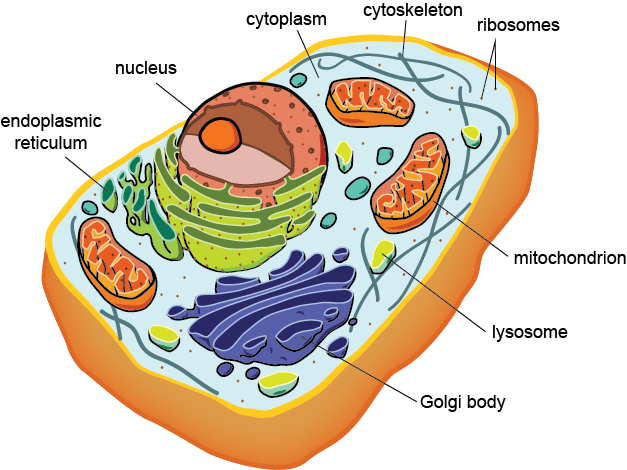
31.List the 3 statements of the Cell Theory
Cells are the basic unit of structure and function in all living things.
All cells are produced from other cells.
Only animal cells are composed of cells.
All living things are composed of cells.
Cells cannot be created nor destroyed.
29.Identify the primary function of the cell organelles below.
Mitochondria: Draw the structure


29.Identify the primary function of the cell organelles below.
Mitochondria: Function
In plants, organelle that goes through photosynthesis
Structural support, contains cellulose
Controls cell functions
Powerhouse, Makes energy (ATP) through cellular respiration.
Makes proteins
29.Identify the primary function of the cell organelles below.
Ribosomes: Draw the structure

29.Identify the primary function of the cell organelles below.
Ribosomes: Function
In plants, organelle that goes through photosynthesis
Structural support, contains cellulose
Controls cell functions
Transport system
Makes proteins
29.Identify the primary function of the cell organelles below.
Nucleus: Draw the structure

29.Identify the primary function of the cell organelles below.
Nucleus: Function
In plants, organelle that goes through photosynthesis
Structural support, contains cellulose
Controls cell functions
Transport system
Regulates what enters and leaves the cell
29.Identify the primary function of the cell organelles below.
Endoplasmic Reticulum: Draw the structure

29.Identify the primary function of the cell organelles below.
Endoplasmic Reticulum: Function
In plants, organelle that goes through photosynthesis
Structural support, contains cellulose
Contains extra water for plants; helps keep shape.
Transport system
Regulates what enters and leaves the cell
29.Identify the primary function of the cell organelles below.
Cell Wall: Draw the structure
29.Identify the primary function of the cell organelles below.
Cell Wall: Function
In plants, organelle that goes through photosynthesis
Structural support, contains cellulose
Contains extra water for plants; helps keep shape.
Transport system
Regulates what enters and leaves the cell
29.Identify the primary function of the cell organelles below.
Cell membrane: Draw the structure
29.Identify the primary function of the cell organelles below.
Cell membrane: Function
In plants, organelle that goes through photosynthesis
Structural support, contains cellulose
Contains extra water for plants; helps keep shape.
Transport system
Regulates what enters and leaves the cell
29.Identify the primary function of the cell organelles below.
Chloroplasts: Draw the structure
29.Identify the primary function of the cell organelles below.
Chloroplasts: Function
In plants, organelle that goes through photosynthesis
Structural support, contains cellulose
Contains extra water for plants; helps keep shape.
Transport system
Regulates what enters and leaves the cell
29.Identify the primary function of the cell organelles below.
Central Vacuole: Draw the structure
29.Identify the primary function of the cell organelles below.
Central Vacuole: Function
In plants, organelle that goes through photosynthesis
Structural support, contains cellulose
Contains extra water for plants; helps keep shape.
Transport system
Regulates what enters and leaves the cell

