wayground logo

Free Printable Worksheets

Font size

S
M
L
XL
Worksheets

Plants

Total questions: 88

Worksheet time: 1hrs 4mins
Name
Class
Date
1.
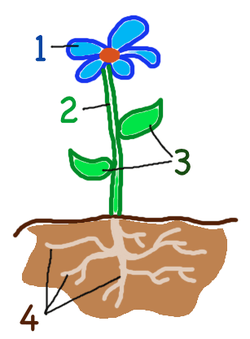
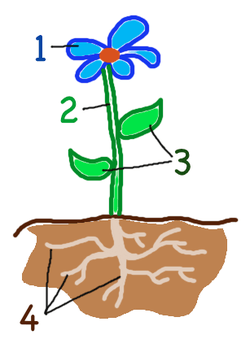
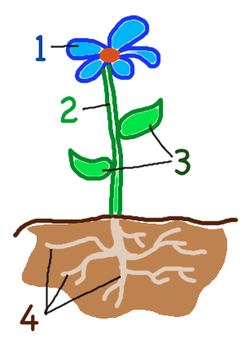
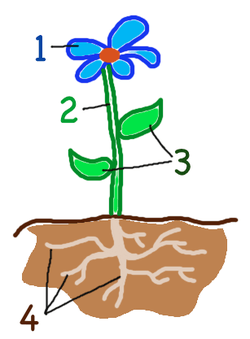
What part of the plant is #1?
a)
flower
b)
stem
c)
root
d)
leaf
2.
What part of the plant is #2?
a)
leaf
b)
flower
c)
stem
d)
root
3.
What part of the plant is #3?
a)
leaf
b)
root
c)
flower
d)
stem
4.
What part of the plant is #4?
a)
leaf
b)
flower
c)
stem
d)
root
5.
The part of the plant that holds the plant in place and absorbs water and minerals from the soil.
a)
stem
b)
roots
c)
leaves
6.
who uses photosynthesis 
a)
us
b)
no body
c)
i dont know 
d)
plants
7.
The function of a ___ is to absorb water, store food, and anchor plants. 
a)
flower
b)
leaf
c)
stem
d)
root
8.
What is the tissue that is used to transport necessary materials throughout the plant?
a)
Circulatory tissue
b)
Transport tissue
c)
Vascular tissue
d)
Pathway tissue
9.
Which of the following statements best describes xylem's function in the plant?
a)
transpports water and minerals up from the roots to the rest of the plant
b)
transports food down from the leaves to the rest of the plant
c)
transports water and minerals down from the roots to the rest of the plant
d)
transports food up from the leaves to the rest of the plant
10.
Which of the following statements best describes phloem's function in the plant?
a)
transpports water and minerals up from the roots to the rest of the plant
b)
transports food down from the leaves to the rest of the plant
c)
transports water and minerals down from the roots to the rest of the plant
d)
transports food up from the leaves to the rest of the plant
11.
What is the part of the flower that is brightly colored to attract pollinators?
a)
Petals
b)
Stamen
c)
Pistil
d)
Sepals
12.
What is the male part of the flower?
a)
Petals
b)
Stamen
c)
Pistil
d)
Sepals
13.
What is the female part of the flower?
a)
Petals
b)
Stamen
c)
Pistil
d)
Sepals
14.
What part of the male part of the flower makes pollen?
a)
Ovary
b)
Anther
c)
Filament
d)
Stigma
15.
What part of the male part of the flower holds up the anther?
a)
Ovary
b)
Anther
c)
Filament
d)
Stigma
16.
What part of the female part of the flower gathers pollen?
a)
Ovary
b)
Style
c)
Filament
d)
Stigma
17.
What part of the female part of the flower is a tube that pollen travels through?
a)
Ovary
b)
Style
c)
Filament
d)
Stigma
18.
What is the male reproductive material of plants?
a)
Seeds
b)
Pollen
c)
Fruit
d)
Sepals
19.
What part of the female part of the flower is the place that holds the eggs?
a)
Ovary
b)
Style
c)
Filament
d)
Stigma
20.
What are the small, green leaf-like structures that protect the flower when it is a bud?
a)
Seeds
b)
Pollen
c)
Petals
d)
Sepals
21.
What part of the flower turns into the fruit?
a)
Seeds
b)
Ovary
c)
Stamen
d)
Sepals
22.
What organelle in the leaves of plants capture light energy from the sun to complete photosynthesis?
a)
Chloroplasts
b)
Mitochondria
c)
Nucleus
d)
Ribosomes
23.
What are the openings on the underside of leaves that let carbon dioxide into the leaf and let oxygen out?
a)
Chloroplasts
b)
Stomata
c)
Stomach
d)
Cuticle
24.
What is pollination?
a)
the transfer of pollen from the anther to the stigma
b)
the union of pollen and egg cells in the ovary of the flower
c)
the dispersal of seeds to a new location
d)
the transfer of cash in a business transaction between plants
25.
What is fertilization?
a)
the transfer of pollen from the anther to the stigma
b)
the union of pollen and egg cells in the ovary of the flower
c)
the dispersal of seeds to a new location
d)
the transfer of cash in a business transaction between plants
26.
What helps plants pollinate by carrying pollen from one plant to another?
a)
Mailman
b)
Pollinator
c)
Terminator
d)
Commentator
27.
In which type of growth response does the plant grow toward a light source?
a)
Phototropism
b)
Heliotropism
c)
Geotropism
d)
Hydrotropism
28.
In which type of growth response does the plant grow in response to gravity?
a)
Hydrotropism
b)
Phototropism
c)
Geotropism
d)
Thigmotropism
29.
Small grains that contain a plant's male reproductive cells.
a)
stamen
b)
pollen
c)
anther
d)
stigma
30.
Synonym for not active.
a)
dormant
b)
sterile
c)
spry
d)
mobile
31.
Small leaf-like structures forming an outer circle at the base of a flower.
a)
petals
b)
sepal
c)
anthers
d)
dicots
32.
The structures containing female reproductive cells.
a)
seeds
b)
style
c)
gametes
d)
anthers
33.
The stalk connecting the ovaries and stigmas.
a)
filament
b)
pistil
c)
style
d)
anther
34.
What part of a plant produces a new plant?
a)
root
b)
stem
c)
leaf
d)
seed
35.
What are two common groups of plants? (Most general grouping)
a)
Monocots & Dicots
b)
Vascular & non-vascular
c)
Flowers & Cones
d)
Seeds & spores
36.
These types of plants are able to grow taller because of the added support and faster nutrient transport of xylem and phloem.
a)
Seedless plants
b)
Vascular plants
c)
Seeded plants
d)
Nonvascular plants
37.
Which of the following is an example of a nonvascular plant?
a)
Grass
b)
Fern
c)
Apple Tree
d)
Moss
38.
Xylem and phloem are examples of _ tissue
a)
Spores
b)
Nonvascular
c)
Seeds
d)
Vascular
39.
Which group is the largest in the Plant Kingdom?
a)
Vascular Plants
b)
Nonvascular Plants
40.
a)
Vascular
b)
Nonvascular
41.
a)
Vascular
b)
Nonvascular
42.
Which gets water directly from their environment?
a)
Vascular Plants
b)
Nonvascular Plants
43.
a)
Vascular
b)
Nonvascular
44.
a)
Vascular
b)
Nonvascular
45.
All of the following are vascular plants EXCEPT:
a)
ferns
b)
oak tree
c)
moss
d)
tulips
46.
Non-vascular plants reproduce through _____________.
a)
seeds
b)
cones
c)
flowers
d)
spores
47.
Which of the following is an example of a vascular plant?
a)
moss
b)
pine tree
c)
liverworts
d)
hornworts
48.
Mosses, liverworts, and hornworts are all this type of plant.
a)
vascular
b)
non-vascular
49.
These plants are low-growing plants that lack transporting tissue
a)
vascular
b)
non-vascular
50.
Liverworts and hornworts are...
a)
vascular 
b)
non-vascular
51.
Which gets water directly from their environment?
a)
Vascular Plants
b)
Nonvascular Plants
52.
An example of a nonvascular plant is a
a)
Moss
b)
Hornwort
c)
Liverwort
d)
All of the above
53.
What gas is released by plants during photosynthesis?
a)
sulfur
b)
carbon dioxide
c)
oxygen
d)
hydrogen
54.

What part of the flower produces eggs?

a)

ovary

b)

petal

c)

anther

d)

stamen

55.
Plants with seeds in cones are called?
a)
gymnosperms
b)
angiosperms
c)
flowers
d)
mosses
56.

What is the largest group of gymnosperms?

a)

conifers

b)

spruce

c)

cedars

d)

deciduous

57.
What do male cones produce?
a)
spores
b)
pollen
c)
eggs
d)
seeds
58.

Ferns are classified as

a)

bryophyte

b)

seedless vascular plants

c)

gymnosperms

d)

angiosperms

59.

A dandelion is an example of a(n)

a)

Gymnosperm

b)

Angiosperm

c)

Seedless vascular plant

d)

Bryophyte

60.

Cycads are are example of ___________

a)

gymnosperm

b)

angiosperm

c)

monocot

d)

dicot

61.

Which plant species require water to reproduce?

a)

bryophytes

b)

seedless vascular plants

c)

Seed Plants - Gymnosperms

d)

Seed Plants - Angiosperms

62.

Select ALL examples that are matched correctly.

a)

Nonvascular plants >> moss

b)

Seedless vascular plants >> fern

c)

Gymnosperms >> cherry tree

d)

Angiosperms >> rose

63.
The main plant body of a moss is __.
a)
gametophyte
b)
sporophyte
c)
capsule
d)
spores
64.
In the moss, the zygote grows into the __.
a)
sporophyte
b)
gametophyte
c)
rhizoids
d)
antheridium
65.
Spores grow into a __.
a)
gametophyte
b)
sporophyte
c)
zygote
d)
archegonia
66.
The main plant body of a vascular plant is:
a)
sporophyte
b)
gametophyte
c)
antheridium
d)
archegonia
67.
The transfer of the pollen grains from the anther to the stigma is called...
a)
Transpiration
b)
Pollination
c)
Fertilization
d)
Ovulation
68.
Tiny plants that grow along edges of a leaf
a)
plantlets
b)
tubers
c)
runners
d)
pollen tube
69.
Above ground stems from which new plants grow
a)
tubers
b)
runners
c)
plantlets
d)
pollen tube
70.
Underground stems from which new plants grow
a)
pollen tube
b)
runners
c)
tubers
d)
plantlets
71.

What part of the environment makes roots grow downward?

a)

gravity

b)

temperature

c)

light

d)

touch

72.

What part of the environment makes stems grow toward it?

a)

gravity

b)

temperature

c)

light

d)

touch

73.
When the plant grows toward the stimuli
a)
Positive
b)
Negative
74.
Vascular or nonvascular?
a)
Vascular
b)
Nonvascular
75.
How do plants prevent wilting?
a)
Close stomata
b)
Open stomata
c)
Grow away from the sun
d)
Grow towards the sun
76.
What do many plants do in the spring?
a)
Lose leaves
b)
Grow stems
c)
Lose stems
d)
Grow flowers
77.
Why do plants grow flowers first in the spring?
a)
Flowers are pretty
b)
To make pollination easier
c)
So animals have something to eat
d)
To make things smell better
78.
What substance do leaves stop making the fall that causes them to lose leaves?
a)
water
b)
chlorophyll
c)
chloroplast
d)
steam
79.
Which is NOT a reason why plants lose leaves in the fall?
a)
To prevent water loss
b)
So they are less likely to break under heavy snow
c)
So the plant will not freeze in cold weather
80.
Adaptation that increases the survival rate of seeds in harsh environments. 
a)
Radicle
b)
Day Neutral Plant
c)
Intermediate Day Plant
d)
Dormancy
81.
Process where water evaporates from leaves and through the stomata. 
a)
Pistil
b)
Transpiration
c)
Stamen
d)
Petal
82.

The turning of all or part of an organism in a particular direction in response to an external stimulus.

a)

Dormancy

b)

Stomata

c)

Tropism

d)

Transpiration

83.
Gymnosperms and angiosperms produce
a)
cones
b)
flowers
c)
fruits
d)
seeds
84.
A fern leaf is called a __________________________.
a)
cambium
b)
frond
c)
rhizoid
d)
stoma
85.
A __________________________ is an opening in a leaf that allows gas exchange.
a)
cambium
b)
frond
c)
rhizoid
d)
stoma
86.
A gymnosperm produces seeds in a 
a)
cone 
b)
flower
c)
fruit
d)
spore
87.
Which does NOT describe a gymnosperm?
a)
cones
b)
flowers
c)
needle-like leaves
d)
seeds
88.
This equation represents what process?
a)
cellular respiration
b)
photosynthesis