wayground logo

Free Printable Worksheets

Font size

S
M
L
XL
Worksheets

Classification and Characteristics of Life

Total questions: 89

Worksheet time: 45mins

Name
Class
Date
1.
Which phylum does this tic belong to?
a)
chordate
b)
arthropod
c)
echinoderm
d)
echinoderm
2.
What is binomial nomenclature?
a)
writing a phylum and class name
b)
writing a genus and class name
c)
writing a kingdom and domain name
d)
writing a genus and species name
3.

The domain Eukarya are organisms whose cells contain a nucleus and organelles. 

a)
True
b)
False
4.
What two kingdoms of life are entirely made up of multi-cellular organisms?
a)
plant and fungi
b)
protist and fungi
c)
plant and animal
d)
animal and protist
5.
What gas is needed for photosynthesis?
a)
carbon  monoxide
b)
carbon dioxide
c)
oxygen
d)
laughing gas
6.
Which of the following is a term for a group of similar organisms that can reproduce fertile offspring?
a)
class
b)
population
c)
species
d)
genus
7.
Chordates all have:
a)
a backbone
b)
legs
c)
fins
d)
antennae
8.
Why is classification important to scientists?
a)
It makes them look smarter
b)
It helps confuse students so very few will actually get to be scientists
c)
It makes it easier to study organisms
d)
Why not
9.
Father of Taxonomy. He created binomial nomenclature; still used today.
a)
Carolus Linnaeus
b)
Charles Darwin
10.
Which of these kingdoms is not part of the Eukarya Domain? 
a)
Bacteria
b)
Plantae
c)
Fungi
d)
Protists
11.
Cells that have a nucleus are called _______________. 
a)
Eukaryotes
b)
Heterotrophs
c)
Prokaryotes 
d)
Autotrophs
12.
What do all organisms need to live?
a)
energy source
b)
water
c)
gasses
d)
all of the above
13.
Which is a reptile
a)
turtle
b)
snake
c)
lizard
d)
all of the above
14.
List the 8 levels of classification from broadest category to most specific category.  
a)
Domain, Kingdom, Phylum, Class, Order, Family, Genus, Species
b)
Kingdom, Domain, Phylum, Class, Order, Family, Genus, Species
c)
Species, Genus, Family, Order, Class, Phylum, Kingdom, Domain
d)
Class, Order, Family, Genus, Species, Domain, Kingdom, Phylum
15.
In the 8 Levels of Classification which levels is the broadest category? 
a)
Kingdom
b)
Family
c)
Species
d)
Domain
16.
As each group in the levels of classification split into smaller groups, the organisms become more ___________.  
a)
different
b)
populated
c)
dissimilar
d)
alike
17.
Bateria are prokaryotes because their genetic material is
a)
in a nucleus
b)
not present
c)
spread throughout the cell (not in a nucleus)
d)
always replicating
18.
Which kingdom has cell walls and makes food using photosynthesis?
a)
Kingdom Protista
b)
Kingdom Fungi
c)
Kingdom Plantae
d)
Kingdom Animalia
19.
Bacteria and ____________ are two domains of prokaryotes.
a)
Protists
b)
Eukarya
c)
Fungi
d)
Archaea
20.
Which is not a current domain?
a)
archaea
b)
eukarya
c)
bacteria
d)
protista
21.
Which kingdom is made of organisms that absorb nutrients from their surroundings as decomposers?
a)
Kingdom Protista
b)
Kingdom Fungi
c)
Kingdom Plantae
d)
Kingdom Animalia
22.
Which type of prokaryote is found in extreme environments?
a)
Archaea
b)
Bacteria
c)
Protists
d)
Fungi
23.
A naming system devised by Linnaeus. Organism names contain the Genus and the species.
a)
polynomial nomenclature
b)
binomial nomenclature
24.
What kingdom is mostly made of decomposers?
a)
plant
b)
animal
c)
fungi
d)
protist
25.
Which contains four important plant groups?
a)

moss, fern, conifer (evergreen), flowering plant

b)
moss, tree, grasses, protists
c)
algae, moss, ferns, trees
d)
algae, fern, reptiles, amphibians
26.
What are the domains of life based on?
a)
the presence or absence of cellular structures
b)
whether they are unicellular or multicelluar
c)
how they get food
d)
all of the above
27.
An organisms scientific name represents:
a)
kingdom and order.
b)
family and genus.
c)
genus and species.
d)
genus and class.
28.

Most inclusive (broadest) category of classification, includes Eukarya, Archaea, and Bacteria.

a)
kingdom
b)
phylum
c)
order
d)
domain
29.
To which domain do plants and animals belong?
a)
eukarya
b)
archaea
c)
bacteria
30.
To which kingdom do humans belong?
a)
animalia
b)
plantae
c)
eubacteria
d)
fungi
31.
This diagram represents:
a)
The six domains of life
b)
the six kingdoms of life
c)
The six phyla of life
d)
binomial nomenclature
32.
What kingdom are single celled organisms with a nucleus in?
a)
archaebacteria
b)
eubacteria
c)
protista
d)
plant
33.
Antibiotics are used to treat
a)
bacterial illnessess
b)
viral illnessess
34.
What phylum would this organism be in?
a)
echinoderm
b)
arthropod
c)
annelid
d)
chordate
35.
These prokaryotic unicelluar organisms are
a)
bacteria
b)
viruses
c)
protists
d)
fungi
36.
round rod and spiral represent three shapes of ___________
a)
viruses
b)
bacteria
c)
protists
d)
animals
37.
Bacteria that live in extreme environments like hot springs are in the domain __________
a)
archaea
b)
bacteria
c)
eukaryote
38.
What animal phylum is a crayfish in with its exoskeleton and jointed legs?
a)
chordate
b)
echinoderm
c)
atrhropod
d)
nematode
39.
Which is NOT considered to be alive?
a)
bacteria
b)
virus
40.
To what genus does this apple belong?
a)
Malus
b)
domestica
c)
plant
41.
Which is written correctly?
a)
a
b)
b
c)
c
d)
d
42.
What is the genus name of the wolf?
a)
sapien
b)
Canus
c)
lupus
d)
mammal
43.
According to this chart, which organism is the most different from the other two?
a)
the left one
b)
the middle one
c)
the right one
44.
To what phylum do these belong?
a)
arthropod
b)
echinoderm
c)
mammal
d)
chordate
45.
According to this key what bird is Camarhynchus?
a)
w
b)
x
c)
y
d)
z
46.
Which of these is in the animal kingdom?
a)
amoeba
b)
bacterium
c)
mushroom
d)
none of these
47.
To which of the three domains do plants, fungi, protists, and animals belong to?
a)
bacteria
b)
archaea
c)
eukarya
d)
team Mercury
48.
Which animal  phylum is pictured with its spiny skin?
a)
arthropod
b)
echinoderm
c)
annelid
d)
chordate
49.
A fern is in the __________ kingdom
a)
plant 
b)
fungi
c)
eubacteria
50.
This flower __________.
a)
is male
b)
is female
c)
is both male and female
51.
What kingdom are these organisms in?
a)
animal
b)
plant
c)
protist
d)
fungi
52.
This organism is an invertebrate
a)
true
b)
false
53.
These organisms are in the phylum arthropoda
a)
true
b)
false
54.
All of these organisms are in the phylum chordata
a)
true
b)
false
55.
What is the most specific level of classification?
a)
domain
b)
phylum
c)
genus
d)
species
56.
The person who created our modern system of classification was _____
a)
Mendel
b)
Hooke
c)
Franklin
d)
Linnaeus
57.
Which two organisms would have more in common, two in the same phylum or two in the same class?
a)
phylum
b)
class
58.
Unicellular organisms with no nucleus are ___.
a)
eukaryotic
b)
prokaryotic
c)
viruses
d)
protists
59.
Which level contains the most different number of species?
a)
genus
b)
phylum
c)
kingdom
d)
order
60.
What reptile is pictured here?
a)
spider
b)
frog
c)
owl
d)
none
61.
To which of the three domains do plants, fungi, protists, and animals belong to?
a)
bacteria
b)
archaea
c)
eukarya
d)
team Mercury
62.
What does this diagram show?
a)
male pine cones
b)
female pine cones
c)
both male and female pine cones
63.
To what animal phylum does this soft bodied organism belong to?
a)
arthropoda
b)
annelida
c)
chordata
d)
mollusca
64.
To which phylum do jellyfish (stinging cells on tentacles) belong?
a)
echinoderm
b)
cindaria
c)
chordata
d)
arthropod
65.
Horses and donkeys can breed so they are the same species.
a)
true
b)
false
66.
This unicellular eukaryotic organisms are in the __________ kingdom
a)
protista
b)
eubacteria
c)
animal
d)
plant
67.
Moss is a ______________
a)
fungus
b)
unicellular plant
c)
vascular plant
d)
non-vascular plant
68.
Sponges are _________
a)
plants
b)
animals
c)
fungi
69.
Can make us sick but don't breathe, eat or need water
a)
virus
b)
protist
c)
bacteria
d)
fungi
70.
Can the number of kingdoms ever change?
a)
yes
b)
no
71.
What tool helps scientists identify an organsim
a)

dichotomous key

b)
Punnett square
c)
a model
d)
calculator
72.
Which (is) are in the plant kingdom?
a)
algae
b)
mushroom
c)

tomato

d)
yeast
73.

Which of these is true about biological classification?

a)

it relies only upon genetic similarities and differences

b)

Its is determined by patterns of DNA only

c)

It looks at DNA similarities/differences and physical features of organisms

d)

It has not changed since the 1700's

74.

What advantage does DNA have over physical characteristics when classifying organisms?

a)

Physical traits often change as organisms grow and develop but DNA stays the same

b)

Plants have DNA but animals do not

c)

DNA often has mutations

d)

DNA changes over an organisms lifetime but physical traits stay the same

75.

How do scientists classify organisms?

a)

They compare their physical traits with each other

b)

They compare their DNA with each other

c)

They look at whether or not organisms have a nucleus, how they reproduce and how they eat

d)

all of these are used to classify organisms

76.

An organisms like this paramecium is in the kingdom ______ (hint see the nucleus)

a)

eubacteria

b)

animal

c)

protista

d)

archaebacteria

77.

Which of these is an invertebrate?

a)

paremecium , amoeba (unicellular protist)

b)

snail, slug, jellyfish

c)

grasshopper and cricket

d)

all of these are invertebrates

78.

Which of these are vertebrates (phylum chordata)?

a)

snake, lizards and other reptiless

b)

frogs, toads and other amphibians

c)

birds, mammals and fish

d)

all of these are vertebrates

79.

Which of these is true about binomial nomenclature?

a)

it is the two word naming system Linnaeus developed in the 1700's

b)

The Genus name is capitalized while the species name is lowercase

c)

scientists all over the world use the same naming system

d)

all of these are correct

80.

Which of these organisms are the most similar? (Hint which two are in the same genus)

a)

Homo naledi and Homo sapiens

b)

Memphitis memphitis and Vulpus vulpus

c)

Tyrannosaurus rex and Felis concolor

d)

Canis lupus and Homo sapiens

81.

Canis lupus is the binomial name of a grey wolf. Which traits were best used to classify it?

a)

How it moves

b)

How it reproduces

c)

Its environment

d)

Its physical and genetic characteristics

82.

If you did an experiment to compare how plants and mushrooms grow in the light and the dark which of these makes the most sense as a hypothesis

a)

Plants grow better in light while mushrooms grow better in the dark

b)

Plants and mushrooms both grow equally well in light and dark

c)

Plants grow better in the dark while mushrooms grow better in the light

d)

neither grew so I can't do my science project :)

83.

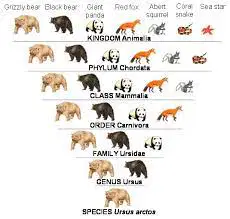
Which two organisms are the most similar?

a)

Grizzly bear and red fox

b)

Grizzly bear and panda bear

c)

red fox and black bear

d)

Grizzly bear and black bear

84.

Which animal is the most different from the grizzly bear?

a)

coral snake

b)

squirrel

c)

red fox

d)

sea star (starfish)

85.

Why is a python in a different class than a brown bear?

a)

the python is a reptile while the brown bear is a mammal

b)

the bear is a vertebrate while the snake is not

c)

brown bears have been known to eat snakes

d)

snakes shed their skin while bears do not

86.

Clams oysters snails slugs and octopus are all in the phylum _______

a)

cnidaria

b)

Mollusca

c)

Arthropoda

d)

Chordata

87.

Which of these is NOT an arthropod?

a)

snail

b)

lobster

c)

grasshopper

d)

bumble bee

88.

Angiosperms make seeds in fruits and have flowers. Which of these would be classified as an angiosperm?

a)

tomato plant

b)

pine tree

c)

moss

d)

fern

89.

Gymnosperms produce seeds on cones. Which of these would be classified as a gymnosperm?

a)

pine tree (fir or spruce)

b)

mushroom

c)

moss

d)

cherry tree