
 Worksheets
Human Heredity (H)
Total questions: 90
Worksheet time: 1hrs 25mins


?

About how many genes does the human genome contain?
46
1 billion
200-300
20,000-30,000
What percentage of sperm cells contain an "X" chromosome?
0%
50%
100%
75%

A dominant pedigree is shown. What is the genotype of II-1?
AA
Aa
aa

A dominant pedigree is shown. What are the potential genotypes of individual I-2?
Aa
aa
AA or Aa
AA

An X-linked recessive trait is shown. Who is more likely to have this disease?
males
females

In the pedigree shown, what is the genotype of individual 1?
AA
AA or Aa
aa
aa or AA

An autosomal recessive trait is shown. How many male individuals have a genotype "aa"?
7
24
In which type of cell division do chromosomal mutations occur?
Mitosis
Meiosis

The proteins found on the surface of RBCs that allow us to type blood as A, B, O or AB are called
antigens
antibodies
aggluntates
Rh factors

What is produced by your body in response to foreign antigens, such as the wrong type of blood?
agglutinates
clotting factors
phagocytes
antibodies

In the image above, what is the percentage of the offspring has the possibility of inheriting blood type O?
0%
25%
50%
100%
What inheritance patterns makes the blood type AB possible?
incomplete dominance
multiple alleles
codominance
total dominance


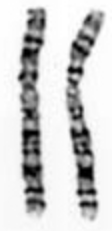

autosomes

Which of the following is why gametes sometimes lack a complete chromosome?

SELECT ALL THAT APPLY:
Male
Female
No chromosomal abnormalities
Trisomy 21

SELECT ALL THAT APPLY:
Male
Female
No chromosomal abnormalities
Trisomy 21
Which of the following is an autosomal recessive disorder?
Huntington's disease
sickle cell anemia
colorblindness
Hemophilia
Which of the following is a autosomal dominant disorder?
Huntington's
Cystic fibrosis
Hemophilia
Sickle cell anemia
Which of the following is a sex-linked disorder?
Hemophilia
Sickle cell anemia
Cystic fibrosis
Huntington's
Which of the following is NOT a chromosomal disorder?
Turner's syndrome
Downs syndrome
Klinefelter's syndrome
Huntington's
Why is Down syndrome called trisomy 21
The person has 21 pairs of chromosomes instead of 23.
The person has an abnormal gene on chromosome 21.
The syndrome is caused by having 21 pairs of autosomes.
The syndrome results from an extra chromosome 21.
What is the effect of sickle-cell anemia?
blocked respiratory pathways
decreased neurological functions
inefficient oxygen transportation
susceptibility to contracting malaria
A man carrying the allele for Huntington’s disease marries a woman who is homozygous recessive for the allele. What is the probability that their offspring will develop Huntington’s disease?
25 percent
50 percent
75 percent
100 percent
Which disorder is characterized by the inability to break down a proteins (specifically phenylalanine) and can be treated by a special diet?
Huntington's
Tay Sachs
Cystic fibrosis
PKU
Which disorder is characterized by the inability to break down lipids in the brain and nervous system and usually results in death by ages 3-5?
Tay-Sachs
Cystic fibrosis
Huntington's
PKU


Disease that caused the body to produce thick and sticky mucus that can clog the lungs and obstruct the pancreas.
hemophilia
cystic fibrosis
tay sachs
sickle cell anemia
Why do sex-linked disorders affect men more than women?
males only have 1 X chromosome
males do not have an X chromosome
girls always have 2 defective X chromosomes
males only have Y chromosomes
Identify the substitution mutation that results in an abnormally shaped protein and that causes a reduced ability to bind and transport oxygen.
Cystic fibrosis
Sickle cell anemia
Huntington's
Hemophilia
45 + XX
Klinfelter's syndrome
Male Down's Syndrome
Female Down's Syndrome
Turner's Syndrome
4. About how many genes are there in the human genome?
a) 2,500
b) 20,500
c) 205,000
1. What is a genome?
a) A group of related genes
b) The complete set of a species' genes
c) Someone who studies genes
What is a genetic mutation
the making of a zombie
any change in the DNA base pairs
the process of duplicating the DNA in a cell
A substitution mutation occurs when
a base pair is missing from the DNA strand
a base pair is added to the DNA strand
a base pair is replaced with a different base pair
An insertion/additon mutation occurs when
a base pair is missing from the DNA strand
a base pair is added to the DNA strand
a base pair is replaced with a different base pair
A deletion mutation occurs when
a base pair is missing from the DNA strand
a base pair is added to the DNA strand
a base pair is replaced with a different base pair
A mutation that helps an organism survive and reproduce
harmful mutation
helpful mutation
neutral mutation
A mutation that decreases an organism's ability to survive and reproduce
harmful mutation
helpful mutation
neutral mutation
Mutations are...
Changes in the sequence of DNA
Broken chromosomes
Bad genes
Mutations can benefit humans because they can:
Cause illness
Make an organism more suited to live in its environment.
Make organisms live shorter lives
Cause organisms to grow extra limbs.
Mutations are random.
True
False

Why are insertion and deletion mutations so harmful?
They change all of the codons from the mutation on down the line, which changes the amino acid sequence
They insert things that an organism doesn't need.
They often delete things that organisms need.
Insertion and deletions are not any more harmful than substitution mutations.

A nucleotide base is inserted or deleted shifting the entire DNA sequence. Entire protein will be changed.
Substitution Mutation
Silent Mutation
Frameshift Mutation
Translocation

A substitution mutation that has no effect
on amino acids sequence
Insertion Mutation
Translocation
Silent Mutation
Deletion Mutation
The mutated DNA segment is TTACGCAAC. This is an example of ___ mutation.
AGA-TTC-ATA-GCG
Mutant-
AGA-TTC-AAT-AGC-G
Mutations are__________
Harmful
Harmful or beneficial
Neutral
Harmful, neutral, or beneficial
A piece of one chromosome detaches and reattaches to a different chromosome
deletion
duplication
inversion
translocation

The chromosomal mutation shown in the image is a
deletion
duplication
inversion
translocation

The chromosomal mutation shown in the image is a
deletion
duplication
inversion
translocation

The chromosomal mutation shown in the image is a
deletion
duplication
inversion
translocation

The chromosomal mutation shown in the image is a
deletion
duplication
inversion
translocation
Nondisjunction
When a segment of a chromosome breaks off.
When a segment of a chromosome breaks off, flips, and reattaches.
When a segment of a chromosome is copied or doubles.
When a segment of a chromosome breaks and attaches to a non homologous chromosome.
When entire chromosomes don't separate evenly during meiosis.



