wayground logo

Free Printable Worksheets

Font size

S
M
L
XL
Worksheets

Unit 2 Test Review

Total questions: 85

Worksheet time: 1hrs 6mins

Name
Class
Date
1.
The pH scale is a range from:
a)
1-7
b)
0-14
c)
1-5
d)
1-20
2.
A(n) ______ is a substance with a pH less than 7
a)
Acid
b)
Alkaline
c)
Base
d)
Buffer
3.
A(n) _______ is a substance with a pH greater than 7.
a)
Base
b)
Acid
c)
Buffer
d)
Water
4.
What is the only substance with a neutral pH of 7?
a)
Milk
b)
Orange Juice
c)
Water
d)
Blood
5.
What is the only substance with a neutral pH of 7?
a)
Milk
b)
Orange Juice
c)
Water
d)
Blood
6.
Complete the sentence.
A substance that is more basic has a _____ pH than a substance that is acidic.
a)
lower
b)
higher
c)
the same
d)
none of the above
7.

In a test of pH levels, a baking soda has a pH of 9 and bleach has a pH of 12. What is true about there relationship?

a)

Both of the solution are Bases

b)

Both of the solution are Acids

c)

The Baking soda is an acid and the Bleach is a base

d)

The baking soda is a base and the Bleach is an Acid.

8.

A base is a substance

a)

That releases OH- ions when dissolved in water

b)

That releases H+ ions when dissolved in water

c)

Does not release any ions when dissolved in water

d)

None of the above

9.

A pH of 3 is how many times more acidic than a pH of 5?

a)

2

b)

20

c)

10

d)

100

10.
On the pH scale higher numbers indicate
a)
acids
b)
bases
11.
If you have a substance with a pH of 7.1 it is a(n).....
a)
Acid
b)
base
12.

The picture below shows the relative concentrations of H+ and OH- in a solution. Is the solution an acid or a base?

a)

acid

b)

base

13.

An acid

a)

is a substance that releases H+ ions when dissolved in water

b)

is a substance that does not release any ions when dissolved in water

c)

is a substance that releases OH- when dissolved in water

d)

releases an equal amount of OH- and H+ ions when dissolved in water

14.

Water has a neutral because

a)

it has more H+ ions than OH-

b)

it has more OH- ions than H+

c)

it does not produce any ions

d)

it has an equal amount of H+ and OH- in solution

15.
According to the pH range which substance is more acidic than lemon juice
a)
Hydrochloric acid
b)
cabbage
c)
milk
16.
Bleach is a strong base, what is the pH level of bleach?
a)
13
b)
14
c)
1
d)
2
17.
A solution has a pH of 7.0.  What would happen to the pH if H ions were added?
a)
pH would go up
b)
pH would go down
c)
pH would stay the same
d)
None of these
18.
A solution has a pH of 7.0.  What would happen to the pH if OH ions were added?
a)
pH would go up
b)
pH would go down
c)
pH would stay the same
d)
None of these
19.
A solution with a pH of 10 is mixed with a solution with a pH of 4.  What would the pH of the mixture most likely be?
a)
10
b)
4
c)
40
d)
7
20.
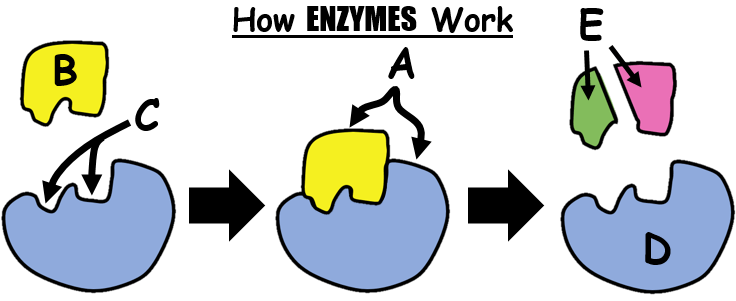
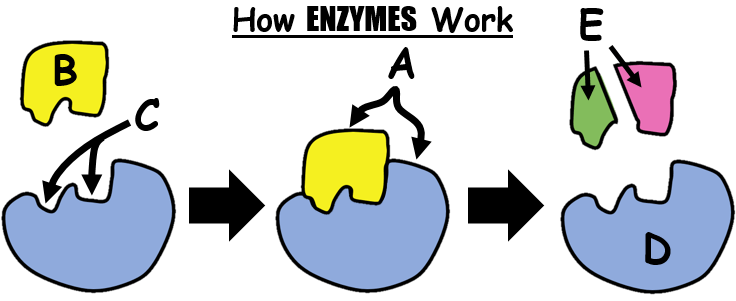
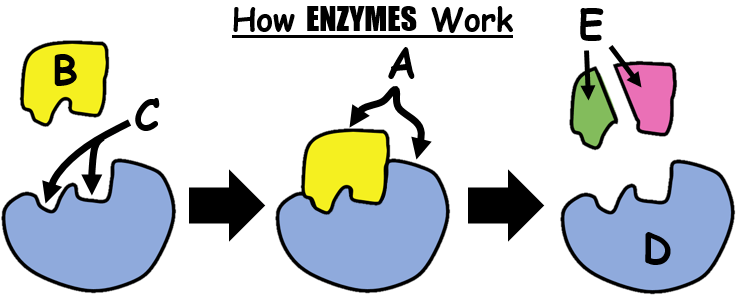
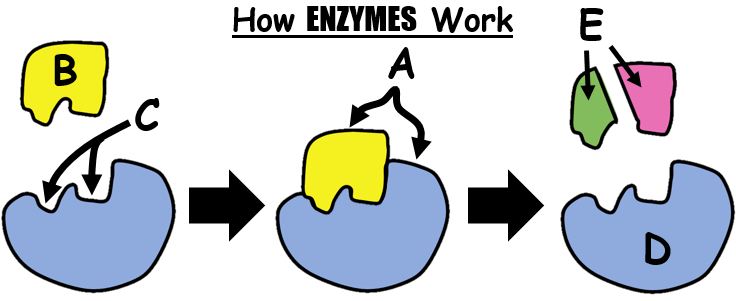
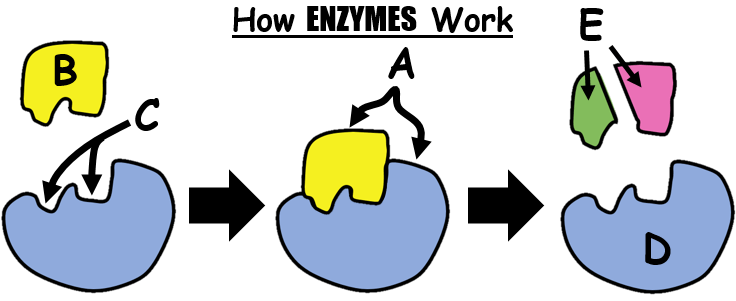
Letter C...
a)
active site
b)
enzymes
c)
substrate
d)
products
21.
Letter B...
a)
active site
b)
enzyme
c)
substrate
d)
products
22.
Letter D...
a)
active site
b)
enzyme
c)
substrate
d)
products
23.
In the diagram, what is letter A? 
a)
product
b)
substrate
c)
enzyme-substrate complex
d)
active site
24.
After the enzyme and substrate bind together and perform the reaction, what does the substrate become?
a)
a substrate
b)
an enzyme
c)
a product
d)
an active site
25.
Any substance that is acted upon by an enzyme is called a(n)?
a)
Coenzyme
b)
Substrate
c)
Vitamin
d)
Polypeptide
26.
What 3 letters do enzymes typically end in?
a)
-ose
b)
-ase
c)
-ese
d)
-tic
27.
Each enzyme only has 1 substrate that will fit its active site.  What is this called?
a)
reusable
b)
catalyst
c)
specific
d)
fragile
28.
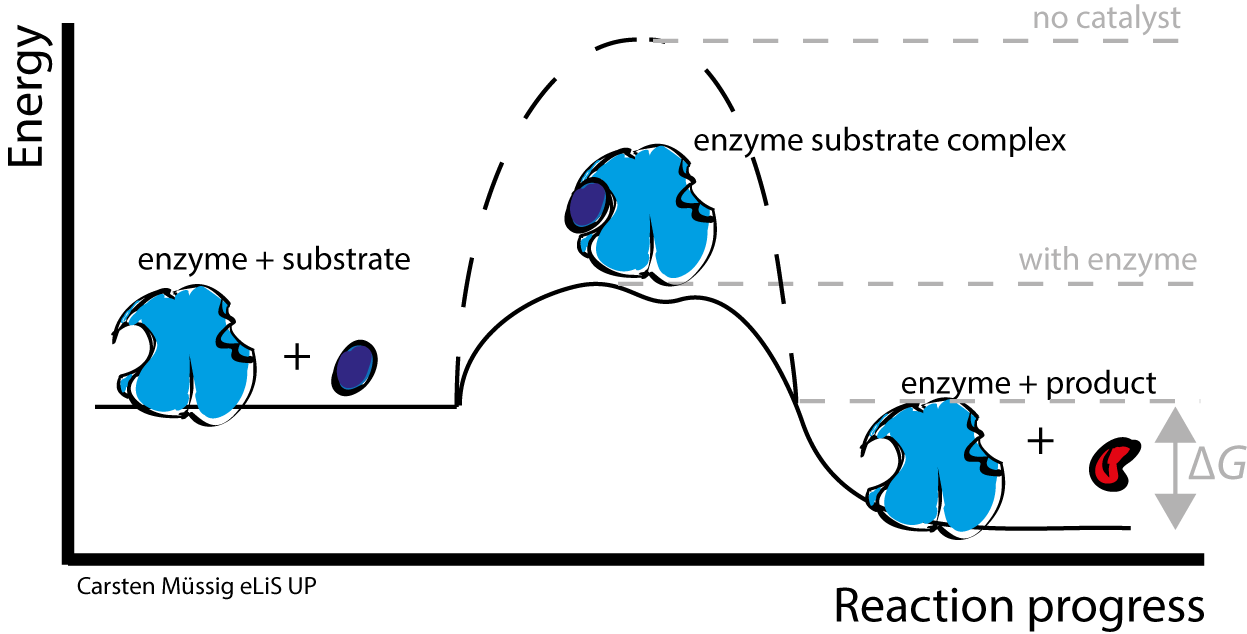
Enzymes are capable of increasing the rate of a chemical reaction within a living cell.  Enzymes accomplish this through which of the following means?
a)
reducing the number of products   
b)
reducing the activation energy
c)
increasing the temperature of the cell
d)
increasing the concentration of reactants 
29.
What is the purpose  of an enzyme?
a)
give permission for the reaction
b)
raise activation energy
c)
speed up reactions
d)
control how many reactions occur
30.

Enzymes are an example of

a)

Lipids

b)

Carbohydrate

c)

Protein

d)

Nucleic Acid

31.
Letter E...
a)
active site
b)
enzyme
c)
substrate
d)
products
32.

In a chemical reaction, ________ are what you have at the end

a)

Products

b)

Molecules

c)

Reactants

d)

Substances

33.
In a chemical reaction, bonds are broken and new bonds are formed that create new substances. The bonds that are broken are called what?
a)
Reactants
b)
Products
c)
Atoms
d)
Catalysts
34.
Enzymes provide a site where reactants called substrates can be brought together in an enzyme-catalyzed reaction. The site is called the
a)
enzyme substrate complex.
b)
reaction site.
c)
active site.
d)
lock and key.
35.
Chemical reactions always involve
a)
the breaking of bonds in reactants.
b)
the formation of new bonds in products.
c)
the breaking of bonds in reactants and the formation of new bonds in products.
d)
enzymes. 
36.
An enzyme speeds up a reaction by
a)
lowering the activation energy.
b)
raising the activation energy.
c)
releasing energy.
d)
absorbing energy.
37.
Each enzyme only has 1 substrate that will fit its active site.  What is this called?
a)
reusablility
b)
denaturation
c)
specificity
d)
fragility
38.
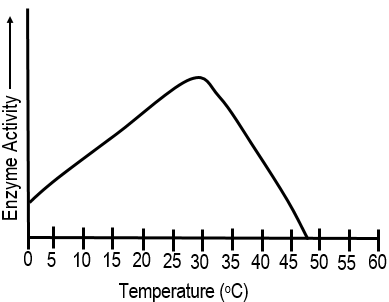
Based on the graph, what is the optimal temperature for this enzyme? 
a)
15oC
b)
40oC
c)
30oC
d)
35oC
39.
An enzyme speeds up a chemical reaction in the cell but can only be used once.  True or False? 
a)
true
b)
false
40.
The molecular formula for water is
a)
W
b)
H2O
c)
2HO
d)
H2O
41.
Which is NOT a property of water that helps or bodies function properly?
a)
Water is a natural antibiotic substance
b)
Water dissolves many substances
c)
Water cools when it evaporates
d)
Water can hold heat (maintain temperature)
42.
If you made blue paint by dissolving dry blue paint powder into water, the liquid blue paint you made is a
a)
ion
b)
solute
c)
solution
d)
concentration
43.
If you dissolve blue paint powder into water, the paint powder is the...
a)
ion
b)
solute
c)
solution
d)
solvent
44.
Water dissolves ionic compounds, like NaCl, because water molecules...
a)
are non polar
b)
have a pH value of 14
c)
Have partially charged ends that interact with ions
d)
do not contain atoms
45.
Water dissolves ionic compounds, like NaCl, because water molecules...
a)
are non polar
b)
have a pH value of 14
c)
Have partially charged ends that interact with ions
d)
do not contain atoms
46.
Which statement best describes an effect of the low density of frozen water on a lake?
a)
When water freezes it contracts, decreasing the water level in the lake.
b)
Water in a lake freezes from the bottom up
c)
Water removes thermal energy from the land, causing the lake to freeze
d)
When water in a lake freezes, it floats and provides insulation for the organisms below
47.
Water is cohesive, the molecules are attracted to one another because of hydrogen bonds. This attraction helps create...
a)
surface action
b)
surface tension
c)
ice
d)
solvents
48.
When water travels up the stem of a plant, this is a result of
a)
surface tension
b)
capillary action and adhesion
c)
capillary action and cohesion
d)
capillary action, cohesion and adhesion
49.
Water helps maintain homeostasis in an organism, which of the following hold true to that?
a)
Its high specific heat
b)
Its ability to dissolve substances
c)
Its ability to be a polar molecules and have a pH of 7
d)
all of these
50.
What property of water is being shown?
a)
polarity
b)
freezing point
c)
hydrogen bonds
d)
solution/universal solvent
51.
What property of water is being shown?
a)
cohesion
b)
adhesion
c)
polarity
d)
freezing point
52.
What property of water is being shown?
a)
solution
b)
adhesion
c)
freezing point
d)
specific heat
53.
What property of water is being shown?
a)
cohesion
b)
adhesion
c)
freezing point
d)
capillary action
54.
What property of water is being shown?
a)
specific heat
b)
surface tension
c)
polarity
d)
solution
55.
What property of water is being shown?
a)
cohesion
b)
specific heat
c)
capillary action
d)
hydrogen bonds
56.

All matter is made of what?

a)

energy

b)

atoms

c)

electrons

57.

The positive particles of an atom are ___________.

a)

electrons

b)

protons

c)

neutrons

58.

The center of an atom where its neutrons and protons are is called the _____________.

a)

nucleus

b)

electron cloud

c)

center

59.

An atom with atomic number 6 would have how many protons?

a)

6

b)

12

c)

3

60.

Particles in an atom that are neutral and have no charge are

a)

protons

b)

electrons

c)

neutrons

61.
True or False? Neutrons have a negative charge
a)
True
b)
False
62.

What is the atomic number for an element with three protons?

a)

6

b)

1

c)

3

63.

A particle that moves around the nucleus is called an _________.

a)

Proton

b)

Neutron

c)

Electron

d)

Quark

64.
In the modern periodic table elements are arranged by:
a)
atomic mass
b)
atomic number
c)
valence electrons
d)
number of isotopes
65.
What does the 1.00794 stand for?
a)
Hydrogen
b)
atomic number
c)
atomic mass
d)
atomic explosion
66.
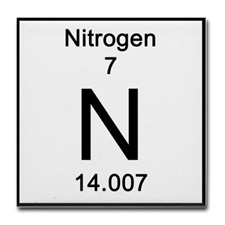
What is the number of protons that the element in this image contain?
a)
14
b)
7
c)
15
d)
18
67.
What is the atomic mass of "F"
a)
9
b)
18
c)
17
d)
19
68.
What are the 3 particles that make-up the atom?
a)
protons, neutrons, and isotopes
b)
neutrons, isotopes, and electrons
c)
positives, negatives, and electrons
d)
protons, neutrons, and electrons
69.
What does the nucleus of an atom contain?
a)
Electrons and neutrons
b)
Protons and neutrons
c)
Neutrinos and positrons
d)
DNA and RN
70.
How many protons are in an atom of carbon?
a)
12.01
b)
8
c)
6
d)
14
71.

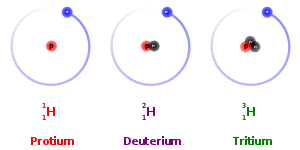
Different isotopes have...

a)

different masses

b)

different protons

c)

different electrons

72.

Which number here is the atomic number?

a)

5

b)

10.811

73.

Isotopes are atoms that have the same number of protons but a different number of _____________.

a)

neutrons

b)

electrons

c)

atoms

74.

The atomic weight represents the weighted average of the

a)

electrons

b)

isotopes

c)

protons

75.
Use your periodic table to answer the following question.
Which of the following atoms has 14 electrons?
a)
Carbon (C)
b)
Silicon (Si)
c)
Sulfur (S)
d)
Argon (Ar)
76.
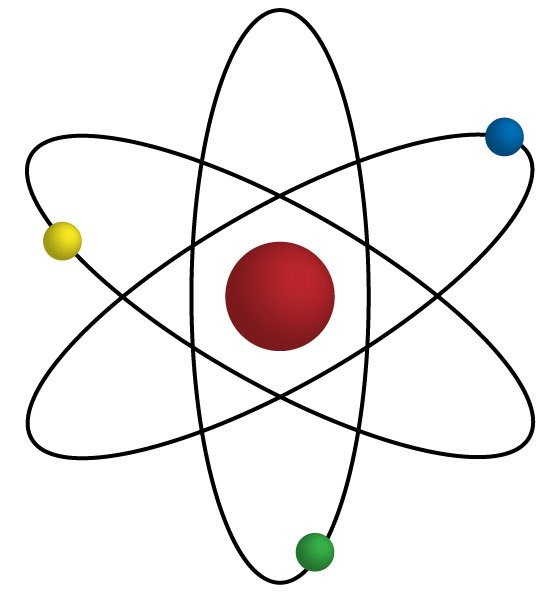
Use the picture of an atom below to answer the question.

Which statement best describes the part of the atom that is shown by the letter B?

a)
It is an electron, and it has a negative charge.
b)
It is an electron, and it has a positive charge.
c)
It is a proton, and it has a negative charge.
d)
It is a neutron, and it has a neutral charge.
77.
Manganese has an atomic mass of 55 and an atomic number of 25. What does this information reveal about most phosphorus atoms?
a)
They contain more neutrons than protons.
b)
They contain more protons than neutrons.
c)
They contain the same amount of protons and neutrons.
d)
They contain more electrons than neutrons.
78.
What makes an atom have a positive charge?
a)
more electrons than protons
b)
more neutrons than electrons
c)
more protons than electrons
d)
less protons than electrons
79.
An atom has 54 protons, 54 electrons, and 131 neutrons. What is the atomic number of the atom?
a)
54
b)
77
c)
131
d)
185
80.
What kind of charge do neutrons have?
a)
positive 
b)
negative
c)
neutral
d)
-3
81.
The protons in an atom’s nucleus have what kind of charge?
a)
positive
b)
negative
c)
neutral
d)
no charge
82.
What is the basic unit of matter (smallest part of an element)?
a)
atoms
b)
elements
c)
protons
d)
compounds
83.
Another way the periodic table is arranged is by family. Families are determined based on the _______________ of an element.
a)
characteristics
b)
atomic mass
c)
number of neutrons
d)
name
84.
The periodic table is also arranged by _________________.
a)
atomic mass
b)
names
c)
temperature
d)
metallic character
85.
How do you find the number of neutrons in an atom?
a)
It is also the atomic number
b)
It is also the atomic mass
c)
Add the atomic mass and the atomic number
d)
Subtract the atomic number from the atomic mass