wayground logo

Free Printable Worksheets

Font size

S
M
L
XL
Worksheets

Unit Evolution/Classification (9, 10, 11, 12)

Total questions: 85

Worksheet time: 1hrs 9mins

Name
Class
Date
1.
Where the better adapted organisms survive to pass traits along to offspring.
a)
Evolution
b)
Natural Selection
c)
Extinction
d)
Artifical Selection
2.
The theory of evolution by natural selection means that what is changing over time?
a)
The inherited traits of a population.
b)
The acquired traits of a population.
c)
Hair color and eye color
d)
Attractive features.
3.
Why are advantageous traits more likely to be passed onto offspring?
a)
Because they are more likely to survive and reproduce.
b)
Because they come from dominant alleles.
c)
Because they come from recessive alleles.
d)
Because the trait is an acquired phenotype.
4.
Mutations are a change in what?
a)
DNA
b)
tRNA
c)
genotype
d)
phenotype
5.

_______ selection is when humans decide who survives and who doesn't

a)

Natural

b)

Animal

c)

Artificial

6.
Rat snakes come in a variety of colors so that they can be camouflaged in the terrain in which they live. 
a)
Artificial Selection
b)
Natural Selection
7.
Farmers raise corn that has been made virus-resistant by adding a gene from the Teosinte weed. 
a)
Artificial Selection
b)
Natural Selection
8.
What type of selection is depicted in the picture? 
a)
stabilizing 
b)
directional 
c)
disruptive 
d)
the answer is not here
9.
Robins typically lay fours eggs. If more then four eggs are produced then the baby chicks are malnourished while smaller egg numbers result in no viable (able to live) baby chicks. This is an example of
a)
stabalizing
b)
disruptive
c)
direction
d)
none of the above
10.
What type of selection?
a)
Directional 
b)
Stabilizing
c)
Disruptive
11.
Only populations can evolve.
Individuals can not evolve.
a)
True
b)
False
12.
What process is being shown in this image?
a)
Variation
b)
Natural Selection
c)
Selective Breeding
d)
Homeostasis
13.
Since the 1800s humans have stopped burning coal, and the trees have returned to their original color. Which moth will be more successful in this environment?
a)
Dark moth
b)
Light moth
c)
Both will be equally successful
d)
Neither will be successful
14.
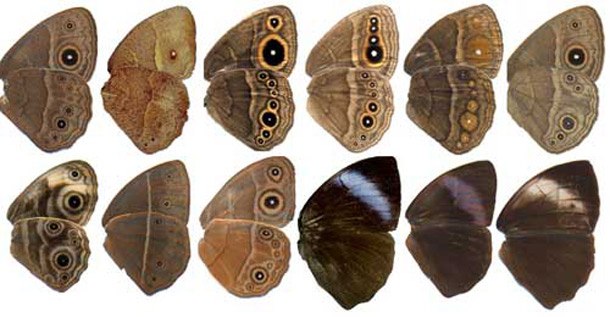
These moths are all the same species. The differences between their wings is an example of ________________
a)
Natural Selection
b)
Variation
c)
Homeostasis
d)
Extinction
15.
Selective breeding is where ___________ decides which traits should be passed on
a)
Nature
b)
 A human
c)
Mr. Holt
d)
The illuminati
16.
a measure of how commonly a particular allele occurs in a population is known as the 
a)
gene pool
b)
allele frequency
c)
mutation rate
d)
phenotype
17.
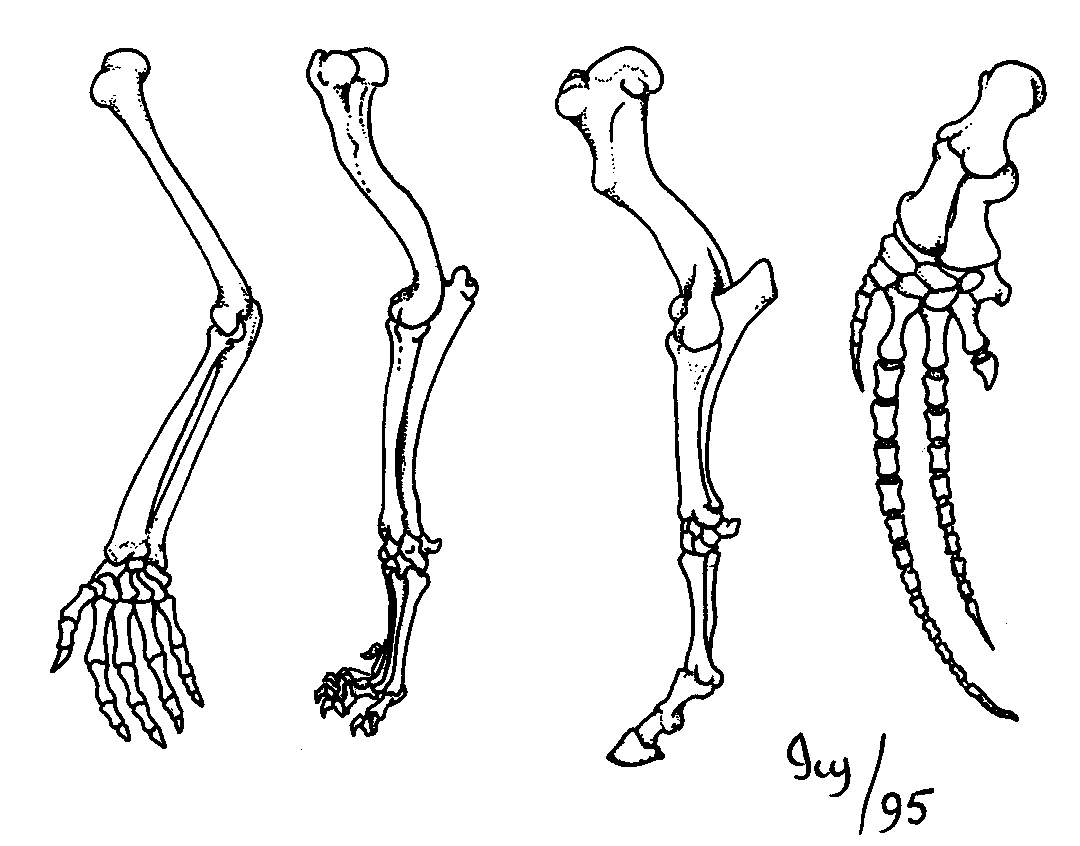
Structures with the same parts have different functions; suggests that organisms share a common ancestry
a)
vestigial structures
b)
homologous structures
c)
adaptive radiation
d)
fossil
18.
If an organism has a vestigial structure, that structure likely once had a function in a(n)
a)
close relative
b)
early ancestor
c)
unrelated organism
d)
embryological stage
19.
Study of embryos of various organisms to show a common ancestor because of similarities in development
a)
natural selection
b)
embryology
c)
speciation
d)
evolution
20.
Structures that have the same function but different structures are...
a)
homologous structures
b)
analogous structures
c)
vestigial structures
d)
embryology 
21.
Two organisms that are closely related would have
a)
very similar DNA sequence
b)
exactly the same DNA sequences
c)
no proteins in common
d)
completely different DNA sequence
22.
The diagram shows fossils in different rock layers. Which of these statements about the age of these fossils is most likely correct?
a)
Fossil A and C are the same age
b)
Fossil B is older than fossil C
c)
Fossils A is older than fossil B
d)
Fossil D is older than fossil C
23.
Which best describes these fossils?
a)
The oldest fossils can be found on the lower layers
b)
The oldest fossils can be found at the top layers
c)
The youngest fossils are always found on the bottom layers
d)
You can not tell the age of any of these fossils
24.
If species A and B have very similar genes and proteins, what is probably TRUE?
a)
species A and B share a relatively recent common ancestor
b)
species A evolved independently of species B for a long period
c)
species A is younger than species B
d)
species A is older than species B
25.
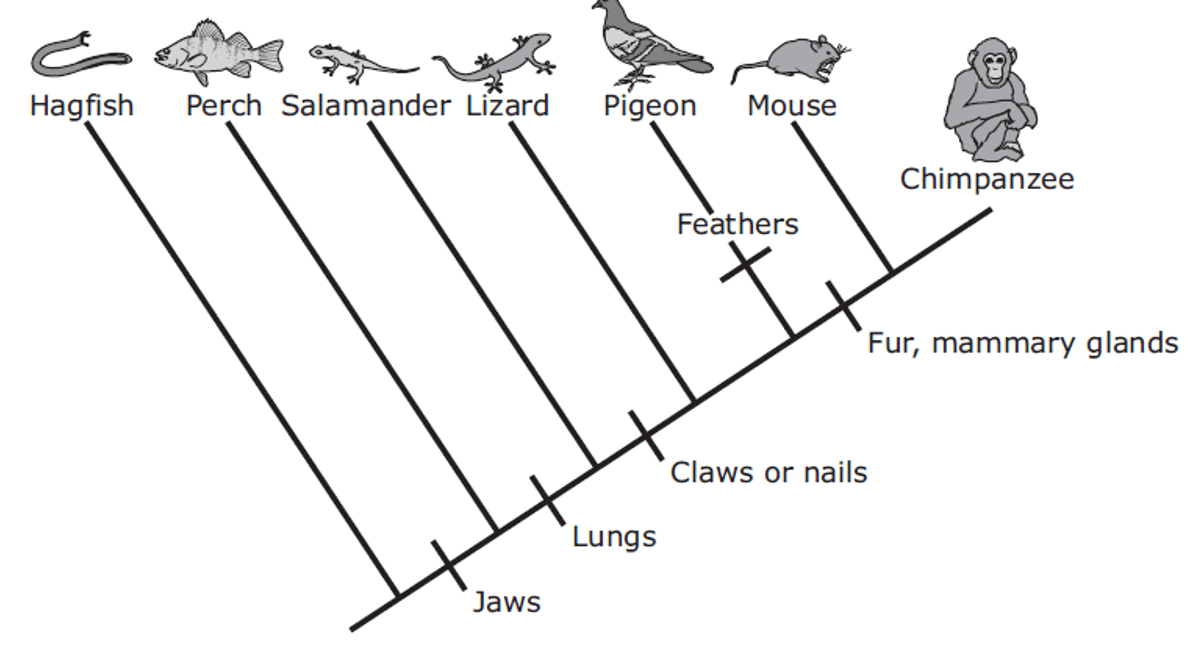
All the animals to the right of the hagfish would have the common characteristic of -
a)
Fur
b)
Claws or nails
c)
Lungs
d)
Jaws
26.
Which of the following pieces of evolution evidence contain both homologous and vestigial structures?
a)
fossil record
b)
comparing embryology
c)
comparing biochemistry
d)
comparing anatomy
27.
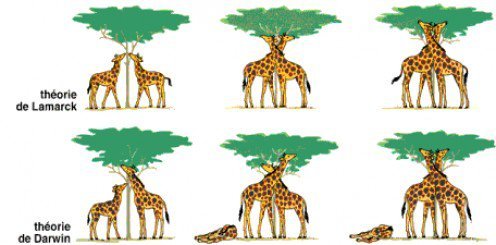
What would happen if the Giraffes never evolve?
a)
they would survive
b)
They would thrive
c)
They would become extinct
d)
They will find another source of food
28.
Bacteria undergo which type of reproduction? 
a)
asexual
b)
sexual
29.
The antibiotic resistance trait can be passed from one bacterium to another during:
a)
conjugation
b)
retaliation
c)
flagellination
d)
pili parties
30.

Put the pictures of the microevolution of insects in the correct order (assumes red means resistant to insecticide)

a)

4, 1, 2, 3

b)

1, 4, 3, 2

c)

3, 4, 1, 2

d)

1, 4, 2, 3

31.
People are making antibiotic resistance worse by:
a)
taking antibiotics only when they need them
b)
putting antibiotics into our food and environment
c)
not sharing antibiotics with others
32.
What is the principle that defines evolution in terms of allele frequency
a)
Natural Selection
b)
Convergent Evolutions
c)
Directional Selection
d)
Hardy -Weinberg
33.
Which condition is not part of Hardy -Weinberg principle
a)
random mating
b)
no genetic drift
c)
no gene  flow
d)
mutations
34.
Combined alleles of all individuals in a population is called
a)
phenothype
b)
gene pool
c)
mutation rate
d)
allele frequency
35.
A chance occurrence that negatively affects a population because the population is small.
a)
genetic drift
b)
mutation
c)
speciation
d)
migration
36.
What type of genetic drift occurs when the population size is greatly decreased?
a)
Founder's Effect
b)
Bottleneck Effect
c)
Intrasexual Selection
d)
Intersexual Selection
37.
Genetic drift is change in the allele frequency of a population due to...
a)
random chance
b)
natural selection
c)
non-random mating (sexual selection)
d)
artificial selection
38.
 Genetic Drift is more likely to happen in... 
a)
aquatic populations
b)
small populations
c)
terrestrial populations
d)
older populations
39.
Which of the following is an example of the bottle neck effect?
a)
Bald Eagles are hunted until near extinction, population recovers.
b)
Small group of iguanas floats to an island, starts a new population.
c)
Red fox pups are more likely to survive in a snowy environment if they are born white.
d)
Farmer chooses seeds from largest apples to plant next year.  This results in larger apples from year to year.
40.
Which of the following is an example of the founder effect?
a)
Bald Eagles are hunted until near extinction, population recovers.
b)
Small group of iguanas floats to an island, starts a new population.
c)
Red fox pups are more likely to survive in a snowy environment if they are born white.
d)
Farmer chooses seeds from largest apples to plant next year.  This results in larger apples from year to year.
41.

Which of the following is an example of natural selection?

a)

Bald Eagles are hunted until near extinction, population recovers.

b)

Small group of iguanas floats to an island, starts a new population.

c)

Red fox pups are more likely to survive in a snowy environment if they are born white.

d)

Farmer chooses seeds from largest apples to plant next year. This results in larger apples from year to year.

42.
Which of the following is an example of artificial selection?
a)
Bald Eagles are hunted until near extinction, population recovers.
b)
Small group of iguanas floats to an island, starts a new population.
c)
Red fox pups are more likely to survive in a snowy environment if they are born white.
d)
Farmer chooses seeds from largest apples to plant next year.  This results in larger apples from year to year.
43.
A change in the genetic composition of a population as a result of descending from a small number of colonizing individuals is called:
a)
founder effect
b)
bottleneck
c)
genetic drift
d)
gene flow
44.
What does the picture represent?
a)
Founder Effect
b)
Mutations
c)
Bottleneck effect
d)
Gene Flow
45.
Natural selection states that organisms are best suited for their environment if they ____________ and ____________.
a)
Survive and Reproduce
b)
Survive and Predate
c)
Survive and Parasitize
d)
Survive and Adapt
46.
According to the bead lab, Genetic drift (bottleneck or founder) tends to ___________ genetic variation (diversity)
a)
Increase
b)
Decrease
c)
Stabilize
d)
Exaggerate 
47.
If a population is not evolving, it is in genetic equilibrium. 
a)
True
b)
False
48.

Ducks and beavers both have webbed-feet.

a)

allopatric speciation

b)

adaptive radiation

c)

convergent evolution

d)

coevolution

e)

sympatric speciation

49.

There are species of lizards that burrow underground. Gophers and moles are mammals that also burrow underground.

a)

allopatric speciation

b)

adaptive radiation

c)

convergent evolution

d)

coevolution

e)

sympatric speciation

50.

The cuckoo bird and cowbirds have evolved eggs that closely mimic those of other birds (the hosts). Their young also have characteristics (feather coloration and calls) that mimic the young of those other birds and encourage the host parents to feed them. In response, some hosts have developed the ability to discriminate between their own offspring and eggs, and those of the cuckoos and cowbirds.

a)

allopatric speciation

b)

adaptive radiation

c)

convergent evolution

d)

coevolution

e)

sympatric speciation

51.

Many fruit-eating birds, especially in tropical rain forests, have adapted with the plants whose fruits they eat. The birds get nourishment, and in the process the plants get their digestion-resistant seeds dispersed (spread out) by regurgitation (throwing up, ew?) or along with the birds' droppings.

a)

Allopatric speciation

b)

Adaptive radiation

c)

Convergent evolution

d)

Coevolution

e)

Sympatric speciation

52.
The model that predicts evolution occurs at a slow, steady rate is called...
a)
gradualism
b)
punctuated equilibrium
c)
adaptive radiation
d)
convergent evolution 
53.
Evolution of two or more species from a common ancestor. May retain ancestral features in common.
a)
Divergent
b)
Convergent
c)
Parallel
d)
Co-evolution
54.

The American flying squirrel and the flying phalanger of Australia live in similar environments and look very similar. However, they are not closely related. Their resemblance is most likely an example of

a)

sexual selection

b)

temporal isolation

c)

convergent evolution

d)

divergent evolution

55.

The wings of robins and the wings of dragonflies are examples of

a)

divergent adaptation

b)

convergent evoltuion

c)

adaptive radiation

d)

punctuated equilibrium

56.

Like all flowering plants, the snapdragon must be pollinated to reproduce, but its flowers are closed. A bumblebee has just enough weight to open a snapdragon flower by landing on it. This adaptation is an example of

a)

convergent evolution

b)

coevolution

c)

divergent evolution

d)

speciation

57.

Rapid evolution with a few intermediate forms

a)

variation

b)

punctuated equilibrium

c)

variation

d)

Lamark

58.

Evolution as a result of acquired characteristics is

a)

species

b)

punctuated equilibrium

c)

Variation

d)

Lamarck's explanation

59.

Evolution as a slow change of one species to another

a)

natural selection

b)

camouflage

c)

radiometric dating

d)

embryology

e)

gradualism

60.

This theory states that species change little for a long period of time then, during a relatively short period of time, under significant change resulting in a new species.

a)

punctuated equilibrium

b)

biogenesis

c)

gradualism

d)

evolution

61.

This theory states that a continuing series of small variations will result in a new species over time.

a)

punctuated equilibrium

b)

biogenesis

c)

gradualism

d)

evolution

62.
Which type of evolution shows a common ancestor?  
a)
convergent
b)
divergent
c)
adaptive radiation 
d)
both divergent and adaptive radiation 
63.
a)
The image shows analogous structures.
b)
The image shows convergent evolution.
c)
The image shows adaptive radiation. 
d)
The image shows organisms that are not closely related.
64.
a)
The image shows convergent evolution. 
b)
The image shows divergent evolution. 
c)
The image shows adaptive radiation.
d)
The image shows analogous structures.
65.
a)
The image shows convergent evolution.
b)
The image shows divergent evolution.
c)
The image shows adaptive radiation.
d)
The image shows homologous structures.
66.
Flying fish, flying birds, and bats are examples of which of the following?
a)
convergent evolution & homologous structures
b)
convergent evolution & analogous structures
c)
divergent evolution & homologous structures
d)
divergent evolution & analogous structures
67.
a)
A=convergent B=divergent C=adaptive radiation
b)
A=adaptive radiation B=convergent C=divergent
c)
A=divergent B=convergent C=adaptive radiation
d)
A=divergent B=adaptive radiation C=convergent
68.
What kingdom is one of the most diverse groups and includes organisms that have characteristics similar to other groups? 
a)
protists
b)
monerans
69.

I have a nuclear membrane, can do photosynthesis and am multicellular. What kingdom do I belong to?

a)

Animalia

b)

Archaebacteria

c)

Plantae

70.

I sometimes get confused by others to be a plant. I'm heterotrophic and digest decaying material. What kingdom to I belong to?

a)

Archaebacteria

b)

Animalia

c)

Fungi

71.

I'm motile and have no cell walls. What kingdom do I belong to?

a)

Animalia

b)

Archaebacteria

72.

I am a prokaryote and live where others can't. What kingdom do I belong to?

a)

Animalia

b)

Archaebacteria

73.
The theory of Endosymbiosis explains
a)
The origin of eukaryotes
b)
How species develop
c)
How bacteria live
d)
Why cells rely on one another
74.
____________ & _________________ are organelles that definitely arose from endosymbiosis.
a)
Rough ER & Smooth ER
b)
Mitochondria & Flagellum
c)
Chloroplast & Mitochondria
d)
Chloroplast and Golgi apparatus
75.
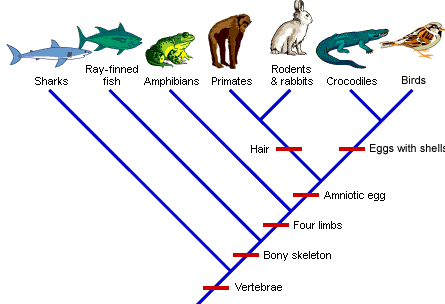
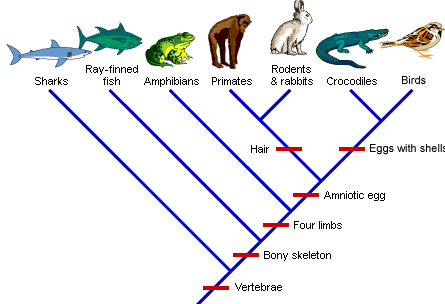
According to this cladogram, sharks are MOST closely related to which organism? 
a)
Amphibians
b)
Ray finned fish
c)
Crocodiles
d)
Birds
76.
Which two orgainsms have hair? 
a)
Sharks & Ray Finned Fish
b)
Primates & Rodents
c)
Birds & Crocodiles
d)
Rabbits & Birds
77.

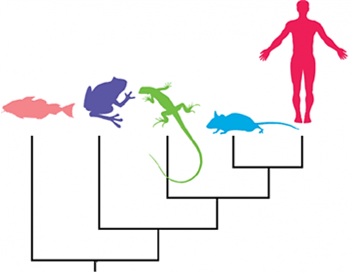
According to this phylogenetic tree, which creature is the least related out of all pictured?

a)

Fish

b)

Frog

c)

Salamander

d)

Human

78.

Which group of animals on this tree are most closely related to birds?

a)

Saurischian dinosaurs

b)

Ornithischian dinosaurs

c)

Crocodiles

d)

None of these are related to birds

79.
What do viruses need to reproduce?
a)
they need genetic material
b)
They need a host cell
c)
They need  bacteria
d)
They need insulin
80.
When a virus invades a living cell, its _______
takes over the cell's functions.
a)
outer coat
b)
genetic material
c)
core
d)
cytoplasm
81.
What part of the phage is the DNA?
a)
A
b)
B
c)
C
d)
D
82.
Antibiotics kill viruses
a)
True
b)
False
83.
What part of a virus is the protein capsule that houses the genetic material (DNA/RNA)?
a)
tail
b)
nucleus
c)
capsid
d)
glycoprotein
84.

Identify the structures.

a)

A: Virus B: Eukaryote

b)

A: Virus B: Bacteria

c)

A: Bacteria B: Prokaryote

d)

A: Virus B: Virus

85.

Viruses are a type of bacteria

a)

No, viruses are not living and bacteria are living organisms

b)

Yes, they are living like bacteria