
 Worksheets
Ultimate EOC Review SC
Total questions: 84
Worksheet time: 3hrs 33mins
Name
Class
Date
1.

What best describes the genetic material shown in photograph B.
a)
The chromosomes are in anaphase
b)
The chromosomes are in metaphase
c)
DNA is possibly being replicated
d)
The genetic material is around the poles and cytokinesis is occurring
2.

Which of the following are true of the cell cycle?
a)
The cell spends most of its time dividing
b)
The cell spends most of its time growing
c)
Replication of DNA occurs at M
d)
Cells enter G0 after M
3.

When is DNA replicated during the cell cycle?
a)
During the G1 phase
b)
During the G2 phase
c)
During the S phase
d)
During the M phase
4.
In DNA replication, complementary base pairing occurs between ___.
a)
Cytosine and uracil
b)
Adenine and guanine
c)
Adenine and uracil
d)
Adenine and thymine
5.
DNA polymerase
a)
Is an enzyme
b)
Adds new nucleotides to the template strand
c)
Proofreads DNA strands to see that they are correct
d)
All of these are characteristics of DNA polymerase
6.

Identify this process.
a)
Replication
b)
Transcription
c)
Translation
d)
Proof reading
7.
Which is a characteristic of cancer?
a)
rapid and uncontrolled cell growth
b)
cell growth delayed at the G1 checkpoint.
c)
cell growth delayed at the G2 checkpoint.
d)
damage to a cell’s cytoplasm
8.

Which of the cells depicted in the line graph are most likely cancerous?
a)
Line A
b)
Line B
c)
Line C
d)
Line D
9.
Which sequence depicts the correct order of protein synthesis within a cell?
a)
DNA → mRNA → amino acids → proteins
b)
DNA → amino acids → mRNA → proteins
c)
DNA → mRNA → proteins → amino acids
d)
DNA → proteins → amino acids → mRNA
10.
Which molecule carries amino acids to the ribosomes?
a)
mRNA
b)
tRNA
c)
DNA
d)
ATP
11.

What type of cell is shown?
a)
eukaryotic
b)
prokaryotic
c)
bacterial
d)
protist
12.
Proteins are assembled within this cell organelle.
a)
nucleus
b)
Golgi apparatus
c)
lysosome
d)
ribosome
13.
Cellular energy is produced in the membrane of this organelle.
a)
endoplasmic reticulum
b)
chloroplast
c)
mitochondria
d)
lysosome
14.
This organelle packages proteins for export from the cell.
a)
Golgi apparatus
b)
endoplasmic reticulum
c)
ribosome
d)
lysosome
15.
This organelle would NOT be found in animal cells.
a)
cell membrane
b)
nucleus
c)
lysosome
d)
chloroplast
16.

What is the name and importance of the molecule shown in the picture?
a)
fatty acid tail; makes up the fat found in butter
b)
phospholipid; makes up cellular membranes
c)
triglyceride; makes up animal lard
d)
cellulose; makes up the cell walls of plants
17.
Which statement most correctly describes the difference between viruses and a bacteria?
a)
Bacteria are pathogens and viruses are not.
b)
Bacteria have a nucleus and viruses do not.
c)
Bacteria can spread throughout the body and viruses cannot.
d)
Bacteria are living and viruses are not.
18.
What is the movement of molecules or solutes from an area of high concentration to an area of low concentration?
a)
osmosis
b)
active transport
c)
merging
d)
diffusion
19.
Which of these requires ATP?
a)
osmosis
b)
diffusion
c)
active transport
d)
stasis
20.

What phase of mitosis is shown in the picture?
a)
Prophase
b)
Metaphase
c)
Anaphase
d)
Telophase
21.
Which class of biomolecules include monosaccharides, disaccharides, and polysaccharides?
a)
carbohydrates
b)
lipids
c)
proteins
d)
nucleic acids
22.
Which class of biomolecules include fats, oils, and steroids?
a)
carbohydrates
b)
lipids
c)
proteins
d)
nucleic acids
23.
Which class of biomolecules includes DNA and RNA?
a)
carbohydrates
b)
lipids
c)
proteins
d)
nucleic acids
24.

What type of cell is shown?
a)
Eukaryotic because it has a nucleus
b)
Eukaryotic because it lacks a nucleus
c)
Prokaryotic because it has a nucleus
d)
Prokaryotic because it lacks a nucleus
25.
Which of these is most likely an enzyme?
a)
Sucrose
b)
Galactose
c)
Fructose
d)
Amylase
26.
The part of the enzyme that the substrate bonds to is called the _____.
a)
active site
b)
activation energy
c)
bond site
d)
peptide bond
27.
For many years scientists debated whether viruses should be considered living organisms. Which statement could a scientist use to support the position that viruses are not living?
a)
viruses have genes encoded in DNA
b)
viruses infect both plant and animal cells
c)
viruses replicate to produce more viruses
d)
viruses require a host cell in order to reproduce
28.
ATG is _____, while UAA is ____
a)
a ribosome - a protein
b)
an amino acid - an enzyme
c)
a DNA codon - an RNA codon
d)
transfer RNA - messenger RNA
29.
A DNA nucleotide may be made up of a phosphate group, along with ____
a)
deoxyribose sugar and uracil
b)
deoxyribose sugar and guanine
c)
ribose sugar and cytosine
d)
ribose sugar and adenine
30.
genetic variation in populations arises through a number of biological processes. Which statement best describes the cause of this variation?
a)
meiosis produces gametes that are identical to each other
b)
random fertilization of an egg cell by a sperm cell increases variation
c)
acquired characteristics caused by environment pressures are passed from parents to offspring
d)
meiosis produces gametes with a genetic makeup identical to the genetic makeup of the parent
31.
what are the reactants for cellular respiration?
a)
H2O and O2
b)
glucose and O2
c)
glucose and CO2
d)
H2O and CO2
32.
what is the process that copies a gene's DNA sequence into a sequence of RNA?
a)
insertion
b)
initation
c)
translation
d)
transcription
33.
Under which environmental condition would primary succession occur?
a)
bare rocks exposed as glaciers melt
b)
meadow following a controlled burn
c)
forest after trees fall during a severe storm
d)
farm field no longer being used to cultivate crops
34.
What is the original source of almost all energy in most ecosystems?
a)
carbohydrates
b)
sunlight
c)
water
d)
carbon
35.

which type of symbiotic relationship is shown in the picture?
a)
parasitism
b)
mutualism
c)
commensalism
d)
predator/prey
36.
The amount of energy that usually transfers from one trophic level to the next...
a)
10%
b)
20%
c)
80%
d)
50%
37.

If there is 1000 Kcal available in the producers in trophic level 1, how much energy is available in the herbivores in trophic level 2?
a)
10 Kcal
b)
1 Kcal
c)
100 Kcal
d)
1000 Kcal
38.

Which species most likely has the largest population?
a)
Herring
b)
Plankton
c)
Shrimp
d)
Shark
39.
Mutations are important because they bring about
a)
death of the organism in which they develop
b)
genetic variation needed for a population to evolve
c)
benefits for the individual, not for the population
d)
Hardey-Weinberg equilibrium within a population
40.
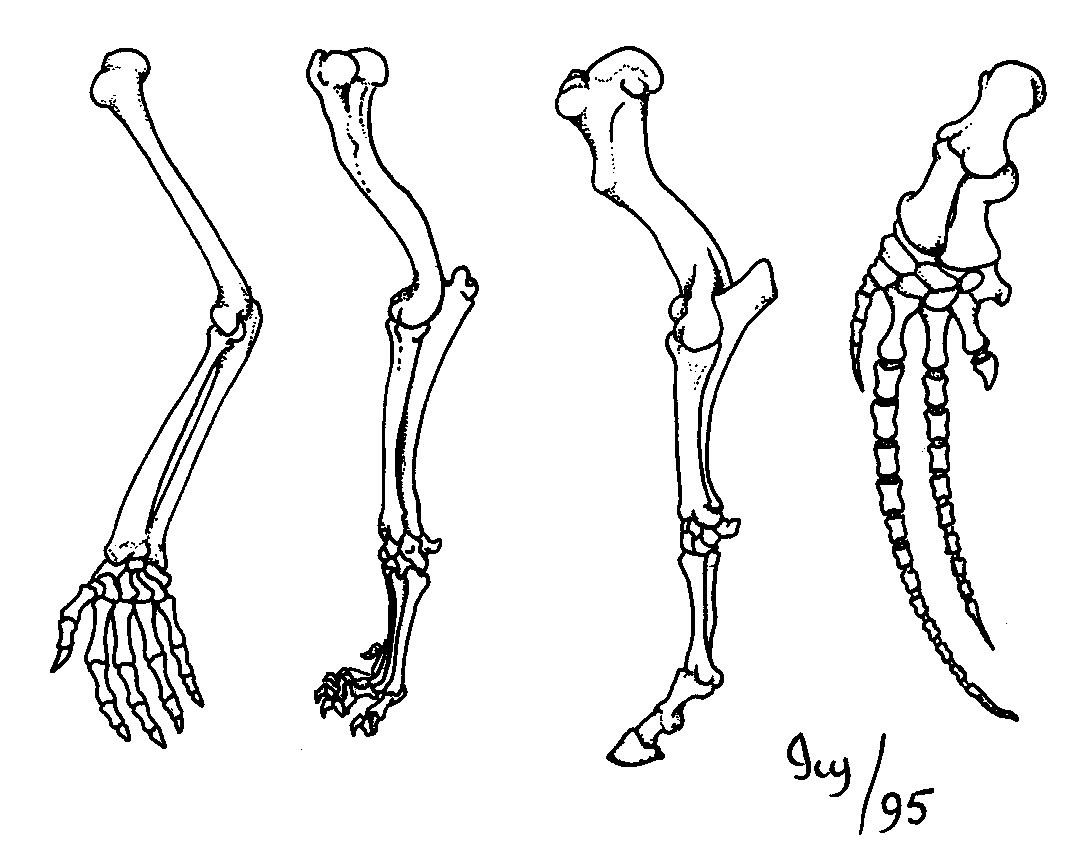
Structures with the same parts have different functions; suggests that organisms share a common ancestry
a)
vestigial structures
b)
homologous structures
c)
adaptive radiation
d)
fossil
41.
A possible explanation to a problem that has not yet been tested.
a)
data
b)
theory
c)
hypothesis
d)
fact
42.
This part of the experiment serves as a basis of comparison; the one variable being tested has been omitted.
a)
experimental group
b)
control group
c)
data
d)
variables
43.
Which of these terms describes the movement of water through a cell membrane?
a)
Osmosis
b)
Metabolism
c)
Homeostasis
d)
+Active transport
44.
how do enzymes speed up biochemical reactions?
a)
they provide energy to the reactants
b)
they absorb energy from the products
c)
they lower the activation energy of the reaction
d)
they increase the number of available reactant particles
45.
the first species to populate an area during succession
a)
primary succession
b)
secondary succession
c)
pioneer species
d)
host
46.
Diatoms are one of the most common types of phytoplankton in marine habitats. Like plants, diatoms contain chlorophyll and produce glucose from which of the following?
a)
O2 and ATP
b)
CO2 and O2
c)
ATP and H2O
d)
CO2 and H2O
47.
Cells can generate as many as 36 to 38 molecules of adenosine triphosphate (ATP) from the metabolism of one molecule of glucose. Which cellular process results in this amount of ATP production?
a)
anaerobic cellular respiration
b)
protein synthesis
c)
aerobic cellular respiration
d)
photosynthesis
48.
A science class is planning a field trip to a local farm that has a large pond. Which of the following lists the order of biological organization from smallest to largest that the students can expect to find at the pond?
a)
organism, community, population, ecosystem
b)
organism, population, community, ecosystem
c)
population, organism, community, ecosystem
d)
population, organism, ecosystem, community
49.

An animal cell placed in a sugar solution is shown in the diagram. Which statement best describes how osmosis will affect this animal cell?
a)
Water will move out of the cell and the cell will shrink
b)
Water will move into the cell and the cell will expand
c)
Sugar will move out of the cell and the cell will expand
d)
Sugar will move into the cell and the cell will expand
50.

The stages of the cell cycle are shown in random order below. Starting with prophase, sequence the diagrams to show the stages of mitosis.
a)
5-3-1-2-4
b)
3-1-4-2-5
c)
4-1-2-5-3
d)
2-3-1-5-4
51.
A gamete that resulted from a meiotic division has 24 chromosomes. How many chromosomes did the parent cell have?
a)
6
b)
12
c)
24
d)
48
52.

The figures below show four processes involving DNA and RNA. Use these figures to answer the next question.
Which figure shows the process of replication?
Which figure shows the process of replication?
a)
figure 1
b)
figure 2
c)
figure 3
d)
figure 4
53.
Which of these statements is true about plant and animal cells that are in the process of cell division?
a)
Most animal and plant cells develop a cell plate
b)
Most animal and plant cells develop a cleavage furrow
c)
Plant cells develop a cell plate and animal cells develop a cleavage furrow
d)
Animal cells develop a cell plate and plant cells develop a cleavage furrow
54.
A particular plant was made using genetic engineering. What do you know about that plant?
a)
The genetic makeup was changed.
b)
It is an artificial plant.
c)
It cannot be eaten.
d)
It was developed for feeding cattle.
55.

If green is dominant over purple, then what is the genotype for this individual?
a)
Purple
b)
Green
c)
GG
d)
gg
56.

Brown fur color is dominant over black fur color. Which of the following is the actual genotype of ALL of the offspring in the next generation of this cross for fur color?
AA x aa
AA x aa
a)
AA
b)
Aa
c)
aa
d)
brown fur
57.

Which is the correct phenotype for this organism?
a)
BB
b)
blue
c)
green
d)
bb
58.

What percentage of the female offspring will be a carrier for this recessive disease?
a)
0%
b)
50%
c)
100%
d)
25%
59.
If a trait is controlled by one gene, but there are 3 possible alleles, the inheritance pattern is called? An example of this is blood typing (A,B,O).
a)
dominance
b)
sex-linked
c)
multiple alleles
d)
polygenic
60.
An individual with XX chromosomes would be ____________.
a)
Male
b)
Female
61.
True or False: Men can NEVER be "carriers" for recessive sex-linked traits because they only have one X chromosome.
a)
True
b)
False
62.
A red lily crossed with a yellow lily produces heterozygous orange lily flowers. This is an example of which type of inheritance?
a)
Codominance
b)
Incomplete Dominance
c)
Sex Linked
d)
Polygenic Trait
63.
The sex of an offspring is determined by
a)
the mother.
b)
the father.
c)
both parents.
d)
the offspring.
64.

A calico cat shows both the traits for orange fur and black fur. What kind of allele expression is this?
a)
Incomplete dominance
b)
Codominance
c)
Independent assortment
d)
Recessive inheritance
65.

There are many variations in skin color that can be inherited based on the combination of alleles that you inherit from your mom and dad. This bell curve distribution is an example of
a)
incomplete dominance
b)
codominance
c)
multiple alleles
d)
polygenic inheritance
66.
How much of your DNA do you inherit from your mom?
a)
10%
b)
25%
c)
50%
d)
it varies
67.
Which of the following crosses will yield only homozygous recessive offspring?
a)
RRYY x RRYY
b)
RrYy x RrYy
c)
rryy x rryy
d)
RrYy x rryy
68.
Most plants appear green because chlorophyll
a)
absorbs green light.
b)
absorbs violet light.
c)
reflects green light.
d)
does not absorb violet light.
69.
Which of the following is the correct equation for PHOTOSYNTHESIS?
a)
6CO2 + 6H2O --> 6O2 + C6H12O6
b)
6CO2 + C6H12O6 + 6H2O --> O2
c)
6O2 + 6H2O --> 6CO2 + C6H12O6
d)
C6H12O6 + 6O2 ---> 6H2O + 6CO2
70.
What is the primary function of the light-dependent reactions of photosynthesis?
a)
To produce glucose
b)
To produce NADPH and ATP
c)
To use ATP
d)
To produce RuBP
71.
Plants need carbon dioxide from their environment to produce glucose during which stage of photosynthesis?
a)
The light-dependent stage
b)
The light-independent stage (The Calvin Cycle)
c)
The electron transport chain
d)
ATP formation
72.
In which eukaryotic organelles does photosynthesis occur?
a)
mitochondria
b)
stomata
c)
xylem
d)
chloroplast
73.
The light-dependent reactions occur in the ________ and the light-independent (dark) reactions take place in the ________.
a)
Chloroplast / thylakoid membrane
b)
stroma / thylakoid
c)
mesophyl / stomata
d)
thylakoid membrane / stroma
74.
This is referred to as the energy currency of the cell
a)
ADP
b)
ATP
c)
Mitochondria
d)
Nucleus
75.
What is the net gain of ATP during glycolysis?
a)
1
b)
2
c)
3
d)
4
76.
Glycolysis takes place in the
a)
mitochondria
b)
cell membrane
c)
cytoplasm
d)
nucleus
77.
The final electron acceptor in the respiration electron transport chain is
a)
oxygen
b)
NADH
c)
glucose
d)
CO2
78.
The ETC produces the most ATP of all the stages of cellular respiration.
a)
true
b)
false
79.
Lactic acid fermentation occurs in ______
a)
bread dough
b)
any oxygen rich environment
c)
muscle cells
d)
mitochondria
80.
Which of the following pass high-energy electrons from the krebs cycle to the electron transport chain?
a)
ATP and ADP
b)
NADH and FADH2
c)
citric acid
d)
acetyl-CoA
81.
Which of the following is not one of the steps of cellular respiration?
a)
Glycolysis
b)
Krebs (Citric Acid) Cycle
c)
Electron Transport Chain
d)
Calvin Cycle
82.
During glycolysis, a six-carbon sugar is converted to ___.
a)
three two-carbon sugars
b)
glucose
c)
two pyruvic acids
d)
a disaccharide
83.
Which pathway is common to both fermentation and cellular respiration?
a)
Krebs cycle
b)
ETC
c)
glycolysis
d)
formation of Acetyl CoA
84.
Anaerobic respiration...
a)
doesn't require CO2
b)
requires CO2
c)
doesn't require oxygen
d)
requires oxygen
100 %

