wayground logo

Free Printable Worksheets

Font size

S
M
L
XL
Worksheets

Cells and Cell Transport - PreAP Bio - Clark

Total questions: 79

Worksheet time: 1hrs 29mins

Name
Class
Date
1.

What characteristic defines this organism as prokaryotic?

a)

Ability to move

b)

Ability to respond

c)

Shape and size

d)

Lacking of membrane-bound organelles and a nucleus

2.

What structures are found in ALL prokaryotic AND Eukaryotic Cells?

a)

flattened, stack-like structures which process macromolecules.

b)

a continuous, interconnected network of membranes.

c)

DNA, cytoplasm, ribosomes, and a plasma (cell) membrane

d)

Power-producing organelles that convert energy into usable forms.

3.
Which structure is found only in eukaryotic cells?
a)
DNA
b)
Phospholipid membrane
c)
Nuclear membrane
d)
Cytoplasm
4.
What is the function of the cell membrane, in ALL living organisms?
a)
Provides support and structure in the cell.
b)
Synthesizes protein for ATP for the cell.
c)
Storage of raw materials (food) and ATP for the cell. 
d)
Regulates the transport of materials into and out of the cell. 
5.

Which of the following does NOT describe Prokaryotic Cells?

a)

Has DNA as genetic material.

b)

Perform metabolic functions with the help of chemical processes.

c)

Transport of nutrients and waste through the plasma membrane.

d)

Produces ATP by using mitochondria.

6.
What type of transport is occurring in Part C of the diagram shown?
a)
Active Transport
b)
Osmosis
c)
Facilitated Diffusion
d)
Diffusion
7.

This diagram illustrates

a)

diffusion

b)

facilitated diffusion

c)

endocytosis

d)

exocytosis

8.

This diagram shows

a)

simple diffusion

b)

facilitated diffusion

c)

endocytosis

d)

exocytosis

9.

In this concentration gradient, most blue molecules will move

a)

to the right, becoming more concentrated

b)

to the left, to even out the concentration

c)

to the middle, to make it isotonic

d)

to the bottom, because of gravity.

10.

3 of the answers below require ATP (energy). Which one does NOT need energy to function?

a)

Endocytosis

b)

Exocytosis

c)

Active transport through protein gates

d)

Facilitated diffusion

11.
What is something that prokaryotic and eukaryotic cells have in common?
a)
They have a nucleus. 
b)
They are multi-cellular. 
c)
They have DNA. 
d)
They have organelles that are membrane-bound.
12.
What is facilitated diffusion?
a)
Transport that uses proteins to help move molecules across the membrane. 
b)
Movements of substances through a membrane. 
c)
When molecules spread from High to Low concentration on their own. 
d)
When pressure pushes something through a membrane. 
13.

What is an isotonic solution?

a)

When solutions are in equilibrium (homeostasis)

b)

When the solution has more solute

c)

When the solution has less solute

d)

Has a greater pressure

14.
What are the 2 parts of a phospholipid? 
a)
Hydrophobic head, hydrophilic tails 
b)
Hydrophobic heads, hydrophobic tails 
c)
Hydrophilic heads, hydrophobic tails 
d)
Hydrophilic heads, hydrophilic tails 
15.
Molecules using simple diffusion move from 
a)
high to low concentrations 
b)
low to high concentrations 
c)
no concentrations  
d)
both concentrations  
16.
What is a sac-like structure used to store water and nutrients? These are much larger in plant cells?
a)
Lysosomes
b)
Mitochondria
c)
Vacuoles
d)
Golgi Body
17.
Which organelle is responsible for making proteins?
a)
Nucleus
b)
Nucleolus
c)
Lysosomes
d)
Ribosomes
18.
This picture represents what type of cell transport?
a)
endocytosis
b)
exocytosis
c)
osmosis
d)
passive transport
19.
Movement of particles from high to low concentration. 
a)
Passive Transport
b)
Active Transport
20.
What is it called when molecules move across the cell membrane from an area of high concentration to an area of low concentration through a carrier protein?
a)
Diffusion
b)
Osmosis
c)
Active Transport
d)
Facilitated Diffusion
21.
what type of solution causes the blood cells to swell and burst.
a)
hypotonic solution
b)
hypertonic solution
c)
isotonic solution
d)
active transport
22.

What is NOT a part of cell theory:

a)

all cells come from existing cells

b)

all cells have a nucleus

c)

all living things are made of cells

d)

cells are basic unit of structure and function in living things

23.

Prokaryotes are

a)

bacteria

b)

fungi

c)

plants

d)

animals

24.

Prokaryotic cells do NOT have membrane bound organelles or ______________________________.

a)

cytoplasm

b)

a nucleus

c)

ribosomes

d)

DNA

25.

In eukaryotic cells DNA is primarily contained within the:

a)

cytoplasm

b)

ribosomes

c)

vacuoles

d)

nucleus

26.

Of the two types of cells, which one is smaller and more simplistic?

a)

prokaryotic cells

b)

eukaryotic cells

27.

All cells have a cell membrane, cytoplasm, DNA, and...

a)

cell wall

b)

nucleus

c)

ribosomes

d)

chloroplast

28.

Structures that have different jobs within the cell:

a)

antibodies

b)

lipids

c)

organelles

d)

blood cells

29.

How can you tell that this is a prokaryote or eukaryote cell?

a)

It is a prokaryote because it doesn't have a nucleus

b)

It is a eukaryotic cell because it has a nucleus

c)

It is eukaryotic because it does not a nucleus nor a cell membrane

d)

It is prokaryote because it has a cell wall
30.
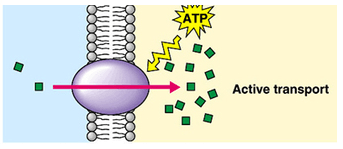
What kind of transport does not require energy?
a)
Active 
b)
Vacuole 
c)
Passive 
d)
Na/K Pump 
31.

ATP is a form of energy used in which process?

a)

Passive Transport

b)

Active Transport

32.
Osmosis is the diffusion of _____ across a selectively permeable membrane.
a)
food
b)
air
c)
water
d)
oxygen
33.

An animal cell is placed in a hypertonic, super salty solution. Since there is MORE water in the animal cell than in the solution, the cell will -

a)

Stay the same

b)

Shrink- get smaller

c)

Swell- get bigger

d)

burst

34.
Which means of particle transport is shown in this diagram?
a)
endocytosis
b)
exocytosis
c)
facilitated diffusion
d)
protein pump
35.
In this situation, where the solute is illustrated by red dots, predict if will WATER move into or out of the cell, and how that will affect the cell.
a)
Water will move into the cell and the cell will expand.
b)
Water will move into the cell and the cell will shrink.
c)
Water will move out of the cell and the cell will expand.
d)
Water will move out of the cell and the cell will shrink.
36.
Which illustration of transport across the membrane requires energy?
a)
A
b)
B
c)
C
d)
D
37.
A person with swollen gums rinses his mouth with warm salt water, and the swelling decreases. Which of the following has occurred?
a)
The swollen gums have absorbed the saltwater solution.
b)
The saltwater solution lowers the temperature of the water in the gums.
c)
The salt in the solution has moved against the concentration gradient.
d)
The water in the gums has moved out due to the high concentration of salt in the solution. 
38.

Identify the following structure

a)

Phospholipid

b)

Cell

c)

Cell membrane

d)

Protein

39.
When particles move from areas of high concentration to areas less concentrated, this has taken place.
a)
diffusion
b)
mitosis
c)
endocytosis
d)
photosynthesis
40.
What process occurs when WATER diffuses across a membrane?
a)
endocytosis
b)
mitosis
c)
osmosis
d)
nuclear fission 
41.

Why are diffusion and osmosis important to cells?

a)

It allows them to take in materials/substances without using energy.

b)

It allows them to reproduce.

c)

It allows them to absorb sunlight.

d)

It allows cells to use all energy.

42.
The picture  is an example of _________________.
a)
isotonic
b)
diffusion
c)
osmosis
d)
active transport
43.

When both inside and outside of a cell have the same amount of water it is said that the cell has reached a state of ___________.

a)

osmosis

b)

equilibrium (homeostasis)

c)

diffusion

d)

hypertonic

44.

What does selectively-permeable mean?

a)

Allow certain things to enter and leave the cell

b)

Nothing gets through

c)

The cell lets only large substances through

45.
Which way will the water molecules move during osmosis?
a)
Out of the cell, so the cell shrinks.
b)
Out of the cell, so the cell swells.
c)
Into the cell, so the cell shrinks.
d)
Into the cell, so the cell swells.
46.
The picture below is an example of _________________.
a)
osmosis
b)
isotonic
c)
diffusion
d)
active transport
47.
This cell organelle helps organisms maintain homeostasis by controlling what substances may enter or leave cells.
a)
vacuole
b)
nucleus
c)
cell membrane
d)
cell wall
48.

Due to the higher concentration of oxygen in the air than your blood, oxygen goes from the lungs into the red blood cells by....

a)

Osmosis

b)

Diffusion

c)

Active Transport

49.

To pump a solute across a membrane AGAINST its gradient requires work; the cell must expend energy. Which of the processes below require energy?

a)

active transport

b)

passive transport

c)

osmosis

d)

gated channels

50.

The cell membrane maintains...

a)

Energy

b)

Homeostasis/Equilibrium

c)

The cell looking good

51.

What is the definition of Selective Permeability?

a)

The movement of materials across the cell membrane that requires NO ENERGY from the cell.

b)

The movement of materials through (or across) the cell membrane

c)

The ability of the cell membrane to allow some things to pass through while preventing other things from passing through.

52.
The picture is an example of...
a)
active tranport
b)
passive transport
c)
diffusion
d)
osmosis
53.

If you looked at red blood cells under a microscope and saw the blood cells exploded, what would you say happened?

a)

The cells were placed in a hypotonic solution.

b)

the solution was isotonic.

c)

The solution was hypertonic.

54.
The amount of particles in a given space.
a)
diffusion
b)
concentration
c)
permeable
d)
active transport
55.

When the concentration of particles inside of a cell is the same as the concentration of particles outside of the cell.

a)

active transport

b)

concentration

c)

diffusion

d)

equilibrium (homeostasis)

56.
Cells need to bring in molecules to carry out cellular processes. Often, this requires moving the molecules across the cell membrane against the concentration gradient. How do these molecules get into the cell?
a)
passive transport by diffusion
b)
active transport using ATP 
c)
passive transport by osmosis
d)
 osmosis
57.
The cell membrane of the red blood cell will allow water, oxygen, and carbon dioxide to pass through. Because other substances are blocked from entering, this membrane is called
a)
perforated
b)
semi-permeable
c)
non-conducive
d)
permeable
58.
 Look at the diagram of a cross-section of a cell membrane below. The cell membrane controls movement of materials into and out of the cell. The following particles are moving from high concentration to low concentration and are using a carrier protein. How would you describe this type of movement across the membrane? 
a)
simple osmosis
b)
active transport
c)
simple diffusion
d)
facilitated diffusion
59.
Look at the cross section of a cell membrane of a eukaryotic cell. H+ ions are being pumped from a low concentration to a high concentration. How do you describe this type of transport across the cell membrane?
a)
active transport
b)
passive transport
c)
facilitated diffusion
d)
co-transport
60.
The diagram below represents a cell and some molecules in its environment. Which molecule would require the use of energy in order to be brought into the cell?
a)
1
b)
2
c)
3
d)
4
61.

A process in which cells surround and engulf substances that are TOO BIG to enter the cell is known as...

a)

Pinocytosis

b)

Phagocytosis

c)

Endocytosis

d)

Receptor-mediated

62.

When a cell forms a vesicle around unwanted particles and expels it OUT of the cell.

a)

Pinocytosis

b)

Endocytosis

c)

Receptor-mediated

d)

Exocytosis

63.

Which way will the small molecules if no energy is used?

a)

Out of the cell

b)

Into the cell

c)

They won't move at all

64.
A fossilized cell is discovered, and evidence suggests it reproduced on its own and had DNA, but a membrane did not enclose its DNA. Which type of organism would this most likely be?
a)
prokaryote
b)
eukaryote
c)
plant cell
d)
animal cell
65.
Which type of cell?
a)
Prokaryote
b)
Eukaryote
66.

Which of the following provide evidence for the endosymbiotic theory?

a)

Large prokaryotic cells engulfed smaller prokaryotic cells, they coexisted within the host cells with double-membrane bound organelles: nucleus, mitochondria, and chloroplast.

b)

Large prokaryotic cells engulfed smaller prokaryotic cells, they did not coexist within the host cell and resulted in being digested.

c)

Small prokaryotic cells engulfed large prokaryotic cells, they did not coexist within the host cells and resulted in being digested.

d)

Endosymbiotic Theory is false.

67.

True or False: Both prokaryotes and eukaryotes have ribosomes and a plasma membrane.

a)

True

b)

False

68.
Which is true of prokaryotic and eukaryotic cells?
a)
Prokaryotic cells are larger than eukaryotic cells.
b)
Eukaryotic cells do not have nuclei, and prokaryotic cells do have nuclei.
c)
Prokaryotic cells lack membrane-bound organelles, and eukaryotic cells contain membrane-bound organelles.
d)
Eukaryotic cells are simpler than prokaryotic cells.
69.

Larger molecules will move -

a)

faster than smaller molecules

b)

slower than smaller molecules

c)

the same speed as smaller molecules

d)

not at all

70.

Endosymbiotic Theory is the idea that ______ cells could have evolved from_____cells

a)

prokaryotic, eukaryotic

b)

eukaryotic, animal

c)

prokaryotic, plant

d)

eukaryotic, prokaryotic

71.

According to the Endosymbiotic Theory, why are the ancestors to Eukaryotic cells Prokaryotes?

a)

Prokaryotic cells evolved

b)

Prokaryotic cells mutated, developing advantageous traits

c)

Prokaryotes grew inside each other, increasing complexity

d)

Prokaryotic cells grew together with eukaryotic organisms

72.

If a channel protein, in the cell membrane, stops working, what would happen?

a)

the molecules that normally go through that protein would decrease

b)

the molecules that normally go through the protein would increase

c)

homeostasis would occur

d)

everything would work as normal

73.

Which type of active transport is displayed?

a)

Endocytosis

b)

Exocytosis

74.

Which type of active transport uses a vesicle to allow a large molecule to exit the cell?

a)

Endocytosis

b)

Exocytosis

75.
In this picture, which way will the water move?
a)
Water will move into the cell
b)
Water will move out of the cell
c)
Water will move in and out of the cell
d)
Water will not move
76.

The concentration of red molecules outside the cell is higher than the concentration inside the cell. The red molecules cannot penetrate the cell. What will happen to the cell?

a)

Water will leave the cell, and the cell will shrink.

b)

Water will enter the cell, and the cell will expand.

77.
Which cell is in a hypotonic environment?
a)
A
b)
B
c)
C
78.
Which cell is in an isotonic environment?
a)
A
b)
B
c)
C
79.
Which cell is in a hypertonic environment?
a)
A
b)
B
c)
C