wayground logo

Free Printable Worksheets

Font size

S
M
L
XL
Worksheets

Biology 4th Six Weeks Rev: Protein Synthesis,Meiosis, Genetics

Total questions: 76

Worksheet time: 2hrs 46mins

Name
Class
Date
1.

Which statement best describes the importance of sexual reproduction?

a)

sexual reproduction produces variation in offspring

b)

sexual reproduction provides regeneration of body parts

c)

sexual reproduction occurs between individuals of the same species

d)

sexual reproduction produces offspring that are identical
2.
Which of the following cell types is formed by meiosis?
a)
skin cells
b)
sperm cells
c)
blood cells
d)
muscle cells
3.
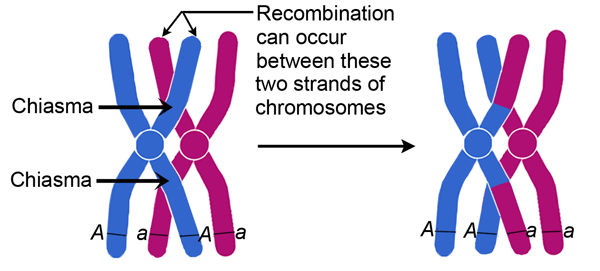
This image shows chromosomes during Prophase 1. Which of the following correctly describes the process shown?
a)
segregation of sister chromatids
b)
condensation and segregation of alleles
c)
mutationin which the DNA content of the gene is altered
d)
crossing - over in which alleles are exchanged
4.
Which of the following statements correctly describes meiosis?
a)
Meiosis does not occur in reproductive cells.
b)
The cells produced at the end are identical 
c)
the cells produced at the end contain half the # of chromosomes
d)
cells divide only once during meiosis
5.
Which of the following normally results from meiosis in a human cell that contains 46 chromosomes?
a)
an egg cell with 46 chromosomes
b)
a liver cell with 23 chromosomes
c)
a sperm cell with 23 chromosomes
d)
a blood cell with 46 chromosomes
6.
Meiosis is the key process in the production of_________.
a)
body cells
b)
RNA
c)
white blood cells
d)
gametes
7.
What kind of cells are made in MEIOSIS?
a)
Haploid cells
b)
Diploid Cells
c)
Skin Cells
d)
Liver Cells
8.
The process of crossing over occurs in what phase of meiosis?
a)
anaphase 1
b)
prophase 1
c)
prophase 2
d)
telophase 1
9.
The chromosomes that pair up during meiosis, are called __________ chromosomes.  
a)
homozygous 
b)
asexual
c)
homologous
d)
genes
10.
Crossing over creates
a)
male genotype
b)
genetic variation (differences)
c)
DNA replication
d)
mitosis
11.
What phase is  shown in the picture?
a)
metaphase 2
b)
anaphase 2
c)
metaphase 1
d)
telophase 1
12.
Meiosis makes sperm and egg cells. In humans, sperm and egg cells each have _____ chromosomes. Therefore a fertilized human egg cell (sperm and egg cell combined) would create a cell with _____ chromosomes.
a)
23, 46
b)
46, 23
c)
2, 4
d)
50, 100
13.
How many daughter cells does Meiosis create?
a)
2
b)
4
c)
8
d)
1
14.
Why is meiosis important for sexual reproduction? 
a)
It allows the zygote formed from fertilization to have triple the chromosome number of the organism. 
b)
It allows gametes to have twice the original number of chromosomes of the organism.
c)
It allows gametes to have half the original number of chromosomes of the organism.
d)
It allows the zygote formed from fertilization to have half the original number of chromosomes of the organism.
15.

(Select all that apply)

Meiosis........

a)

REDUCES THE NUMBER OF CHROMOSOMES BY ONE HALF

b)

PRODUCES UNIQUE SEX CELLS

c)

ALLOWS TRAITS TO BE PASSED TO OFFSPRING

d)

INCREASE GENETIC VARIATION

16.
Why do we need meiosis?
a)
To double the number of chromosomes going into sex cells
b)
To halve the number of chromosomes going into sex cells
c)
To triple the number of chromosomes going into sex cells
d)
To not change the number of chromosomes going into sex cells
17.
What phase is represented?
a)
metaphase 1
b)
metaphase 2
c)
anaphase 1
d)
anaphase 2
18.
a)
Prophase I
b)
Prophase II
c)
Telophase I
d)
Telophase II
19.
Which letter(s) in the diagram correspond to cells that are haploid? 
a)
A
b)
B
c)
C
d)
A and B
20.
What phase is this?
a)
Interphase II
b)
Prophase I
c)
Metaphase I
d)
Anaphase II
21.
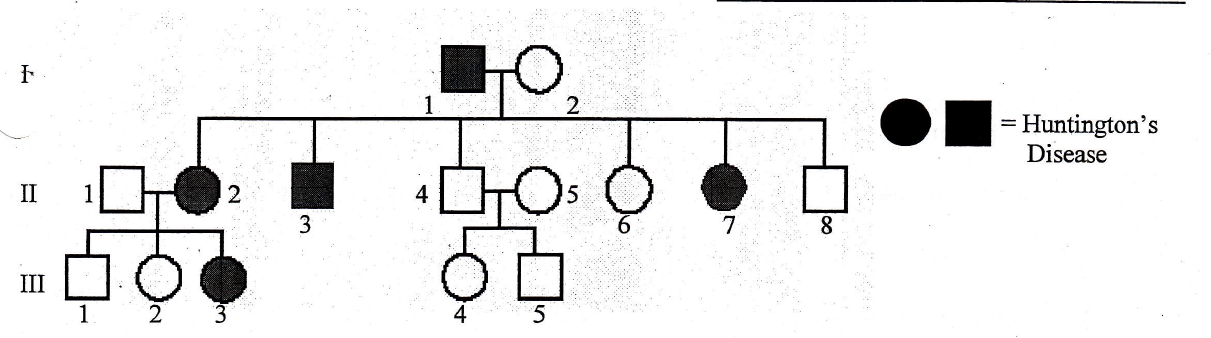
How many generations are shown in this pedigree?
a)
1
b)
2
c)
3
d)
4
22.

In a pedigree, what shape represents a male?

a)

circle

b)

square

c)

triangle

d)

diamond

23.
How many boys did the mother and father from the first generation have?
a)
2
b)
4
c)
5
d)
6
24.
How many people in this whole pedigree have the trait/disease?
a)
2
b)
3
c)
4
d)
6
25.
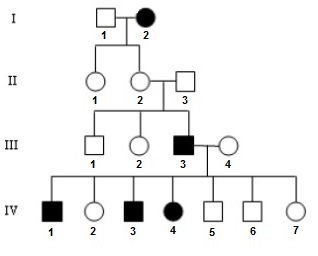
How many generations are shown in this pedigree?
a)
1
b)
2
c)
3
d)
4
26.

There are no carriers for Huntington's Disease- you either have it or you don't. Huntington's disease is therefor what type of trait?

a)

Dominant

b)

Recessive

c)

Sex Linked

27.
Huntington's Disease is a dominant trait.
What is the correct genotype for individual I-2?
a)
HH
b)
Hh
c)
hh
d)
H_
28.
Give the genotype for person III-3.
a)
GG
b)
Gg
c)
gg
d)
we cannot be 100% sure of the genotype
29.
Give the genotype for person II-1, for this autosomal trait.
a)
GG
b)
Gg
c)
gg
d)
we cannot be 100% sure of the genotype
30.
What kind of trait is colorblindness if females can be carriers without having the disease?
a)
Regular trait
b)
Sex-linked trait
c)
Co-dominant trait
d)
Incomplete dominant trait
31.
If hemophilia is a sex-linked recessive trait, what genotype would individual III-3 have?
a)
XbX
b)
XbXb
c)
XbYb
d)
XbY
32.
What is the mode of inheritance shown here?
a)
Autosomal Dominant
b)
Autosomal Recessive
c)
Sex Linked Recessive
d)
Co-dominant
33.
If this pedigree shows an autosomal recessive disorder, what MUST the genotype of individual II-3 be?
a)
HH
b)
Hh
c)
hh
d)
None of the above
34.
Homozygous is when...
a)
the alleles are the same
b)
the alleles are different
c)
the alleles are absent
d)
the alleles are present
35.
Heterozygous is when...
a)
the alleles are the same
b)
the alleles are different
c)
the alleles are absent
d)
the alleles are present
36.
In a heterozygous genotype, the ___________ allele takes over in the phenotype.
a)
recessive
b)
dominant
c)
lower case letter
d)
both 
37.
T - tall and t = short
In the punnett square below, what belongs in the missing square
a)
tt
b)
Tt
c)
Bb
d)
TT
38.
B = brown fur  b = white fur
In the punnett square, what is the probability for white fur? 
a)
0%
b)
25%
c)
50%
d)
75%
39.
In the punnett square shown, what must the genotype of the missing parent be?
a)
BB
b)
Bb
c)
bb
d)
Tt
40.
Which of the following is a phenotype?
a)
Aa
b)
black hair
c)
heterozygous genes
d)
mutated DNA
41.
What genotype is missing from this Punnett Square?
a)
RrYy
b)
RRYY
c)
rryy
d)
RrYY
42.
Cross Two Homozygous plants
(
RRYY x rryy)
R = round seeds, r  = wrinkled seeds Y = yellow seeds, y = green seeds
What percent will have Round and Yellow seeds? 
a)
0%
b)
25%
c)
50%
d)
100%
43.
An allele that is masked when a dominant allele is present. The "weaker" gene. 
a)
Dominant Allele
b)
Recessive Allele
44.
An organism’s genetic makeup or allele combination.
a)
Genotype
b)
Phenotype
c)
Beanotype
d)
Notype
45.
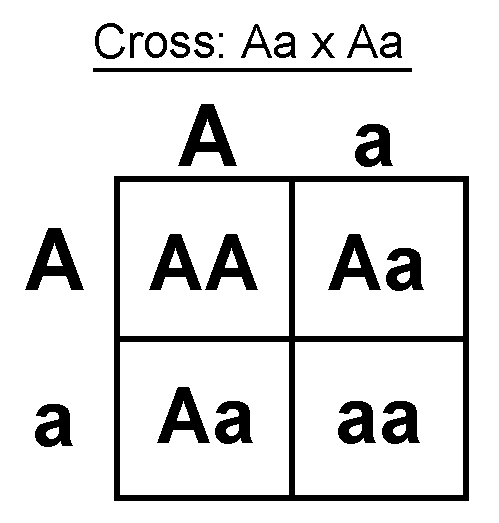
In a certain species of plant, the color purple (P) is dominant to the color white (p).
According to the Punnett Square, what is the probability of an offspring being white?
a)
25%
b)
0%
c)
100%
d)
50%
46.

What is the phenotypic ratio in this cross?

Brown is dominant to blonde.

a)

2:2 Brown to Blonde

b)

3:1 Brown to Blonde

c)

4:0 Brown to Blonde

d)

3:1 Blonde to Brown

47.

What is the GENOTYPIC ratio if two heterozygous brown eyed parents were to cross?

a)

2:2:1

b)

3:1

c)

1:2:1

d)

2:2

48.

What is the PHENOTYPIC ratio if a heterozygous brown eyed parent crossed with a blued eyed parent?

a)

2:2

b)

3:1

c)

4:0

d)

1:2:1

49.
What is the dominant trait?
a)
yellow pea seeds
b)
green pea seeds
c)
there is no dominant seed
d)
Jolly green giant
50.

In Labradors, coat color is an epistatic trait. Black (B) is dominant to chocolate (b). However, if the dog is homozygous recessive (ee) in the epistatic genotype, the dog will be yellow. From the following cross, how many yellow dogs would be likely?

a)

12

b)

8

c)

4

d)

2

51.

Snapdragons are a flower that get their color from genes that represent incomplete dominance. Red (R) is dominant to White (r). But the heterozygous flowers are pink. What is the phenotypic ratio of a cross between two pink snapdragons?

a)

3:1

b)

1:2:1

c)

2:2

d)

1:1:1:1

52.

What were the parent's genotypes for this cross?

a)

AB and oo

b)

Ao and Bo

c)

AA and BB

d)

AB and Ao

53.

What does the term phenotype mean?

a)

the observable characteristic of an individual

b)

the allele combination of an individual

c)

how an organism looks

d)

when one allele in a gene is dominant and one allele is recessive

54.

In what process is mRNA synthesized?

a)

Transcription

b)

Translation

c)

DNA Replication

d)

Mitosis

55.

Where does TRANSCRIPTION occur?

a)

Nucleus

b)

Ribosome

c)

Cytoplasm

d)

Mitochondria

56.

Which of the following is a codon?

a)
b)

ATG

c)

AUG

d)

AUT

57.

How many codons equals 1 amino acid?

a)

1

b)

2

c)

3

d)

4

58.

A polypeptide is a sequence of ____________________ held together by a ______________ bond.

a)

amino acids; peptide

b)

fatty acids; ionic

c)

proteins; hydrogen

d)

fatty acids; covalent

59.

TRANSCRIBE this DNA sequence: TACGTTACT

a)

AUGCAAUGA

b)

ATGCAATGA

c)

AUGGATUGA

d)

TACGTTACT

60.

TRANSLATE this RNA sequence: AUGCAAUGA

a)

Met-Glu-Stop

b)

Met-His-Stop

c)

Thr-Glu-Stop

d)

Thr-Pro-Stop

61.

The important enzyme related with transcription is;

a)

gyrase

b)

DNA polymerase

c)

RNA polymerase

d)

ligase

62.

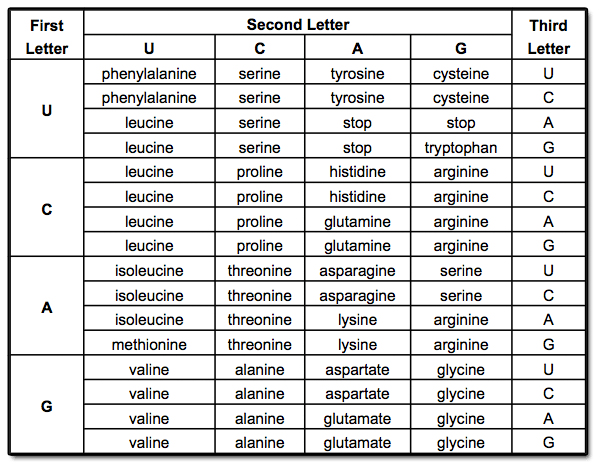
DNA molecule segment is : TTACGCAAG The mutated DNA segment is TTACGGCAAG. This is an example of ___ mutation.
a)
Substitution
b)
Deletion
c)
Insertion
d)
Inversion
63.
What amino acid is represented by the codon UUA?
a)
Phenylalanine
b)
Tyrosine
c)
Leucine
d)
Stop codon
64.
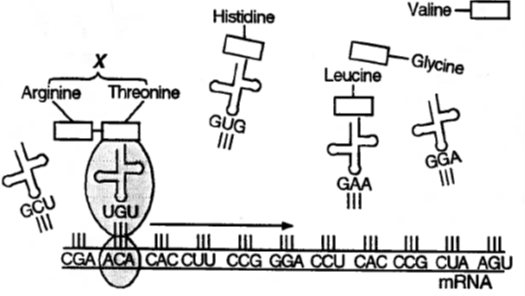
What process is going on in this photo? 
a)
Transcription 
b)
Translation 
c)
Replication 
d)
All the above 
65.
Translation is a process in eurkaryotic cells takes place in the:
a)
Cytoplasm
b)
Nucleus
c)
Nucleolus
d)
Golgi Bodies
66.
What is made during translation?
a)
transfer RNA
b)
messenger RNA
c)
Proteins
d)
Spanish Rice
67.
Which of the following is the process of reading mRNA code to produce a protein?
a)
replication
b)
translation
c)
transcription
68.
ATTTGAGCC- Original
ATTGAGCC - Mutated
The example above is an example of a 
a)
Insertion- Frameshift
b)
Deletion- Substitution
c)
Deletion -Frameshift
d)
All of the above
69.
Which of the following carries amino acids to the site of protein synthesis? 
a)
mRNA
b)
rRNA
c)
tRNA
d)
nRNA
70.
What causes mutations?
a)

Mistakes in replication or environmental factors

b)
The amino acids
c)
Passed down by genetics
d)
It's how your born
71.
What are the building blocks of proteins called?
a)
DNA
b)
RNA
c)
Ribosomes
d)
Amino Acids
72.

What process is happening in the diagram?

a)

transcription

b)

translation

c)

dna replication

d)

mitosis

73.

What makes RNA different from DNA?

a)

they type of phosphate

b)

Urocil as a nitrogen base

c)

having C pair with G

d)

RNA is double stranded

74.

The site of protein synthesis?

a)

nucleus

b)

ER

c)

Ribosome

d)

Golgi Body

75.

What amino acid is this codon?

UAA

a)

Aspargine

b)

Histidine

c)

Stop

d)

Alanine

76.

The gene would result in which amino acid chain? Hint: Two steps. TAC CCG GGA ATT

a)

Iso - Pro - Gly - Iso

b)

Met - Gly - Pro - Stop

c)

Met - Cys - Ser - Stop

d)

Asp - Lys - Leu - Val