wayground logo

Free Printable Worksheets

Font size

S
M
L
XL
Worksheets

Biology Final Spring Semester 2021

Total questions: 79

Worksheet time: 2hrs 1mins

Name
Class
Date
1.
Proteins are made of monomers called ___________
a)
Nucleotides
b)
Monosaccharides
c)
Amino Acids
d)
Glycerol and fatty acids
2.
DNA and RNA are examples of 
a)
Carbohydrates
b)
Lipids
c)
Proteins
d)
Nucleic Acids
3.
Nucleotides are monomers of
a)
Carbohydrates
b)
Lipids
c)
Proteins
d)
Nucleic Acids
4.
Monosaccharides are monomers of
a)
Carbohydrates
b)
Lipids
c)
Proteins
d)
Nucleic Acids
5.
Waxes, oils and fats are examples of
a)
Carbohydrates
b)
Lipids
c)
Proteins
d)
Nucleic Acids
6.
What is the function of nucleic acids?
a)
store genetic information
b)
store energy (long-term)
c)
store energy (short-term)
d)
build skin, hair, nails, muscles
7.
Which of the following organic compounds is the main source of energy for living things?
a)
carbohydrates
b)
lipids
c)
nucleic acids
d)
proteins
8.
Which macromolecule stores energy, insulates us, and makes up the cell membrane?
a)
lipids
b)
proteins
c)
carbohydrates
d)
nucleic acids
9.
What are the monomers of DNA?
a)
glycerols
b)
amino acids
c)
fatty acids
d)
nucleotides
10.
Lipids can be digested into what smaller subunits?
a)
nucleic acids
b)
amino acids
c)
fatty acids
d)
glucose
11.
Genetic information is stored in which class of organic compounds?
a)
proteins
b)
lipids
c)
nucleic acids
d)
carbohydrates
12.
All polymers are made up of...
a)
monosaccharides
b)
monomers
c)
proteins
d)
None of these
13.
All organic compounds contain the element
a)
carbon
b)
nitrogen
c)
phosphorus
d)
sulfur
14.
Building blocks of the body, hair , muscles etc.
a)
protein
b)
nucleic acid
c)
lipids
d)
carbohydrates
15.
Enzymes are..
a)
nucleic acids 
b)
carbohydrates 
c)
lipids 
d)
proteins 
16.
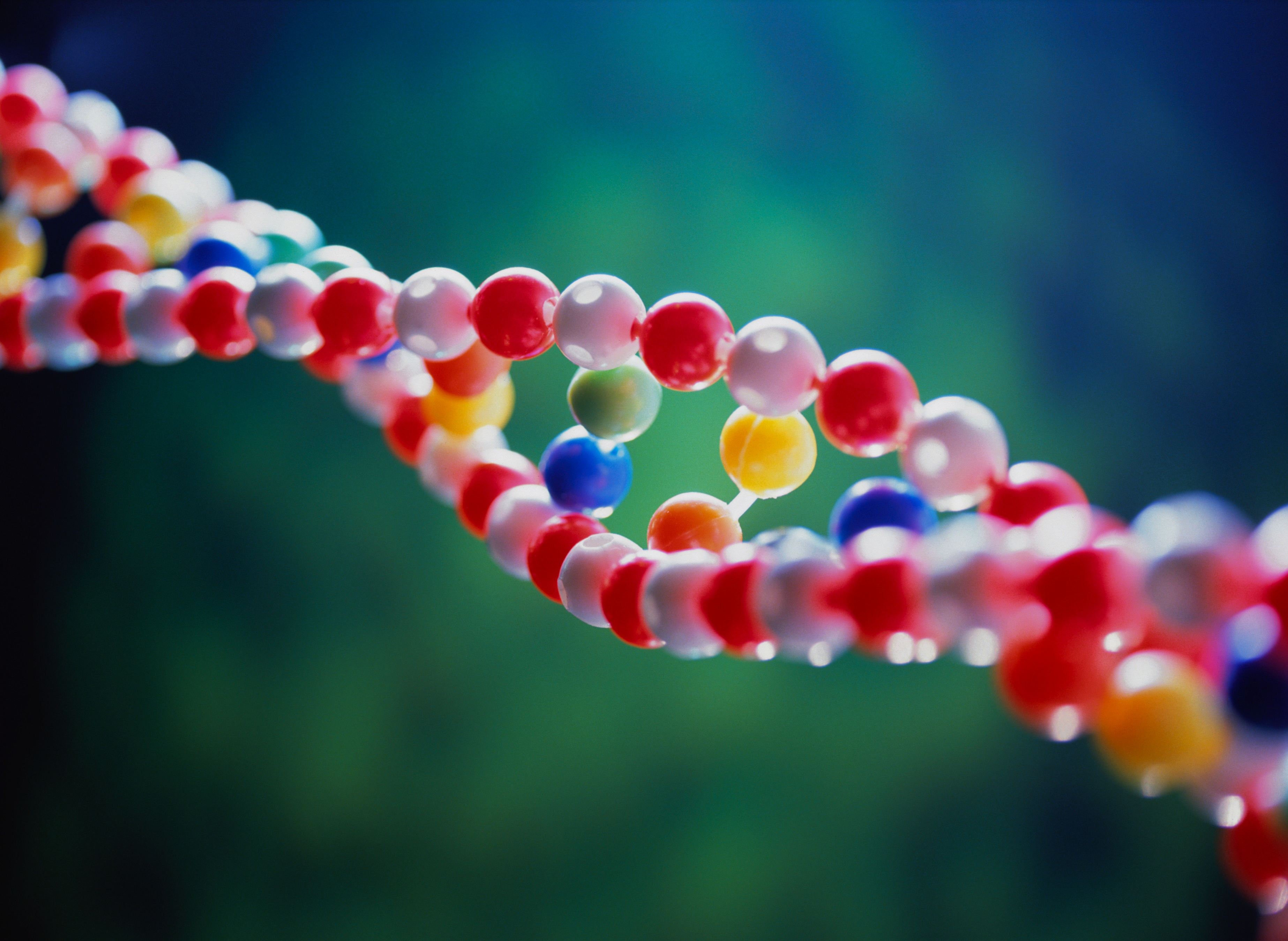
Which major macromolecule is being represented in this image? 
a)
carbohydrate
b)
lipid
c)
protein
d)
nucleic acid
17.
RNA and DNA are which type of macromolecules?
a)
carbohydrate
b)
lipid
c)
nucleic acid
d)
protein
18.

There are 3 types of RNA. What are they? (Select all that apply)

a)

tRNA

b)

rRNA

c)

mRNA

d)

xRNA

19.
RNA contains the sugar
a)
ribose
b)
deoxyribose
c)
glucose
d)
lactose
20.
Which of the following statements is true?
a)
DNA is single-stranded
b)
RNA is single-stranded
c)
DNA contains uracil
d)
RNA contains deoxyribose
21.
What is the product of translation?
a)
DNA
b)
mRNA
c)
tRNA
d)
proteins
22.

The Process of creating RNA from DNA

a)

Transcription

b)

Translation

c)

Replication

23.

In RNA the base T is replaced with

a)

U

b)

G

c)

C

d)

A

24.

What combines together to make a protein?

a)

Amino Acid

b)

RNA

c)

Ribosome

d)

DNA

25.

What organelle is the site of translation?

a)

Nucleus

b)

Ribosome

c)

Mitochondria

d)

Chloroplast

26.

What is the order for Protein Synthesis?

a)

Transcription -> Translation -> Protein

b)

Translation - > Transcription -> Protein

c)

Protein -> Transcription -> Translation

d)

Translation -> Protein -> Transcription

27.
Which type of RNA takes the instructions from the nucleus to the cytoplasm?
a)
mRNA
b)
tRNA
c)
rRNA
d)
RNA polymerase
28.
What is the product of transcription?
a)
DNA
b)
mRNA
c)
tRNA
d)
proteins
29.

Carries the amino acid used to make a protein

a)

mRNA

b)

rRNA

c)

tRNA

30.

Which of the following tells the Ribosome to START?

a)

AUG

b)

UGG

c)

UGA

d)

UCA

31.

Which of the following tells the Ribosome to STOP?

a)

UAC

b)

UGG

c)

UGA

d)

UCA

32.
A portion of mRNA is coded CUG. The corresponding DNA is coded
a)
GAC
b)
GTC
c)
CTG
d)
CAG
33.
A portion of DNA reads GAG. The corresponding mRNA would be
a)
GUG
b)
GTG
c)
CTC
d)
CUC
34.
DNA polymerase and RNA polymerase are similar in that they
a)
are both enzymes
b)
both are involved in making new polymers
c)
both can be found doing work in the cell nucleus
d)
all of these things are true
35.
DNA strands 1 and 2 are able to separate and rejoin easily due to
a)
the action of RNA polymerase 
b)
the nature of hydrogen bonds
c)
the presence of uracil
d)
Trick question! It is none of these.
36.
Which sequence of DNA bases would pair with this partial strand
CAT TCA CTG
a)
ATG TGA CAG
b)
TAC ACT GTC
c)
GTA AGT GAC
d)
CAT TCA CTG
37.
Why is DNA important?
a)
it is very small and very complicated
b)
it's in everything
c)
it serves as the blueprint for traits of all living things
d)
because we eat it every day for energy
38.

DNA is the instructions on how to make..

a)

carbohydrates

b)

proteins

c)

phosphates

d)

lipids

39.

DNA is the instructions on how to make..

a)

carbohydrates

b)

proteins

c)

phosphates

d)

lipids

40.
Which of the following is not a base found in DNA?
a)
adenine
b)
thymine
c)
cytosine
d)
uracil
41.

Translate the mRNA sequence to an amino acid sequence.


AUG-CCC

a)

Met-Pro

b)

Met-His

c)

His-Pro

d)

His-Met

42.
What 3 things make up a nucleotide?
a)
Sugar, Phosphate, Nitrogen Base
b)
Sugar, Hydrogen, Carbon
c)
Carbon, Phosphate, Nitrogen
d)
mRNA, tRNA and rRNA
43.
What stores the code for making an individual protein?
a)
DNA
b)
a gene
c)
a chromosome
d)
transfer RNA
44.
What makes DNA different from RNA?
a)
they type of phosphate
b)
the type of sugar
c)
having C pair with G
d)
Having A's
45.
A 3 nucleotide sequence of mRNA
a)
codon
b)
anticodon
46.
Deoxyribose is the sugar in RNA
a)
True
b)
False
47.
Which correctly outlined the central dogma
a)
DNA --> mRNA --> rRNA
b)
DNA --> tRNA --> protein
c)
DNA --> mRNA --> protein
d)
DNA --> amino acid --> protein
48.
Brings the amino acids to the ribosome
a)
mRNA
b)
tRNA
c)
rRNA
d)
DNA
49.
Where does transcription take place?
a)
nucleus
b)
cytoplasm
c)
ribosome
50.
Which of the following alleles is homozygous (purebred) recessive?
a)
Tt
b)
tt
c)
TT
d)
t
51.
Aa is
a)
homozygous (purebred)
b)
heterozygous (hybrid)
52.
In a heterozygous genotype, the ___________ allele takes over in the phenotype.
a)
recessive
b)
dominant
c)
lower case letter
d)
both 
53.
T - tall and t = short
In the punnett square below, what belongs in the missing square
a)
tt
b)
Tt
c)
Bb
d)
TT
54.
In a Punnett square each box represents a(n)....
a)
offspring
b)
parent
c)
gene
d)
trait
55.

The passing of traits from parent to child is known as _______________.

a)

heredity

b)

gene

c)

DNA

d)

RNA

56.

The different forms of a gene are known as ________________.

a)

Punnett Square

b)

Chromosomes

c)

DNA

d)

Alleles

57.

How many offspring will show the recessive trait?

a)

0%

b)

25%

c)

50%

d)

75%

58.
Females-XX; MalesXY.  A couple has 4 girls.  What is the chance the next child will be a boy?
a)
75%
b)
100%
c)
25%
d)
50%
59.
The exact genetic makeup of an organism, such as RR, Tt, PP is its?
a)
phenotype
b)
dominance
c)
genotype
d)
trait
60.
An offspring will receive how many alleles from each parent to determine a specific trait?
a)
one
b)
two
c)
three
d)
five
61.
Two brown eyed parents (Bb) have a baby. What is the chance the baby is blue eyed?
a)
0 %
b)
25%
c)
50%
d)
75%
62.
If green is dominant over purple, then what is the genotype for this individual?
a)
Purple
b)
Green
c)
GG
d)
gg
63.
Which of the following cell types is formed by meiosis?
a)
muscle cells
b)
skin cells
c)
sperm cells
d)
blood cells
64.
What is one advantage of sexual reproduction?
a)
offspring are identical to parents
b)
offspring are resistant to viruses
c)
offspring are born live, rather thna from eggs
d)
offspring inherit a wider variety of genetic information
65.
Sex cells are produced through the process of
a)
mitosis
b)
cytokinesis
c)
binary fission
d)
meiosis
66.

A gene is

a)

a section of DNA

b)

a chemical found in the nucleus of cells

c)

contains instructions for building a protein

d)

all of the above

67.

During meiosis, one parent cell gives rise to how many daughter cells?

a)

1

b)

2

c)

3

d)

4

68.
What is it called when a sperm and egg meet?
a)
meiosis
b)
fertilization
c)
cell division
d)
mitosis
69.
The chromosomes that pair up during meiosis, are called __________ chromosomes.  
a)
homozygous 
b)
asexual
c)
homologous
d)
genes
70.
A male shark has 40 chromosomes in each of its sex cells. How many would be present in its body cells?
a)
20
b)
40
c)
80
d)
160
71.
Which letter(s) in the diagram correspond to cells that are haploid? 
a)
A
b)
B
c)
C
d)
A and B
72.
What causes genetic variation in meiosis?
a)
chromosomes lining up
b)
crossing over of chromosomes
c)
separation of chromosomes
d)
chromosomes pulling apart
73.
Crossing over helps promote 
a)
male genotype
b)
genetic variation
c)
DNA replication
d)
mitosis
74.
Females have ____ and males have _____ chromosomes.
a)
XX, XY
b)
XY, XX
c)
XX, XX
d)
XY, XY
75.
A human being has a somatic cell that has 46 chromosomes.  What is the haploid number found in a gamete?
a)
23
b)
46
c)
69
d)
92
76.
What is this?
a)
Trisomy 13
b)
Monosomy 21
c)
47, XXY
d)
Trisomy 21
77.
What is the name of the step in the diagram above? 
a)
Interphase
b)
Prophase I
c)
Metaphase I
d)
Anaphase I
78.
What is the name of the step found above?
a)
Interphase
b)
Prophase I
c)
Metaphase I
d)
Anaphase I
79.
What type of cells does meiosis produce? 
a)
2 Genetically identical cells
b)
2 Genetically different cells
c)
4 genetically identical cells
d)
4 genetically different cells