
 Worksheets
2.1 through 2.4 IB Biology (No Water)
Total questions: 84
Worksheet time: 53mins
What is the maximum number of bonds a carbon atom can form with another atoms?
3
2
4
6
Which chemical group do amino acids contain that carbs and lipids do not?
hydroxyl
amine
carboxyl
methyl
Which term describes the synthesis of complex molecules fromsimpler molecules?
adhesion
catabolism
metabolism
anabolism
Which term describes the synthesis of complex molecules fromsimpler molecules?
adhesion
catabolism
metabolism
anabolism
Which can be explained by the solvent properties of water?
Sodium chloride is transported as Na+ and Cl– in blood.
Movement of water occurs under tension in the xylem.
Water is the coolant in sweat.
Ice floats on liquid water.
Which substance must be transported in the blood by lipoprotein complexes?
Cholesterol
Oxygen
Sodium chloride
Amino acids
At room temperature, water is a liquid and methane is a gas. Which molecular property explains this difference?
Higher molecular mass of water
Dipolarity of water
Presence of more hydrogen in methane
Higher boiling point than methan
Which type of reaction is the breakdown of starch into sugars?
Denaturation
Reducation
Catabolic
Condensation
Which molecule is a polysaccharide?
Glucagon
Glucose
Glycerol
Glycogen
What property of water makes it suitable as a coolant?
It takes a lot of energy to increase the temperature of water.
It takes a lot of energy for water to evaporate.
Water molecules are cohesive and stick to the skin.
Water is a good solvent so it can transport heat from the body.
Which type of chemical reaction is an example of anabolism?
Phytolysis
Combustion
Hydrolysis
Condensation
What feature of carbon makes it most suitable as a basis for life?
Its abundance in nature
Its bonding properties
Its teativity to light
Its presence in the early atmosphere of the Earth
In an enzyme-catalyzed reaction, the _____ binds to the _____ .
Substance, enzyme
Substrate, enzyme
Substrate, active site
Substrate, allosteric site
An increase in which of these factors will guarantee an increase in enzyme activity?
Temperature
pH
Substrate concentration
Amount of enzyme present
With relation to enzyme and substrate, what does the term "successful collision" mean?
When the substrate bumps into the active site and sticks to it.
When a product is formed
When the substrate bumps into the active site
When the substrate bumps into the enzyme

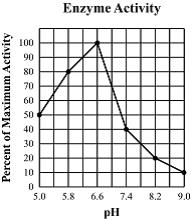
This graph represents enzyme activity with relation to which factor?
Temperature
pH
Substrate concentration

This graph represents enzyme activity with relation to which factor?
Temperature
pH
Substrate concentration

This graph represents enzyme activity with relation to which factor?
Temperature
pH
Substrate concentration
How would you expect the optimum pH of enzymes to vary between the stomach and acidic hot springs?
The optimum pH would be roughly the same.
The optimum pH in acidic hot springs would be much lower than the stomach
The optimum pH in acidic hot springs would be much larger than the stomach
Depends on the enzyme.
How would you expect the optimum pH of enzymes to vary between the stomach and alkaline lakes?
The optimum pH would be roughly the same.
The optimum pH in alkaline lakes would be much lower than the stomach
The optimum pH in alkaline lakes would be much larger than the stomach
Depends on the enzyme.
Catalase is an enzyme produced in the liver. It decomposes hydrogen peroxide into water and oxygen gas. Where would you expect its optimum temperature to be?
0°C
40°C
100°C
It has no optimum temperature since the higher the temperature, the more collisions.
Describe the advantages of enzyme immobilization.
If a mutation occurs in a DNA sequence that codes for an enzyme, what is the most likely result?
There will likely be no change in the shape and function of the enzyme.
The enzyme will most likely fold in a way that makes its shape incompatible with the substrate and the enzyme will not function correctly.
The enzyme will not be produced at all.
The enzyme will have an enhanced ability to bind with the substrate.
Which of the following is directly responsible for the shape of an enzyme/protein?
The amino acid sequence of the protein and the properties of the amino acids that make up the protein.
The temperature of the surrounding environment.
The pH of the surrounding environment.
The amount of substrate present.
Which one shows a secondary structure of protein?


How many polypeptides does hemoglobin have?
3
10
8
4
Proteins including enzymes can be used for removing stains, pregnancy tests, and insulin for treating diabetes.
False
True
What is the correct definition for a polypeptide?
Chains of amino acids that are made by linking together amino acids by condensation reactions.
Two amino acids are linked by a condensation reaction between the amine group of one amino acid and the carboxyl group of the other.
Four amino acids, linked by three peptide bonds.
Which one shows a primary structure of protein?


Are ALL of these functions carried out by proteins? Cytoskeletons, Blood clotting, Cell adhesion, Immunity
Yes
No
What is collagen’s function?
Enzymes in secretions such as nasal mucus and tears; it kills some bacteria by digesting the peptidoglycan in their cell walls.
Membrane protein used to make connections between structures inside and outside a cell.
Structural protein in tendons, ligaments, skin and blood vessel walls; it provides high tensile strength, with limited stretching.
Transport protein in red blood cells; it binds oxygen in the lungs and releases it in tissues with a reduced oxygen concentration.
Amino acids that are linked together by ribosomes to make polypeptides all have some identical structural features.
False
True
Denaturation is a structural change in a protein that results in the loss (usually permanent) of its biological properties.
False
True
Which one shows a tertiary structure of protein?


Which part of the amino acid is never the same?
Amine group
Carboxyl group
R group
Hydrogen group
A proteome is as unique to a person as their genome is.
True
False
What type of bond joins neighboring amino acids together? (check all that apply)
Peptide bonds
Hydrogen bonds
Ionic bonds
Covalent bonds
What is the name of the bond that is formed when a polypeptide is made?
Ester bond
Glycosidic bond
Amine bond
Peptide bond
Which parts of the amino acid react with another amino acid to form a peptide bond?
The carboxyl group and the amino group
The amine group and the R group
The R group and carbon backbone
The carboxyl group and the R group
Which one shows a quaternary protein structure?


Scientists have found geysers on one of Saturn’s moons. The geysers release water vapor containing complex organic compounds, which may indicate the presence of life. Which of the following elements is most likely abundant in the organic compounds in the water vapor?
carbon
chlorine
iron
zinc
Which of the following is the main reason that humans need to include carbohydrates in their diet?
Carbohydrates are broken down in cells for energy.
Carbohydrates combine to form many different proteins.
Carbohydrates act as catalyst to speed up chemical reactions.
Carbohydrates are the building blocks for cell growth and repair.

The diagram shows the structure of palmitic acid. What type of fatty acid is palmitic acid?
it is monosaturated
it is polyunsaturated
it is saturated
it is a trans-fatty acid
What is a role of cholesterol in animal cells?
it increases body fat
it controls membrane fluidity
it lines the inner wall of capillaries
it is a constituent of bile
Which molecule diagram corresponds to the name?


Which molecule is a sugar?


What molecule is a polysaccharide?
glucagon
glycose
glycerol
glycogen
Which substance is used for structure in plants?
amylopectin
cellulose
collagen
starch
That is the maximum number of fatty acids that can be condensed with glycerol?
one
two
three
four

Which described these molecules correctly?
I: ribose II: amino acid
I: glucose II: amino acid
I: ribose II: fatty acid
I: glucose II: fatty acid
Where one part of water molecules is partially negative and the other is partially positive is called
Bonding
Polarity
Charged
Neutral
Hydrophillic means
water-loving
water-fearing
Which substance is more likely to dissolve in water?
Hydrophillic
Hydrophobic
In the Phospholipid bilayer, there is a __________ head and a ___________ tail.
polar; nonpolar
nonpolar; polar
Molecular Biology is the study of
Biological molecules
Chemical processes in living organisms
Organic chemistry
DNA
Common types of carbon compounds in living organisms are:
DNA, enzymes, nitrogenous bases, and amylose.
Nucleic acids, amino acids, carbohydrates, and lipids.
Urea, amino acids, nucleic acids, and carbohydrates
Carbon dioxide, Lipids, carbohydrates, and proteins.
Nucleic acids, proteins, carbohydrates, and lipids.
What is a -COOH group called?
Amine group
Hydroxyl
Carboxyl
Methyl
Metabolism is best defined as:
A chemical reaction.
The web of all enzyme-catalyzed reactions in a cell or organism.
The web of all chemical reactions in a cell or organism.
The web of all endergonic reactions in a cell or organism.

