wayground logo

Free Printable Worksheets

Font size

S
M
L
XL
Worksheets

EWF Semester 1 Final Review 2020

Total questions: 83

Worksheet time: 2hrs 34mins

Name
Class
Date
1.

What is the amplitude of the wave?

a)

3 cm

b)

8 cm

c)

16 cm

d)

24 cm

2.

What is the wavelength of the wave?

a)

3 cm

b)

8 cm

c)

16 cm

d)

24 cm

3.

The greater the frequency, the ________ energy carried by the wave.

a)

more

b)

less

4.

If short wavelength has more ENERGY than long wavelength, which color Lightsaber is the most dangerous, or powerful?

a)

Red

b)

Orange

c)

Blue

d)

Green

5.
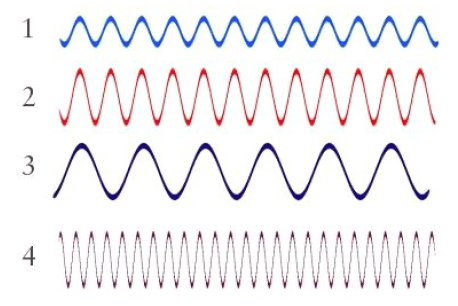
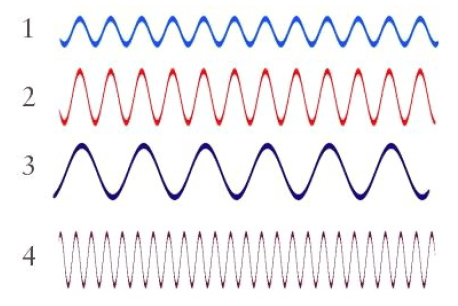
Which wave in the diagram has the greatest wavelength?
a)
1
b)
2
c)
3
d)
4
6.
What is the lowest point on a wave?
a)
amplitude
b)
peak
c)
trough
d)
wavelength
7.
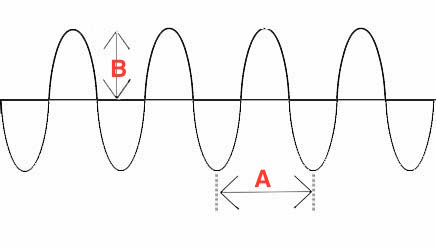
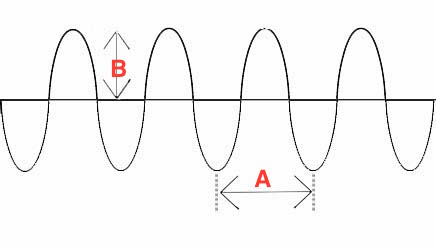
Which wave has a greater frequency?
a)
A
b)
B
8.
All waves carry
a)
energy
b)
light 
c)
matter
d)
particles
9.
All waves carry
a)
energy
b)
light 
c)
matter
d)
particles
10.
Which material does sound travel the fastest?
a)
solid 
b)
liquid 
c)
gases
11.
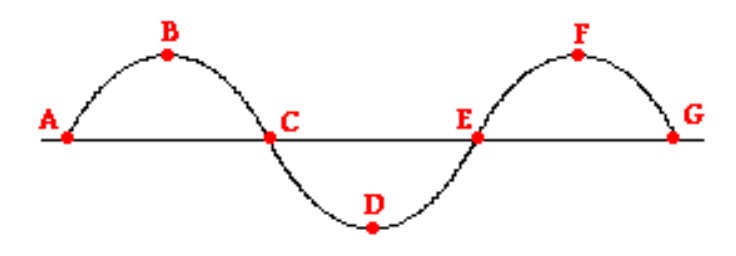
Which letter(s) represent the trough of the wave?
a)
A
b)
B & D
c)
D
d)
C & G
12.
Which vocabulary term is used to identify the distance between points C & G?
a)
Amplitude
b)
Crest
c)
Frequency
d)
Wavelength
13.

What wave has the slowest frequency?

a)

green

b)

red

c)

yellow

d)

blue

14.
The wave-particle duality of light describes light as...
a)
a wave only
b)
a particle only
c)
both a wave and a particle
d)
neither a wave nor a particle
15.
A particle of light is called a photon.
a)
True
b)
False
16.

This guy created the famous slit experiment and saw the interference patterns behaved just like waves

a)

Einstein

b)

Young

c)

Maxwell

d)

Heisenberg

17.

What are solar panels made of?

a)

silicon

b)

solar cells

c)

metal

d)

plastic

18.

How long do solar panels last?

a)

25-30 years

b)

5 years

c)

2 years

d)

11 years

19.

Solar Cells convert light into electricity?

a)

True

b)

False

20.

Plants need what to do photosynthesis just like solar panels?

a)

Food absorbed from ground

b)

Sun's energy

c)

Food broken down

d)

Minerals from the soil

21.

Cons (Disadvantages) of using Solar Energy include:

SELECT ALL THAT APPLY

a)

It's Renewable

b)

Expensive to Install

c)

It is not a constant source of energy

d)

All the Above

22.

Pro (Advantages) of using solar energy include:

SELECT ALL THAT APPLY

a)

Renewable

b)

Expensive to Install

c)

Produces no pollution during its operation

d)

Expensive to store energy

23.

Solar cells first became a practical energy source for NASA for what application?

a)

Space Shuttle

b)

Rocket boosters

c)

Rovers

d)

Satellites

24.

Solar panels work because light can act like a

a)

particle

b)

wave

25.

The _______________ determines the color of visible light.

a)

wavelength (and frequency)

b)

speed

c)

amplitude

d)

particles of the medium

26.

Shorter Waves have ____Energy,Longer Waves___Energy?

a)

Lower,Higher

b)

Higher,Lower

27.
When the frequency of a wave increases, what happens to the wavelength?
a)
The wavelength is not directly affected by the frequency of a wave.
b)
The wavelength increases.
c)
The wavelength decreases.
d)
More specific information is needed to form a conclusion about the wavelength.
28.
Waves move ___ through vibrations
a)
Energy
b)
Matter
c)
Mass
d)
Weight
29.
Transverse waves are ___.
a)
Parallel
b)
Perpendicular
c)
Weird
30.
Longitudinal waves are ______.
a)
Parallel
b)
Perpendicular
c)
Crazy
31.

The highest point on a wave is:

a)

the crest

b)

the trough

c)

the top

d)

the coast

32.
What kind of wave is pictured below?
a)
compressional wave
b)
transverse wave
c)
sound wave
d)
mechanical wave
33.
What type of wave move a slinky back and forth?
a)
longitudinal
b)
transverse
34.
In a longitudinal wave, the parts where the coils are close together are called what?
a)
longitudes
b)
rarefactions
c)
compressions
d)
contractions
35.
What property of this wave is represented by the letter "A"
a)
amplitude
b)
crest
c)
trough
d)
wavelength
36.
What property of the wave is represented by the letter "B"?
a)
amplitude
b)
crest
c)
trough
d)
wavelength
37.
Which wave in the diagram has the greatest frequency?
a)
1
b)
2
c)
3
d)
4
38.
Which wave in the diagram has the greatest wavelength?
a)
1
b)
2
c)
3
d)
4
39.

What is a wavelength?

a)

How many waves pass a certain point

b)

The distance from one wave crest to another

c)

The entire length of a wave

40.
When light hits a black object, like the one in the picture, what will happen to the different colors?
a)
All colors of light will bounce off
b)
All colors of light pass through it
c)
All colors of light will be absorbed
d)
None of the above
41.

When light passes through a prism, why do you see different colors?

a)

Each color has a different wavelength, so they all bend at different angles

b)

Because Stone Cold said so

c)

Because the prism is magical and allows you see the colors

d)
42.
Which wave in the diagram has the greatest frequency?
a)
1
b)
2
c)
3
d)
4
43.
Which wave in the diagram has the greatest wavelength?
a)
1
b)
2
c)
3
d)
4
44.

Which wave is carrying more energy?

a)

The blue wave because it has a larger amplitude.

b)

The blue wave because it has higher frequency.

c)

The red wave because it has higher amplitude.

d)

The red wave because it has higher frequency.

45.

The two waves are similar in...

a)

frequency

b)

amplitude

c)

wavelength

d)

energy

46.
Voltage can be induced in a wire by
a)
a. moving the wire near a magnet.
b)
b. moving a magnet near the wire.
c)
c. changing the current in a nearby wire.
d)
d. all of these
47.
How could the experimenter increase the amount of electricity being induced by this experiment?
a)
Increase the number of coils
b)
Decrease the number of coils
c)
Flip the magnet around
d)
Nothing, the amount of electricity cannot be increased
48.
In 1831 who discovered electromagnetic induction?
a)
Thomas Edison
b)
Nikola Tesla
c)
Michael Faraday
49.
What would happen if I move a bar magnet in and out of a coil of copper wire?
a)
Electric current would disappear 
b)
The magnet would explode 
c)
Electric current will flow through the wire
d)
It would produce a gravitational field
50.

Can you produce current in a wire with a magnet that is sitting still?

a)

Yes; having a magnet near a wire is enough to excite the electrons

b)

No; the magnetic field has to be changing to excite the electrons

c)

No; magnets cannot create electricity

51.

The Free Response section is worth one -third of your final exam. Go to the "Electromagnetic Induction Video" assignment if you don't know the answer.

Explain step-by-step how turning on the water leads to the production of electricity in this generator.

Use the terms: magnet, spin, magnetic field, electrons, wire coils, flow, electricity.

4 lines
52.

Go to the "Electromagnetic Induction Video" assignment if you don't know the answer.

Name 2 ways to produce more electricity.

4 lines
53.

These diagrams represent what happens in a solar panel when sunlight hits the panel. Explain what is happening on the left then the right side of the image.

If you don't know the answer, go to the "Solar Panel Video Questions" assignment and watch the first video.

4 lines
54.
Conduction can only occur between two objects when –
a)
one object is less dense than the other.
b)
both objects are in physical contact with each other.
c)
one of the objects is made of a metal.
d)
both objects are exactly the same temperature.
55.

Which of the following is an example of conduction?

a)

Solar energy warming a room.

b)

Hot air rising from the stove.

c)

Hot air drying a wet towel.

d)

Heat moving from an iron to a shirt.

56.
Which of the following are kinds of heat transfer.
a)
Conduction
b)
Convection
c)
Radiation
d)
All of the above
57.

Heat will always transfer from the ___________ object to the ________ object.

a)

The hottest object to the coolest object.

b)

The coolest object to the hottest object.

c)

The solid object to the liquid object.

d)

The liquid object to the solid object.

58.
Jenny poured some hot chocolate into a cup and stirred it with a metal spoon.  She noticed the spoon was really warm.  What is the best explanation for this?
a)
The spoon is a conductor.
b)
The spoon reflects heat.
c)
The spoon is an insulator.
d)
She touched the spoon first and waited to touch the cup.
59.

Heat transfer between the air in 1st and 2nd floor of a house is an example of

a)

conduction

b)

convection

c)

radiation

d)

thermal equilibrium

60.

The energy of moving particles

a)

potential energy

b)

thermal energy

c)

school

d)

temperature

61.
What is the difference between heat and temperature?    
a)
a.  Temperature measures the motion of molecules, and heat is the energy of that motion
b)
b.  Temperature is measured by a thermometer, and heat is measured by a barometer
c)
c.  Heat is measured in calories, and temperature is measured in joules
d)
d.  Heat is caused by the sun, and temperature is caused by conditions in the atmosphere
62.

What type of heat transfer is shown?

a)

convection

b)

conduction

c)

radiation

d)

bonfire

63.

If a door was left open between the bedroom (74 degrees) and the living room (68 degrees), what would likely happen to the temperatures after several hours?

a)

nothing, they would not change

b)

both rooms would become hotter 

c)

both room would become colder

d)

the bedroom temp. would lower and the living room temp. would rise

64.

Why was the water able to boil in the blender? There are 2 correct answers

a)

The blender overheated

b)

The faster molecules move around, the more heat there is

c)

Thermal energy increases when kinetic energy increases

d)

None of the above

65.

Which type(s) of heat transfer occur when a red hot metal ball is placed in a mortar full of ice?

a)

Conduction when the ball touches the ice and the wall of the mortar

b)

Convection within the water (from melted ice)

c)

Radiation from the ball to the person standing nearby

d)

Only 2 of the above are correct

e)

All 3 types of heat transfer occur

66.

What is energy?

a)

the ability to do work

b)

the movement of electrons

c)

UPS global services

67.

what is thermal energy?

a)

cool

b)

moving parts

c)

heat

68.

a Christmas tree lights use what type of energy?

a)

electrical

b)

thermal

c)

mechanical

69.

Which is Potential Energy?

a)

Radiant Energy

b)

Mechanical Energy

c)

Chemical Energy

d)

Sound Energy

70.

Which 2 types of energy does the object in the image use?

a)

Electric and Thermal

b)

Nuclear and Elastic

c)

Chemical and Mechanical

d)

Sound and Elastic

71.
What kind of energy is represented in the picture?
a)
Thermal
b)
Chemical
c)
Sound
d)
Nuclear
72.
Energy of motion is which type of energy?
a)
Potential
b)
Kinetic
c)
Sound
d)
Gravitational
73.
Stored energy is called ______ energy.
a)
Kinetic
b)
Potential
c)
Pacific
d)
Safe
74.
Energy stored in the height of an object is called ___________ potential energy.
a)
Elastic
b)
Chemical
c)
Gravitational
d)
Nuclear
75.
When is it OK to eat or drink in the lab?
a)
Always
b)
Never
76.
What should you do if you break glass in the lab?
a)
Tell the teacher.
b)
Sweep up the glass.
c)
Pick up the glass with your hands.
d)
Ignore it; the teacher will clean it up when she sees it later.
77.
I will perform only those activities that have been authorized by the instructor.
a)
True
b)
False
78.
If you are not sure what to do during a lab activity:
a)
guess
b)
change lab partners
c)
ask a teacher
d)
just sit quietly and do nothing
79.
It's fine to smell chemicals directly from their containers.
a)
True
b)
False
80.

What should I always remember when working in the lab?

a)

Be quick!

b)

Be proactive!

c)

Be smart!

d)

Be safe!

81.

Combustible materials should always be kept away from flames and heat. What does combustible mean?

a)

It breaks easily.

b)

It can be used to make your hair look neat and tidy.

c)

It can light on fire and burn easily.

d)

It is located on the vehicle used to transport students to school.

82.

When should you tie back long hair or baggy clothing?

a)

When working with chemicals

b)

When working with fire

c)

ALWAYS

83.
Before leaving the lab you should always wash or sanitize your hands.
a)
True 
b)
False