
 Worksheets
MYP Chemistry unit review
Total questions: 80
Worksheet time: 1hrs 21mins
Which of the following techniques can we use to separate homogeneous mixtures?
Crystallisation
Distillation
Evaporation
All of the above

Name the separation technique
Centrifuge
Bunsen burner
Distillation
Evaporation

Name the separation technique
Distillation
Crystallisation
Magnetic Separation
Condensation

Name the separation technique
Filtration
Evaporation
Distillation
Separation
In a salt water solution ...
Salt is the solute and water is the solvent
Salt is the solvent and water is the solute
Which of the following statements tells us that a sample of liquid is pure water?
It is colourless.
It leaves no residue when filtered.
It boils at 100oC.
It is odourless.
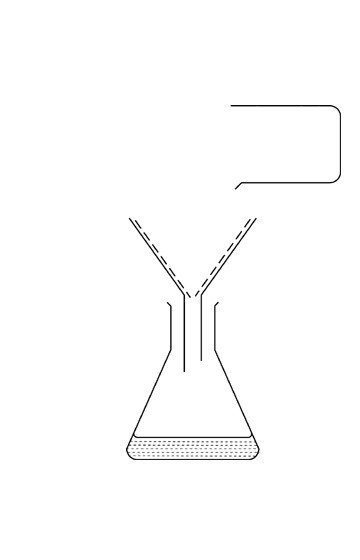
What is the name of this separation technique?
distillation
filtration
evaporation
chromatography
For paper chromatography to work,
the dyes must have different boiling points.
the dyes must have different solubilities in the solvent.
the starting line on the chromatogram must be drawn using pen.
The starting line must be below the level of the solvent.
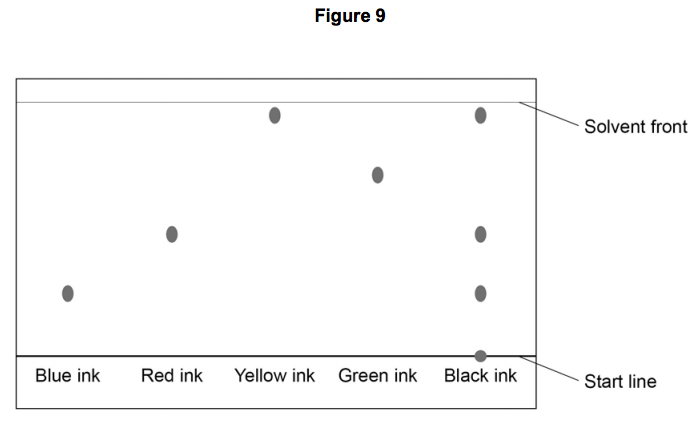
Which ink is most soluble?
Blue
Red
Yellow
Green
Which ink is a mixture?
Blue
Red
Yellow
Black
USE THE PERIODIC TABLE
How many valence electrons does sodium have?
1
2
3
4
USE THE PERIODIC TABLE
How many valence electrons does Phosphorus have?
31
5
15
4
Which elements have the most similar chemical properties?
boron and carbon
oxygen and sulfur
aluminum and bromine
argon and silicon

This could be the dot diagram of
Mg
Cl
C
O
What is the goal of the Lewis Dot Structure?
To determine the electron position.
To show the element's valence electrons & bonding capabilities.
To find the atomic mass of an element.
To search for the number of electrons in an individual atom.

This is a correct dot diagram for neon (Ne)
true
false

This is a correct dot diagram for carbon (C)
true
false

This is a correct dot diagram for nitrogen (N)
true
false
Two objects that are similarly charged will...
attract.
repel.
not experience an electric force.
implode.
An object becomes positively charged by...
gaining negative charges.
losing negative charges.
gaining positive charges.
losing positive charged.
An object becomes negatively charged by...
gaining negative charges.
losing negative charges.
gaining positive charges.
losing positive charged.
Metal atoms are most likely to form...
positively charged cations.
negatively charged anions.
neutral molecules.
bations.
Electrolyte solutions are formed when compounds dissolve and break apart into...
charged particles.
neutral particles.
atoms.
liquid particles.
Non-Metal atoms are most likely to form...
positively charged cations.
negatively charged anions.
neutral molecules.
bations.
Atoms from group 2 on the Periodic Table are likely to form ions of what charge?
+1
+2
0
−1
−2
Atoms from group 16 on the Periodic Table are likely to form ions of what charge?
+1
+2
0
−1
−2
What is the name of an ionic compound formed from Calcium and Oxygen?
Calcium Oxide
Calcium Monoxide
Monocalcium Monoxide.
Calcium Dioxide
What is the formula of an ionic compound formed from Lithium and Oxygen?
Li2O
LiO2
2LiO
Li2O


Which of the following atoms will GAIN electrons to form an ion? (check all that apply)
Calcium
Neon
Bromine
Nitrogen
Rubidium
Which of the following atoms will LOSE electrons to form an ion? (check all that apply)
Calcium
Neon
Bromine
Nitrogen
Rubidium
Beryllium will ________ electrons to form an ion. It's ion symbol is _______.
lose 2; Be2-
lose 2; Be2+
gain 6; Be6-
gain 6; Be6+
Cr3+ O2-
Al3+ O2-
NH4F
The name of FeCl₂ is
iron chloride
iron (II) chloride
iron (I) chloride
iron dichloride
LiBr is called
lithium bromine
lithium (I) bromine
lithium bromide
lithuim (I) bromide
Which of these combinations is an ionic compound made of?
Metal and Metal
Nonmetal and Nonmetal
Metal and Nonmetal
Cation and Cation
Name the following ionic compound: Cs2S
cesium sulfide
cesium sulfate
cesium II sulfate
cesium II sulfide
When naming ionic compounds with transition metals you need to include roman numerals to show the _____ of the metal..
atomic number
mass number
charge
ionization energy
When naming a compound, which of these is written first?
Metal
Nonmetal
Anion
Cation
When naming a compound, what must the last part be?
the element with "ide" at the end
the element with the ending "ite"
the name of the element
the element with "ide" at the end, unless its a polyatomic ion
What is the name of the compound Na2(SO4)?
Sodium sulfate
Sodium sulfide
Sodium sulfite
Sodium sulfuroxide
The name of the compound Ca3(PO4)2
calcium phosphate
tricalcium diphosphate
calcium phosphorus oxide
calcium phosphide
By looking at the formula of an ionic compound, we can determine the charge (oxidation state) of a transition metal.
True
False
When silver nitrate is added to a solution of Iodide ions what is the expected results ?
Cream precipitate
White precipitate
Yellow precipitate
No visible change
What colour precipitate does barium sulphate form?
White
Green
Yellow
Cream
What is initially observed when sodium hydroxide is added in excess to a solution of Fe2+ ions?
Green precipitate
Brown precipitate
Blue precipitate
White precipitate
A green precipitate formed when sodium hydroxide is added to an unknown solution indicates the presence of.....
Iron(III)
Calcium
Copper
Iron(II)
Dilute sodium hydroxide can be added to an unknown solution to indicate the presence of....
Iron(II)
Iron(III)
Copper
All of them
Which metal produces an apple green flame?
Barium
Calcium
Silver
Lead
Which metal produces a brick red flame?
Barium
Calcium
Silver
Lead
Silver nitrate and nitric acid are used to test for....
Metals
Noble gases
Halogens
Metal oxides
A gas produced when nitric acid is added to an unknown solution indicates the presence of....
Sulfate
Carbonate
Phosphate
Nitrate
In flame testing, what element is indicated by an yellow flame?
Carbon
Sodium
Copper
Lithium
When doing a flame test, what element is indicated by a purple/lilac flame?
Barium
Calcium
Potassium
Copper
Which ion can be detected in solution by adding dilute sodium hydroxide and then warming, before testing the gas given off with damp red litmus paper? A blue colour is a positive result.
Ammonium
Chloride
Sulfate
Carbonate
Many ions can be detected in solution by adding another solution and observing the colour of the solid formed. What term is given to a solid formed in a reaction between two solutions?
Filtrate
Precipitate
Residue
Solution
What is the colour of the solid hydroxide formed when testing for copper(II) ions?
Blue
Green
Orange
Brown

The following properties are all characteristics of ionic compounds EXCEPT
high melting and boiling points
soft
crystal lattice structure
conduct electricity when dissolved in water
What type of forces hold on an ionic lattice together?
Electrostatic attraction forces
Covalent bond
Metallic bond
Van der Waals forces
What properties does an ionic compound have?
A low boiling point and it conducts electricity when dissolved in water
A high melting and it conducts electricity when liquid
A high boiling point and it conducts electricity when solid
Ionic compounds conduct electricity when dissolved in water. Which statement below best explains the property?
Ions are free to move.
Electrons are free to move.
Bonds are strong.
There are weak intermolecular forces of attraction.


Which is not true of the chemical bond shown on the diagram?
An electron from Na is transferred to Cl.
The bond is ionic since electron is shared by the two atoms.
A metal and a non-metal are involved in the bonding.
Na will become positively charged and Cl will be negatively charged.

