wayground logo

Free Printable Worksheets

Font size

S
M
L
XL
Worksheets

Chemistry Bootcamp

Total questions: 76

Worksheet time: 3hrs 32mins

Name
Class
Date
1.

How many Nitrogen atoms are in the in H2C3O4N5?

a)

2

b)

3

c)

4

d)

5

2.
Which letter represents a proton?
a)
A
b)
B
c)
C
d)
D
3.
Which letter represents a neutron?
a)
A
b)
B
c)
C
d)
D
4.
Which letter represents an electron?
a)
A
b)
B
c)
C
d)
D
5.
Which letter represents the nucleus?
a)
A
b)
B
c)
D
d)
E
6.
Which statement best describes the locations of the subatomic particles?
a)
The protons and electrons are found in the nucleus, while neutrons are in the cloud outside the nucleus
b)
The neutrons are in the nucleus, while the protons and electrons are in the cloud outside the nucleus
c)
The protons and neutrons are in the nucleus, while the electrons are in the cloud outside the nucleus
d)
The electrons and neutrons are in the nucleus, while the protons are in the cloud outside the nucleus
7.
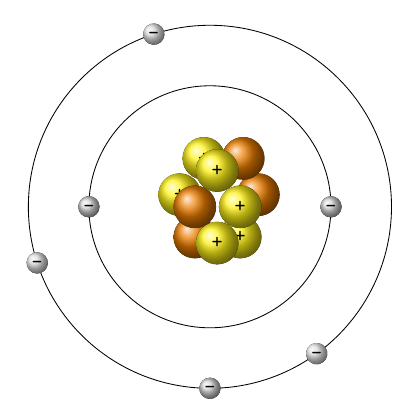
What is the atomic mass of the atom pictured? 
a)
9
b)
10
c)
18
d)
19
8.
What is the element name of the atom pictured? 
a)
Fluorine
b)
Neon
c)
Argon
d)
Potassium
9.
What is the atomic number of the atom pictured? 
a)
11
b)
12
c)
22
d)
23
10.
True or False - Protons and Neutrons have about the same mass.
a)
True - They have about the same mass
b)
False - They do not have about the same mass
11.
Which subatomic particle has a negative (-) charge?
a)
Proton
b)
Electron
c)
Neutron
12.
The subatomic particles in blue are...
a)
Neutrons
b)
Protons
c)
Electrons
13.
How many electrons does this picture show?
a)
4
b)
5
c)
6
d)
3
14.
How many protons does this atom have?
a)
3
b)
6
c)
4
d)
2
15.
How many protons are in Boron (B) ?
a)
3
b)
5
c)
10
d)
11
16.
What is the number of protons that the element in this image contain?
a)
14
b)
7
c)
15
d)
18
17.
What element is this?
a)
Helium
b)
Hydrogen
c)
Argon
d)
Silver
18.
What's a valence electron?
a)
electrons in the second energy level
b)
electrons in the outermost energy level
c)
the atomic number
d)
electrons in the first level
19.
Which particle does not contribute mass to the atom?
a)
Proton
b)
Neutron
c)
Electron
d)
Nucleus
20.
What is the atomic mass of "F," Fluorine?
a)
9
b)
18
c)
17
d)
19
21.
How many the electrons does "Al," aluminum, have?
a)
5
b)
10
c)
13
d)
3
22.
An atom has 10 protons, 15 neutrons and 10 electrons what is its mass number.
a)
20
b)
10
c)
5
d)
25
23.
The nucleus contains _____
a)
only protons
b)
protons and neutrons
c)
protons and electrons
d)
electrons and neutrons
24.

How many protons are in Gold

a)

79

b)

197

c)

118

d)

276

25.

A Student drew atomic models of four atomic models. Based on the drawings, which one is the least reactive?

a)

Chlorine, because it has three energy levels with seven electrons in the third level

b)

Gallium, because it has four energy levels with three electrons in the fourth level

c)

Neon, because it has two energy levels with eight electrons in the second level

d)

Tin, because it has five energy levels with four electrons in the fifth level

26.

An atom of which element is represented by this model?

a)

Carbon (C)

b)

Neon (Ne)

c)

Sodium (Na)

d)

Boron (B)

27.

A student is studying calcium, a highly reactive element that humans need for strong bones. Which characteristic of calcium is most closely related to its chemical reactivity?

a)

The 20 protons in each atom of calcium

b)

The 2 valence electrons in each atom of calcium

c)

The atomic mass of calcium, which is 40.078 amu

d)

The density of calcium, which is 1.54 g/cm3

28.

A chemist is identifying the elements present in a sample of seawater. What characteristic of an element’s atoms always determines the element’s identity?

a)

The number of neutrons

b)

The number of protons

c)

The location of valence electrons

d)

The number of valence electrons

29.

How many valence electrons does the atom of Carbon-14, shown above have?

a)

14

b)

10

c)

6

d)

4

30.

An element’s reactivity and other chemical properties are determined by the number of -

a)

isotopes it has.

b)

oxidation states.

c)

valence electrons.

d)

orbitals in an atom.

31.

______ always gives the identify of the atom.

a)

Protons

b)

Neutrons

c)

Electrons

32.

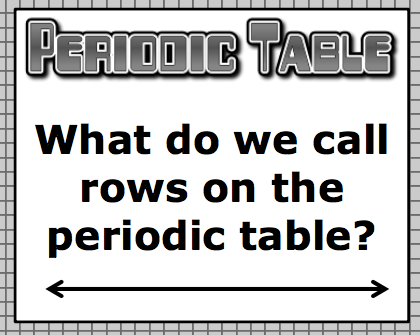
Elements in the same period/row have the same--

a)

# of valence electrons

b)

# of protons

c)

# of energy shells

d)

# of neutrons

33.

The mass of the atom is located ---

a)

in the Nucleus

b)

in the Electron Cloud

c)

protons only

d)

neutrons only

34.
a)
3
b)
13
c)
4
d)
14
35.
How many O's are in Al₂(SO₄)₃
a)
4
b)
12
c)
7
d)
24
36.

Sodium sulfate is used in laundry detergent. It is a compound that contains 2 atoms of sodium, 1 atom of sulfur, and 4 atoms of oxygen. What is the correct chemical formula for sodium sulfate?

a)

NA2SO4

b)

Na2S2O4

c)

Na2SO4

d)

Na2SO8

37.

Based on the data, which number shows the correct location of the element with 2 valence electrons and 3 energy levels.

a)

1

b)

2

c)

3

d)

4

38.

Which two atoms are elements in the same group in the periodic table?

a)

Atom 3 and Atom 4

b)

Atom 1 and Atom 4

c)

Atom 3 and Atom 2

d)

Atom 1 and Atom 2

39.
a)
Periods
b)
Groups
40.
a)
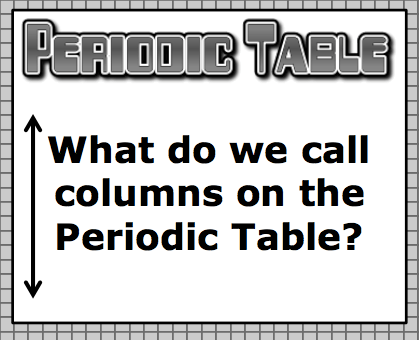
Periods
b)
Groups
41.

How many valence electrons are in an element in group 15 in the periodic table?

a)

5

b)

15

c)

7

d)

8

42.

Which pair of properties describes the elements in Group 1?

a)

They are chemically stable

b)

They have 8 valence electrons

c)

They are the most reactive metals

d)

They are the most reactive non metals

43.

Which of these formulas contain equal numbers of nitrogen atoms?

a)

Formulas I and III

b)

Formulas I and IV

c)

Formulas I, II and V

d)

Formulas II and III

44.

The chemical formula for sodium sulfate is Na2SO4. How many sulfur atoms are in the formula for sodium sulfate?

a)

1

b)

2

c)

6

d)

7

45.

How many atoms of oxygen are in a molecule of glucose (C6H12O6)?

a)

4

b)

6

c)

12

d)

24

46.

How many atoms in all are found in the compound above?

a)

3

b)

4

c)

5

d)

6

47.

What combination of beads should the use to model the formula? Blue represents carbon, green represent oxygen and red represent hydrogen.

a)

6 blue, 6 red and 6 green

b)

12 green, 6 red and 6 blue

c)

12 red, 6 blue and 6 green

d)

12 blue, 6 green and 6 red

48.
How many Elements are in the compound C2H8O ?
a)
2
b)
1
c)
3
d)
0
49.
How many total atoms are in the compound C2H8O ?
a)
11
b)
2
c)
8
d)
1
50.

How many more atoms of Oxygen than than Magnesium are in this formula? MgSO4MgSO_4  

a)

4

b)

3

c)

2

d)

6

51.
How many atoms are there TOTAL in:
H2SO4
a)
6
b)
5
c)
7
d)
3
52.

C3H5(NO3)3

a)

C = 3, H = 5, N = 3, O = 9

b)

C = 3, H = 5, N = 1, O = 9

c)

C = 9, H = 15, N = 3, O = 9

d)

C = 9, H = 15, N = 1, O = 3

53.
How many O's are in Al₂(SO₄)₃
a)
4
b)
12
c)
7
d)
24
54.
How many atoms of Oxygen are in Fe(NO3)3 ?
a)
6
b)
3
c)
9
d)
1
55.

How many atoms are represented in the reactants in the equation?

a)

6

b)

7

c)

4

d)

5

56.
How many oxygen atoms are in this chemical formula?
a)
6 oxygen atoms
b)
2 oxygen atoms
c)
3 oxygen atoms
d)
4 oxygen atoms
57.

2Li2BrO3

How many atoms are in this chemical formula above?

a)

12

b)

2

c)

7

d)

10

58.

A group of students creates a table to use while completing an investigation with these chemicals.

Which formulas above represent a molecule with 6 atoms?

a)

C3H8O and NaHCO3

b)

MgSO4 and NaHCO3

c)

NH4OH and C3H8O

d)

C2H4O2 and MgSO4

59.

Which of the following accurately describes the chemical formula of the molecule shown above?

a)

3CH8O

b)

C3H7O

c)

C4H8O2

d)

C3H8O

60.

Which of the following molecules has the formula CH2O?

a)
b)
c)
d)
61.
Which of the following could indicate a chemical change? 
a)
All of the answers could indicate Chemical Change 
b)
a color change has occurred 
c)
bubbles appear 
d)
properties are different after a reaction
62.
A copper penny turning greenish after a few years is an example of...
a)
Chemical Change
b)
Physical Change
63.
A change in which NEW substances are formed.
a)
Chemical change
b)
Physical change
c)
Casual change
d)
Formal change
64.
A scientist performed four investigations using eight different liquids. In each investigation, the scientist combined two of the liquids and recorded observations. In which investigation is it LEAST likely that the liquids reacted chemically?
a)
1
b)
2
c)
3
d)
4
65.
What is an example of a Chemical change?
a)
Ripped paper 
b)
boiled egg
c)
cracked egg
d)
sugar in water
66.
Which of the following IS a SIGN of a chemical reaction?
a)
Dissolving
b)
Melting
c)
Bubbles form
d)
Expected color change
67.

Four students performed four different investigations by combining different substances. Their results are shown in the table provided. In which experiment are new substances being formed?

a)

Experiment 1

b)

Experiment 2

c)

Experiment 3

d)

Experiment 4

68.
Is burning wood a chemical or physical change?
a)
chemical
b)
physical
69.
Which of the following is a sign that a chemical reaction has occurred?
a)
change in shape
b)
melting
c)
formation of a gas
d)
dissolving
70.

A clear liquid from a flask is poured into another clear liquid in a beaker. Which of the following results indicates a new substance was formed?

a)

The level of the substance in the beaker is higher after the other liquid is added.

b)

A yellow solid forms and then settles to the bottom of the beaker.

c)

Small white crystals are left behind in the flask that held the first liquid.

71.

A student observes a marshmallow as it is heated and burns. The student concludes that a chemical reaction has occurred. Which of the following observations about the burning marshmallow provides evidence of a chemical reaction?

a)

Heat is added to the sugar crystals.

b)

The sugar melts and becomes a liquid.

c)

Gas is produced as the marshmallow turns black.

d)

No evidence of chemical reaction is present.

72.
Which of these is a property of metals?
a)
It's malleable
b)
It can't conduct electricity
c)
They are used in food
d)
It's very brittle
73.
Which of the following is a good conductor of heat?
a)
Metal
b)
Nonmetal
c)
Metalloid
74.
Which of these grouping of elements could have the characteristic of brittle?
a)
Metal
b)
Nonmetal
75.
Luster is ___________
a)
A.  the way light is reflected off a surface.
b)
A.  how well a piece of matter conducts electricity. 
c)
A.  the capability of being drawn out into thin wires or threads.
d)
A.  the capability of being hammered out thin.
76.
Malleability is ___________
a)
the way light is reflected off a surface.
b)
how well a piece of matter conducts electricity
c)
A.  the capability of being drawn out into thin wires or threads.
d)
the capability of being hammered out thin.