
 Worksheets
metals nonmetals metalloids
Total questions: 75
Worksheet time: 1hrs 23mins

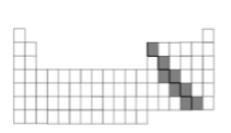
Elements in the shaded area can best be described as -
Shiny and brittle
Insulators
Good conductors

Elements in the shaded area can best be described as -
Malleable
Brittle
Dull
Insulators


Fill in the blank: Nonmetals have a ___________ surface, and they do not conduct heat or electricity.
electricity
dull
changed
luster
metals


Find Vandium (V) on the periodic table, it is a .......
Metal
Nonmetal
metalloid
Find Arsenic (As) on the periodic table, it is a .......
Metal
Nonmetal
metalloid
Find Bromine (Br) on the periodic table, it is a .......
Metal
Nonmetal
metalloid

The elements in blue in this picture are...
metals
nonmetals
metalloids
The elements in green in this picture are...
metals
nonmetals
metalloids
The elements in yellow in this picture are...
metals
nonmetals
metalloids
At room temperature MOST nonmetals are ____________.
plasma
gases
liquid
solid
Krypton (Kr) is a colorless gas that does not conduct electricity. Where would you find this element on the Periodic Table?
on the left
on the right
in the middle
at the bottom
What is a semiconductor?
an element that conducts electricity
an element that conducts electricity only under certain conditions
an element that does not conduct electricity
an element that barely conducts electricity
Aluminum is an element that is used to make soda cans and sheet metal for airplanes. What property of aluminum makes it useful in this way?
Aluminum is a conductor
Aluminum is ductile
Aluminum is malleable
Aluminum has a high melting point
The majority of the elements on the Periodic Table are
metals
nonmetals
metalloids
solids
Copper is used as wiring in many homes because it is a _________ metal.
malleable
ductile
conductive
insulated
Sodium (Na) is a silvery metallic element with an extremely high melting point. This element is a __________ and will be found on the __________ side of the Periodic Table.
nonmetal, right
metal, right
nonmetal, left
metal, left
The ________ make up the smallest group on the Periodic Table.
metals
nonmetals
metalloids
solids
Which of the following is a metalloid? (more than one is correct)
Hydrogen
Boron
Germanium
Titanium
Polonium
What kind of elements are dull and have low melting points?
metals
nonmetals
metalloids
megametals

I am shiny
Metal
Nonmetal
Metalloid

I am malleable
Metal
Nonmetal
Metalloid

I am a good conductor of electricity and/or heat
Metals
Nonmetals
Metalloids

I am strong
Metal
Nonmetal
Metalloids

I am ductile - I can be draw into wires
Metals
Nonmetals
Metalloids

I am a solid all the time
Metals
Nonmetals
Metalloids

I magnetic or can be magnetized.
Metals
Nonmetals
Metalloids

I could be shiny OR dull
Metals
Nonmetals
Metalloids

I can be nonmalleable or malleable
Metals
Nonmetals
Metalloids

I am a semi-conductor
Metals
Nonmetals
Metalloids

I am only dull
Metals
Nonmetals
Metalloids

I am NOT malleable
Metals
Nonmetals
Metalloids

I am a poor conductor of electricity and/or heat
Metals
Nonmetals
Metalloids

I am brittle.. I can be easily broken up
Metals
Nonmetals
Metalloids

I am NOT ductile - I cannot be pulled into a wire
Metals
Nonmetals
Metalloids

I can be a solid, liquid or a gas
Metals
Nonmetals
Metalloids

I am nonductile and ductile
Metals
Nonmetals
Metalloids

I can be brittle OR strong
Metals
Nonmetals
Metalloids
Neon is colorless, a poor conductor of heat and is not able to be stretched. How would it be classified?
Nonmetal
Metalloid
Metal
None of the above
Manganese is shiny, conducts heat and electricity, and can be hammered into thin sheets. What is is?
Nonmetal
Metal
Metalloid
None of the above
This word is used to describe a substance that breaks apart easily and is weak and fragile
Conductivity
Ductile
Malleable
Brittle
Metals are...
dull, brittle, insulators.
shiny or dull, brittle, semiconductor.
shiny, malleable, conductors.
shiny, dull, insulator.
Use your Periodic Table to help you. Boron would be classified as a...
Metal
Nonmetal
Metalloid
Luster
how an object reflects light
can be hammered into a shape
transfers heat and/or electricity
Conductivity
how an object reflects light
can be hammered into a shape
transfers heat and/or electricity
Malleability
how an object reflects light
can be hammered into a shape
transfers heat and/or electricity
____________is the ability of a substance to be drawn out into a wire.
Conductivity
Ductility
Mass
Luster
Which of these elements is NOT a metal?
Antimony
Chromium
Calcium
Uranium
The element Hydrogen is a ___________.
metal
nonmetal
metalloid
compound
How many Metalloids are on the Periodic Table?
7
6
92
31

Metal
Nonmetal
Metalloid

Metal
Nonmetal
Metalloid

Metal
Nonmetal
Metalloid

