wayground logo

Free Printable Worksheets

Font size

S
M
L
XL
Worksheets

Review: Central Dogma of Biology

Total questions: 75

Worksheet time: 54mins

Name
Class
Date
1.
The DNA sequence ATCAGCGCTGGC is part of a gene. How many amino acids are coded for by this message?
a)
4
b)
8
c)
12
d)
20
2.
What is the relationship between a protein, the cell, and DNA?
a)
DNA is produced by protein which is produced in the cell
b)
Protein is composed of DNA which is produced in the cell
c)
DNA controls the production of protein in the cell
d)
A cell is composed of DNA and protein
3.
Genetic info flows in one direction. Which best represents this flow?
a)
DNA-protein-RNA
b)
Protein-RNA-DNA
c)
RNA-protein-DNA
d)
DNA-RNA-protein
4.
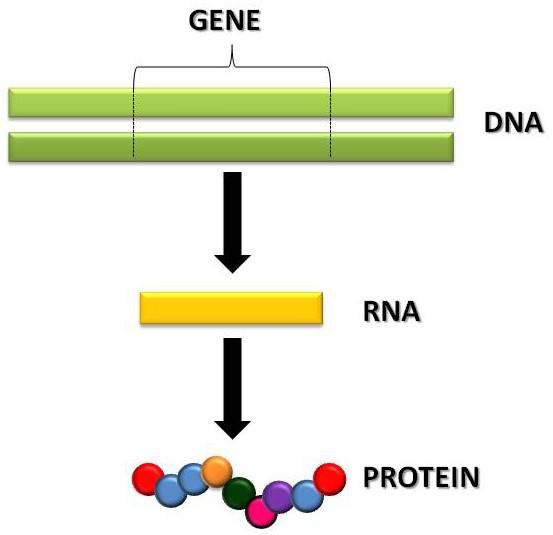
The diagram shows the process of
a)
Transcription
b)
Translation
c)
Replication
d)
Mitosis
5.
Which process is shown?
a)
diffusion
b)
repiration
c)
recombination
d)
translation
6.
Where does transcription take place?
a)
nucleus
b)
ribosome
c)
cytoplasm
d)
smooth ER
7.
Where does translation take place?
a)
Nucleus
b)
Ribosome
c)
Golgi Body
d)
Cytoplasm
8.
DNA sequence is ACAGTGC. How would this be coded on mRNA?
a)
TGTCACG
b)
UGUCACG
c)
GUGACAU
d)
CACUGUA
9.
Which of the following is incorrect regarding RNA?
a)
RNA contains uracil
b)
RNA can only be found inside the nucleus
c)
RNA is single stranded
d)
RNA contains genetic information
10.
What nitrogen base is in DNA but NOT RNA?
a)
uracil
b)
thymine
c)
guanine
d)
adenine
11.
Which is the mRNA molecule that would be transcribed from this DNA template:
TGGCAA
a)
ACCGTT
b)
UGGCAA
c)
UCCGUU
d)
ACCGUU
12.
Carries the genetic code to the ribosome
a)
mRNA
b)
tRNA
c)
rRNA
d)
DNA
13.
A molecule of DNA is made up of _________.
a)
amino acids and proteins
b)
ATP and enzymes
c)
paired nucleotides
d)
receptor enzymes
14.
Which do DNA and RNA have in common?
a)
Both are double stranded.
b)
Both contain ribose molecules.
c)
Both contain phosphate groups.
d)
Both contain uracil.
15.
If the structure of DNA were likened to a ladder, what would make up the “supporting structure” (not the “rungs”) of the ladder?
a)
amino acids and sugars
b)
nucleotide bases, including thymine
c)
nucleotide bases, including uracil
d)
sugar-phosphate molecules
16.
What process is shown in the illustration below?
a)
commensalism
b)
deletion
c)
passive transport
d)
replication
17.
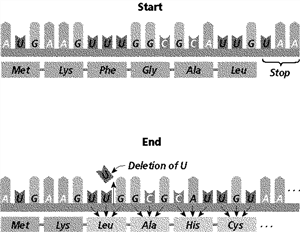
What type of mutation has occurred in Figure 12-3?
a)
substitution
b)
frameshift
c)
lethal
d)
insertion
18.
Which defines a codon in DNA or mRNA?
a)
pair of nucleic acid and sugar
b)
pair of phosphate and sugar
c)
three-base code
d)
two-base code
19.
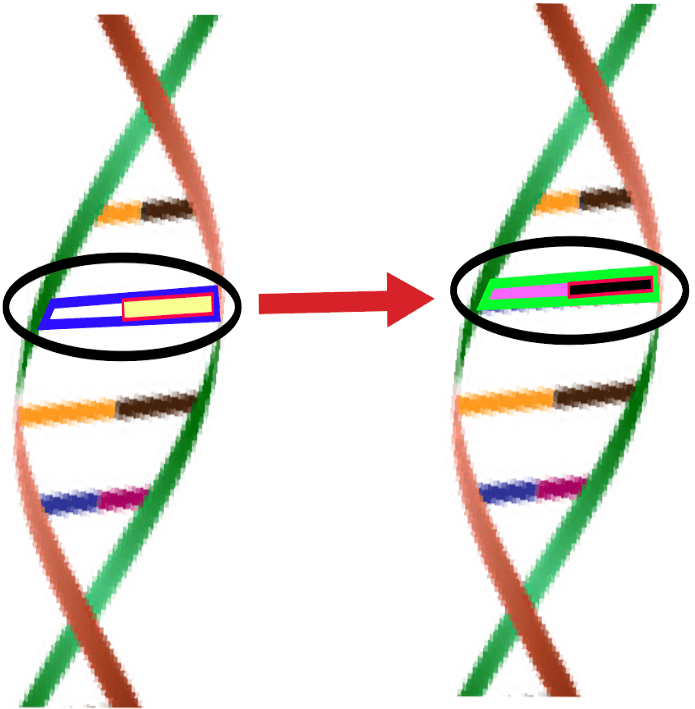
What mutation has occurred here? 
T-G-A-C-C-A
T-G-A-G-C-A
a)
Substitution
b)
Deletion
c)
Insertion
d)
Frameshift 
20.
Are all mutations bad?
a)
Yes
b)
No
21.
Any change in the sequence of DNA is...
a)
transgenic shift
b)
Single Genotype
c)
Monohybrid Trait
d)
Mutation
22.
What are the building blocks of proteins called?
a)
DNA
b)
RNA
c)
Ribosomes
d)
Amino Acids
23.
DNA has a ______ strand; RNA has a ______ strand.
a)
double/double
b)
double/triple
c)
double/single
d)
single/single
24.
Assembles RNA during transcription
a)
RNA Polymerase 
b)
Mutations
c)
Gene Expression
d)
Point Mutation
25.
Which enzyme has the job of unzipping the double helix?
a)
Helicase
b)
Polymerase
c)
Ligase
d)
Primerase
26.
Which enzyme fixes the Okazaki fragments in the lagging strand?
a)
Helicase
b)
Polymerase
c)
Ligase
d)
Primerase
27.
If a strand reads:
3' A A A T T T C 5'
The matching strand would read...
a)
5' T T T A A A G 3'
b)
3' T T T A A A G 5'
c)
5' A A A T T T C 3'
d)
3' U U U A A A G 5'
28.
What are the gaps between the newly synthesized DNA on the lagging strand called?
a)
Okazaki fragments
b)
Polymer gaps
c)
Helicase fragments
d)
Acidic gaps
29.
This picture is illustrating the ____ nature of DNA.
a)
anti-parallel
b)
deoxyribosic
c)
helical
d)
radioactive
30.
The enzyme that splits open the DNA creates what's called a fork - where the DNA separates into the lagging strand and the ______ strand.
a)
leading
b)
leveraging
c)
Okazaki
d)
ligase
31.
DNA replication turns one strand of DNA into two new strands of DNA. What percent of each new strand is the old strand?
a)
Half of each new DNA is the old DNA
b)
The old strand of DNA was digested, so none
c)
The new DNA is entirely made up of the old DNA
d)
About every sixth base comes from the old DNA
32.

Which enzyme is responsible for adding the free nucleotides to the replicating DNA? ​

a)

DNA Helicase

b)

DNA Ligase

c)

DNA polyermase

d)

RNA Polymerase

33.

If a person suffered from a disorder where their DNA fragments were unable to fill in the missing slots in between the fragments of the lagging strand, they would most likely have a disorder that affected which enzyme?

a)

DNA Helicase

b)

DNA Ligase

c)

DNA polyermase

d)

RNA Polymerase

34.
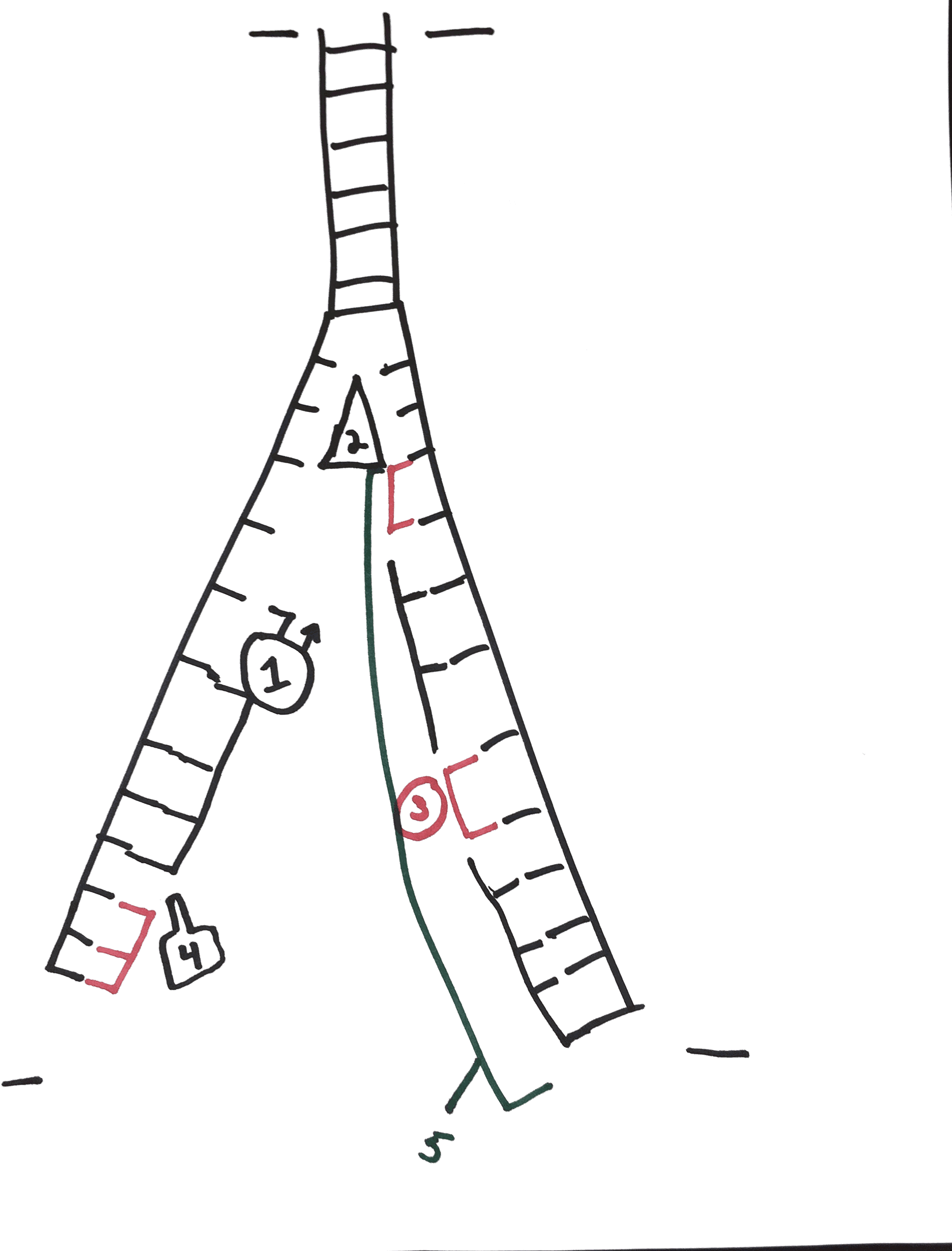
order of replication
a)
3, 4, 2, 1
b)
3, 1, 4, 2
c)
2, 1, 4, 3
d)
3, 4, 1, 2
35.
Place the following in sequential order
1. Recoil
2. Straightens the double helix
3. Breaks Hydrogen bonds
4. Adds Free nucleotides
a)
1, 2, 3, 4
b)
3, 4, 2, 1
c)
3, 2, 4, 1
d)
2, 3, 4, 1
36.
Why does DNA replicate?
a)
To create another copy for the new cell
b)
To create a duplicate copy in case the original gets damaged
c)
To create a new copy to replace the damaged original
37.

#3 setting Primers

a)

Ligase

b)

Helicase

c)

Polymerase

d)

Primase

38.

Worked on DNA imaging techniques and published Franklin's x-ray crystallography image of DNA

a)

Watson & Crick

b)

Franklin

c)

Wilkins

d)

Pauling

e)

Chargaff

39.

Provided clear x-ray crystallography images of DNA

a)

Watson & Crick

b)

Franklin

c)

Wilkins

d)

Pauling

e)

Chargaff

40.

Built models to determine that DNA was a double helix shape with base pairs A-T and G-C in rungs between the sugar/phosphate backbone of DNA.

a)

Watson & Crick

b)

Franklin

c)

Wilkins

d)

Pauling

e)

Chargaff

41.

Discovered that there was the same amount of A and T in a cell, and C and G in a cell.

a)

Watson & Crick

b)

Franklin

c)

Wilkins

d)

Pauling

e)

Chargaff

42.
The work of scientists including Griffin, Avery, Hershey & Chase and Franklin helped us to determine the __ are responsible for carrying genetic material.
a)
Amino Acids
b)
Proteins
c)
Nucleic Acids
d)
Carbohydrates
43.
If Chargaff found that a sample of DNA has 20% ADENINE, how much GUANINE would he have determined to be there?
a)
30%
b)
20%
c)
80%
d)
60%
44.
From his work with mice and pneumonia-causing bacteria, Frederick Griffin coined the term
a)
Replication
b)
Transcription
c)
Transformation
d)
Translation
45.
How did Hershey and Chase's use of radiolabeled bacteriophages to study the genetic material validate Avery's research?
a)
It demonstrated conclusively that the genetic material is not protein.
b)
It showed that bacteriophages are not digested by bacterial enzymes.
c)
It proved that bacteria will take up phosphorus, but not sulfur.
d)
It confirmed that bacteriophages cannot inject radiolabeled DNA.
46.
Which scientist conducted tests on extracts made of bacteria to show that the genetic material in bacteria is DNA?
a)
Martha Chase
b)
Oswald Avery
c)
Frederick Griffith
d)
Alfred Hershey
47.
By using a kitchen blender and isotopes, Hershey and Chase
a)
determined that nuclein was what transformed rough to smooth bacteria, and thus developed the transforming principle.
b)
was able to isolate nuclein and determined that nuclein was made up of hydrogen, oxygen, nitrogen and phosphorus.
c)
traced radioactive phosphorus and radioactive sulfur and determined that DNA was incorporated into the nucleus of cells.
d)
determined by isolation of nucleic acid from various species, the ratio of adenine to thymine and guanine to cytosine.
48.

Mutations that effect gametes and that will be passed on

to the next generation

a)

Genetic change

b)

Protein synthesis

c)

Apoptosis

d)

Cell membrane

49.

A permanent change in the DNA sequence

which can affect a single gene or group of genes

a)

Homeostasis

b)

Somatic Cell

c)

Chromosomal Mutation

d)

Gene Mutation

50.

One nucleotide base is changed so only one amino acid

is affected

a)

Substitution Mutation

b)

Point Mutation

c)

Translocation

d)

Inverse Mutation

51.

A point mutation where one nucleotide base replaces an original nucleotide base

a)

Inversion Mutation

b)

Chromosomal Mutation

c)

Translocation

d)

Substitution Mutation

52.

A substitution mutation that has no effect

on amino acids sequence

a)

Insertion Mutation

b)

Translocation

c)

Silent Mutation

d)

Deletion Mutation

53.

A nucleotide base is inserted or deleted shifting the entire DNA sequence. Entire protein will be changed.

a)

Substitution Mutation

b)

Silent Mutation

c)

Frameshift Mutation

d)

Translocation

54.

A frameshift mutation where a nucleotide base

is removed from the DNA sequence.

a)

Deletion Mutation

b)

Substitution Mutation

c)

Translocation

d)

Silent Mutation

55.

Mutations that involve parts of or all of

a chromosome

a)

Replication

b)

Deletion Mutation

c)

Chromosomal Mutation

d)

Transcription

56.

Part of a chromosome is reversed.

a)

Inversion Mutation

b)

Deletion Mutation

c)

Translocation

d)

Point Mutation

57.

Part of one chromosome is transported and attached

to a non-homologous chromosome

a)

Inversion Mutation

b)

Translocation Mutation

c)

Duplication Mutation

d)

Point Mutation

58.

Failure of homologous chromosomes

to separate during meiosis.

Results in gametes with either one extra or one missing chromosome.

a)

Translocation

b)

Nondisjunction

c)

Replication

d)

Transcription

59.

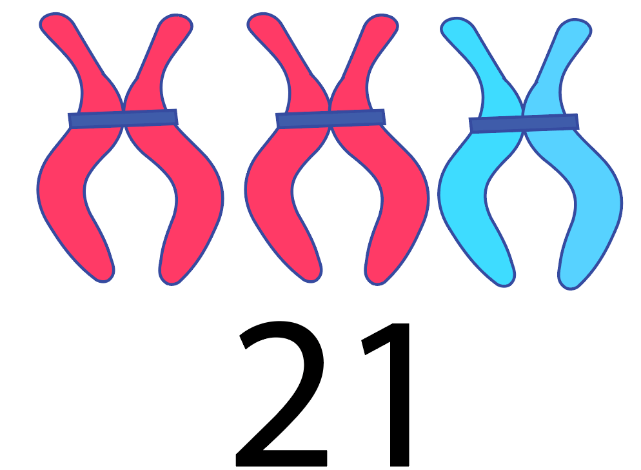
Condition caused by nondisjunction at pair 21 during meiosis.

Individuals have an extra chromosome

at pair 21, or a total of 47 chromosomes.

Also called Trisomy 21.

a)

Cystic Fibrosis

b)

Translocation

c)

Hemophilia

d)

Down Syndrome

60.

A point mutation where DNA adenine (A)

is replaced by thymine (T) resulting in a single amino acid change during translation(affects blood cell

shape and function)

a)

Encephelitis

b)

Hemophilia

c)

Sickle Cell Anemia

d)

Influenza

61.

Which Karyotype displays a female with Down syndrome?

a)
b)
c)
d)
62.
Why are insertion and deletion (frameshift) mutations so harmful?
a)
They change all of the codons from the mutation on down the line, which changes the amino acid sequence
b)
They insert things that an organism doesn't need.
c)
They often delete things that organisms need.
d)
Insertion and deletions are not any more harmful than substitution mutations.
63.
The survival of a species depends on its ability to adapt to changes in the environment. Which statement correctly describes a way that mutations increase the likelihood that a species will survive in a changing environment?
a)
Mutations are a source of variation in the species
b)
Mutations are the cause of disease in the species
c)
Mutations are not harmful when they occur in somatic cells
d)
Mutations are always passed on to subsequent generations
64.
Which mutation will cause translation to stop? 
a)
Mutations 1 and 3 only
b)
Mutation 1 only
c)
Mutation 2 only
d)
Muations 1, 2, 3
65.
What is the name given to part of a DNA molecule that codes for a protein?
a)
Glucose
b)
Chromosome
c)
Gene
d)
Phosphate
66.
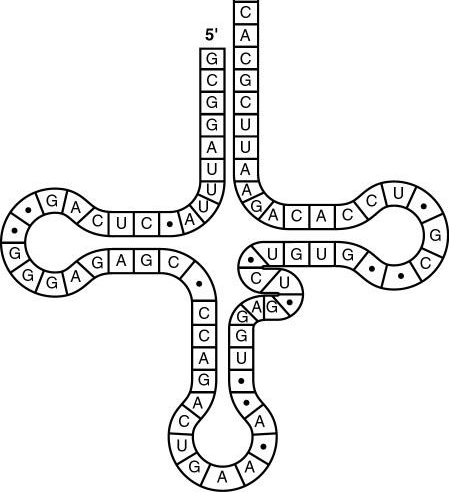
What structure of this molecule binds with the mRNA molecule?
a)
Amino Acid
b)
tRNA
c)
Anticodon
d)
Codon
67.
In eukaryotes, functional messenger RNA molecules are made from
a)
exons spliced together after introns are removed
b)
introns spliced together after eons are removed
c)
exons spliced together with introns
d)
long pieces of RNA shortened by the Dicer enzyme
68.

How can a person's muscle cells have the same exact DNA sequences as their nerve cells even though the look and perform completely different?

a)

The two different cells become mutated

b)

The proteins expressed in each cell are different

c)

They actually have different DNA in the two types of cells.

d)

The genome of the different cells changes
69.
Activation or deactivation of genes by environmental experiences throughout development
a)
turn on genes
b)
gene expression
c)
environmental factors
d)
gene markers
70.
The difference between DNA code and the epigenome is that the DNA code is
a)
flexible, while the epigenome is fixed for life
b)
fixed for life, while the epigenome is flexible
c)
determined by the environment, while the epigenome is not
d)
determined by one's stress level, while the epigenome is not
71.
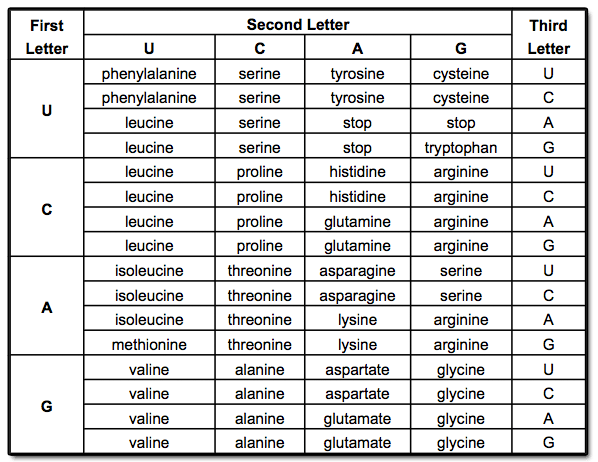
What is the correct amino acid sequence for the mRNA code AUGCCAGUAUGA
a)
Met-Pro-Ala-Val
b)
Met-Pro-Val
c)
Tyr-Gly-His
d)
Tyr-Gly-Arg-His
72.
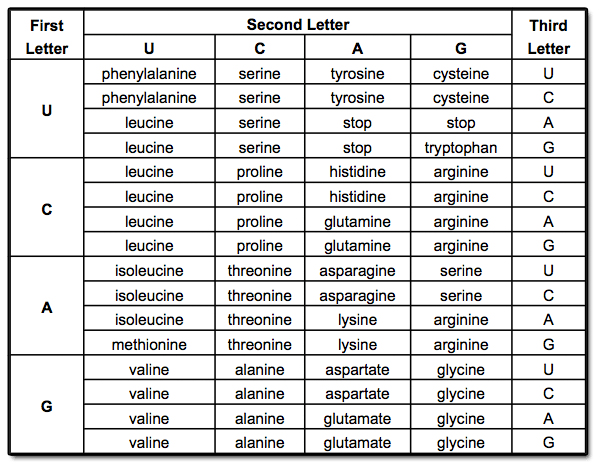
What amino acid is represented by the codon UUA?
a)
Phenylalanine
b)
Tyrosine
c)
Leucine
d)
Stop codon
73.

Translate the mRNA sequence to an amino acid sequence.


AUG-CCC

a)

Met-Pro

b)

Met-His

c)

His-Pro

d)

His-Met

74.

tRNA plays a role in which of the following ?

a)

picking up the amino acid specified by the anticodon

b)

recognizing the appropriate codons in mRNA

c)

translating codons into amino acids

d)

all of these are correct

75.
What would happen if we did not have start codons?
a)
Polypeptide chains would continue to grow
b)
Amino acids would bind to tRNA
c)
Protein synthesis wouldn't occur
d)
mRNA would form a double strand