wayground logo

Free Printable Worksheets

Font size

S
M
L
XL
Worksheets

Midterm exam review

Total questions: 80

Worksheet time: 3600secs
Name
Class
Date
1.

Natural Selection is driven by a change in the environment and survival of the

a)

Earth

b)

Fastest

c)

Fittest

d)

Biggest

2.
Where the better adapted organisms survive to pass traits along to offspring.
a)
Evolution
b)
Natural Selection
c)
Extinction
d)
Artifical Selection
3.

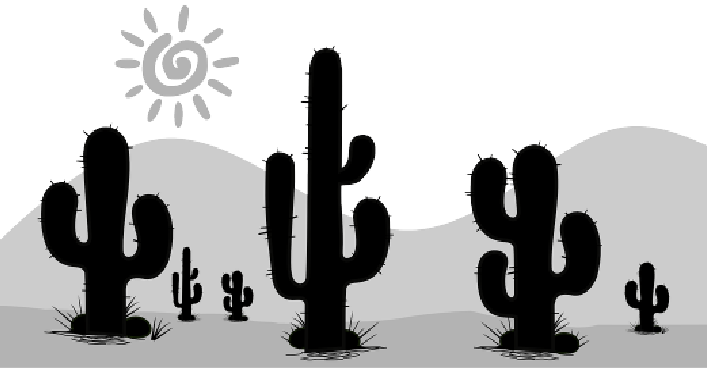
A farm contains a population of both brown and green grasshoppers. After the growing season, a farmer plows one field on the farm, leaving behind only exposed dirt. After a few weeks, some grass begins to grow in that field, and within a month, the field is covered in grass. What change in the population of grasshoppers would be expected in the field during this time based on their genetic variation in color?

a)

The green and brown grasshoppers will choose to mate with each other, resulting in both colors of grasshoppers having roughly equal numbers in the field.

b)

After plowing the field, brown grasshoppers would be more plentiful, but over time, the green grasshoppers would become more plentiful in the field.

c)

After plowing the field, green grasshoppers would be more plentiful, but over time, the brown grasshoppers would become more plentiful in the field.

d)

The green and brown grasshoppers will eat plants of any color, resulting in both colors of grasshoppers having roughly equal numbers in the field.
4.
The most recent ancestral form or species from which two different species evolved is known as ________________________.
a)
a common ancestor.
b)
an embryonic stage.
c)
development.
d)
evolution.
5.
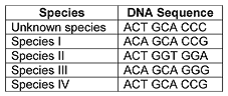
According to this data, the unknown bacterial species is most closely related to: 
a)
Species I
b)
Species II
c)
Species III
d)
Species IV
6.

What is the building block of the biomolecule, Nucleic Acid?

a)
b)
c)
d)
7.
What part of a nucleotide accounts for the genetic variation between individuals?
a)
phosphate
b)
nitrogenous base
c)
deoxyribose
d)
sugar
8.
If one strand of DNA has the sequence TTACCG, the sequence of the other strand of the same molecule will be
a)
AATGGC
b)
TTACCG
c)
AACGGC
d)
AATGGG
9.
What are the functions of genes?
a)
instructions for producing proteins
b)
instructions for producing DNA
c)
instructions for producing lipids
d)
they have no function
10.
What does mRNA do?
a)
provides information from DNA to ribosomes
b)
transfers amino acids to the ribosomes
c)
makes up ribosomes
d)
builds proteins
11.
Which phrase best describes translation?
a)
converts mRNA into a polypeptide
b)
catalyzes bonds between amino acids
c)
produces RNA from DNA molecules
d)
recycles tRNA molecules for reuse
12.
DNA replication results in two DNA molecules,
a)
each one with two original strands
b)
each one with two new strands
c)
each one with one new strand and one original strand
d)
one with two new strands and the other with two original strands
13.
A process in which DNA has the unique ability to make an exact copy of itself.
a)
Replication
b)
Translation
c)
Transcription
14.
The process of DNA replication is called semi conservative because it results in
a)
none of these
b)
Two DNA molecules.  One original molecule and one with two new strands
c)
two exact copies with new strands
d)
two identical molecules, each with 1 original strand and one new.
15.
What type of gene mutation has occurred here? 
T-G-A-C-C-A
T-G-A-C-C-A-A
a)
Base Substitution
b)
Base Deletion
c)
Base Insertion
d)
Frameshift 
16.
What type of gene mutation has occurred here? Normal-
AGA-TTC-ATA-GCG
Mutant-
AGA-TTC-AAT-AGC-G
a)
deletion frameshift
b)
insertion frameshift
c)
substitution
d)
nonsense
17.
DNA molecule segment is : TTACGCAAG
The mutated DNA segment is TTACGCAAC. This is an example of ___ mutation.
a)
Base Substitution
b)
Base Insertion
c)
Base Inversion
d)
Translocation
18.
Where do mutations occur?
a)
DNA and RNA
b)
DNA 
c)
RNA
d)
mRNA and tRNA
19.
When one base replaces another, this is a common type of mutation called what?
a)
Insertion
b)
Substitution
c)
Inversion
d)
Deletion
20.

Deletion

a)

A

b)

B

c)

C

21.

Substitution

a)

A

b)

B

c)

C

22.

Insertion

a)

A

b)

B

c)

C

23.

What is number 4 called?

a)

chromosome

b)

sister chromatids

c)

centromere

d)

homologous chromosomes

24.

This picture which illustrates the structure and number of chromosome is called? (Hint: start with k...)

(a)  

25.

How many chromosomes are there in this picture? (please type only number)

(a)  

26.

Which type of chromosome in this frame is called? and which sex of this human is it?

a)

sex chromosomes, male

b)

autosomes, male

c)

sex chromosomes, female

d)

autosomes, female

27.

AA

a)

Genotype

b)

Phenotype

28.

Blue eyes

a)

Genotype

b)

Phenotype

29.

Curly hair

a)

Genotype

b)

Phenotype

30.
Which of the following is heterozygous
a)
FF
b)
tt
c)
Gg
d)
RR
31.
Which of the following is homozygous recessive?
a)
rr
b)
AA
c)
TT
d)
Ff
32.
Which of the following is homozygous dominant?
a)
Jj
b)
Rr
c)
MM
d)
ee
33.
The physical appearance of a trait is known as the-
a)
genotype
b)
phenotype
c)
characteristics
d)
intelligence
34.
How many letters does a genotype contain?
a)
1
b)
2
c)
3
d)
4
35.
Mark is heterozygous. If B is for brown hair, and b is for blonde hair, what is Mark's phenotype?
a)
Brown Hair
b)
Blonde Hair
c)
Brown and Blonde Hair
d)
Black Hair
36.
Mark is heterozygous. If B is for brown hair, and b is for blonde hair, what is Mark's genotype?
a)
BB
b)
bb
c)
Bb
d)
bB
37.
T - tall and t = short
In the punnett square below, what belongs in the missing square
a)
tt
b)
Tt
c)
Bb
d)
TT
38.
What allele combination should go in the missing box?
a)
AA
b)
Aa
c)
aa
d)
none of these
39.
If B = brown hair and b = blonde hair, what is the probability of brown hair?
a)
25%
b)
50%
c)
0%
d)
75%
40.
In rabbits, black fur (B) is dominant over brown fur (b). If a rabbit has brown fur, what can you conclude about its genotype?
a)
It is BB.
b)
It is Bb
c)
It is brown
d)
It is bb.
41.
How many boxes would say BB?
a)
1
b)
2
c)
4
d)
0
42.
Tay-Sachs disease is a lethal, autosomal recessive genetic disorder. If both parents are heterozygous carriers of the disease, what are the chances of them having a child who is also a heterozygous carrier for Tay-Sachs?
a)
0%
b)
25%
c)
50%
d)
75%
43.
Red-green color blindness is an X-linked recessive trait. A red-green color-blind woman and a red-green color-blind man have a son. What is the probability that the son is also red-green color-blind?
a)
0%
b)
25%
c)
50%
d)
100%
44.

The genetic disorders hemophilia and color-blindness are called Sex-Linked recessive disorders because the mutated allele is located on the ______.

a)

Y-chromosome

b)

X-chromosome

c)

any chromosome

d)

all chromosomes

45.

Sex-linked disorders like hemophilia and color-blindness are more common in _____ because they only have one X chromosome.

a)

males

b)

females

46.
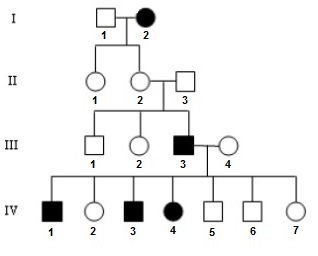
What does a filled in square represent?
a)
Not affected Female
b)
Not affected Male
c)
Affected Male
d)
Affected Female
47.
How many generations are shown in this pedigree?
a)
1
b)
2
c)
3
d)
4
48.
How many kids did the mother and father from the first generation have?
a)
2
b)
4
c)
5
d)
6
49.
This pedigree represents the inheritance of hemophilia in this family. How many of the females have the hemophilia trait?
a)
8
b)
5
c)
2
d)
3
50.
What do half colored symbols represent?
a)
The individual is a carrier (heterozygous).
b)
The individual expresses the trait.
c)
The individual has both recessive alleles.
d)
The individual has both dominant alleles.
51.
Is this trait (the shaded individuals) dominant or recessive?
a)
dominant
b)
recessive
52.
Give the genotype for person II-1, for this autosomal trait.
a)
GG
b)
Gg
c)
gg
d)
we cannot be 100% sure of the genotype
53.
If this pedigree shows an autosomal recessive disorder, what MUST the genotype of individual II-3 be?
a)
HH
b)
Hh
c)
hh
d)
None of the above
54.

What is an example of a positive feedback mechanism?

a)
b)
55.
The term for maintaining internal temperature is: 
a)
Thermoregulation
b)
Thermometer
c)
Homeothermal
d)
Homeostasis
56.
Rapid growth during puberty causes your body to release more and more growth hormones. As you grow, more and more growth hormones are released until puberty is reached, and then the hormones stop.
a)
Positive Feedback Response
b)
Negative Feedback Loop 
57.
If the calcium in your blood decreases below homeostasis levels, a gland in the brain will sense the decrease and send a chemical message to your bones. Your bones will release calcium into the blood, bringing blood calcium levels back up.
a)
Positive Feedback Response
b)
Negative Feedback Loop 
58.
When glucose levels in the blood rise, your brain sends a signal to your pancreas. The pancreas releases insulin, which opens channels in cell membranes to allow glucose to enter the cell, lowering blood sugar levels. 
a)
Positive Feedback Response
b)
Negative Feedback Loop 
59.
Homeostasis
a)
allows for a wildly fluctuating internal environment
b)
is impossible in vertebrates
c)
is the maintenance of a relatively stable internal environment and often incorporates a form of feedback regulation
d)
is the maintenance of a relatively stable external environment and often incorporates a form of feedback regulation
60.

Excess glucose in the bloodstream is converted to which other substance when stored in the liver and muscle cells?

a)

glygogen

b)

glucagon

c)

glycerin

d)

glycerol

61.
Which is true of prokaryotic and eukaryotic cells?
a)
Prokaryotic cells are larger than eukaryotic cells.
b)
Eukaryotic cells do not have nuclei, and prokaryotic cells do have nuclei.
c)
Prokaryotic cells lack membrane-bound organelles, and eukaryotic cells contain membrane-bound organelles.
d)
Eukaryotic cells are simpler than prokaryotic cells.
62.

Which does only eukaryotic cells contain?

a)

nucleus

b)

DNA

c)

cell membrane

d)

ribosomes

63.

Prokaryotic cells do not have…….

a)

membrane bound organelles

b)

cell membrane

c)

DNA or RNA

d)

life

64.

What is an unspecialized cell that can become many different types of cells?

a)

stem cell

b)

eukaryotic cell

c)

prokaryotic cell

d)

gamete

65.

How does a stem cell become a muscle or nerve cell

a)

activation of different genes

b)

fertilization of gametes

c)

mitosis

d)

meiosis

66.

Cells

a)

have the same DNA regardless of type

b)

have DNA based on cell type

67.

Stem cells becoming specialized cells (e.g. nerve, blood, skin, etc.) is called...

a)

cell fertilization

b)

cell differentiation

c)

cell division

d)

cell cycle

68.
This type of cell is not yet specialized, but has the ability to turn into a variety of specialized cell types. It is used in research to treat a variety of medical ailments and diseases.
a)
stem cell
b)
bone cell
c)
nerve cell
d)
gamete
69.

What causes differentiation?

a)

The DNA is different in each type of cell.

b)

Some cells have more or less DNA than others.

c)

Only specific genes in the DNA are activated.

70.

What is the definition of cell specialization?

a)

an organism that contains cells

b)

a special type of mutation in bacteria cells

c)

the differentiation of cells as they develop

d)

the replication of DNA

71.
Mitosis is the process by which
a)
Cells get bigger
b)
Cells get smaller
c)
Body cells divide into two
d)
Cells die
72.
In mitosis, the two resulting cells are
a)
different from the starting cell and identical to each other.
b)
different from the starting cell and different from each other.
c)
identical to the starting cell and different from each other.
d)
identical to the starting cell and identical to each other.
73.
A sequence of DNA that codes for a protein and determines a trait.
a)
Sister Chromatid
b)
Homologous Chromosomes
c)
Genetics
d)
Gene
74.
The genetic makeup of a trait. For example: Tt or TT (T = tall height)
a)
Genetics
b)
Genotype
c)
Chromosome
d)
 Eye color
75.

A _______ is a segment of DNA that controls our traits.

a)

gene

b)

gamete

c)

chromosome

d)

chromatid

76.

A _________ is DNA tightly coiled around proteins.

a)

gene

b)

chromosome

c)

trait

d)

mutation

77.
Which of the following are in the correct order?
a)
proteins determine traits --> genes code for proteins --> DNA divided into genes
b)
proteins determine traits --> DNA divided into genes --> genes code for proteins
c)
DNA divided into genes --> proteins determine traits --> genes code for proteins
d)
DNA divided into genes --> genes code for proteins --> proteins determine traits
78.
Which of the following is a circular DNA from bacteria that can hold a foreign gene?
a)
plasmid
b)
restriction enzyme
c)
ligase
d)
protein expression
79.
Which of the following is a protein that acts as DNA scissors?
a)
plasmid
b)
restriction enzyme
c)
ligase
d)
protein expression
80.

Directs all cell activities through the DNA located there.

a)

Endomembrane System

b)

Nucleus

c)

Ribosomes

d)

Mitochondria