wayground logo

Free Printable Worksheets

Font size

S
M
L
XL
Worksheets

DNA/RNA/PROTEIN/MUTATIONS

Total questions: 77

Worksheet time: 1hrs 8mins

Name
Class
Date
1.
What are the three components of a nucleotide?
a)
sugar, hydrogen, nitrogen base
b)
sugar, oxygen, nitrogen base
c)
sugar, phosphate, nitrogen base
d)
sugar, phosphate, protein
2.

In DNA replication, if the original sequence reads AATTTGCG, the complementary DNA strand would read?

a)

AAUUUCGC

b)

AATTTGCG

c)

TTAAACGC

d)

UUAAACGC

3.

In which of the following ways does genetic information typically flow in an organism?

a)

trait --> proteins --> RNA --> DNA

b)

RNA --> trait -->protein --> DNA

c)

DNA --> RNA --> protein --> trait

d)

DNA --> protein --> trait--> RNA

4.
What are the building blocks of proteins called?
a)
DNA
b)
RNA
c)
Ribosomes
d)
Amino Acids
5.

What term describes when mRNA is read 3 consecutive letters (bases) at a time and it codes for a single amino acid?

a)

Codon

b)

Anticodon

c)

Polypeptide

d)

Gene

6.

Which choice below correctly summarizes the base-pairing rules in RNA?

a)

A-G

C-T

b)

A-C

T-G

c)

A-U

C-G

d)

A-T

C-G

7.
How would the DNA sequence GCTATA be transcribed to mRNA?
a)
GCUAUA
b)
CGATAT
c)
CGAUAU
d)
GCUTUT
8.

Which of the following is true regarding the process shown in the image?

a)

The process shown above is known as cloning and involves the production of RNA from protein molecules.

b)

The process shown above is known as replication and involves the production of DNA from RNA.

c)

The process shown above is known as transcription and involves the production of proteins from DNA.

d)

The process shown above is known as translation and involves the production of proteins from RNA.
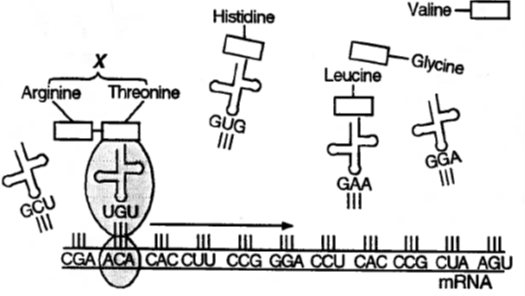
9.
What process is going on in this photo? 
a)
Transcription 
b)
Translation 
c)
Replication 
d)
All the above 
10.
The main function of tRNA is to...
a)
carry a message that, when translated, forms proteins
b)
form a portion of ribosomes
c)
string together complementary RNA and DNA strands
d)
bring amino acids from the cytoplasm to the ribosomes
11.

Which component of the DNA molecule provides instructions for the production of the protein and determines the traits of the organism?

a)

The phosphate group

b)

The sugar molecule

c)

The sequence of nitrogen bases

d)

The hydrogen bonds that hold the sugars to the bases

12.

What is the role of mRNA in expressing specialized structures?

a)

Making energy available for cellular activities

b)

Creating bonds to from biomolecules

c)

Producing sugars that assist with replication

d)

Providing information to form proteins

13.

What is the purpose of the cellular process shown in the image?

a)

Preserving genetic information for future generations

b)

Deleting the information in the sequence produced from the DNA template

c)

Transcribing information in the DNA sequence for use by the cell

d)

Producing more nucleotides for the DNA sequence

14.

What type of biomolecule is being produced in the image?

a)

Carbohydrate

b)

Lipid

c)

Nucleic Acid

d)

Protein

15.

Once the DNA is copied into RNA, it goes to what organelle to begin protein synthesis?

a)

nucleus

b)

rIbosome

c)

cytoplasm

d)

centriole

16.
Which of the following statements about the genetic code is true?
a)
A codon can specify more than one amino acid
b)
Every codon specifies a different amino acid
c)
Some codons specify the same amino acid
d)
Some codons have no function at all
17.

When using your codon chart, what sequence can you use to find the correct amino acid?

a)

DNA

b)

mRNA

c)

tRNA

d)

Any of these will do

18.

A mutation is defined as:

a)

A change in the cell's structure

b)

Anything that changes in an embryo

c)

Any change in the physical features of a human

d)

A change in the DNA sequence

19.
What causes mutations?
a)
Mistakes in replication or environmental substances
b)
The amino acids
c)
Passed down by genetics
d)
It's how your born
20.
What are the three types of mutation? 
a)
Insertion, Deletion, Subsitution
b)
Deletion, Newstion, Subsitution 
c)
Newstion, Deletion, Insertion 
d)
Insertion, Newstion, Substitution 
21.
If you are missing or have an extra base  at the end of your mutated DNA . What type of mutation occurred?
a)
Substitution
b)
Frameshift
c)

Inversion 

d)

Replacement

22.
RNA contains the sugar
a)
ribose
b)
deoxyribose
c)
glucose
d)
lactose
23.
Which of the following statements is true?
a)
DNA is single-stranded
b)
RNA is single-stranded
c)
DNA contains uracil
d)
RNA contains deoxyribose
24.
What is the difference between DNA and RNA in terms of bases?
a)
RNA contains uracil in place of thymine
b)
RNA contains uracil in place of adenine
c)
RNA contains uracil in place of guanine
d)
RNA contains uracil in place of  cytosine
25.
In messenger RNA, each codon specifies a particular
a)
nucleotide
b)
enzyme
c)
amino acid
d)
promoter
26.
There 3 types of 
a)
DNA
b)
RNA
27.
A portion of DNA reads GAG. The corresponding mRNA would be
a)
GUG
b)
GTG
c)
CTC
d)
CUC
28.
Why are insertion and deletion (frameshift) mutations so harmful?
a)
They change all of the codons from the mutation on down the line, which changes the amino acid sequence
b)
They insert things that an organism doesn't need.
c)
They often delete things that organisms need.
d)
Insertion and deletions are not any more harmful than substitution mutations.
29.

In what process is mRNA synthesized?

a)

Transcription

b)

Translation

c)

DNA Replication

d)

Mitosis

30.

Where does TRANSCRIPTION occur?

a)

Nucleus

b)

Ribosome

c)

Cytoplasm

d)

Mitochondria

31.

Why must transcription occur where DNA can be found?

a)

because DNA can't leave

b)

because ribosomes are in the nucleus

c)

because DNA polymerase is found there

d)

because helicase unzips the DNA

32.

What is the purpose for anti-codons?

a)

to ensure the correct amino acid is dropped off

b)

to match the strand of DNA

c)

to decode a sequence of 4 nucleotides into an amino acid

d)

to make me hate biology

33.
Genetic info flows in one direction. Which best represents this flow?
a)
DNA-protein-RNA
b)
Protein-RNA-DNA
c)
RNA-protein-DNA
d)
DNA-RNA-protein
34.
What mutation has occurred here? 
T-G-A-C-C-A
T-G-A-G-C-A
a)
Substitution
b)
Deletion
c)
Insertion
d)
Frameshift 
35.
Normal-
AGA-TTC-ATA-GCG
Mutant-
AGA-TTC-AAT-AGC-G
a)
deletion frameshift
b)
insertion frameshift
c)
substitution
d)
nonsense
36.

ATTTGAGCC- Original

ATTGAGCC - Mutated

The example above is an example of a

a)

Insertion

b)

Point mutation

c)

Deletion

d)

Substitution

37.
a change in one DNA triplet that may result in a new triplet that codes for a stop codon instead of an amino acid is known as
a)
missense
b)
nonsense
c)
frameshift
d)
silent
38.
A type of substitution in which no  amino acids change is called 
a)
Missense
b)
Nonsense
c)
Silent
d)
Deletion
39.
In a point mutation, this would have the worst effect on the function of the protein 
a)
an insertion or deletion near the end of a gene
b)
an insertion or deletion at the beginning of the gene
c)
an insertion at the middle of the gene
d)
a base substitution
40.
Which of the following can increase the rate of mutation?
a)
UV Radiation
b)
Viruses
c)
toxic chemicals 
d)
All of the above
41.
A frameshift mutation would result from...
a)
a base deletion only
b)
a base substitution only
c)
either an insertion or deletion of a base
d)
a base insertion only
42.
A missense mutation results from...
a)
a base substiution that causes no change in amino acid
b)
a base substitution that causes a change in one amino acid
c)
a base change that codes for a stop 
d)
a base insertion or deletion
43.
YOU NEED YOUR CODON CHART!
Suppose the following DNA sequence was mutated from GAGAGAGAGAGAGAGAAC to GAGACAGAGAGAGAGAAC. What type of mutation has occurred?
HINT: Transcribe first!
a)
substitution-silent
b)
substitution-missense
c)
substitution-nonsense
d)
frameshift
44.
Original: ATC CAT
Mutation: ATC GCAT
What mutation occurred?
a)
deletion
b)
insertion
c)
silent
d)
transverse
45.
Which of the following is not a Mutagenic factor(causes mutations).
a)
X-rays
b)
Chemicals we smoke or eat
c)
Drinking water
d)
Tanning
46.
This is the theory that describes protein building in this order: DNA to RNA to protein. DNA is transcribed to RNA which is translated to protein. Protein is never back-translated to RNA or DNA; DNA is never directly translated to protein.
a)
central dogma
b)
translation
c)
mutation
d)
polymerase
47.
This is a 3 letter sequence of DNA or messenger RNA code that stands for one amino acid in a protein. 
a)
codon
b)
transcription
c)
non-ambigous
d)
RNA
48.
The set of rules by which information encoded in genetic material (DNA or mRNA sequences) is translated into proteins (amino acid sequences) by living cells
a)
genetic code
b)
semi-conservative
c)
polyermase
d)
codon
49.
enzymes that aid in shaping RNA molecules and separating DNA into single strands
a)
helicase
b)
RNA
c)
semi-conservative
d)
transcription
50.
a physical or chemical agents which cause mutations
a)
mutagen
b)
replication
c)
transcription
d)
mutation
51.
Any change in the nucleotide sequence of DNA
a)
mutation
b)
redundant
c)
translation
d)
helicase
52.
each codon specifies for one amino acid.
a)
non-ambigous
b)
polyermase
c)
RNA
d)
central dogma
53.
enzymes that assist in the synthesis (production) of nucleic acids, RNA and DNA
a)
polyermase
b)
non-ambigous
c)
central dogma
d)

helicase

54.
each amino acid may be coded by multiple codons
a)
redundant
b)
mutation
c)
codon
d)
mutagen
55.
This is the copying process by which a cell duplicates its DNA.
a)
replication
b)
mutagen
c)
genetic code
d)
redundant
56.
A single stranded nucleic acid that plays a role in protein synthesis. There are three different types:  mRNA, tRNA, rRNA
a)
RNA
b)
helicase
c)
mutagen
d)
genetic code
57.
 two copies of the original DNA molecule are produced, each copy conserving (replicating) the information from one half of the original DNA molecule
a)
semi-conservative
b)
genetic code
c)
helicase
d)
translation
58.
the first step in the production of proteins; the process of copying DNA to RNA.
a)
transcription
b)
codon
c)
redundant
d)
replication
59.
This is the second step of production of proteins; mRNA is decoded to produce a specific polypeptide.
a)
translation
b)
central dogma
c)
replication
d)
semi-conservative
60.
Any change in the sequence of DNA is...
a)
transgenic shift
b)
Single Genotype
c)
Monohybrid Trait
d)
Mutation
61.
Where do mutations occur?
a)
DNA and RNA
b)
DNA 
c)
RNA
d)
mRNA and tRNA
62.
Mutations affect the ________ of a protein. Because of this the proteins ______ is affected as well. 
a)
gene, function 
b)
sequence, gene
c)
shape,function
63.
Why are insertion and deletion mutations so harmful?
a)
They change all of the codons from the mutation on down the line, which changes the amino acid sequence
b)
They insert things that an organism doesn't need.
c)
They often delete things that organisms need.
d)
Insertion and deletions are not any more harmful than substitution mutations.
64.
DNA molecule segment is : TTACGCAAG
The mutated DNA segment is TTCGCAAG. This is an example of ___ mutation.
a)
Substitution
b)
Deletion
c)
Insertion
d)
Inversion
65.
Normal-
GAG-CTC-GAC-AGA
Mutant
GAG CTC-CAC-AGA
a)
no mutation
b)
substitution
c)
insertion
d)
deletion
66.
Are all mutations bad?
a)
Yes
b)
No
67.
What do helpful mutations do? 
a)
Increases chances of survival 
b)
Decreases changes of survival 
c)
Increases chances of developing cancer
d)
Decreases skills
68.

In this type of point mutation, one base pair is lost

a)

substitution

b)

insertion

c)

deletion

d)

translocation

69.

In this type of point mutation, one extra base pair is inserted into a sequence of DNA

a)

substitution

b)

insertion

c)

deletion

d)

translocation

70.

The bottom DNA sequence in the image has been altered by this type of mutation

a)

substitution

b)

insertion

c)

deletion

d)

translocation

71.

The bottom DNA sequence in the image has been altered by this type of mutation

a)

substitution

b)

insertion

c)

deletion

d)

translocation

72.

A permanent change in the DNA sequence

which can affect a single gene or group of genes

a)

Homeostasis

b)

Somatic Cell

c)

Chromosomal Mutation

d)

Gene Mutation

73.

What mutation has occurred here?

T-G-A-C-C-A

T-G-A-G-C-A

a)

Substitution

b)

Deletion

c)

Insertion

d)

Frameshift

74.

Original: ATC CAT

Mutation: ATC GCAT

What mutation occurred?

a)

deletion

b)

insertion

c)

silent

d)

transverse

75.

DNA molecule segment is : TTA-CGC-AAG

The mutated DNA segment is TTC-GCA-AG. This is an example of ___ mutation.

a)

Substitution

b)

Deletion

c)

Insertion

d)

Inversion

76.

Mutations are SOMETIMES helpful to the organism.

a)

true

b)

false

77.

True or false, mutations create genetic diversity?

a)

True

b)

False