wayground logo

Free Printable Worksheets

NEW

Font size

S
M
L
XL
Worksheets

Unit 5 Test Review

Total questions: 80

Worksheet time: 1hrs 19mins

Name
Class
Date
1.
Members of a species in a defined area
a)
Ecosystem
b)
community
c)
biodiversity
d)
population
2.
Consumer that eats plants
a)
heterotroph
b)
herbivore
c)
producer
d)
community
3.
Organisms that relies on other organisms for food; consumer
a)
herbivore
b)
decomposer
c)
heterotroph
d)
species
4.

All the organisms in a particular location, including their nonliving environment

a)

ecosystem

b)

biosphere

c)

community

d)

population

5.
What does fungi do to dead plants and animals?
a)
Leave them there
b)
Decompose them
c)
Wait for other animals to eat them
d)
Move away
6.
What may happen if the snowshoe hare was removed from the food web pictured?
a)
The insects in the habitat would increase.
b)
The shrew population would decrease due to being only hawk food source.
c)
The willow tree population would decrease.
d)
Foxes would dies due to no food source. 
7.
In the energy pyramid here, how much of the energy in the producers gets passed to the herbivores?
a)
10%
b)
20%
c)
80%
d)
90%
8.
Which of the following leads to a decrease in biodiversity?
a)
protection of ecosystems
b)
pollution control
c)
selective cutting
d)
introduction of exotic or invasive species
9.
In the food web shown, the snail would be considered...
a)
primary consumer
b)
secondary consumer
c)
tertiary consumer
d)
producer
10.
What is the original source of almost all energy in most ecosystems?
a)
carbohydrates
b)
sunlight
c)
water
d)
carbon
11.
An organism that produces its own food supply from inorganic compounds is called a(an)
a)
heterotroph
b)
consumer
c)
detritivore
d)
autotroph
12.
What is the term for each step in the transfer of energy and matter within a biological community?
a)
energy path
b)
food web
c)
trophic level
d)
food pyramid
13.
What does a food web represent?
a)
All connections of energy flow throughout all organisms in a habitat.
b)
The specific ways that mutualism is carried out.
c)
A single pathway or energy flow between organisms. 
d)
How carnivores get their food. 
14.
diagram that shows the energy available to each trophic level in an ecosystem; 10% is passed on to upper levels, the rest is lost as heat
a)
succession 
b)
cellular respiration
c)
energy pyramid
d)
biochemical cycle
15.
Study of interactions between organisms and their environment 
a)
niche
b)
community 
c)
ecology
d)
ecosystem
16.
Non-living factor that affects an ecosystem
a)
biotic factor
b)
abiotic factor
c)
food chain 
d)
biome
17.
Organisms that breaks down and absorbs nutrients from dead organisms 
a)
consumer
b)
trophic level
c)
decomposer
d)
species
18.

A food chain is illustrated below:

The wavy arrows represented most likely indicate

a)

A. Energy released from metabolism into the environment as heat.

b)

B. Oxygen released from metabolism produced by cellular respiration.

c)

C. The absorption of energy from the environment that has been created.

d)

D. The transport of glucose away from the organism through photosynthesis.

19.
An individual belonging to a specific species
a)
Biotic
b)
Community
c)
Organism
d)
Reptile
20.
All of the living and nonliving things in an area that interact with each other are called a/an ______.
a)
community
b)
habitat
c)
population
d)
ecosystem
21.
The living part of an ecosystem
a)
Biotic
b)
Abiotic
c)
Mother Earth
d)
Flowers
22.
Two or more members of a particular species living and interacting in the same area
a)
Community
b)
Population
c)
Organisms
d)
Biosphere
23.
Different populations living and interacting with each other in the same area
a)
Biome
b)
Ecosystem
c)
Community
d)
Niche
24.
The area between the highest mountain and the deepest ocean where life can be found
a)
Biosphere
b)
Biome
c)
Farm
d)
Ecosystem
25.
Examples of a producer
a)
frog
b)
algae
c)
worm
d)
mouse
26.
What is a herbivore?
a)
an animal that gets energy from eating other animals
b)
an organism that gets energy from eating only plants
c)
an animal that gets energy by eating both plants and other animals
d)
an animal that eats only herbs
27.
What is a carnivore?
a)
an animal that gets energy by eating other animals
b)
An animal that gets energy by eating only plants
c)
an animal that gets energy by eating both plants and animals
d)
an animal that makes its own energy through photosynthesis
28.
An animal that gets energy from eating both plants and animals is a 
a)
herbivore
b)
carnivore
c)
omnivore
d)
autotroph
29.
The shrew provides energy for the _______?
a)
cricket
b)
grasshopper
c)
frog
d)
snake
30.
Which of the following is a herbivore?
a)
cricket
b)
frog
c)
hawk
d)
shrew
31.
What is this called?
a)
Food Web
b)
Food Chain
c)
Abiotic Factors
32.
All of the carbon in existence is continually recycled in the carbon cycle
a)
True
b)
False
33.
Which of the following removes carbon from the atmosphere?
a)
Combustion
b)
Respiration
c)
Photosynthesis
d)
Death
34.
If the plant population decreased, the amount of carbon would _________.
a)
Stay the same
b)
Increase
c)
Decrease
35.
carbon dioxide is a gas produced  by ________ and used by __________
a)
plants and animals 
b)
carbon and photosynthesis
c)
animals and plants 
d)
photosynthesis
36.
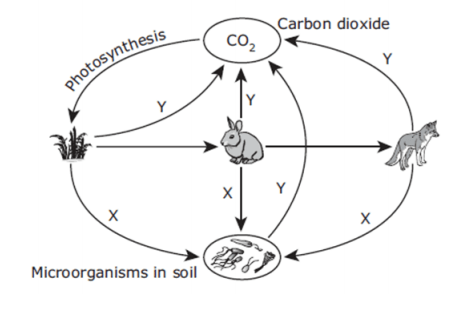
The diagram shows the flow of organic molecules through an ecosystem. What two processes are identified by the labels X and Y?
a)
X : Respiration
Y : Predation
b)
X : Adaptation
Y : Decomposition
c)
X : Fermentation
Y : Nitrogen Fixation
d)
X : Decomposition
Y : Respiration
37.
In the carbon cycle, producers take in the gas __
a)
carbon dioxide
b)
oxygen
c)
nitrogen
d)
carbon monoxide
38.
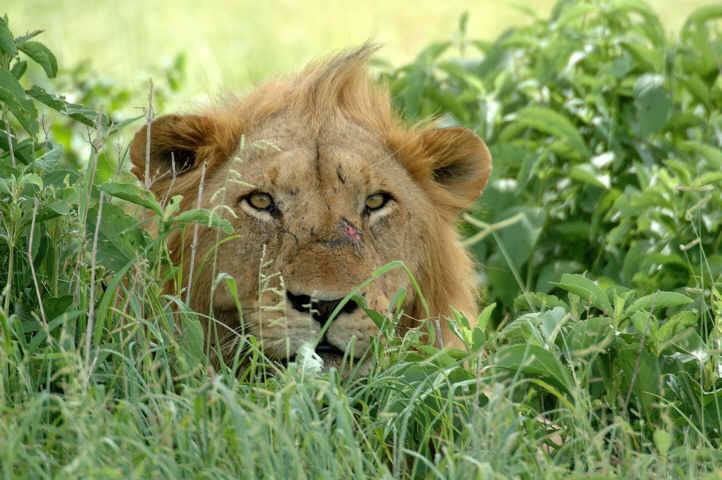
How does the carbon in grass become part of a lion?
a)
The lion eats the grass
b)
Carbon from grass doesn't end up in a lion. 
c)
The carbon ends up in the lion's food chain. 
d)
The lion breathes in carbon given out by the plant
39.
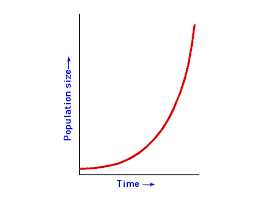
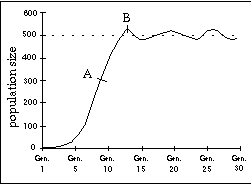
What type of growth is shown in the diagram?
a)
exponential growth
b)
logistic growth 
c)
predator-prey cycle
d)
boom-bust curve
40.
Largest number of individuals of a population that the environment can support...  
a)
carrying capacity
b)
population crash
c)
lag phase
d)
mutualism
41.
Which type of growth is best illustrated by this rabbit population?
a)
exponential
b)
logistic
c)
S-shaped
d)
predator-prey
42.
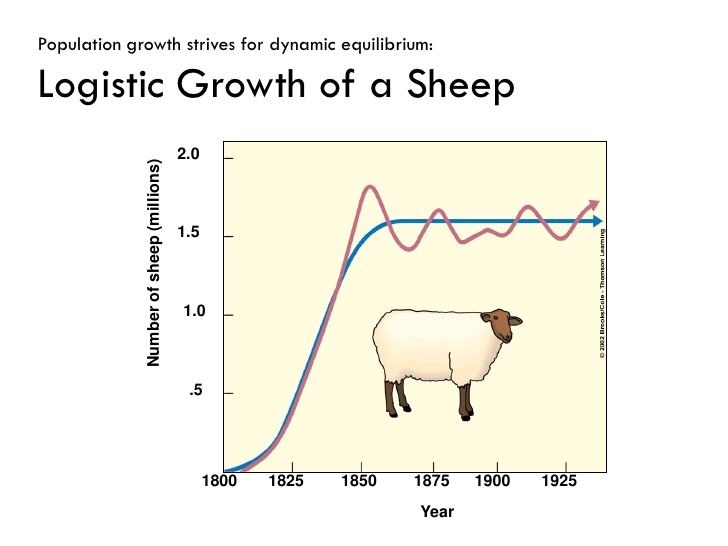
What is the carrying capacity for this sheep population?
a)
1.8 million
b)
1.25 million
c)
1.6 million
d)
1.o million
43.
Type of growth that occurs when disease and parasites are present...
a)
exponential
b)
J-shaped
c)
predator-prey
d)
logistic
44.
What is the carrying capacity of this population?
a)
100
b)
200
c)
300
d)
400
45.
If a disease destroying barley plants in a field swept through an ecosystem, what would happen to the barley eating bird population in the the field ?
a)
The bird population would stay the same
b)
The bird population would infinitely increase
c)
The bird population would decrease
46.
What point on the graph represents the carrying capacity?
a)
A
b)
B
c)
C
d)
D
47.
Will competition increase/decrease the carrying capacity of an ecosystem for the animal in competition?
a)
Decrease
b)
Increase
48.
When a population grows past the ecosystem's carrying capacity, what happens to the population?
a)
Continues to grow
b)
The population starts to die off to return to carrying capcity
c)
The population will go extinct due to lack of resources
d)
The population grows then finds a new carrying capacity
49.
If the carrying capacity of a predator decreases, what will happen to the carrying capacity of the prey?
a)
Will Increase
b)
Will Decrease
c)
Will stay the same
d)
Will fluctuate
50.
Limiting factors are sometimes helpful because they can keep the population from getting to large.
a)
True
b)
False
51.
If the number of births in a population is the same as the number of deaths in a population, what will happen to the growth of the population?
a)
It will increase.
b)
It will decrease.
c)
It will stay the same.
d)
It will fluctuate.
52.
If the number of births is greater than the number of deaths in a population, what will happen to the growth of the population?
a)
It will increase.
b)
It will decrease.
c)
It will stay the same.
d)
It will fluctuate.
53.
What is the approximate carrying capacity of Paramecium aurelia cultured alone?
a)
150
b)
400
c)
450
d)
500
54.
 Jenn is studying a population of fish found in a pond that has a decreasing carrying capacity.  Which of the following factors would not decrease the carrying capacity of her fish? 
a)
drought
b)
flooding
c)
food shortages 
d)
 a freeze  
55.
How does the predator-prey relationship affect a population?
a)
The predators and prey are in competition with each other.
b)
Usually either the predator or the prey will become extinct.
c)
The relationship controls the population size of both species.
d)
The predator species usually has exponential growth.
56.
The parasitic wasp injects its larvae into caterpillars . Acid rain has destroyed the caterpillar population. What will happen to the wasp population?
a)
Stay the same
b)
Increase
c)
Decrease
57.
What is the carrying capacity of the graph?
a)
around 500
b)
more than 500
c)
less than 500
d)
around 600
58.
Competition, disease, predation, and parasitism are considered ___________ ____________ limiting factors
a)
Density-dependent
b)
Density-independent
59.
Natural disasters and weather patterns like earthquakes, floods, and tornadoes, blizzards, and heatwaves are considered ___________ ____________ limiting factors
a)
Density-dependent
b)
Density-independent
60.
In a forest ecosystem, which of the following is the best example of a limiting factor for a rabbit population?
a)
Squirrel Population
b)
Sunlight
c)
Grass available
61.
Excessive amounts of rain caused a flood in the southwest United States that resulted in substantial amounts of deaths in the rabbit population? This situation is an example of a density _____________ limiting factor.
a)
density-independent
b)
density-dependent
c)
density- too high
d)
density- too low
62.
Sea otters live in the ocean. Which of the following is NOT likely to be a limiting factor on the sea otter population?
a)
Disease
b)
Competition
c)
Drought
d)
Predation
63.
A small marine area has phytoplankton as its only producer.  Should the marine biologist be concerned about this ecosystem?
a)
No the fish do not need the phytoplanton. Since there are so many fish, there is high biodiversity.
b)
Yes, this ecosystem has low biodiversity.  Without a producer the herbivores will die out leaving no food.
c)
Yes, this system has high biodiversity; however the fish can adapt and get food from another source.
d)
Yes, the fish will overate to get all of the phytoplankton that is left, then they will die.
64.
How do biodiversity and sustainability work together?
a)
The lower the biodiversity the greater the sustainability.
b)
The higher the biodiversity, the less sustainable the ecosystem
c)
The higher the biodiversity, the greater the sustainability.
d)
Biodiversity has nothing to do with sustainability.
65.
High biodiversity is 
a)
having a lot of the same organism.
b)
having a few of the same organism.
c)
having a lot of variety of different organisms.
d)
only having one of each organism. 
66.
This picture is a great example of ____________ biodiversity.
a)
high
b)
moderate
c)
low
d)
hhhmmmm there is no way to know without counting.
67.
This picture is a great example of ____________ biodiversity.
a)
high
b)
moderate
c)
low
d)
hhhmmmm there is no way to know without counting.
68.
This picture is a great example of ____________ biodiversity.
a)
high
b)
moderate
c)
low
d)
hhhmmmm there is no way to know without counting.
69.

Which of the following is NOT a way in which humans are destroying habitats?

a)

Gathering rain water to use to water crops

b)

Clearing out prairies to grow a single crop

c)

Cutting trees to use as toilet paper

d)

Building a shopping mall with a large parking lot

70.

What is an invasive species?

a)

An organism that is new to an environment that has positive effects on the environment.

b)

An organism that is native to an environment that has negative effects on the environment.

c)

An organism that is new to an environment that has negative effects on the environment.

d)

An organism that is native to an environment that has positive effects on the environment.

71.

The excessive use of species that have economic value is known as

a)

pollution

b)

habitat destruction

c)

over - exploitation

d)

climate change

72.

The threat to biodiversity that occurs when the homes of different species are destroyed

a)

pollution

b)

habitat destruction

c)

over - exploitation

d)

climate change

73.

When human-made chemicals and garbage find their way into nature and harm the air, soil, and water it is called

a)

pollution

b)

habitat destruction

c)

overexploitation

d)

climate change

74.
What is the difference between biotic and abiotic?
a)
Biotic are non-living things
b)
Abiotic are living organisms
c)
Biotic is life,
Abiotic is non-living
d)
Biotic is non-living, Abiotic is living
75.
Which option is abiotic?
a)
Plants
b)
Bacteria
c)
Water
d)
Fungi
76.
Which option is biotic?
a)
Light
b)
Water
c)
Salt in the water
d)
Angel fish
77.

Image "B" shows more biodiversity than image "A". Why?

a)

Because "B" shows more different species than image "A"

b)

Because image "B" has less different species than "A"

c)

"A" has a greater number of same species plants so this statement is wrong.

d)

Both images show the same biodiversity

78.

Biodiversity is important to keep an area (biome) healthy. In this example "Food Web A" is sustainable. Why is sustainability important for an ecosystem in "Food Web A".

a)

If one organism is removed the food web can still operate (work) with little or no negative effect.

b)

If an organism is removed the food web will collapse and will affect the environment.

79.
Carbon can be found in...
a)
The atmosphere
b)
Soil
c)
Fossil fuels
d)
All of the above
80.

How is the carbon cycle similar to the water cycle?

a)

Both involve liquid substances falling to the Earth from the atmosphere?

b)

Neither process works at low temperature.

c)

Both involve the transfer of substances between animals, plants, and the Earth.

d)

Both involve the transfer of substances between the earth and outer space.