wayground logo

Free Printable Worksheets

NEW

Font size

S
M
L
XL
Worksheets

Final MCAS Review

Total questions: 75

Worksheet time: 1hrs 20mins

Name
Class
Date
1.
An offspring will receive how many alleles from each parent to determine a specific trait?
a)
one
b)
two
c)
three
d)
five
2.
Which of the following is a phenotype?
a)
BB
b)
Bb
c)
bb
d)
Blue eyes
3.
having two of the same genes for the trait (sometimes called purebred).
a)
homozygous
b)
hetrozygous
c)
protein
d)
chromosome
4.
Incomplete dominance means that the traits are
a)
expressed equally
b)
dominant
c)
recessive
d)
blended
5.
One form of a gene is called_______________
a)
a DNA
b)
a Phenotype
c)
a trait
d)
an allele
6.
If green is dominant over purple, then what is the genotype for this individual?
a)
Purple
b)
Green
c)
GG
d)
gg
7.
A heterozygous long-tusked elephant is crossed with a homozygous recessive short-tusked elephant. What is the probability of the offspring having short tusks?
a)
0%
b)
25%
c)
50%
d)
75%
8.

Which of the following genotypes is homozygous dominant?

a)

Yy

b)

yY

c)

yy

d)

YY

9.

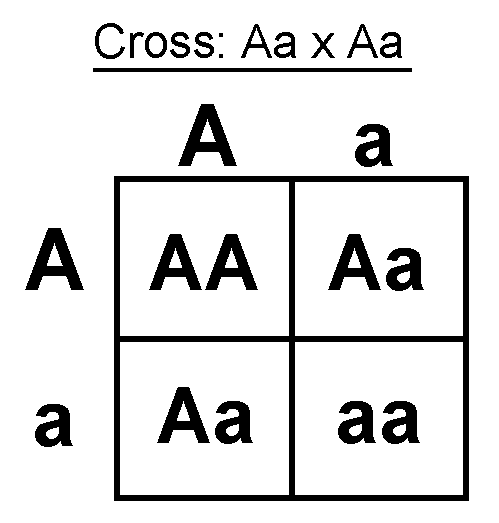
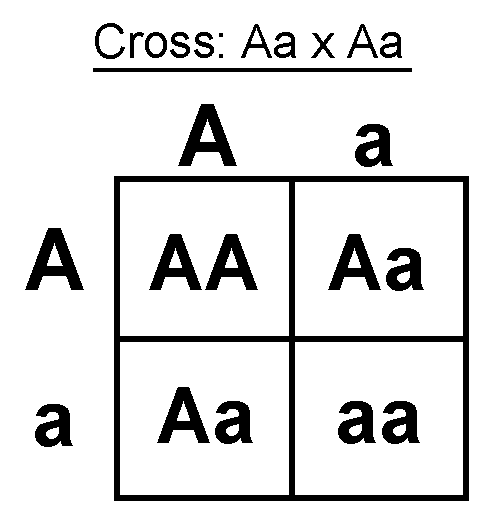
What is the genotypic ratio of the offspring?

a)

3:1

b)

1:3

c)

1:2:1

d)

2:2

10.

What are the phenotype percentages of the offspring?

(A-Brown fur color; a-white fur color)

a)

50 % Brown fur and 50% White fur

b)

25 % Brown fur and 75% White fur

c)

75 % Brown fur and 25% White fur

d)

0% Brown fur and 100% White fur

11.
If you cross a black guinea pig with a white guinea pig and the offspring are gray, what type of dominant trait would that be.
a)
incomplete dominance
b)
codominance
c)
codependant
d)
cooperative
12.

B=Brown fur

b=tan fur

What percent of the offspring would be tan when you cross BbxBb?

a)

75%

b)

25%

c)

50%

d)

100%

13.
In rabbits, black fur (B) is dominant over brown fur (b). If a rabbit has brown fur, what can you conclude about its genotype?
a)
It is BB.
b)
It is Bb
c)
It is brown
d)
It is bb.
14.
This is an example of
a)
Complete dominance
b)
Mendelian Genetics
c)
Codominance
d)
Incomplete Dominance
15.
What is the term for a feature that allows an organism to survive in its environment?
a)
adaptation
b)
variation
c)
homologous structure
d)
vestigial structure
16.
a)
analogous structures
b)
homologous structures
c)
vestigial structures
d)
none of the above
17.
What is the process of which humans breed organisms for certain traits?
a)
artificial selection
b)
descent without modification
c)
inheritance of acquired characteristics
d)
natural selection
18.
Vertebrate embryos pass through similar stages of development is evidence for
a)
use and disuse
b)
homologous structures
c)
common ancestry
d)
acquired characteristics
19.
Individuals that are well adapted to their environment will survive and produce
a)
better traits
b)
stronger genes
c)
more offspring
d)
fewer mutations
20.
All the individuals of a species that live in a particular area are called a 
a)
group
b)
population
c)
variation
d)
fossil
21.
The remnant of an organ that had a function in an early ancestor is known as a(n)
a)
vestigial structure
b)
analogous structure
c)
homologous structure
d)
fossil structure
22.
Which of the following is a factor in natural selection?
a)
Individuals of species compete with one another to survive.
b)
All species are genetically diverse.
c)
Individuals better able to adapt to changes leave more offspring.
d)
All are correct 
23.
The fossil record provides evidence that 
a)
Fossils cannot be dated.
b)
All species were formed during Earth’s formation and have changed little since then.
c)
The fossilized species have no connection to today’s species.
d)
Older species gave rise to more-recent species.
24.
Members of different subspecies
a)
Are considered to be entirely different species.
b)
Can no longer interbreed successfully.
c)
Differ genetically because of adaptations for different living conditions.
d)
Will never diverge to become different species.
25.
Starting in 1954, commercial fishers in the northwest Pacific were paid by weight, rather than by the individual fish, for pink salmon. The fishers increased the use of a type of net that selectively catches larger fish.  Which of the following effects did this change in fishing technique most likely have on the salmon population over the next 20 years?
a)
The average body size of the salmon population decreased significantly.
b)
The average body size of the salmon population increased significantly.
c)
The average body size of the males in the salmon population increased, and the females stayed the same.
26.
European rabbits were introduced to Australia in 1859. The rabbits reproduced rapidly in their new habitat, displaced other animals, and overgrazed vegetation. In an attempt to reduce the rabbit population, a virus was introduced in 1951. This virus is usually deadly to European rabbits. When the virus was first introduced, the rabbits died in large numbers, but the death rate decreased over time. Which of the following best explains the decrease in the rabbit death rate? 
a)
Young rabbits learned to avoid being infected with the virus.
b)
The lifespan of the virus was too short to affect rabbits over a long period of time.
c)
Natural selection favored rabbits that were resistant to the virus. 
d)
No correct choices.
27.
Which of the following statements gives the most likely explanation for the presence of two very similar species of squirrels living on opposite sides of the Grand Canyon?
a)
One squirrel traveled across the canyon and started a new population on the other side.
b)
One squirrel traveled across the canyon and interbred with a different population on the other side.
c)
Members of one single squirrel species were geographically separated by the formation of the canyon.
d)
Members of two different squirrel species migrated from two different places to opposite sides of the canyon. 
28.
The Asian shore crab invaded parts of the eastern coast of the United States about 15 years ago. The Asian shore crab preys on blue mussels. In the time since the Asian shore crab arrived, the average shell thickness of the blue mussel population has increased. Which of the following is the most likely reason that this increase in shell thickness has occurred? 
a)
Blue mussels with thick shells attract more crabs that mussels without thick shells.
b)
Blue mussels with thick shells grow in larger colonies than mussels without thick shells.
c)
Blue mussels with thick shells catch more food per day than mussels without thick shells.
d)
Blue mussels with thick shells survive and reproduce more successfully than mussels without thick shells.
29.
Comparing human hemoglobin of chimpanzees, horses, kangaroos, and chickens, reveal that humans have the fewest amino acid differences with 
a)
Kangaroos
b)
Horses
c)
chickens
d)
chimpanzees
30.
The formation of new species is a process known as ____________________, which is typically the product of divergence. 
a)
gradualism
b)
speciation
c)
reproductive isolation
d)
subspecies
31.
All living things get their energy from which of the following sources?
a)
food
b)
water
c)
sun
32.
Which of the following is another word for a plant?
a)
autotroph
b)
heterotroph
c)
consumer
33.
Which of the following is an organism that eats only meat?
a)
herbivore
b)
carnivore
c)
omnivore
34.
Which of the following terms describes an area where an organism lives?
a)
community
b)
habitat
c)
area
35.
Which is an example of a parasitic relationship?
a)
a bee pollinates a flower
b)
a tapeworm takes nutrients from a dog
c)
an orchid lives in a tree but does not harm the tree
36.
In which type of relationship do both species benefit?
a)
parasitism
b)
mutualism
c)
commensalism
37.
Barnacles grow on whales.  Whales give the barnacles a place to live but the barnacles do not help or harm the whale.  Which type of relationship is this?
a)
commensalism
b)
mutualism
c)
parasitiesm
38.
The living part of an ecosystem
a)
Biotic
b)
Abiotic
c)
Mother Earth
d)
Flowers
39.
The non-living part of an ecosystem
a)
Ocean
b)
Lava Flow
c)
Birds
d)
Abiotic
40.
The study of how living things interact with one another and with their environment.
a)
Biology
b)
Lithology
c)
Ecology
d)
Farmacology
41.
Organisms that look similar and can produce fertile offspring
a)
Species
b)
Fish
c)
Community
d)
Trees
42.
At what stage does this population reach it's carrying capacity on the Demographic Transition Model
a)
1
b)
2
c)
3
d)
4
43.
When a plant uptakes water and transpires it to the atmosphere, this is known as _______
a)
Condensation
b)
Evapotranspiration
c)
Infiltration
d)
Aquifer
44.
Bacteria which convert nitrogen gas into bio-available forms of nitrogen, such as ammonia and nitrate, are known as _____
a)
De-nitrification bacteria 
b)
Nitrogen fixing bacteria
c)
Oxidizers
d)
Buffers
45.
Phosphorus is an essential nutrient for plants and animals because it is use to make _______
a)
Carbohydrates
b)
Glucose
c)
RNA / DNA
d)
Starches
46.
Fungi are a  ________
a)
Autotrophs
b)
Heterotroopers
c)
Decomposers
d)
Primary Consumers
47.
Approximately 90 percent of energy iconsumed by an organism is lost to ___ 
a)
Growth
b)
Inefficiencies in its metabolism 
c)
Repairing cells
d)
Carbon dioxide
48.

Which of the following statements account for the change in population seen between years 7 and 8?

a)

The birth rate of the pigeons increased.

b)

The emigration rate of the pigeons decreased.

c)

The death rate of the pigeons exceeded the birth rate.

d)

The neighborhood reached its carrying capacity for the pigeon population

49.

The number of pythons found throughout Everglades National Park has increased in recent years. These huge snakes are not native to Florida and are believed to have been released into the wild by pet owners. Wildlife biologists have initiated attempts to capture and remove these pythons. Which statement best explains the biologists’ reason for removing these pythons from the Everglades?

a)

The pythons could upset the territorial boundaries of native organisms.


b)

The pythons could adapt to overcome diseases common to native snakes.

c)

The pythons could prey on native organisms and cause native populations to decline.

d)

The pythons could begin to interbreed with native snakes and produce a more successful species.

50.

Rabbits introduced into Australia over 100 years ago have become a serious pest to farmers. Rabbit populations increases so much that they displaced many native species of plant eaters. What is the most logical explanation for their increased numbers?

a)

Rabbits have a high death rate.

b)

There are few effective predators.

c)

Additional rabbit species have been introduced.

d)

There is an increase in rabbit competitors.

51.

Each step in a food chain is called a trophic level. What percentage of energy available at one trophic level is transferred to organisms at the next level?

a)

about 2 percent

b)

about 10 percent

c)

about 25 percent

d)

about 50 percent

52.
Which of the following is not a nitrogen base found in DNA?
a)
Thymine
b)
Uracil 
c)
Guanine
d)
Adenine
53.
According to Chargaff's rule, Cytosine always pair with
a)
Adenine
b)
Uracil
c)
Thymine
d)
Gaunine
54.
What is the significance of the sequence (order) of the Nitrogen Bases in DNA?
a)
The order of the Nitrogen Bases determines the number of chromosomes present in an organism.
b)
The order of the Nitrogen Bases determines the traits that an organism will possess (have).
c)
The order of the Nitrogen Bases determines the gender of an organism.
d)
The order of the Nitrogen Bases determines whether an organism is abiotic biotic.
55.
The twisted ladder shape of DNA is known as a
a)
Double Helix
b)
Triple Helix
c)
Single Helix
d)
Triple Helix
56.
Which answer choice would by complementary (match up) with the DNA strand   
ATGCATTCGA
a)
ATGCATTCGA
b)
TACGTAAGCT
c)
TACCTAAGGA
d)
ATGCCATGAA
57.
Which process is shown?
a)
diffusion
b)
repiration
c)
recombination
d)
translation
58.
Which of the following is the blueprint for the production of RNA within a cell?
a)
DNA
b)
protein
c)
ATO
d)
carbohydrate
59.
The DNA sequence ATCAGCGCTGGC is part of a gene. How many amino acids are coded for by this message?
a)
4
b)
8
c)
12
d)
20
60.
What is the relationship between a protein, the cell, and DNA?
a)
DNA is produced by protein which is produced in the cell
b)
Protein is composed of DNA which is produced in the cell
c)
DNA controls the production of protein in the cell
d)
A cell is composed of DNA and protein
61.
Genetic info flows in one direction. Which best represents this flow?
a)
DNA-protein-RNA
b)
Protein-RNA-DNA
c)
RNA-protein-DNA
d)
DNA-RNA-protein
62.
The diagram shows the process of
a)
Transcription
b)
Translation
c)
Replication
d)
Mitosis
63.
Where does transcription take place?
a)
nucleus
b)
ribosome
c)
cytoplasm
d)
smooth ER
64.
Where does translation take place?
a)
Nucleus
b)
Ribosome
c)
Golgi Body
d)
Cytoplasm
65.
DNA sequence is ACAGTGC. How would this be coded on mRNA?
a)
TGTCACG
b)
UGUCACG
c)
GUGACAU
d)
CACUGUA
66.
Carries the genetic code to the ribosome
a)
mRNA
b)
tRNA
c)
rRNA
d)
DNA
67.

What are the two steps of protein synthesis (in order)?

a)

Translation and Replication

b)

Transcription and Translation

c)

Replication and Transcription

d)

Replication and Mitosis

68.

A polypeptide is a sequence of:

a)

proteins

b)

base nucleotides

c)

amino acids

d)

monosaccharides

69.

What is the function of DNA replication?

a)

A protein is made

b)

DNA makes a copy of itself

c)

Food is broken down

d)

A cell splits into two daughter cells

70.

A change in a gene, group of genes or chromosome that results in a change in the proteins

a)

Replication

b)

Mutations

c)

Translation

d)

Transcription

71.

A point mutation where one nucleotide base replaces an original nucleotide base

a)

Inversion Mutation

b)

Chromosomal Mutation

c)

Translocation

d)

Substitution Mutation

72.

A substitution mutation that has no effect

on amino acids sequence

a)

Insertion Mutation

b)

Translocation

c)

Silent Mutation

d)

Deletion Mutation

73.

A nucleotide base is inserted or deleted shifting the entire DNA sequence. Entire protein will be changed.

a)

Substitution Mutation

b)

Silent Mutation

c)

Frameshift Mutation

d)

Translocation

74.
Why are insertion and deletion (frameshift) mutations so harmful?
a)
They change all of the codons from the mutation on down the line, which changes the amino acid sequence
b)
They insert things that an organism doesn't need.
c)
They often delete things that organisms need.
d)
Insertion and deletions are not any more harmful than substitution mutations.
75.
Why is the order of amino acids so important?
a)
The order of amino acids dictates what shape the protein will fold into.
b)
It is not important. The protein folding chamber will force the protein to fold into the correct shape.