wayground logo

Free Printable Worksheets

Font size

S
M
L
XL
Worksheets

Cell Energy and Transport Review TEST GRADE

Total questions: 72

Worksheet time: 42mins

Name
Class
Date
1.

What phase of mitosis is represented?

a)

prophase

b)

metaphase

c)

anaphase

d)

telophase

2.

What phase of mitosis is represented?

a)

prophase

b)

metaphase

c)

anaphase

d)

telophase

3.

What phase of mitosis is represented?

a)

prophase

b)

metaphase

c)

anaphase

d)

telophase

4.

What phase of mitosis is represented?

a)

prophase

b)

metaphase

c)

anaphase

d)

telophase

5.

what acronym can you use for the phases of mitosis?

a)

PMAT

b)

TAMP

c)

MATP

d)

PAMT

6.

What phase is described?

- nuclear envelope disappears

- chromosomes become visible

- microtubules form

a)

prophase

b)

metaphase

c)

anaphase

d)

telophase

7.

chromosomes line up in the middle during which phase?

a)

prophase

b)

metaphase

c)

anaphase

d)

telophase

8.

sister chromatids are pulled apart and away from each other during which phase?

a)

prophase

b)

metaphase

c)

anaphase

d)

telophase

9.

two nuclei form during which phase?

a)

prophase

b)

metaphase

c)

anaphase

d)

telophase

10.

what does the M stand for in the Cell Cycle

a)

Meiosis

b)

Mitosis

c)

Multicellular

11.

which phase results in 2 daughter cells?

a)

prophase

b)

metaphase

c)

telophase

d)

cytokinesis

12.

A repeated pattern of cell growth, and DNA replication, and cell division that occurs in Eukaryotic cells

a)

interphase

b)

mitosis

c)

cell cycle

13.

which is cell division?

a)

prophase

b)

interphase

c)

mitosis

d)

telophase

14.

which is cell growth an DNA replication?

a)

Interphase

b)

mitosis

15.

what happens at G1 and G2?

a)

cell division

b)

DNA replication

c)

growth

16.

what happens at the S phase?

a)

growth

b)

cell division

c)

DNA replication

17.

which is phase of the cell cycle is NOT part of interphase?

a)

M

b)

G1

c)

S

d)

G2

18.

which word mean to make something?

a)

synthesis

b)

division

c)

growth

d)

cycle

19.

where does a cell spend the most time?

a)

interphase

b)

mitosis

20.

Which organelle is responsible making food (Glucose) using sunlight?

a)

Cell Membrane

b)

Nucleus

c)

Chloroplast

d)

Mitochondria

21.

Select all that are raw materials for Photosynthesis.

a)

Water

b)

Carbon Dioxide

c)

Oxygen

d)

Sunlight (Light Energy)

e)

Glucose (Sugar/food)

22.

Select all that are products of Photosynthesis.

a)

Water

b)

Carbon Dioxide

c)

Oxygen

d)

Sunlight (Light Energy)

e)

Glucose (Sugar/food)

23.

How does most of the water needed by the plant get into its leaves?

a)

It enters through the stomata

b)

The roots absorb it and then it travels up the stem

c)

It's made during a chemical reaction in the leaf

d)

The flowers capture water and deliver it to the leaves

24.
Why do plants conduct photosynthesis?
a)
To make light
b)
To make mitochondria
c)
To make glucose
d)
To release carbon dioxide
25.
How does carbon dioxide get into the leaves of a plant?
a)
It's absorbed by the roots
b)
It's made in a chemical reaction in the stem
c)
It enters through the stomata
d)
It goes through the flowers
26.
Which of these conditions would decrease the rate of photosynthesis in a plant?
a)
Above average precipitation
b)
Changing the daylight hours from 14 hrs to 10 hrs
c)
Changing the CO2 concentration from 380 ppm to 410 ppm
d)
All of these choices
27.
Which choice correctly shows the gases that enter and exit plants during photosynthesis?
a)
Enter: Oxygen
Exit: Carbon dioxide
b)
Enter: Water vapor
Exit: Glucose
c)
Enter: Carbon dioxide
Exit: Oxygen
d)
Enter: Light
Exit: Water vapor
28.

Which of the following is the correct equation for PHOTOSYNTHESIS?

a)

light + carbon dioxide + water --> glucose + oxygen

b)

carbon dioxide + sugar + water --> oxygen + light

c)

oxygen + light + water --> carbon dioxide + sugar

d)

carbon dioxide + oxygen + water --> Light+ Sugar

29.
Which organisms perform Photosynthesis?
a)
Only Autotrophs
b)
Only Heterotrophs
c)
Autotrophs and Heterotrophs
30.
Which of the following is an example of an AUTOTROPH?
a)
Appletree
b)
Dog
c)
Mushroom
d)
Human
31.
What is the ultimate ORIGINAL source of energy for living things
a)
Sugar
b)
Sun
c)
Moon
d)
Carbon Dioxide
32.

What is the pigment in chloroplasts that performs photosynthesis?

a)

Chlorosynthesis

b)

Chlorophyll

c)

Chloroplast

d)

Green

33.
Plants need ________ for photosynthesis
a)
oxygen
b)
soil
c)
carbon dioxide
d)
sugar
34.
What is photosynthesis?
a)
The process in which humans eat their food
b)
When a photographer takes a photo.
c)
To get your pictures from the photo lab.
d)
The process in which plants make their food.
35.
Leaves look green because.....
a)
they eat their vegetables
b)
to blend into their environment
c)
they contain a molecule named chlorophyll
d)
they are sick
36.
The ____________ is the most photosynthetic part of a plant.
a)
leaf
b)
flower
c)
roots
d)
stem
37.
Glucose is a ...
a)
sugar
b)
carbohydrate
c)
source of quick energy
d)
all are correct
38.
The formula for glucose is...
a)
C12 H22 O11
b)
NaCl
c)
NaOH
d)
C6 H12 O6
39.

Which organelle and process converts chemical energy stored in sugar into ATP?

a)

Chloroplasts via Photosynthesis

b)

Mitochondria via Carbon cycle

c)

Photosynthesis via Chloroplasts

d)

Mitochondria via Cellular Respiration

40.

Who is more likely to make sugar using sunlight?

a)

Hulk, he's an 'animal'

b)

Groot, he's a 'plant'

41.

Which process converts carbon dioxide, water, and sunlight into sugar and oxygen?

a)

Cell respiration

b)

Nucleus

c)

Chlorosynthesis

d)

Photosynthesis

42.

What are the 2 products of photosynthesis?

a)

Sugar and CO2

b)

sugar and O2

c)

H2O and CO2

d)

H2O and CO2

43.

Which organelle is only in PLANT cells?

a)

Mitochondria

b)

Cell Membrane

c)

Chloroplast

d)

Nucleus

44.

What is the energy transformation that occurs in photosynthesis?

a)

Light energy to Chemical energy

b)

Light energy to Electrical energy

c)

Chemical energy to Light Energy

45.

Which organelle and process converts chemical energy stored in sugar into ATP?

a)

Chloroplasts via Photosynthesis

b)

Mitochondria via Carbon cycle

c)

Photosynthesis via Chloroplasts

d)

Mitochondria via Cellular Respiration

46.

What are the reactants (inputs) of Cellular Respiration?

a)

Glucose and O2

b)

O2 and H2O

c)

Glucose and CO2

d)

O2 and CO2

47.

Which organisms undergo cell respiration?

1. Plants

2. Animals

3. Bacteria

a)

1. Only

b)

1. and 2. Only

c)

3. Only

d)

ALL organisms, 1., 2. and 3.

48.

Which organelle is the site of Cell Respiration in Eukaryotes?

a)

Chlorplast

b)

Mitchondria

c)

Nucleus

d)

Cell Membrane

49.

Which describes the role of producers in an ecosystem?

a)

create sugars with sunlight

b)

eat consumers for energy

c)

release Carbon Dioxide into the atmosphere

d)

decompose once living things

50.

Humans add carbon to the atmosphere by:

1. burning fossil fuels

2. planting trees

3. burning rainforests

4. cellular respiration

a)

2 only

b)

1 and 4

c)

1, 3, and 4

51.

Process that removes Carbon from the atmosphere:

a)

Photosynthesis

b)

Cell Respiration

c)

Protein Syntesis

d)

Aerobic Cell Respiration

52.

Substance removed by autotrophs from their environment:

a)

CO2

b)

O2

c)

C6H12O6

53.

What is the consequence of fewer trees on earth?

a)

More oxygen in atmosphere

b)

Less carbon dioxide in atmosphere

c)

More carbon dioxide in atmosphere

54.
When humans burn fossil fuels, most of the carbon quickly enters the                       as carbon dioxide.
a)
Water
b)
Atmosphere
c)
Sun
d)
Air
55.

If the plant population decreased, the amount of atmospheric carbon would _________.

a)

Stay the same

b)

Increase

c)

Decrease

56.

Which is a true statement?

a)

Humans depend on oxygen, plants depend on carbon dioxide

b)

Plants produce carbon dioxide

c)

Humans depend on carbon dioxide, plants depend on oxygen

57.

Which of the following is the best conclusion that can be made from this graph?

a)

atmospheric carbon dioxide levels have been decreasing since 1960

b)

atmospheric carbon dioxide levels have increased steadily since 1960

58.
During osmosis
a)
water moves from high to low concentration
b)
large or oddly shaped molecules move across a cell membrane
c)
water moves when energy is used
d)
proteins are built
59.
In the given scenario what will happen?  An egg is placed in pure water for 48 hours.
a)
The egg will gain water and swell.
b)
Water will move in and out of the cell equally, and the cell with neither shrink nor swell.
c)
The egg will lose water and shrink.
60.
Ideally, your cells should be in a(n) _______ solution
a)
Hypertonic
b)
Hypotonic
c)
Isotonic
d)
Cola
61.
The picture below is an example of _________________.
a)
osmosis
b)
isotonic
c)
diffusion
d)
active transport
62.
Passive transport requires no
a)
concentration gradients
b)
osmosis
c)
motion
d)
energy
63.
_______ regulates what enters and leaves a cell.  
a)
Cell Membrane
b)
Nucleus
c)
Mitochondria
d)
Cytoplasm
64.
Osmosis
a)
diffusion of water molecules through a semi-permeable mebrane from an area of low concentration to an area of high concentration
b)
the diffusion of particles from an area of high concentration to an area of low concentration
c)
diffusion of water molecules through a semi-permeable membrane from an area of high concentration to an area of low concentration
d)
the diffusion of particles from an area of low concentration to an area of high concentration
65.
The cell below is in a _________ solution.
a)
Hypotonic
b)
Hypertonic
c)
Isotonic
66.
Which cell is placed into a hypotonic environment? 
a)
A
b)
B
c)
C
d)
D
67.
Which way will the water molecules move during osmosis?
a)
Out of the cell, so the cell shrinks.
b)
Out of the cell, so the cell swells.
c)
Into the cell, so the cell shrinks.
d)
Into the cell, so the cell swells.
68.
Where is there a low concentration of perfume?
a)
in the bottle
b)
on the hand
c)
in the room
d)
in the top
69.
What is diffusion?
a)
when molecules move 
b)
when molecules move from a high concentration to a low.
c)
no movement 
d)
molecules move everywhere
70.
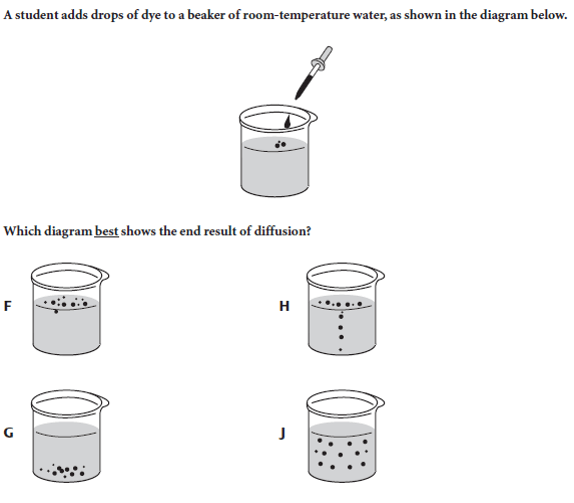
Which diagram best shows the end result of diffusion?
a)
F
b)
G
c)
H
d)
J
71.
 An animal cell placed in a hypertonic (salty) solution will
a)
Stay the same
b)
Shrink- get smaller
c)
Swell- get bigger
72.
What is the definition of  Selective Permeability?
a)
The movement of materials across the cell membrane that requires NO ENERGY from the cell.
b)
The movement of materials through (or across) the cell membrane
c)
The ability of the cell membrane to allow some things to pass through while preventing other things from passing through.
d)
The movement of molecules from an area of high concentration to a area of low concentration