
 Worksheets
Unit 1 Test Review
Total questions: 71
Worksheet time: 1hrs 9mins
Name
Class
Date
1.
An organism that produces its own food supply from inorganic compounds is called a(an)
a)
heterotroph
b)
consumer
c)
detritivore
d)
autotroph
2.

The image provided is an example of a(n):
a)
Carnivore
b)
Herbivore
c)
Producer
d)
Autotroph
3.

A living relationship between two species in which one organism is harmed is called...
a)
mutualism
b)
commensalism
c)
parasitism
d)
niche
4.

symbiotic relationship in which both organisms benefit
a)
competition
b)
Mutualism
c)
nitrogen fixation
d)
energy pyramid
5.
The amount of energy that usually transfers from one trophic level to the next...
a)
10%
b)
20%
c)
80%
d)
50%
6.
Which of the following would be the definition of a detritivore?
a)
Animals that eat insects.
b)
Organisms that feed on rocks, recycling the nutrients back into the ground.
c)
Organisms that eat only pants
d)
Things that feed on dead organisms, recycling the nutrients back into the ground.
7.
The nonliving aspects of an ecosystem.
a)
Abiotic factors
b)
Biotic factors
8.
The living portions of the ecosystem.
a)
Biotic factors
b)
Abiotic factors
9.
Water temperature would be an example of ...
a)
A biotic factor
b)
An abiotic factor
10.
A collection of organisms that belong to different populations but all live in the same area and interact with one another.
a)
Population
b)
Ecosystem
c)
Community
d)
Ecosphere
11.
A place where an organism lives.
a)
Terrain
b)
Habitat
c)
Community
d)
Population
12.
What does every food chain start with? (Even if it's not drawn or written there!)
a)
producers
b)
sun
c)
consumer
d)
decomposers
13.
The following two factors must be present in a successful habitat.
a)
rocks and sand
b)
biotic and abiotic
c)
biotic and trees
d)
abiotic and water
14.
_________________ is the term to describe all the members of one species living in a particular area.
a)
Community
b)
Pod
c)
Population
d)
Gaggle
15.
__________________ are all the different populations that live together in an area.
a)
Herd
b)
School
c)
Population
d)
Community
16.
What do consumers do in the food chain?
a)
They obtain energy from other organisms.
b)
They break down dead plant and animal material.
c)
They use sunlight to make food.
d)
They are parasites of plants.
17.
Which of the following directly use the Sun's energy to produce their own food?
a)
decomposers
b)
carnivores
c)
consumers
d)
producers
18.
If the population of grizzly bears gradually increases over time, which of the following will most likely occur?
a)
The number of prey species will decrease.
b)
The size of the bear population will continue to increase.
c)
The bear population in that area will eventually die out.
d)
The number of prey species will increase.
19.
All of the living AND non-living things in an particular area is called a(n):
a)
ecosystem
b)
house
c)
community
d)
mountain
20.
Grass is considered a ...
a)
consumer
b)
producer
c)
decomposer
d)
composers
21.
What is a example of a abiotic factor?
a)
Panda
b)
Turtle
c)
Butterfly
d)
weather
22.
As a dog walks through thick brush, a tick attaches to its leg. Which best describes the relationship between the dog and the tick?
a)
parasitism
b)
mutualism
c)
commensalism
23.

Penguin
a)
Heterotroph
b)
Autotroph
24.

Willow Tree
a)
Heterotroph
b)
Autotroph
25.
Which of the following formulas represents photosynthesis?
a)
6 H2O + 6 O2 = C6H12O6 + 6 CO2
b)
6 H2O + 6 CO2 = C6H12O6 + 6 O2
c)
C6H12O6 + + 6 O2 = 6 H2O + 6 CO2
26.
Organisms that cannot make their own food and must obtain energy from external sources are called
a)
autotrophs
b)
heterotrophs
c)
thylakoids
d)
plants
27.
What is an autotroph?
a)
an organism that can make their own food.
b)
an organism that cannot make their own food
c)
Herbivore
d)
Omnivore
28.
What is a carnivore?
a)
an animal that gets energy by eating other animals
b)
An animal that gets energy by eating only plants
c)
an animal that gets energy by eating both plants and animals
29.
Omnivores eat
a)
meat only
b)
plants only
c)
both meat and plants
d)
freshly dead organisms
30.
Carnivores that eat freshly dead organisms are
a)
herbivores
b)
decomposers
c)
omnivores
d)
scavengers
31.
These organisms break down decaying biotic wastes and then return the materials to the ecosystem.
a)
decomposers
b)
scavengers
c)
carnivores
d)
producers
32.
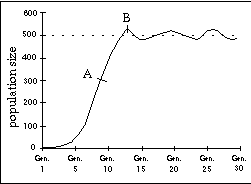
What is the carrying capacity of the graph?
a)
around 500
b)
more than 500
c)
less than 500
d)
around 600
33.

When a population grows past the ecosystem's carrying capacity, what happens to the population?
a)
Continues to grow
b)
The population starts to die off to return to carrying capcity
c)
The population will go extinct due to lack of resources
d)
The population grows then finds a new carrying capacity
34.

In a forest ecosystem, which of the following is the best example of a limiting factor for a rabbit population?
a)
Squirrel Population
b)
Sunlight
c)
Grass available
35.

The largest number of individuals in a species that an environment can support long term
a)
carrying capacity
b)
emigration
c)
immigration
d)
population density
36.
The largest number of individuals in a species that an environment can support long term
a)
carrying capacity
b)
emigration
c)
immigration
d)
population density
37.

What does biodiversity mean?
a)
Only one species in an area.
b)
The different amount of species in an area
c)
All abiotic life
d)
Nitrogen fixation
38.
Humans are causing extiction in which ways?
a)
By over hunting animals for food or products.
b)
By destroying the natural habitat of species.
c)
By polluting the environments of the world.
d)
All of the above.
39.

Kudzu vine is native to Japan, but was first brought to the United States in 1876. It has spread so fast that it has earned the nickname, "the vine that ate the South," because it smothers trees. What is this an example of?
a)
mass extinction
b)
invasive species
c)
eutrophication
d)
biomagnification
40.
_____ species is a non-native plant/animal introduced accidentally or intentionally by humans.
a)
extinct
b)
endangered
c)
threatened
d)
invasive (exotic)
41.
Why are invasive species a threat to biodiversity?
a)
they can out compete native organisms for their resources
b)
they can cause harm to the environment
c)
they can be harmful to humans
d)
all statements are true
42.
What organisms are at the bottom of an energy pyramid?
a)
Producer
b)
Consumer
c)
Decomposer
d)
Scavenger
43.
What do the arrows indicate in a food web?
a)
What eats what
b)
Where the energy is being transferred
c)
How the animals are related
44.
How much Energy moves on to the next level in the pyramid after some energy go to Waste, Use, & Heat
a)
40%
b)
10%
c)
5%
d)
20%
45.

Cattle egrets forage (feed) in fields among cattle. The egret gets easy access to flying insects stirred up by the cattle, and the cattle don't care if they are there or not.
a)
mutualism
b)
commensalism
c)
competition
d)
parasitism
46.
A relationship between two organisms in which one organism benefits and the other is unharmed...
a)
Mutualism
b)
Competition
c)
Parasitsm
d)
Commensalism
47.

What type of symbiosis? Hummingbirds feed on nectar from flowers. The flowers are pollinated by hummingbirds as they move from flower to flower.
a)
commensalism
b)
mutualism
c)
parasitism
d)
predation
48.
Which symbols best describe parasitism?
a)
+,+
b)
+,-
c)
+,0
d)
-,0
49.
Succession that occurs in an area with NO SOIL
a)
ecological succession
b)
primary succession
c)
secondary succession
d)
pioneer speciles
50.
The first organisms that appear in an ecological community
a)
ecological succession
b)
primary succession
c)
secondary succession
d)
pioneer speciles
51.
The final stable community of plants and animals is called:
a)
pioneer community
b)
farmland
c)
climax community
d)
old field
52.
Natural disasters such as flooding and tornadoes are linked to ________________.
a)
primary
b)
secondary
c)
old field
d)
ecosystem
53.
This type of succession occurs after a volcano erupts or a glacier recedes...
a)
Apex succession
b)
Primary succession
c)
Secondary succession
d)
Tertiary succession
54.
The series of changes that occurs in an area where the ecosystem has been disturbed, but where soil and organisms still exist
a)
Primary succession
b)
Secondary succesion
c)
Tertiary succession
d)
Climax community
55.
Which one of these does not add CO2 to the atmosphere?
a)
cooking with gas
b)
planting trees
c)
burning wood
d)
riding in a bus
56.
Combustion is another word for _______________.
a)
a train
b)
a bus
c)
a dog
d)
burning
57.
How do living organisms return carbon to the atmosphere in the carbon cycle?
a)
respiration and photosynthesis
b)
decomposition and respiration
58.
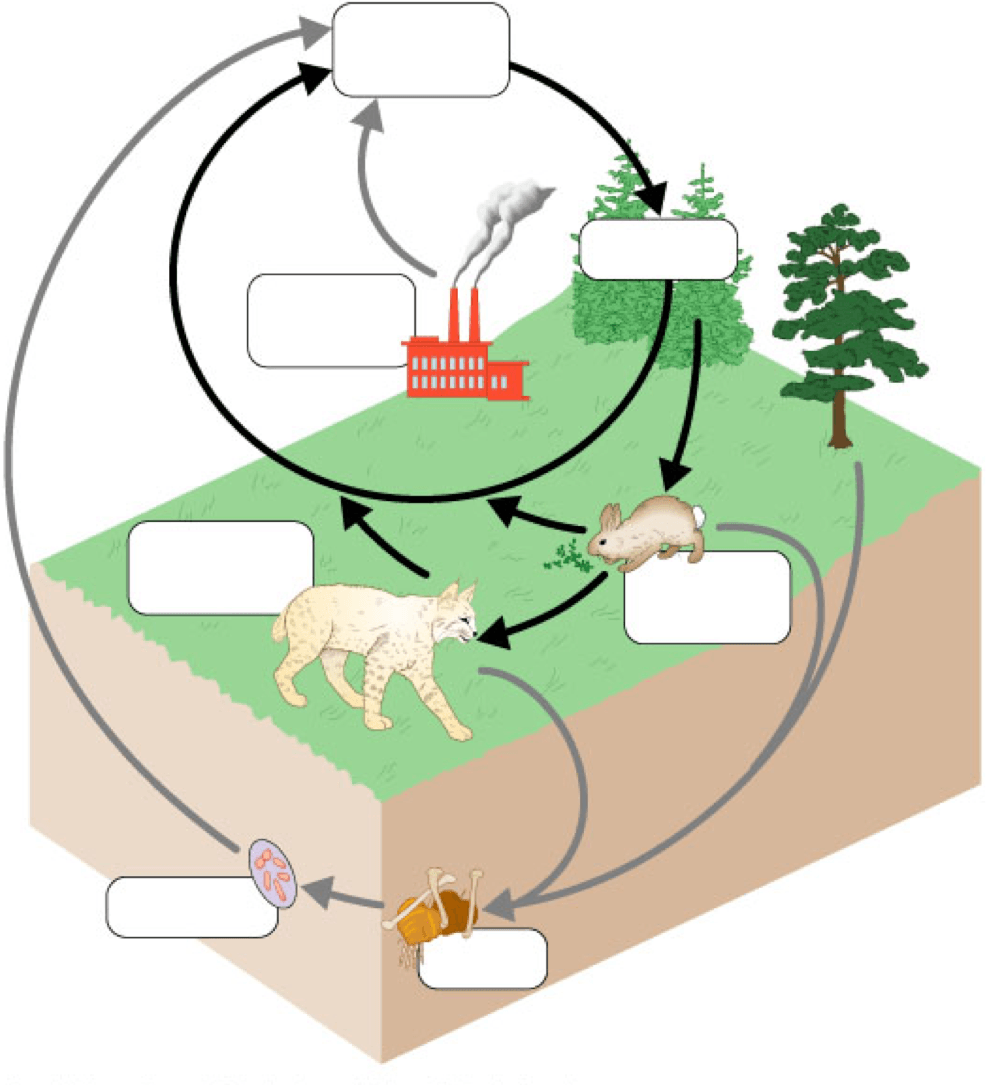
In what process is Carbon transformed into chemical energy?
a)
Photosynthesis
b)
Respiration
c)
Primary Production
d)
Secondary Production
59.
All of the carbon in existence is continually recycled in the carbon cycle
a)
True
b)
False
60.
Which of the following removes carbon from the atmosphere?
a)
Combustion
b)
Respiration
c)
Photosynthesis
d)
Death
61.
Organisms that do not decompose can be buried and become what?
a)
water
b)
nutrients
c)
air
d)
fossil fuels
62.
If the plant population decreased, the amount of carbon would _________.
a)
Stay the same
b)
Increase
c)
Decrease
63.
Which organelle performs PHOTOSYNTHESIS?
a)
Chloroplast
b)
Mitochondria
64.
What process occurs when light energy is captured in autotrophs and converted into sugar?
a)
Photosynthesis
b)
Cellular Respiration
65.

Which of the following is the correct equation for PHOTOSYNTHESIS?
a)
6CO2 + 6H2O --> 6O2 + C6H12O6
b)
6CO2 + C6H12O6 + 6H2O --> O2
c)
6O2 + 6H2O --> 6CO2 + C6H12O6
d)
C6H12O6 + 6O2 ---> 6H2O + 6CO2
66.

Which gas is removed from the atmosphere during photosynthesis?
a)
hydrogen
b)
oxygen
c)
nitrogen
d)
carbon dioxide
67.
What are the products of photosynthesis?
a)
water and carbon dioxide
b)
oxygen and glucose
c)
oxygen and carbon dioxide
d)
oxygen and water
68.
All living things do which of the following?
a)
Chemosynthesis
b)
Respiration
c)
photosynthesis
d)
all of the answers
69.
Cellular Respiration's goal is to
a)
make water
b)
make ATP
c)
make glucose
d)
make oxygen
70.
What is cellular respiration?
a)
the breakdown of glucose to release ATP
b)
the breakdown of glucose to release NADH
c)
the breakdown of glucose to release FADH
d)
the breakdown of glucose to release carbon
71.
Which organelle performs CELLULAR RESPIRATION?
a)
Chloroplast
b)
Mitochondria
100 %

