wayground logo

Free Printable Worksheets

NEW

Font size

S
M
L
XL
Worksheets

Final Staar Biology Practice

Total questions: 67

Worksheet time: 1hrs 17mins

Name
Class
Date
1.

Which is true of prokaryotic and eukaryotic cells?

a)

Prokaryotic cells are larger than eukaryotic cells.

b)

Eukaryotic cells do not have nuclei, and prokaryotic cells do have nuclei.

c)

Prokaryotic cells lack membrane-bound organelles, and eukaryotic cells contain membrane-bound organelles.

d)

Eukaryotic cells are simpler than prokaryotic cells.

2.
Name the phase
a)
metaphase
b)
Anaphase
c)
Telophase
d)
Prophase
3.
DNA is replicated during the ______ phase of the cell cycle.
a)
G1
b)
Synthesis
c)
G2
d)
G0
4.
DNA molecule segment is : TTACGCAAG
The mutated DNA segment is TTCGCAAG. This is an example of ___ mutation.
a)
Substitution
b)
Deletion
c)
Insertion
d)
Inversion
5.
Cattle egrets forage (feed) in fields among cattle. The egret gets easy access to flying insects stirred up by the cattle, and the cattle don't care if they are there or not.
a)
mutualism
b)
commensalism
c)
competition
d)
parasitism
6.
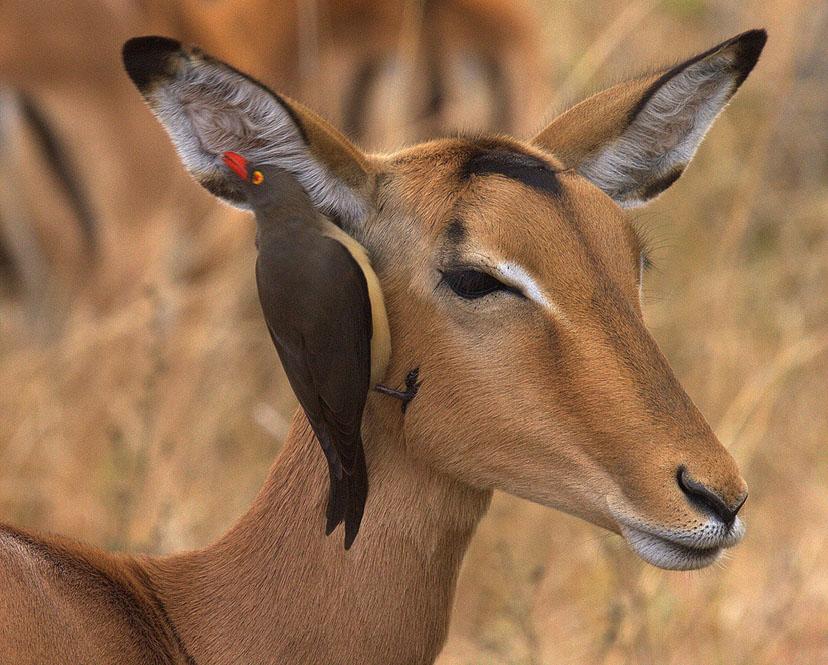
Red-billed oxpeckers are birds that often feed on parasites that infest impala.  This is an example of _______.
a)
commensalism
b)
mutualism
c)
neutralism
d)
competition
7.
The reactants of photosynthesis are
a)
sugar and water.
b)
sugar and oxygen.
c)
carbon dioxide and water.
d)
carbon dioxide and oxygen.
8.
What occurs after a disturbance that leaves soil intact?
a)
primary succession
b)
secondary succession
c)
pioneer species
d)
climax community
9.
How can you tell that Zebra Mussles are an invasive species from the graph shown?
a)
The population of rotifers goes up after zebra mussels they are introduced.
b)
The population of rotifers goes down after zebra mussels are introduced.
c)
The population of rotifers stays about the same after zebra mussels are introduced.
d)
The population of zebra mussels goes down after they are introduced.
10.

What are the offspring's possible phenotypes?

Brown fur is dominant. White fur is recessive.

One parent is homozygous for brown fur as the other is heterozygous.

a)

100% White fur

b)

50% Brown fur 50% White fur

c)

100% Brown fur

d)

75% Brow fur 25% White fur

11.
Cross Two Homozygous plants
(
RRYY x rryy)
R = round seeds, r  = wrinkled seeds Y = yellow seeds, y = green seeds
What percent will have Round and Yellow seeds? 
a)
0%
b)
25%
c)
50%
d)
100%
12.

How do enzymes speed up chemical reaction?

a)

Increasing activation energy

b)

Decreasing activation energy

c)

Increasing deactivation energy

d)

Decreasing deactivation energy

13.
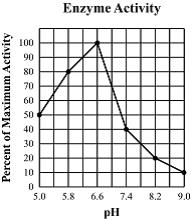
Which of the following conclusions can be drawn from this graph?
a)
The optimum pH of the enzyme is 6.6.
b)
The optimum pH of the enzyme is 5.8
c)
The enzyme’s activity increases as pH increases 5.0 to 9.0
d)
The enzyme’s activity is greater around pH of 8.0 .
14.

Influenza infects a cell and causes it to lyse immediately. What do they use the appendages on the outside of this picture for?

a)

Attachment

b)

Poison host

c)

Replicate dna

d)

Create a nucleus

15.

This diagram is demonstrating

a)

Mutation

b)

Non-random mating

c)

Gene Flow

d)

Genetic Drift

e)

Natural Selection

16.
Crossing over helps promote 
a)
male genotype
b)
genetic variation
c)
DNA replication
d)
mitosis
17.

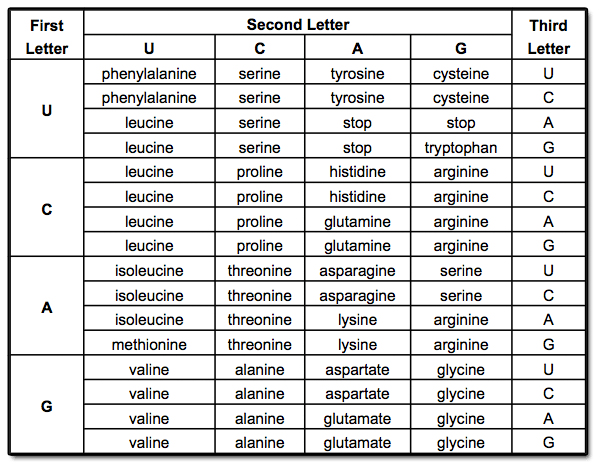
What amino acid is represented by the codon UAA?

a)

Phenylalanine

b)

Tyrosine

c)

Isoleucine

d)

Stop codon

18.
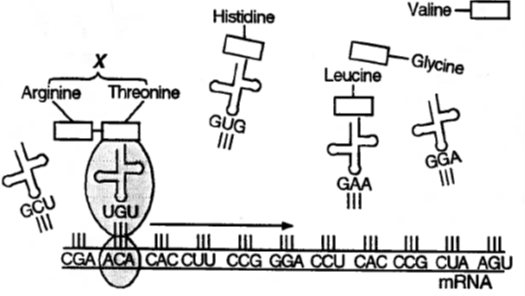
What process is going on in this photo? 
a)
Transcription 
b)
Translation 
c)
Replication 
d)
All the above 
19.

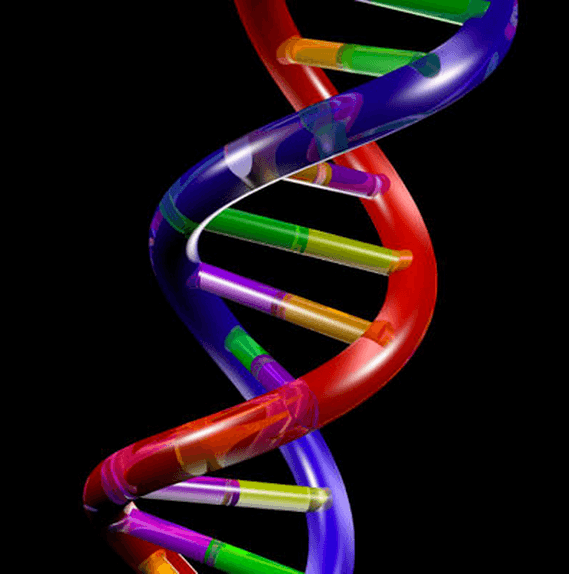
Which component of DNA determines the traits of an organism?

a)

Nitrogen Bases

b)

Phosphate

c)

Hydrogen bonds

d)

Deoxyribose Sugar

20.
Which of the following are monomers of proteins?
a)
monosaccharides
b)
nucleotides
c)
amino acids
d)
fatty acids
21.
a cell organelle composed of RNA and protein; the site of protein synthesis
a)
nucleotide
b)
protein
c)
ribosome
d)
RNA
22.
What process is occurring in the diagram?
a)
DNA replication
b)
Transcription
c)
Translation
d)
Protein synthesis
23.

What amino acid is represented by the codon TAC?

a)

Phenylalanine

b)

Tyrosine

c)

Methionine

d)

Isoleucine

24.
Which sequence of DNA bases would pair with this partial strand
ATG TGA CAG
a)
ATG TGA CAG
b)
TAC ACT GTC
c)
GTA AGT GAC
d)
CAT TCA CTG
25.

What determines the code, or information, of a DNA molecule?

a)

the shape (structure) of the nitrogen bases

b)

the order of the nitrogen bases

c)

the color of the nitrogen bases

d)

the frequency (number) of nitrogen bases
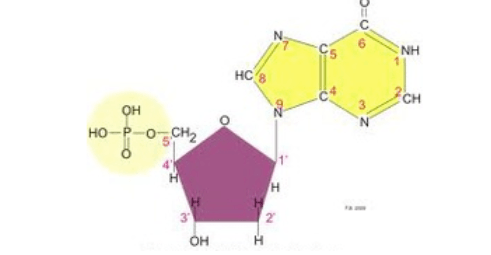
26.
Which biomolecule is this a picture of?
a)
Protein
b)
Nucleic Acid
c)
Lipid
d)
Carbohydrate
27.

When levels go above or below a set point a hormone is released to return the body to set point. When the body is restored to set point no more hormone is released. This is an example of...

a)

a positive feedback loop

b)

a negative feedback loop

c)

a neutral feedback loop

d)

not maintaining homeostasis

28.
Endocrine glands produce __________ which maintain the body in homeostasis
a)
oils
b)
neurotransmitters 
c)
tears
d)
hormones
29.

The major organ of the integumentary system is

a)

Skin

b)

Heart

c)

Hormones

d)

Lungs

30.
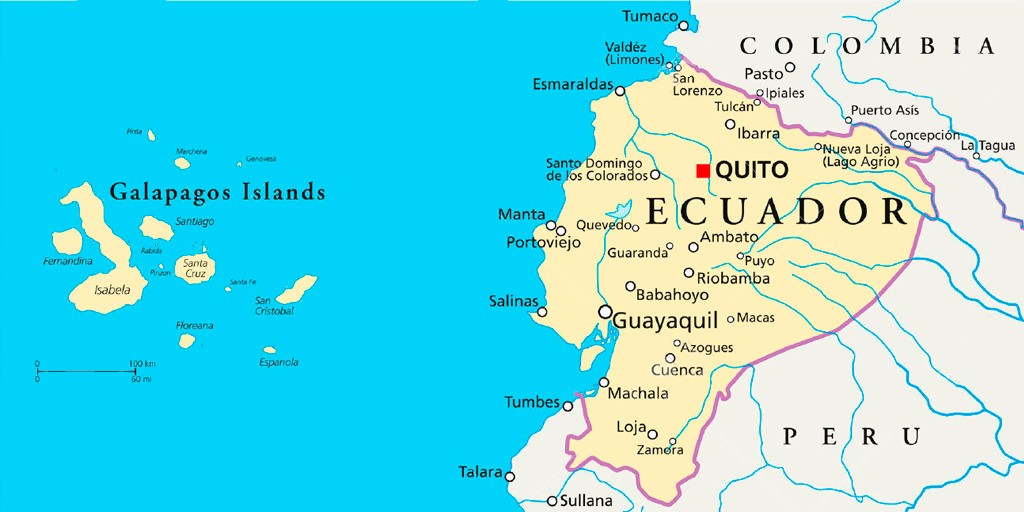
The Galapagos Islands, a small group of islands off the coast of Ecuador, is home to reptiles such as the giant tortoise and the iguana. The eastern islands are much older than the islands to the west.  Which statement about the origin of these reptiles is best supported by this information?
a)
The ancestor of each species came from different continents at different times.
b)
The common ancestors of the reptiles probably came from Equador.
c)
The common ancestor of each species evolved in Peru and came to the islands at the same time.
31.
The picture shows the members of the Camelidae family. The physical features and the geographical origin of these animals provide evidence that - 
a)
they live in the same type of environment.
b)
have slowly evolved to become herbivores.
c)
have a common ancestor.
d)
exchanged DNA in the past.
32.
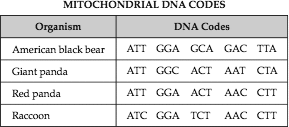
What conclusions can be made based on this table shown?
a)
the American black bear and the giant panda are most closely related
b)
the giant panda and the red panda are most closely related
c)
the red panda and the racoon are the most closely related
33.
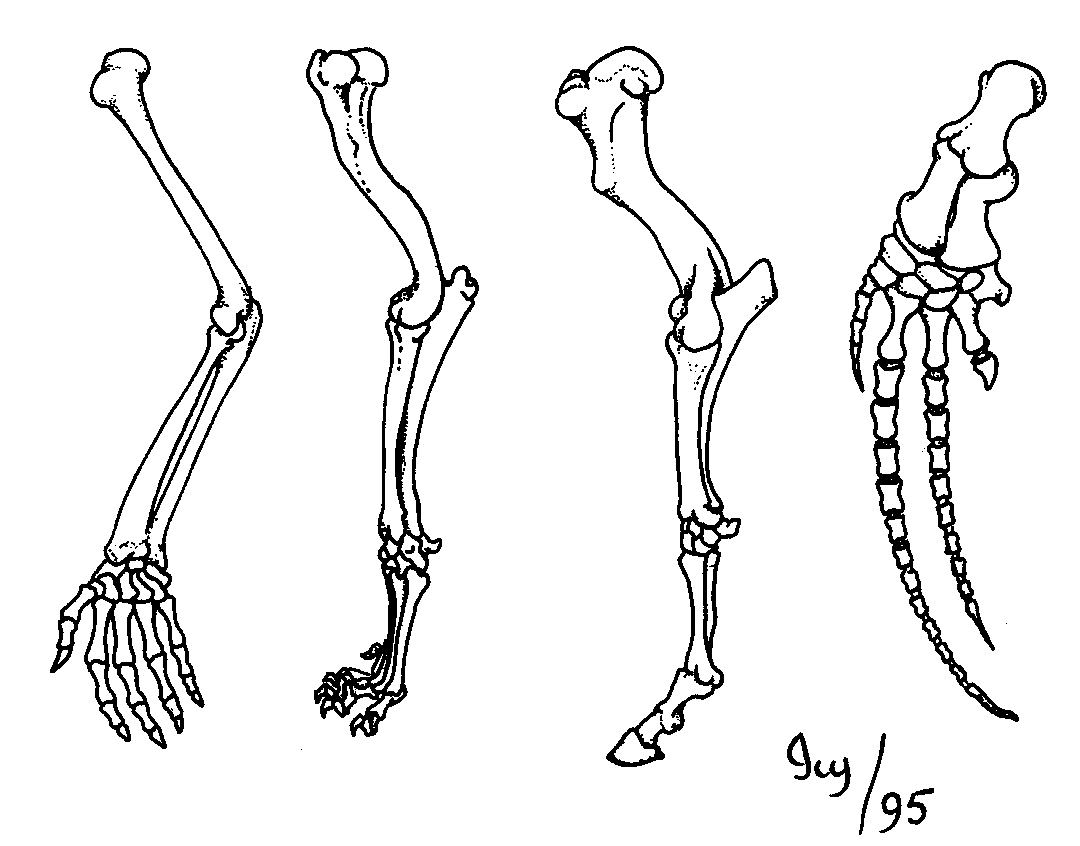
Scientists compare the limbs of organisms to look for evidence of common ancestry. These limbs provide evidence of common ancestry because they -
a)
perform the same function
b)
are the same size
c)
have the same basic structure
d)
are parts of the same animal
34.
Knowledge of which of the following would provide the best evidence regarding the evolutionary relationships of the species shown in the diagram?
a)
Neck Lengths
b)
Feeding patterns
c)
DNA sequences
d)
Common Predators
35.
The more similar the stages of embryonic development, the more likely that organisms share ____________
a)
a common ancestor.
b)
embryos.
c)
eggs.
d)
embryology.
36.
Structures with the same parts have different functions; suggests that organisms share a common ancestry
a)
vestigial structures
b)
homologous structures
c)
adaptive radiation
d)
fossil
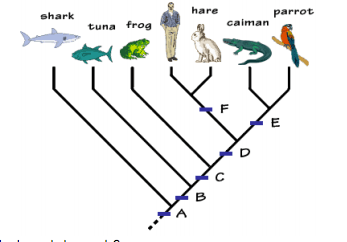
37.
On the cladogram, which organism is the closest relative of the human?
a)
Frog
b)
Hare
c)
Caiman
d)
Parrot
38.
Guppies are small fish that live in freshwater.  Most guppy species reproduce sexually, but some reproduce asexually.  There are two lakes in a particular region.  One lake contains a species of guppy that reproduces asexually.  The other lake contains a species of guppy that reproduces sexually.  A scientist studying these lakes predicts that the sexually reproducing guppies would survive better that the asexually reproducing guppies if a fungus was introduced in both lakes.  Which statement supports this hypothesis?
a)
The sexually reproducing guppies are identical to one another.
b)
The sexually reproducing guppies have a variation of inherited characteristics.
c)
The sexually reproducing guppies require only one individual for reproduction.
d)
The sexually reproducing guppies are carriers of recessive genes.
39.

A gene from organism A can be put into organism B and work because

a)

all organisms share the genetic code

b)

they have the exact same genome

c)

they lack a nucleus

d)

the eyes of texas are upon us

40.
Which phrase best describes cancer?
a)
absence of cyclins
b)
multiple gene mutations
c)
uncontrolled cell growth
d)
precesnce of genetic defects
41.
In what way is the DNA of a nerve cell different from the DNA of a muscle cell?
a)
The DNA is the same but each cell contains different genes
b)
The DNA is the same but different genes are turned on and turned off in each cell
c)
The DNA is different, but the same genes are turned on and off in each cell
d)
The DNA is different, but each cell contains the same genes
42.
Which of these is responsible for the different morphologies of these cells?
a)
Metabolism
b)
Replication
c)
Gene Expression
d)
None of these account for the different morphologies
43.

In turtles, the temperature of eggs during a certain period in their development is the deciding factor in determining the gender of the offspring. In the case of the European pond turtle, an incubation temperature of 23 degrees celcius results in all male baby turtles, while an incubation temperature of 30 degrees celcius results in all female baby turtles. What is a likely reason for such gender development in turtles?

a)

a change in temperature results in the mutation of a gene in the developing embryo

b)

a change in temperature causes a variation during cell division of the developing embryo

c)

a change in temperature causes a change in the expression of the genes determining sex

d)

a change in temperature reverses the expression of the dominant and recessive alleles

44.
Which organisms are closely related? 
a)
American badger and leopard
b)
coyote and gray wolf
c)
european otter and leopard
d)
coyote and american badger
45.

What is the importance of a standardized taxonomic system to the scientific community?

a)

To have many different common names for one species.

b)

To organize species' cells, tissues, organs, and organ systems

c)

To have a universal scientific naming system

d)

To analyze species genetic information

46.

Which of the following organisms are most closely related?

a)

organisms that share a domain

b)

organisms that share a family

c)

organisms that share a genus

d)

organisms that share a kingdom

47.

Which is the best prediction regarding the current classification system?

a)

The system may change as new information and organisms are discovered.

b)

Scientists will become bored with the current system and develop a new one.

c)

Over time, organisms will become extinct, so classification will become simpler.

d)

The system is set in stone and most likely will not change.

48.
I have cell walls
I am an autotroph
I am multicellular
What am I?
a)
Plant
b)
Animal
c)
Eubacteria
d)
Unicorn
49.
I have no cell walls
I am eukaryotic
I reproduce sexually
I am multicellular
What kingdom do I belong to?
a)
Plantae
b)
Animalia
c)
Protista
d)
Fungi
50.
I can be either a heterotroph or an autotroph-
I can be either multicellular or unicellular-
I can have cell walls or not-
The only thing for sure about me is that I have a nucleus in my cells...
I am Kingdom ____________ .
a)
Plantae
b)
Protista
c)
Animalia
d)
of Oz
51.
The mouse in this food web would be considered a:
a)
Primary Consumer
b)
Producer
c)
Tertiary Consumer
d)
Secondary Consumer
52.
Which of the following would be the most likely effect, if there were a sudden increase in the cricket population?
a)
There would be a decrease in the small bird population.
b)
There would be a decrease in the grass/flowers population.
c)
There would be a decrease in the mice population.
d)
There would be an increase in the grass/flowers population.
53.
If there is 1000 Kcal available in the producers in trophic level 1, how much energy is available in the herbivores in trophic level 2?
a)
10 Kcal
b)
1 Kcal
c)
100 Kcal
d)
1000 Kcal
54.
Which sequence correctly shoes the levels of increasing organisation of the human body?
a)
cell-tissue-organ-organ system-organism
b)
organism-organ system-organs-tissues-cells
c)
cells-organs-tissues-organ system-organism
d)
organism-cell-tissue-organs-organ system
55.
If you see cardinals, blue jays and owls in your back yard, this is an example of a 
a)
community
b)
population
c)
ecosystem
d)
species
56.
What are the 7 levels of classification, listed in order from most specific to least specific?
a)
a.  Kingdom, phylum, order, class, family, genus, species 
b)
Kingdom, phylum, class, order, family, genus, species 
c)
Species, genus, family, order, class, phylum, kingdom
d)
Species, genus, order, class, family, phylum, kingdom 
57.
Instructions found in the cells of an organism determine the characteristics or traits that the organism will have. This is an example of what life characteristic?
a)
Living things that reproduce
b)
Living things that obtain energy
c)
Living things that contain DNA
d)
Living things that contain cells
58.
Which part of the leaf allows gases to enter and exit the cell?
a)
mesophyll
b)
stomata
c)
cuticle 
d)
guard cells
59.
Thigmotropism is a plant's response to what stimuli?
a)
light
b)
touch
c)
water
d)
gravity
60.
Vascular Tissue that carries water and dissolved minerals  from the roots of a plant to its leaves
a)
Xylem
b)
Phloem
c)
Stem
d)
Stomata
61.
Small openings in the underside of a leave through which oxygen and carbon dioxide can enter and leave the plant
a)
Cuticle
b)
Stomata
c)
Phloem
d)
Xylem
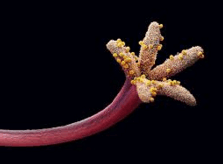
62.
The part of the flower on which the pollen grains land.
a)
pistil
b)
stamen
c)
style
d)
stigma
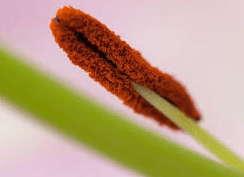
63.
The part of a flower that produces the male reproductive cells.
a)
anther
b)
style
c)
stigma
d)
filament
64.

What condition absolutely must be present in a population before evolution can act upon it?

a)

more females than males

b)

a source of new alleles

c)

genetic variation

d)

a harsh environment

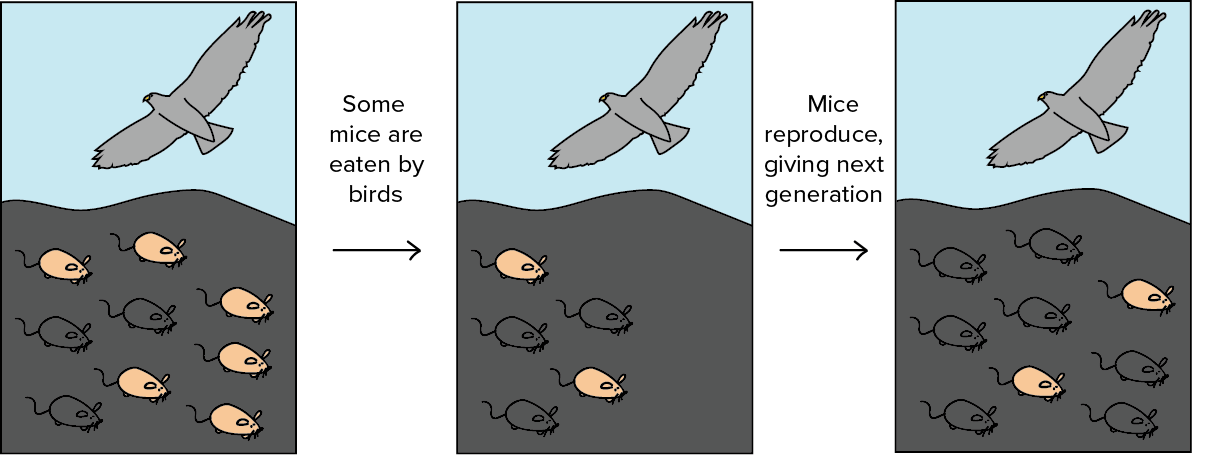
65.

Why is the mouse population changing over time?

a)

The light fur mice can reproduce more successfully than the dark fur mice

b)

The hawks eat more dark fur mice than light mice because they hunt by smell

c)

The hawks eat more light fur mice than dark fur mice because they can see the light fur mice more easily

d)

The hawks eat more dark fur mice than light mice because they can see the dark fur mice more easily

66.
Mutations are important because they bring about
a)
death of the organism in which they develop
b)
genetic variation needed for a population to evolve
c)
benefits for the individual, not for the population
d)
Hardey-Weinberg equilibrium within a population
67.
Which best describes the role of mutations in natural selection?
a)
Mutations help an organism to better survive in their environment
b)
An organism may acquire a helpful mutation by interacting with the environment
c)
A mutation may result in an adaptive trait that makes an organism more likely to survive and reproduce
d)
Organisms with certain traits are more likely to win competitions for mutations