
 Worksheets
Diffusion and Osmosis
Total questions: 72
Worksheet time: 36mins
Selectively Permeable Membrane
Allows some materials to pass through but keeps other materials out
Concentration
Amount of substance in a given space
Diffusion
Movement of particles from an area of concentration to an area of lower concentratioin
Osmosis
Diffusion of water molecules through a selectively permeable membrane
Diffusion is the movement of particles from __1__ concentration to __2__ concentration until they are __3__ spread out.
higher
1
lower
2
evenly
3
Select all answer choices that are examples of diffusion
The student sitting next to you just came from gym class and forgot to shower and you can tell.
After sitting in the bathtub for hours, your fingers start to look like prunes.
The girl sitting two rows ahead of you put on too much perfume this morning.
One way to get rid of slugs in your garden is to sprinkle salt on them, so they shrivel up.
Yum! Something smells good. The neighbors are cooking on the grill.
Select all answer choices that are examples of osmosis
Gargling with salt water when you have a sore throat causes your swollen throat cells to shrink and feel better.
After sitting in the bathtub for hours, your fingers start to look like prunes.
Oxygen molecules move from the air sacs in the lungs across the cell membranes.
The student sitting next to you just came from gym class and forgot to shower and you can tell.
One way to get rid of slugs in your garden is to sprinkle salt on them, so they shrivel up.
Active transport goes against the concentration gradient. What does that mean?
High to Low
Low to High


Pick all that apply: Passive Transport
Osmosis
Simple Diffusion
Doesn't require Energy
Molecules move from low concentration to high concentration

Why is diffusion so important in biology?
It's the basic power source for most types of cells
It allows substances to move across cell membranes
It prevents toxins from entering our bodies
Without diffusion, cell division could not take place

If the dots represent sugar, what direction will water flow?
Into the cell
Out of the cell
Into and out equally (equilibrium)

What is the movement of particles with the concentration gradient using protein "helpers"?
diffusion
facilitated diffusion
active transport
enzymatic reactions

An example of facilitated diffusion is
CO2 and O2 exchange in the lungs
Glucose transport
Na+ / K+ Pumps
Endocytosis

After diffusion has occurred & the concentrations are the same on both sides of a membrane, the substance is said to be in _________ ____________ .
exocytosis
dynamic equilibrium
net movement
facilitated

Some cells move large particles OUT of the cell through the process of:
Protein Synthesis
Endocytosis
Exocytosis
Cytoplasmic Streaming

If the body can no longer make ATP, which type of transport would be impacted?
Facilitated Diffusion
Osmosis
Active Transport
Simple Diffusion

Which one does not belong with the others
No energy
Molecules move from high to low concentration
Passive transport
Energy needed
Selectively Permeable Membrane
Can be compared to a window screen
Diffusion
Process by which oxygen and carbon dioxide is moved into a cell
Osmosis
When water particles move from an area of higher concentration to an area of lower concentration
Which best describes which directions molecules move during diffusion?
from an area of equilibrium to an area of high concentration
from an area of equilibrium to an area of low concentration
from an area of low concentration to an area of high concentration
from an area of high concentration to an area of low concentration
What is the process by which water diffuses across a selectively permeable membrane?
active transport
osmosis
simple diffusion
facilitated diffusion
Why is diffusion so important in biology?
It's the basic power source for most types of cells
It allows substances to move across cell membranes
It prevents toxins from entering our bodies
Without diffusion, cell division could not take place

Which cell is in a hypertonic environment?
A
B
C
None of them are hypertonic

If the dots represent sugar, what direction will water flow?
Into the cell
Out of the cell
Into and out equally (equilibrium)
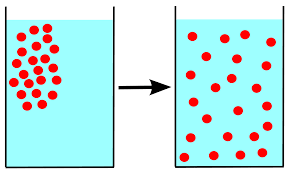
The picture below is an example of _________________.
osmosis
isotonic
diffusion
active transport
How long does diffusion last?
Until the concentration of particles in the system is equal
Until a region in the system has a smaller concentration of particles than the other
Until a region in the system has a greater concentration of particles than the other
Until the particles disappear from the system
Our cells get rid of carbon dioxide multiple times a minute. Which body process takes in oxygen and puts out carbon dioxide?


Where do plants get the energy for photosynthesis to take place?
nutrients in the soil
the sun
chlorophyll
bee pollination

WHAT TYPE OF SOLUTION GETS IN CONTACT WITH THIS RED BLOOD CELL?
HYPERTONIC
HYPOTONIC
ISOTONIC
ISOCELES
WHAT DO YOU CALL THE BURSTING OUT OF CELL DUE EXPOSURE TO A HYPERTONIC SOLUTION?
PLASMOLYSIS
CREMATION
CYTOLYSIS
NONE OF THE CHOICES

WHAT TYPE OF SOLUTION GETS IN CONTACT WITH THIS RED BLOOD CELL?
HYPERTONIC
HYPOTONIC
ISOTONIC
ISOMERIC

WHAT DO YOU CALL THE BULGING OF CELL DUE EXPOSURE TO A HYPOTONIC SOLUTION?
PLASMOLYSIS
CREMATION
CYTOLYSIS
CRENATION

WHAT TYPE OF SOLUTION GETS IN CONTACT WITH THIS RED BLOOD CELL?
HYPERTONIC
HYPOTONIC
ISOTONIC
ISOTOPIC
If NO ENERGY IS REQUIRED for substances to pass through the membrane, the process is called _______transport.
POTENTIAL
KINETIC
ACTIVE
PASSIVE
From the Greek words for "same" and "steady," refers to any process that living things use to actively maintain fairly equal and stable conditions necessary for survival. This is usually has positive and negative feedbacks.
BALANCE
EQUILIBRIUM
HOMESTASIS
STABILITY
If ENERGY IS REQUIRED for substances to pass through the membrane, the process is called _______transport.
POTENTIAL
KINETIC
ACTIVE
PASSIVE

Which gases move into and out of the blood at the lungs by diffusion
Nitrogen and Oxygen
Oxygen and Carbon Dioxide
Nitrogen and Carbon Dioxide
Argon and Nitrogen

Type of cell transport that depends on the natural flow of concentration gradient and doesn't require ATP for it to happen
passive transport
active transport
Pressure exerted by fluid in a cell that presses the cell membrane against the cell wall
turgor pressure
atmospheric pressure
osmotic pressure

What's happening here?
RBCs swell in hypertonic solution
RBCs swell in isotonic solution
RBCs swell in hypotonic solution
Which TWO parts of the membrane allow molecules to pass through?
How does the cell membrane help maintain homeostasis in each cell?
The cell membrane allows all substances to pass through freely
The cell membrane controls the movement of substances in and out of the cell
The cell membrane provides energy for the cell
The cell membrane produces proteins necessary for cell function
Passive transport (a) require energy because it moves (b) the concentration gradient, from (c) .
Active transport (a) require energy because it moves (b) the concentration gradient, from (c) .

What is the correct description of the transport in the image?
small molecules crossing the lipid bilayer (diffusion)
large molecules crossing through a protein (facilitated diffusion)
many molecules coming into the cell using a membrane vesicle (endocytosis)
many molecules coming out of the cell using a vesicle to fuse with the membrane (exocytosis)

Using the image, choose the correct form of transport and explanation of how you know:
Active transport, because the molecules are crossing the membrane using a protein
Passive transport because the molecules are crossing the membrane using a protein
Active transport because the molecules are moving from low to high concentration
Passive transport because the molecules are moving from high to low concentration
Organize these options into the right type of transport:
does NOT require energy
requires energy
molecules move WITH the gradient
molecules move AGAINST the gradient
molecules move from high concentration to low
molecules move from low concentration to high
Which of the following images show transport that REQUIRES ENERGY? (more than one answer is correct!)


Which of the following images show transport that DOES NOT require energy? (more than one answer is correct!)


Nucleus control center of the cell
Selectively Permeable golgi apparatus
Non Permeable membrane


Hypertonic
The solution contains a high concentration of solute an and low concentration of water
Hypotonic
The solution contains a low concentration of solute an and high concentration of water
Isotonic
The solution has an equal concentration of solute and water compared to the inside of the cell

